

Editorial

Reginald T. Yu
Editor-in-Chief
The presence of Commissioner Charlito Martin Rada Mendoza as Guest of Honor and Speaker at this Weekly Membership Meeting could not be more timely.
After months of public anxiety, institutional introspection, and reform work behind the scenes, the Bureau of Internal Revenue has formally lifted the suspension on tax audits — effective January 27, 2026 — not as a return to old habits, but as a decisive pivot toward a more disciplined, transparent, and accountable system of tax administration.
The resumption of audits under newly issued circulars and orders marks a clear acknowledgment of past vulnerabilities and a firm commitment to correct them. The reforms are not cosmetic. They strike at the very points where public trust was most eroded. The introduction of a single-instance audit per taxpayer per taxable year, enforced through an electronic Letter of Authority, decisively ends the specter of repetitive, overlapping, and sometimes harassing examinations. The automatic consolidation of existing audits beginning March 4, 2026 further signals the Bureau’s resolve to simplify processes and reduce discretion that invites abuse. Just as critically, the explicit prohibition of audits in public venues restores professional boundaries long blurred, reinforcing both taxpayer dignity and institutional integrity.
Perhaps most consequential is the renewed emphasis on personal accountability. Under the new rules, violations of audit procedures now carry administrative, civil, and even criminal consequences for erring officials. This is not merely regulatory tightening — it is a cultural reset. It reframes enforcement not as power exercised over taxpayers, but as responsibility exercised on behalf of the Republic.
These reforms reflect the governing philosophy Commissioner Mendoza brings to the Bureau: reform that is structural, data-driven, and grounded in due process. His professional journey — from private legal practice to senior revenue operations oversight and frontline customs leadership — has shaped an administrator keenly aware that credibility, once lost, can only be rebuilt through consistency, restraint, and institutional discipline.

Beyond audits, the Bureau’s recent issuances reveal a broader responsiveness to economic realities and technological change.
The increase in tax-exempt de minimis benefits, effective January 6, 2026, quietly but meaningfully acknowledges the pressures of inflation on Filipino workers. By raising ceilings on items such as rice subsidies and clothing allowances, the Bureau signals that revenue collection need not come at the expense of basic employee welfare.
Likewise, the extension of VAT filing deadlines for non-resident digital service providers reflects regulatory pragmatism. As the tax net expands into the digital economy, the Bureau has shown a willingness to adjust timelines when systems encounter real-world constraints — an important signal to global service providers navigating Philippine compliance for the first time.
The rollout of an enhanced electronic documentary stamp tax system and the clarified, extended deadlines for online registration of books of accounts further underscore the Bureau’s digital direction. Compliance is being nudged away from paper, ambiguity, and physical presence toward traceable, system-based processes that protect both the taxpayer and the State.
Taken together, these measures tell a coherent story. This is not a Bureau retreating from enforcement, nor one blindly asserting authority. It is an institution attempting — deliberately and publicly — to recalibrate its role: firm but fair, modern but mindful, exacting yet accountable.
For taxpayers, professionals, and civic leaders alike, the message is clear. The pause in audits was not an abdication of duty; it was an opportunity to rebuild the rules of engagement. The resumption, under reformed procedures, challenges both sides of the tax relationship to meet higher standards of conduct.
In that sense, today’s conversation is not merely about tax policy. It is about trust — how it is broken, how it is rebuilt, and how institutions earn the moral authority to collect what is due. Under the current reform agenda, the Bureau of Internal Revenue appears determined to prove that reform is not an announcement, but a discipline — one that must be practiced daily, in full view of the public it serves.
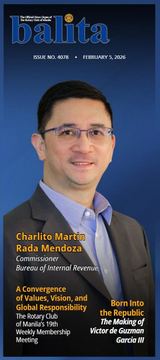
 A Convergence of Values, Vision, and Global Responsibility: The Rotary Club of Manila’s 19 Weekly Membership Meeting
 Charlito Martin Rada Mendoza