
Six Areas of Focus
Rotary's focus on disease prevention and treatment, plus an update on the Save the Little Children's Heart Project.

Rotary’s Focus on Disease Prevention and Treatment, plus Update on Save the Littles Children’s Heart Project
As noted last week, Rotary International has selected six categories of causes that Rotary’s charitable arm, The Rotary Foundation, supports. They are:
Peace and Conflict Resolution
Maternal and Child Care
Disease Prevention and Treatment
Basic Education and Literacy
Water and Sanitation, and
Economic and Community Development.
Our health is everything. Yet 400 million people in the world cannot afford or do not have access to basic health care. Rotary International believes that good health care is a basic human right. Disease results in misery, pain and poverty for millions of people worldwide. That is why treating and preventing disease is so important to Rotarians.

Rotary sets up clinics, blood donation centers and training facilities in underserved communities struggling with outbreaks and health care access. We design and build infrastructure that allows medical professionals, patients, government and NGO’s to work together. Together we combat disease like polio, diabetes, malaria, HIV/Aids, Alzheimer’s, multiple sclerosis, and more.
Prevention is not only cheaper than treatment; it literally saves and improves quality of life beyond comparison. That is why we focus on health education and bringing people routine medical hearing vision and dental care.
The Rotary Foundation is changing the world by providing grants for projects and activities around the globe. Last year, USD $65 million was given in grants by Rotary to fight disease.
RCM has initiated or supported a great many initiatives and participations in the focus on Disease Prevention and Treatment. These include more medical and dental missions than we can remember, going back before RI and TRF identified the six areas of focus. For decades, we have done our own medical projects or collaborated with Rotary clubs from several countries to provide access to specialized health care both in the metro area and in the provinces. We participated in the very first implementation of PolioPlus in the world!
For years, our members looked forward to hands-on participation in Medico-Surgical Missions carried out jointly with our Sight Conservation Committee headed by Chair Dr Jack Bautista and Dental/Drug Abuse Chair Dr. Caloy Buendia. We have improved the health of countless children by providing surgeries to correct congenital cleft palates and other dental and vision procedures, locally and nationally. This used to be a four-day out-of-town mission with a ₱400,000 budget. Additionally, with the generous support of Jack Bautista, we have operated a dental clinic in Manila for the poor for decades.
Medical Equipment and Repair Training started as a “Three H” grant project in 1999 through PD Rob Sears, in cooperation with International AID, RC San Fernando La Union and RC Modesto (California), during the Presidency of PP/DG Peter Wohlrab, of Univ of Perpetual Help, Laguna and Lorna Colleges. That total project cost was USD $392,645. Medical equipment donations were made to Brent Hospital - Zamboanga, Sorsogon Provincial Hospital, and Bacnotan District Hospital in La Union. Extension modules were added on availability of additional funds through US Dept. of State Biosafety Engagement Program from 2007-2012.
Our Drug Abuse Prevention Project undertook seminars years ago, with video viewing as advocacy against substance abuse. It was revived by PP Gert Gust, whose psychiatrist wife, Dr. Dolce P. Estrella-Gust, was a long-standing member of the Philippines Dangerous Drug Board. We ran a Save a Heart – Save a Life Pacemaker Implantation Program with Rtn Nilo Aventura, but it was terminated when an unfortunate conflict arose with another personality, no longer with the club.
We have hosted innumerable international medical and dental missions, such as the gynecological surgical group from the US a few months ago. Rtn. Dr. Jun Aventura now heads the coronary bypass team at PHC, and we have helped some indigent patients through our “Save a Life” program.
Just last year, I learned of a poor boy from the provinces, four-year old Joneil Dasi-an, who had Tetralogy of Fallot, a serious congenital heart defect comprised of four heart deformities. He was literally blue in skin color from very poor blood oxygen concentration. See the before picture, compared to his sister and mother. He was weak, sickly, grossly underweight, and couldn’t run five meters without collapsing. He seemed like a smart kid, but missed a lot of school, putting him well below grade level. He suffered “Tet spells” in which his blood oxygen saturation fell as low as 30%, and he was at serious risk of heart failure!
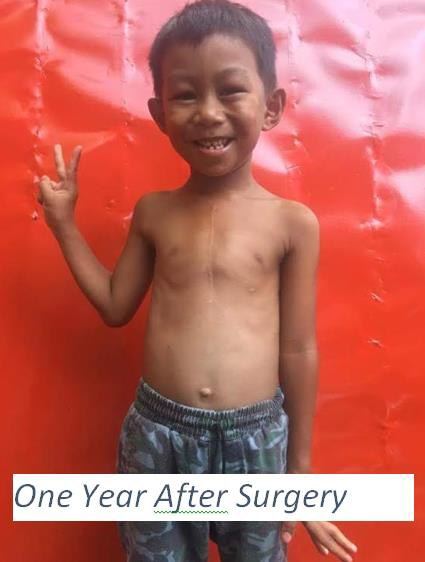
I was asked to help by paying for a 2d echocardiogram that could qualify him for PhilHealth coverage. It started that small, but eventually I personally undertook a mission that ultimately took him to India for open-heart surgery, in collaboration with Dr. Azad Moopen’s Save the Little Children Foundation. You recall much of the story, when just a year ago I brought the mother and the boy to one of our meetings, post surgery. By then, I had spent more than ₱100,000 and a huge amount of time over a four-months time period. It was worth it.
Today, the boy is not only in great health, he is working very hard in school and already at the top of his class, just one year after being so far behind. His aunt visited the family last week, and the boy showed her dozens of school papers with 100%, because he wanted me to know how much he appreciates his life being saved, how committed he is to making a success of his whole life. It really touched my heart. He calls me “taytay” and says he will take care of me “when I’m old and useless(!)” because he feels that I saved his life.
Last year I shared with the club an arrangement that I had made with Aster Philippines’ “Save the Little Hearts Foundation” and Dr. Moopen’s Foundation (Dubai), in which we could send congenital heart disease patients from indigent Filipino families to Aster MedCity quaternary care advanced hospital in Cochin City, State of Kerala, India, for their life-saving surgeries. Dr. Moopen would provide the entire medical care package and all we had to do was pay for travel expenses, which I costed at an average of ₱50,000 per case. Several of our member’s hearts were touched, and they generously opened their wallets, contributing enough funds to handle at least eight more cases.
In October, we sent two patients from the Bacolod area to India for their surgeries, and both were successful. Baby Abby Pasquin Vito had a complete repair. During 3d echocardiogram the day before surgery, Baby Eli Alpire was determined to be too small for permanent surgical repair. Instead, a pulmonary artery shunt was implanted, which increases the flow of blood from the ventricle to the lungs, improving oxygenation. The ventral septal defect (hole in the heart) remains, and additional surgery will be required later. Both patients have both gained weight, are very active – mom’s chase them instead of carrying – and the families begin a long path of financial recovery from expenses that had devastated their entire extended families.
I was very excited, and worked very hard to get more cases processed to save these children’s lives. However, it became very complicated. Several children were judged medically unsafe for the long travel. Those cases would have to be undertaken here in the Philippines at PHC, Children’s Hospital or Philippines General Hospital. Many families were and are simply afraid to travel to India – of course, none of these people had ever traveled out of the country and some, never out of the region.
Some patient’s families had a very difficult time meeting PhilHealth’s or the foundation’s requirements for qualifications. They had to provide proof of indigency, usually DSWD “White Card.” That process alone can take months, and is sometimes complicated if a parent lacks a birth certificate. It is simply not possible to get a NSA birth certificate if there is no record of birth in the system (that happens when very poor people were born at home, especially in mountainous regions, etc.) and the person now stays far away from the place where they were born. If you are in same place, there is an application process, but you have to apply there and cannot apply in other provinces.
The families also have to provide current medical records showing the exact condition and medical necessity. Typically, the families just cannot afford to get that kind of information. Even if they once had the information, it must be made current at least once every six months, which takes time and money and often expensive travel. Their community might not have a pediatric cardiologist in a government hospital. The family income is so low and expenses so high that they cannot even afford an eighteen peso pill to help the child when suffering a tetralogy spell, let alone paying ₱2,800 – 3,500 for a 2d echocardiogram.
The children can have no infection, yet most if not all have some dental caries, which must be repaired, or the baby teeth removed. Access to pediatric dentistry is challenging and expensive. For example, I paid about ₱30,000 for baby Joneil’s dental work prior to surgery. Indigent families in the provinces have little real hope of handling such expenses themselves; they usually just pray and work to find help wherever it might be.
Working with Aster Philippines Country head and President Joyce Sacao-Alunao, we undertook to establish a Memorandum of Agreement with the Philippine Heart Center. That took some time, especially because a new Executive Director had just been appointed. We now have a good MOU in place, but we have not been able to accomplish any surgeries under that agreement.

We have helped families complete the process for full “Zero balance billing” with no co-pay with the Z Pack benefit for Congenital Heart Defects under PhilHealth. It usually takes up to four or five YEARS to accomplish this, but we helped get it done in five months for ten-year-old Mark James Magcayang from Daet, Cam Norte. He had open-heart surgical repair of Ventral Septal Defect (hole in the heart between the left and right ventricles), and is enjoying a good recovery. I met the boy and his family prior to the surgery. They were literally exhausted from the ordeal of qualification, and the boy had missed so much school that even at age ten, he was discouraged about his prospects for graduation. We encouraged him, but he is clearly a risk for drop out.
With the collaborative MOA in place, I have agreed that the funds donated by our members with the intention of paying for travel to India can now be used to pay for expenses that are excluded under PhilHealth. These expenses include devices, such as cardiac catheters. I have also agreed that we can provide or reimburse certain other expenses, such as in hospital extra meal for the babies’ mothers, travel from the provinces to Manila, accommodations during pre-op diagnostic trips, and so forth. I believe that these expenses are consistent with the spirit and intent of our donor members when we were only dealing with travel to India.
Prior to surgery, pediatric cardiologists use a combination of diagnostic tools to determine the best course of treatment for the patients. These include 2d and 3d echocardiograms, CT and MRI imaging studies, and hemodynamic catheter studies. MRI and cath studies are frequently required for complicated cases prior to surgery. Many pediatric heart diseases can be treated with the far less invasive catheterization alone, rather than open-heart surgery, so many pediatric cardiologists prefer to do cath studies unless the need for open-heart surgery is totally clear cut.
Philippine Heart Center has two surgical suites that are designed and equipped exclusively for pediatrics, and these suites usually have one or two surgeries every single day. A quota is assigned for charity cases, and that quota is booked rather far in advance, allowing exceptions only in emergencies. The hospital has only one pediatric catheterization lab. That lab is under renovation for more than two months already and will not be usable until June or maybe even July. Six of the eight cases that we are working on are required for catheterization studies, hence our predicament in scheduling.
The most expensive of the catheters required is for patient Michaela Denise Capapas, a four years old female patient with TOF complicated by an absent pulmonic valve. Michaela’s family are residents of Baguio. We have already prepared a check for the ₱150,000 cost of the Medtronic Contegra Pulmonary Valved Conduit, and the supplier will not accept payment until the surgery is completed. That device is by far the most expensive one, constructed of a bovine aorta with two flapped valves installed – it is really high tech! Many of the devices cost less than ₱20,000, so our average costs should remain at or below the originally targeted ₱50,000 per patient.
Remaining cath studies patients include:
Jedidiah Salamat, one year old male, dextrocardia ASD, VSD, PVA, PDA, patient from Hagonoy Bulacan,
John Lenard Recio, one year old male, TOF, from Balintawak,
Lei Frances Susaya, two year old female, ASD/VSD - PDA stenting, from Pasay,

Jed Christian Quimco, two years old male, DTGA VSD, from Pasig,
Kuechel Lubrio, three years old female, ASD, TAPVR, from Muntinlupa, and
Kesha Villaraza Nolasco, sorry I don't have file.
Additionally, we have the following patients just awaiting surgery scheduling:
Hadwin Gian Deyro, four years old male, VSD, from Baguio,
Sofia Gaan, seven year old female, VSD, from Sampaloc Manila,
Rhozel Panganiban, two years old female, VSD, from Gen San, and
Drenz Khalil Francisco, five years old male, VDA/PDA, from Laguna.
There are about twenty additional patients who are in earlier stages of qualifications. It is my hope that we will not only be able to help all of the patients listed above, but that we will also be able to help many of the additional patients. We can no longer link specific patients with specific donors, due to the widely varying costs of each patient. I hope that this is still OK with our donors.
Did you know that there is a Rotary International Fellowship of Health Professionals? https://www.rotary-site.org/health-professionals
Next week: another area of TRF Focus.

 President's Corner
 Guest of Honor and Speaker's Profile
 The Week That Was