

Kontemporaryong Gamelan Pilipino (KONTRA-GAPI)
Prof. Pedro R. Abraham traces the history, instruments and tours of the Kontemporaryong Gamelan Pilipino, the U.P. resident ethnic music and dance ensemble.
(Resident Ethnic Music and Dance Ensemble)
The gamelan is the quintessential orchestra of South East Asia. Africa may lay claim to massed polyrhythmic drums, Europe the symphony orchestra and North America, the jazz and rock bands, but no musical ensemble typifies this part of the world - its mysticism and timelessness, its beauty & grandeur, its heritage and feeling of community the way the gamelan does. The wonder of it is that while the broad tradition may be shared by many cultures, each has evolved a style, a sense of aesthetics and a mode of presentation unique to itself - a mirror of its people & society, history & lore, ecology & climate, perceptions & values.
The Kontemporaryong Gamelan Pilipino draws inspiration from this ancient and profound source nurtured and sustained by the depth, wealth and cultural diversity of the Philippines and her Asian roots. Widely identified by its acronym Kontra-GaPi, the group strives to express music and kindred arts from indigenous well-springs, reaping from the people and giving back to them in new form “as magical as the moonlight and constantly changing as water”.
Kontra-GaPi had its beginnings when in 1989 I as a faculty member of the Department of Arts Studies, College of Arts and Letters of the University of the Philippines (U.P.) in Diliman was commissioned to write a score for “A Dream Play” by August Strindberg . Produced in Filipino translation by Dulaang U.P., the resident repertory theater company, the director had only one guideline: that the music be distinctly Filipino and Asian. Throughout the run of the play the music, for its stunning exotic appeal, received consistently excellent reviews by critics, academics, students and regular theater-goers alike. This encouraged the then ad-hoc band to transform itself into an independent performing organization. Soon after, they were invited by the Heritage Arts Center in Quezon City to render their very first concert performance. In February 1993, Kontra-GaPi was appointed resident gamelan or ethnic music and dance ensemble by the Dean of the College of Arts and Letters. For their significant trend-setting and visionary contribution the group was awarded in February 1996 the U.P. Diliman Chancellor’s signal plaque for Outstanding Achievement in the Arts (Performing Arts Category).
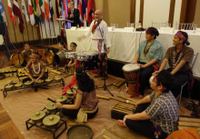
The word gamelan derives from the Javanese word “gamel,” to hammer. Characteristically, a gamelan consists of percussion instruments such as gongs and drums of graduated sizes; wood and metal xylophones of varied timbre; flutes and whistles; assorted bamboo, wooden and metal percussion & voices for singing & for creative vocables. Kontra-GaPi uses ideophones such as the kulintang, gangsa, tongatong and kalutang; chordophones like the hegalong, kulibet, gitgit and kuritang; aerophones such as the diwdiw-as, esmi, tonggali and suling; and membranophones like the debakan, solibaw and Cordilleran drums of varying sizes and shapes. The human body itself by way of applause, stomping, chest pounding, clicking and other means turns into a producer of myriad sounds. There are, too, quaint pieces like the kuribaw or mouth harp and the tambi or zither-drum in a store of over a thousand instruments. The collection is more than sufficient for an ensemble which performs with artists as many as fifty and as few as five. A full evening programme typically assembles fifteen to twenty performers.
In Kontra-GaPi, music is dance heard even as dance is music seen. A performance is an event where the artists in turn sing, dance, mime and play as many as ten instruments each. This total-theater approach also takes in the audience not as a conventional crowd but as an essential participant in the creative process transforming the occasion into a unity - a tribe, as it were, in a participative ritual.
The ensemble thrives on the assumption that every human being, by definition, is creative, alone or as part of a community. Creativity is not the exclusive preserve of ‘experts’ and excellence can be attained by individuals who possess varying levels of artistic ability. No auditions are held to recruit members. Any student, faculty, or worker from the university or anyone from anywhere else interested may join to discover for themselves how far and how deeply they can go as instrumentalists, singers dancers or mime-actors. Each one makes a contribution merited according to ability & sustained by discipline and dedication, responsibility and enterprise, and love for the nation’s cultural heritage.
“Gapi” means to shackle. The group takes a firm stand contra what stifles freedom, individuality and inventiveness. It also takes a strong position contra the idea that Filipino excellence in art must derive from the West. Instead, Kontra-GaPi asserts even as it proclaims that the artistic traditions of the Philippines and South-East Asia including the gamelan are every bit as deserving of the highest renown and adulation as other traditions around the world- confidently, a true and resounding source of pride.
Over the years, the ensemble has presented more than two thousand shows for audiences of all types and age-groups in all kinds of venues, much more if one includes lecture-demonstrations and workshops in music and dance. From the state-of-the-art theaters of the Cultural Center of the Philippines, hotel pavilions and lobbies, school auditoriums and yards, church naves and parks, to make-shift stages, barangay or community all-purpose halls, sports courts, private residences, ricefields, the streets, markets & open spaces, Kontra-GaPi has brought its art to where the people are or to where they can or choose to come together.
The troupe has gone on road tours of virtually all the regions in particular the provinces of Abra, Agusan del Norte, Aklan, Bataan, Batangas, Benguet, Biliran, Bontoc, Cagayan, Camarines Norte, Cavite, Cebu, Davao, Ilocos Norte, Ilocos Sur, Ilo-ilo, Isabela, Kalinga, Laguna, Leyte, Misamis Oriental, Masbate, Mindoro Occidental, Misamis Oriental, Northern Samar, Nueva Ecija, Nueva Vizcaya, Palawan, Pampanga, Pangasinan, Rizal, Romblon, Samar, Sorsogon, Tarlac, Quezon, and Zambales.
From April to October 1997, Kontra-GaPi traveled on its first international mission to Austria, Belgium, France, Germany, the Netherlands and Switzerland in Western Europe, and in North America to Canada & the United States, with a stop in Hawaii before returning home. Tours of Laos, Vietnam and, again, the U.S. were launched in 1999. A return tour of half a year of Canada and, for the third time, the U.S. in the year 2000 proved to be a resounding success as were all the others. In 2003, Kontra-GaPi visited Australia followed next by tours of Thailand in May 2009, show in the Philippine Pavilion at the World Expo in Shanghai, China April to November 2010, & a return to Europe: Belgium, the Czech Republic, France, Germany, Luxembourg, the Netherlands & Switzerland, from May-July 2013 all to equally consistent high praise. Smaller troupes have performed in Belarus Indonesia, Norway & Taiwan. These international engagements were set in motion upon the invitation of festival organizers, government bureaus, international organizations, Philippine diplomatic missions, Filipino expatriate communities and friends.
Contact: Phone: 0918 9167408 http://kontragapi.wordpress.com// 02-9249011 private YouTube: Kontragapi Facebook:KG Connection 02-9270581 work Edru Abraham

 Felino “Jun” A. Palafox, Jr.
 President’s Corner
 Edru Abraham and Kontra-GaPi Leave Manila Rotarians in Awe