

STAR Rtn. Emilio Gonzalez La’O: His Journey from Engineering and Lawyering to Entrepreneurship
An interview with the President and CEO of Cold Front Technologies Asia, Inc. on leaving his career in the US to build a business in the Philippines.

How many professionals can leave a flourishing career and start building a business from scratch? STAR Rtn. Emilio “Emil” Gonzalez La’O is this type of person. He took the leap of faith, left his successful career in the US, came back to the Philippines and set up a business here. As President and CEO of Cold Front Technologies Asia, Inc., he did not only pull it off; he and his wife achieved some industry firsts in the Philippines and in Southeast Asia.
Get to know more about STAR Rtn. Emil’s interesting and inspiring journey – how he gave up his well-paying job and shifted from lawyering to entrepreneurship, and, in just a few years, already made a mark in the industry. In this interview, he also shares some very motivating words to aspiring entrepreneurs.

Rhea Vitto Tabora (RVT): Please share something about yourself that your fellow Rotarians might not readily know.
Emilio Gonzalez La’O (EGL): I enjoy cooking. That’s a hobby I picked up in the States while living on my own. In fact, I proposed to my wife, Jennifer, by cooking her an 11-course meal. I even watch a lot of cooking shows and usually have them on the TV as my “background noise”. My favorite cuisine to cook – and eat – is Italian because it could be rustic comfort food or it could be refined haute cuisine. What I like about cooking is that it’s not precise and I can be rather spontaneous and experimental. I can make the same dish several times, try different techniques or use different ingredients, and it may not always turn out exactly the same, but it will still taste good. The idea that I need to use whatever ingredients I have, whatever quality they may be, and make it work really appeals to me. And that pretty much aligns with what it’s like being an entrepreneur – use what I have, make it work and make the most of it.

RVT: What inspired you to take the leap of faith, leave your flourishing career in the US and set up a business in the Philippines?
EGL: In the States, I had a good career at Intel Corporation. It was a great opportunity, great learning experience but at the same time, because it was a large corporation, it was very structured and regimented. You didn’t necessarily have your hands in every piece of the puzzle. That’s something I’ve always wanted to take on. I wanted to build something, to have my hands in all the pieces, trying to make it work, putting the pieces together. Just like in cooking, you have a guide on what you think it will come out to be but you’re not entirely sure it will, so you take a leap of faith that the finished product is going to be wonderful or better than the sum of the parts you put in.

I believe I learned that from my father, Bololo. By the way, I’m actually named after him, and in the old Spanish tradition of carrying his grandfather’s last name (Gonzalez) and his grandmother’s last name (La’O). I never got the chance to work with my father, but he was an entrepreneur his whole life. At least, for as long as I can remember, he always had his own companies and did his own thing. I really look up to him, and continue to look up to him, and the example he led. I wanted to follow his footsteps, forge my own path to see what I can accomplish and, hopefully, be able to achieve a fraction of the success he had.
Taking a leap of faith to leave the US, coming back here to the Philippines and starting our own business are parts of that journey. Sadly, my wife and I were not blessed with children. But because of that, we figured that we were in a point in our lives where basically it was now or never. If we waited any longer, we would be too old to really do anything significant. We knew there were opportunities here and in Southeast Asia. Majority of the economic growth is here in Asia. More importantly, our families are back home in the Philippines. So, we thought it would be great to be back and be closer to family and friends. We were ready to take the leap of faith and it was the right time for us to do so.

RVT: How did you grow Cold Front to become one of the industry leaders in commercial refrigeration, cold storage and air-conditioning systems in the Philippines?
EGL: When we started the company in 2016, my wife and I knew we wanted to work with products that were not necessarily the cheapest in the market nor did we want to fight in terms of price. I think there’s enough competitors in that segment of the market. We wanted to compete by bringing in high quality products at reasonable prices and give the customer the best value for money. Because of that mindset, we don’t necessarily win the lion’s share of orders, but we would get the higher end of orders from customers who really care about product quality. That doesn’t necessarily mean the quality of products we sell, but the quality of their products that they display and store in ours.

Then, we took that quest for quality one step further. We made the conscious effort to pursue innovation. My background is in Mechanical Engineering, and I come from the high-tech industry. I do not have any experience in refrigeration and air-conditioning, and I think that is a benefit because I’m not necessarily beholden to the traditional ways of doing refrigeration and air-conditioning. I’m open to trying new avenues, trying new things, and really trying to move this industry that’s quite traditional, that’s been around 180 years, and to explore new technologies.
Cold Front is the exclusive dealer of AHT, which is an Austrian refrigeration brand that is highly regarded as one of the best in the world when it comes to island or bunker freezers. If you go to grocery stores and convenience stores like 7-11 in Europe, all you’ll see are AHT products. They own the lion’s share of the market segment there. AHT perfected the island freezer design and AHT was one of the early adopters of water loop refrigeration technology. The traditional refrigeration systems you see in groceries are either plug-in (which has the compressor inside each unit, just like your kitchen refrigerator) or centralized remote (which has the compressors placed in a mechanical room far from the grocery display area, similar to split type aircon). Water loop system combines the benefits of both types without their downsides. So, with AHT, we were the first to bring that technology to the Philippines.

Fortunately for us, AHT was bought by Daikin two years ago. Given our close relationship with AHT, we were then introduced to the whole Daikin family. We looked at the air-conditioning market and, again, tried to determine what our value proposition would be. Daikin already had the quality. So, we decided to carve our niche and build our expertise in the industrial applications – such as package ACUs, ducted AHUs, chilled water systems. In terms of cold storage systems, we work very closely with some Japanese counterparts of ours who have developed leading edge technology using carbon dioxide (CO2) refrigerant. As a matter of fact, they’re growing quite tremendously in Japan. What they do fits very well with our business model and because of our great collaborative relationship, we’re working to bring their products here in the Philippines as well.
RVT: What have you learned during the pandemic that has changed the game for your business?

EGL: The pandemic didn’t necessarily change the game for us, but rather, it positively reinforced some of our core beliefs. Being customer-centric, having really good products, and being innovative is tantamount to us growing and becoming more successful. More to the point, the pandemic showed us that we were on the right path in the right industry. Refrigeration, air-conditioning and cold storage are all part of the cold chain that delivers two basic human necessities: food and medicine. One of the things I’m very proud of was during the lockdown last year, our people were able to go around and continue our operations. Because we acted very quickly, we were able to get IATF clearance whereas a lot of competitors were not able to or had to close down. We knew our work was essential because we installed and serviced systems for groceries, commissaries, and pharmaceutical companies. So, during that time we were called on by our existing customers and by a lot of new customers with refrigeration systems or air-conditioning systems that we did not install but were breaking down. So I think our customers would acknowledge the fact that even during the height of ECQ, we were able to deploy our employees to our customers’ sites, get them to address any service concerns that they have, or get them to install new products or systems; whereas others may not necessarily have had the workforce to be able to do that.
And I believe a lot of our customers realized during the lockdown that because it is much more difficult to get on-time service response, a lot more difficult to get maintenance or repair work done, there is now a greater focus on getting quality product as opposed to just the cheapest product. Of course, there are still customers who only look at capex. But we’re seeing a lot more would rather have something that they know is working 24-7 versus something that breaks quickly and be uncertain when a service technician can come out and fix it. We’re also seeing customers realizing that they need new products and leading-edge technologies that provide them with more benefits than what their traditional products may provide them, such as better cooling, better energy efficiency, longer life, less maintenance requirements, more environmentally friendly. So, these are all things that they are now looking at as they embrace innovation for their future growth and expansion plans post-pandemic.

RVT: What experiences do you feel shaped you the most?
EGL: First of all, my multi-disciplinary education. I have an engineering background, an MBA background, and I even have a law degree. I’ve always been fascinated by how to build things, how to make things function and that led me to pursue my mechanical engineering degree. Now that I am working with refrigeration, air-conditioning, and cold storage, having that degree has certainly come in handy. Then taking my MBA triggered my entrepreneurial spirit – really wanting to create something on our own as opposed to working for somebody else. While my law degree has enabled me to create partnerships with international companies, such as AHT, such as Freor, through cooperative agreements that are beneficial to everybody and not just to one party.

The second thing that shaped me is the 20-25 years I spent working in Silicon Valley and just being around the high-tech industry. I was there when disruptive technological advancements first evolved from start-ups – Google, eBay, Apple. My last role at Intel was as Director of the Development Team for Internet of Things (IoT) and we would embed everyday objects with programming hardware and software. Most people in Silicon Valley have that “start-up mentality” and know that failure is part of risk taking and that’s okay. I think that’s part of what helped my wife and I to say, let’s take this leap, let’s go to the Philippines, let’s start a brand-new career, let’s start a company on our own and if it fails, it’s okay. We do everything we can to make sure it’s a success, but at the same time, we aren’t afraid of failure. We’re willing to try new things, try new products, work with different people to really shape the company to be at the leading edge of refrigeration and air-conditioning technology.
RVT: Looking back at your life thus far, what are you most proud of?
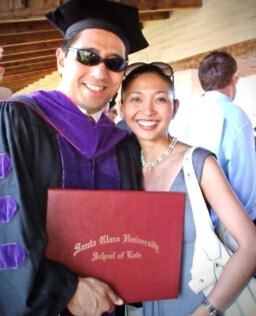
EGL: It’s hard to say that there’s one thing I am most proud of. I’m certainly proud of my education because I really worked hard for all those degrees. The time I spent at Intel, being able to work in high-tech is something that I am proud of. Starting Cold Front is another thing I am proud of. With Cold Front itself, I think the things that we have been proud of, my wife and I, is that we have been able to do some of the industry firsts in the Philippines and in Southeast Asia. We installed the first water loop system in the Philippines five years ago. Last year, we installed the very first green refrigerant R290 water loop system in the country and in Southeast Asia. It’s still the only one of its kind in the Philippines and one of the greenest grocery stores in Southeast Asia to this day. So we’re very proud of that and hope that we can continue to grow that.
Actually, I really see these Cold Front milestones more as a personal accomplishment. The reason is that the people we have in the company come from traditional refrigeration and air-conditioning background. When we first said that we wanted to do a water loop system, there were a lot of people who were nervous or skeptical about it because they have never tried something like this. Even though we lead the company, we still had to try to get their buy-in to do it. I’m very proud that we were able to nudge them enough forward to get this thing installed, even though it was really outside our comfort zone. And then, once it was finally installed, they all took great pride in their accomplishment as well. So even though it is an accomplishment officially of the company, I’m proud that we really pushed it to fruition.

RVT: Name a business leader whom you look up to, and why.
EGL: The business leader I look up to is Jeff Bezos because he pretty much did the same thing we are trying to do right now. He had a flourishing career in investment banking, and, for all intents and purposes, he basically had his life set. He had a great job, making very good money, led a very, very comfortable life. But he basically gave it up. He went ahead and started a business from scratch, not knowing whether it will succeed or fail. One of his famous quotes is he never feared failure, he feared regret: “I wanted not to have regrets. I knew for a fact, I have this idea, and if I don’t try, I’m going to regret having never tried. And I know also, if I try and fail, I’ll never regret having tried and failed.”

What makes Jeff Bezos one of the great leaders of our time is once he started his business, he continued to push the envelope. Another saying of his I subscribe to is “If the size of your failures isn't growing, you're not going to be inventing at a size that can actually move the needle.” Because that means you, as a company, are not growing and not making a significant mark in your industry. We’re not talking about seeking to fail. And failing at something you’re normally good at isn’t something to embrace either. What I believe is that being afraid to fail should never stop you from trying to achieve your goals. You should be willing to take on more and more calculated risks with the potential of bigger and bigger failures or bigger and bigger rewards. That’s the only way you can take that next leap and continue to grow and get to the next stage of your company.
RVT: What advice do you have for aspiring entrepreneurs?

EGL: Just go for it. To echo Jeff Bezos, the bigger regret in your life is to look back and see that you never even tried. It’s better to try and fail rather than to never have tried at all. If it’s something you’re thinking of doing, something you dream of ever doing, do it. And do it as soon as possible so that you have time to either fail and start again or have the luxury of time to enjoy the fruits of your labor and sacrifices.
RVT: What do you enjoy doing most outside of work?

(EGL): Right now, the thing I enjoy doing the most is trying to play the game of golf. During the lockdown itself, it was very difficult to do any of the things we normally like to do – such as socialize with friends, go out to dinner, travel. These all basically stopped when the pandemic occurred. I think one of the few things that we are able to do as a recreational activity is golf. That’s why it’s exploding in popularity. It’s at an all-time high as a sport, not only here, but around the world. Golf enables me to get out of the house, exercise, see my friends with ample social distancing, and be around nature.
RVT: What inspired you to join the Rotary Club of Manila?

I joined the Rotary largely in part because of Rotarian Jason Bogovich, who has a very similar experience as us. He’s an American but decided to uproot from the States and move to the Philippines when he met his wife, our dear friend Lora Woellhaf. Jason invited me to Rotary several times and I got to meet a lot of people during those times. I saw that there was a lot of like-minded people – a lot of entrepreneurs, a lot of people who left other countries and came to the Philippines to start anew. I immediately felt very comfortable in the group. So being able to be around these Rotarians who I admire, learning from them, being able to bounce ideas and share experiences with them is something that really appealed to me.

 Hon. Maria Leonor G. Robredo
 President’s Corner
 The Week That Was