

STAR Rtn. Carlos G. Serapio: The Extraordinary Journey of a Purposeful Lawyer
Rtn. Carlos G. Serapio shares snippets of his life as a Martial Law prisoner and how he drew inspiration from it in writing a book.

His is a journey only a few would dare take. While he might have the talent, resources and political influence to go far in life, he labored hard not to enrich himself with earthly possessions, but rather found enough satisfaction from the gratitude of the people whose welfare he has pursued and fought for. He ardently advocated people’s rights, equality and justice even at the expense of his own liberty. Colorful and interesting it may be, his life journey is rooted on principles of fairness and Christian virtues but marked with challenges and trials.
From fighting for the rights of laborers and ensuring that ‘those who have less in life will have more in law’, to legal engineering, to political consultancy, STAR Rtn. Carlos G. Serapio (CGS) is walking a lawyer’s path filled with purpose. In this interview, STAR Rtn. CGS shares snippets of his life as a Martial Law prisoner and how he drew inspiration from it in writing a book which he personally gave to His Holiness, the Pope. He also talks about how his father and grandfather influenced him to become a lawyer, and why he is so passionate about “bringing to fruition His Kingdom on His Anointed Land (Lupang Hinirang) and His elect and refined (Pili-Pino) People.”

Rhea Vitto Tabora (RVT): Please share something about yourself that your fellow Rotarians might not readily know.
Carlos G. Serapio (CGS): I was arrested and detained twice during Martial Law. In 1978, after I chaired and operated the LABAN Poll Watching Operations Center, I was nabbed together with several hundred others in a protest march that ensued. While waiting to be ‘booked’ in Fort Bonifacio, I escaped with the assistance of my now deceased political mentor and soulmate Emmanuel ‘Manny’ E. Cruz (+) who pretended to be a military officer. In 1980, I was again arrested in a big ‘dragnet operations’ in Greenhills, San Juan. I was with Manny, as well as with some labor union leaders for a pre-departure briefing. I was supposed to go back to the United States for a meeting with the late Senator Raul S. Manglapus and other exiled leaders when this happened. We were initially brought to Camp Karingal where I found out that hundreds of farmers, workers and urban poor settlers identified with our Christian Movement were also rounded up. I was paraded in front of them with an officer wrapping his arm around my shoulder, an act that was clearly intended to intrigue and imply that I was the rat or stool pigeon who caused their arrest. I was later transferred to Camp Bagong Diwa where most of those who were arrested with me were brought. For the first time, there were more Christians than communists in the detention center. I represented the Christian Groups while the Troika of Fidel Agcaoli (+), Pepe Luneta (+) and Satur Ocampo spoke for the communists and their leftist supporters in political talks or negotiations. On January 18, 1981, I was released from detention, weeks after I was visited by the Papal Nuncio at that time, H.E. Bruno Torpigliani. I supposed the military regime then interpreted the visit as a preparation for Pope (St.) John Paul II’s request to meet with political prisoners during his scheduled State Visit on the following month. To avoid this embarrassment and ‘faux pas’, Bicutan was dismantled and all remaining political detainees were transferred to Muntinlupa so they can be tagged as common crime violators.

Subsequently, I was privileged to be among those who had a private audience with His Holiness, the Pope. I took the opportunity to give him the manuscript of a book that I was inspired to write in prison. Years later, the latest book version was handed to Pope Francis, thru Bishop Du when I met the Pontiff in Tacloban. In 2004, I was also arrested with Sec. Salvador Enriquez, Former DBM and Finance Secretary of President Fidel Ramos, Ambassador later Congressman Roy Señeres and Gen. Fortunato Abat, all of whom are now deceased. The case for inciting to sedition is still pending with me as the only remaining accused.
RVT: Why did you go into law practice? Have you always wanted to become a lawyer?

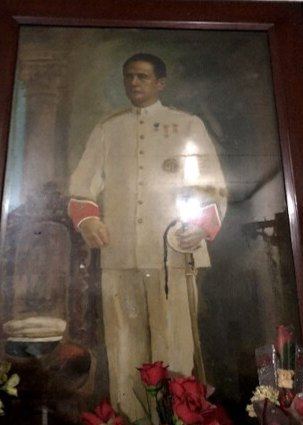
CGS: I was only five (5) years old when I remember telling my childhood playmates that I intended to be a lawyer. This may have been influenced by the fact that my grandfather and father were lawyers who eventually became judges. In the case of my grandfather, he followed as a politician after his father who was the first Governor-General of Bulacan, by also becoming a Mayor of Polo, now Valenzuela, and an Assemblyman. He also sired Nacing Santiago, who was governor of Bulacan for 18 years and was likewise at one time a Mayor of Polo and a Provincial Board Member. He was the half-brother of my father. A meeting between Don Claro M. Recto and my grandfather that I witnessed may have been a subliminal factor also in my aspiration to be a lawyer involved in politics. Parenthetically, I should mention though that in high school, becoming a priest also crossed my mind. This is altogether another story.
RVT: What do you wish you knew about practicing law before you got into it?
CGS: Noble and reputable the practice of law may be, the ideals and justice that the law seeks to serve are subject to the human weaknesses of those called upon to uphold and honor it as well as to a system that has become captive to the importunings and caprices of a powerful few and their interests. This is what I wish I should have known and prepared for before I plunged into waging quixotic legal battles.
RVT: Which legal practice area are you into and why did you choose it?

CGS: I started as a lawyer of labor unions, specifically the Federation of Free Workers. I wanted really to be of service to those whom the beloved late President Ramon Magsaysay referred to as ‘those having less in life should have more in law’. I was a ‘General Practitioner’ when I established my own firm and later tried to specialize in those projects and virgin areas that require what some call as ‘Legal Engineering’. Guided by the philosophy that ‘Law should be a stabilizing tool in times of social peace and prosperity, and an instrument of change when there is social unrest and instability’, I became more interested and involved in Political Consultancy wherein structured, logical legal thinking can be applied.
RVT: Without divulging sensitive details, can you share your most interesting/ memorable case?

CGS: It was a labor case that I won for striking workers of a tire company. The award may appear substantial but when divided among the workers, their share may just be enough to pay for debts they may have incurred and the balance to sustain them for a few months. The award was final and executory. I was therefore surprised and flabbergasted when a conciliation meeting was called at the highest level to negotiate the reduction of the award. I was so angry that I told the workers that since that was their money, it was up to them if they will agree to have it reduced. I knew that they were already hurting and desperate. I could not stand seeing them do the proverbial ‘kapit sa patalim’ decision. So, I walked out of that meeting and soon after, left Labor Practice altogether, and committed myself to ‘changing the system’, through political struggles.
RVT: Who has had the biggest influence in your life and why?

CGS: My family, both from my father and mother sides. My parents in very different but complementary ways. My schools, the Maryknoll School of St. James Academy, Ateneo de Manila and the University of the Philippines College of Law. My childhood friends, compatriots and some great minds I had the privilege of encountering and engaging in my political journey. Student Catholic Action and the Catholic Church. Maryknoll Sisters and Columban Priests. Prof. Roque Ferriols, S.J. and the Jesuit scientist, anthropologist and philosopher Teilhard de Chardin. Mama Mary and Our Lord Jesus Christ, most significantly.
RVT: What do you consider your greatest accomplishment?

CGS: There were milestones perhaps, but there is no ‘greatest achievement’ that I can really claim yet. It is still evolving and a work in progress. Once I can honestly tell myself that I have fulfilled the purpose for which I was created by our Loving Heavenly Father, then I have truly, greatly achieved. What would that be? As I discussed in my book, it is playing my role, big or small, in bringing to fruition His Kingdom on His Anointed Land (Lupang Hinirang) and His elect and refined (Pili-Pino) People. The “Ark” that I have founded and built for this mission is the KAMALAYANG PINOY MOVEMENT – KPM/ KATIPUNAN NG KAMALAYANG KAYUMANGGI – KATIPUNAN PARTY. Its vision and direction is to make us realize that the real sovereign of our land is the Almighty Creator who blessed us with rich natural resources and many more bountiful gifts that include a beautiful mind and radiant soul. The vessel of His Sovereign Power is us, the People, who must assert and recover our authority from those to whom we delegated our God-given power but who betrayed our trust and subverted the system that was supposed to serve our interests. We are the fulfillment of our prayer, if we accept and abide by the God who resides in us. We are “JUAN ORACION”, the oracle of our ordained destiny.
Meantime, I am happy that I have sired two (2) sons, written a book, and have caused the planting of a tree. I know that I should do better on the third one by personally and successfully planting a tree myself.

RVT: What inspired you to join the Rotary Club of Manila? How did the experience change your outlook in life?
CGS: Honestly, I never really imagined myself joining Rotary at this late stage in my life. If not for the insistence and beautiful, historic tradition pitch of my proposer, Anton Mauricio, who I think even went out of his way to request the then outgoing President Bobby Joseph to be his co-proposer, a humbling honor that I cannot refuse, I would not have obliged. After all, considering my history and the journey that I am still making, I did not want to be misunderstood, and I felt like it was not the kind of lake where I can comfortably swim and be in my elements. I am more than happy though that I joined. In the past three (3) months I have attended the regular weekly meetings, I have learned a lot. I marveled at the richness of its tradition and of its glorious past. I am inspired by the esprit de corps of its present composition of men who transcend borders of all kinds and who can speak of both the mundane and the sacred, but most especially of what is the true meaning of life and of being human. I salute these gentlemen of RCM.

RVT: If you could give one piece of advice to an aspiring lawyer, what would it be?
CGS: The law has its inherent, God-sourced noble value, but it is the character of the lawyer who upholds the honor and nobility of its professional practice.

RVT: What are your interests and hobbies? What do you do when you are not at work?
CGS: Being with friends and enjoying the gifts of nature. The real joy of playing golf and singing to me, are the fellowships. Travel makes me commune with God’s ‘Wonderful country and World’ that He has gifted as a blessing to all of us. Like a child with wonders in his eyes, I still see beauty even amidst the ugliness that human folly has blighted God’s Magnificent Creation. I grew up doing ‘Corporal Works of Mercy’ as taught by my Catholic faith, and it is as if I have come full circle by just witnessing the reach out initiatives of the men of this club, my club, RCM, the Rotary Club of Manila. I am honored to be counted among the valiant accomplished men of RCM who are animated by the energy of ‘Love to Serve Others’. My faith in the innate goodness of man is reinforced because of you guys. RCM gentlemen are on deck, Salute!! What gratifies me most is seeing and being with men whose love for God and country, whose virtues and values put the highest premium on the Rotary Commitment of ‘Service Above self’ and ‘Serve to Change Lives’.


 President’s Corner
 The Week That Was