
National Integrated Cancer Control Act
Editor-in-Chief Raoul C. Creencia asks where the country stands in meeting the objectives of the National Integrated Cancer Control Act after four years.

The United Nations Sustainable Development Goal No. 3.4 aims to reduce premature mortality from non- communicable diseases by 30% by 2030. Consistent with this goal, Republic Act 11215, otherwise known as the National Integrated Cancer Control Act (NICCA), was signed into law in February 2019. With this law, cancer patients were expected to have better access to more responsive and affordable healthcare services.
Studies indicate that, in our country with a population of over 110 million, cancer is among the leading causes of death. In 2020 alone, cancer is said to account for over 150,000 new diagnoses and over 90,000 deaths. What is more, according to the 2018 Global Data on Cancer, more than 140,000 new cancer cases and more than 80,000 cancer deaths are expected every year in the Philippines. Breast cancer is the most common cancer among Filipinos, followed by lung, colon, liver, and prostate. Lung cancer tops the leading cause of death among all cancers followed by liver, breast, colon, and leukemia.
Next month, we will mark the 4th year anniversary of the passage of NICCA, and thus could be a good opportunity for health officials, advocates, and professionals to evaluate the actual reforms and programs that were implemented conformably with the provisions of the law. It is well to note that the NICCA envisions, among others, the development of national and regional cancer centers; educational initiatives for healthcare professionals and laypeople; psychosocial, supportive, and palliative services; the establishment of a national cancer registry; support for training in and conduct of cancer research; and expanded financial support for patients under PhilHealth and the Cancer Assistance Fund. The NICCA also emphasizes cancer prevention and improvement of cancer survivorship by strengthening essential programs and increasing investments for the entire cancer care continuum. It aims to make cancer services and care more accessible to all Filipinos.
The question, therefore, is this: After four years, where are we in meeting these objectives? We know that pursuant to Special Provision No. 13 of the Department of Health (DOH) approved budget under the General Appropriations Act for Fiscal Year 2022, the DOH implemented the Cancer Assistance Fund (CAF) which aims to provide support for patients living with cancer and for cancer survivors. Where are we in the other envisioned projects under the law? Are these projects working? Or are they enough? Are we meeting our objectives?
Health advocates and professional organizations view NICCA as an important step in the right direction. Some professionals, however, call for its careful implementation, given the “stark disparities in healthcare access, social and cultural determinants of health, the need for Filipino-led research, and the value of multi-institutional and regional collaboration.” In their November 2022 article in the Lancet Regional Health (Western Pacific) Edward Christopher Dee, Michelle Ann B. Eala and their co-authors opined that, in the implementation of NICCA, the following must be considered:
1. The deeply rooted health inequities in the country and prioritize communities most in need, particularly in geographically isolated and disadvantaged areas of the archipelago. As cancer care systems develop in cities, majority of which are private in nature, public institutions severely lag, perpetuating healthcare disparities;
2. Social and cultural determinants of health, given varying levels of socioeconomic development, diverse cultures, and heterogeneous belief systems;
3. Research that focuses on the needs of Filipino cancer patients is necessary given the nation's unique genetic ancestry, cancer epidemiology, social determinants of health, and healthcare access barriers; and,
4. In addition to public-private partnerships in the procurement and development of cancer care infrastructure, multi-institutional exchange is necessary given the interdisciplinary nature of cancer care.
This week’s regular meeting will feature a medical expert who will talk about cancer care in the Philippines, and who could hopefully likewise give her views on the developments and challenges in implementing the NICCA.

 President's Diary
 24th Regular Meeting: A Recap
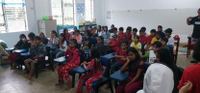 Rotary Club of Manila Provides Essential Supplies to Students and Teachers at Pangotloan Elementary School in General Nakar, Quezon Province