

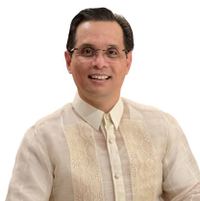
Hon. Artemio V. “Art” Panganiban
Chief Justice and Past President of the Rotary Club of Manila, guest of honor and speaker on November 16, 2023.

It is always both uplifting and inspiring to honor the distinguished men who have helped weave and shape the legacy and landmark achievements of Asia’s First Rotary Club. Today, the Rotary Club of Manila celebrates a remarkable Rotarian, its 71st President, who has lived a life of service and integrity; and one who, as Chief Justice of the Supreme Court, has been affectionately acclaimed by his peers as the “Renaissance Jurist of the 21st Century”, whose “mental dexterity” impressively “extricates the possible from the hypothetical, the emerging from the established, the literature in science and the law in art.” Kabalita
Artemio Villaseñor Panganiban Jr. (born December 7, 1936) is a Filipino jurist. He served as the 21st Supreme Court Chief Justice of the Philippines from 2005 to 2006.
Panganiban was born on December 7, 1936, in Manila in a poor family. His parents were Artemio Panganiban Sr. and Patricia Villaseñor. He graduated with “Honorable Mention” from the Juan Luna Elementary School in 1950. He also finished with “Honorable Mention” from the Victorino Mapa High School in 1954. Panganiban was granted a University of the Philippines scholarship, but failed to enroll because his impoverished parents could not afford the then 15-centavo bus ride between Diliman and the family's small rented apartment in Cataluna Street, Sampaloc, Manila (nonetheless he was bestowed in 1998 with a membership in the UP Chapter of the Phi Kappa Phi honor society). He earned a degree of Associate in Arts summa cum laude at the Far Eastern University in 1956. He also earned a degree of Bachelor of Laws, and graduated cum laude also at the Far Eastern University in 1960. Prior to his graduation, he was named as the 1959 “Most Outstanding Student” of Far Eastern University. In the 1960 Philippine Bar Examination, he placed sixth, with a rating of 89.55%. In 1997, he was given an honorary doctorate degree in law by the University of Iloilo. He was a founder and former president of the National Union of Students of the Philippines from 1958 to 1959 and legal consultant to the Education Secretary and to the National Board of Education from 1963 to 1965. Panganiban was also conferred a Doctor of Laws (Honoris Causa) degree by the Far Eastern University in 2002, by the University of Cebu in 2006, by Angeles University, in 2006, and by the Bulacan State University, in 2006.
Panganiban started as an Associate Lawyer and apprentice of Jovito Salonga at the Salonga, Ordoñez and Associates Law Office from 1961 to 1963. According to Panganiban, his biggest heroes were Jose W. Diokno, the father of human rights, Salonga his mentor, and future Chief Justice Claudio Teehankee; Panganiban could not find sufficient funds to continue his scholarship offer in Yale, so Salonga, a Yale alumnus, brought him under his wing to teach him all he learned from Yale and all he knew of the law.
In 1963, the young Panganiban formed his own law firm PABLAW (Panganiban, Benitez, Parlade, Africa and Barinaga Law Offices), which he headed until he joined the Supreme Court in 1995. He also became the vice president of the Legal Management Council of the Philippines from 1976 to 1977. He was the Vice President for Legal Affairs and General Counsel, Philippine Chamber of Commerce and Industry (PCCI), 1991–1995. He was Chief Legal Counsel of the Parish Pastoral Council for Responsible Voting (PPCRV), 1991–1995, and the only Filipino appointed by Pope John Paul II to the Pontifical Council for the Laity. He was Legal Counsel of the Manila Archdiocesan and Parochial Schools Association – MAPSA from May 7, 1993 – October 9, 1995. He was Chair of Workshop on Administration of Justice, Multi-Sectoral Conference convened to discuss the first 100-day and first 1,000-day programs of President Fidel Ramos, held on June 13, 1992, and on October 17, 1992, respectively.
He taught law and political science at the Far Eastern University, Assumption Convent, and San Sebastian College from 1961 to 1970. He became a bank director of the International Corporate Bank (which is now owned by the Union Bank of the Philippines) from 1972 to 1974. From 1978 to 1981, he was a consultant of the World Tourism Organization and was an honorary consul of the Republic of Honduras from 1981 to 1983. He was the president of Arpan Tourism Industries Corp. from 1974 to 1993 and Baron Travel Corporation from 1967 to 1993. Panganiban was the Chief legal counsel of the Liberal Party from 1987 to 1991 and was president of the Philippine Daily Inquirer from 1991 to 1992. He was also the governor of the Management Association of the Philippines and president of the Rotary Club of Manila. He was also the former president of Philippine-Finland Association and RCM Eyebank Foundation Inc. Panganiban's 2008 occupation is: Philippine Daily Inquirer column writer; adviser, consultant and/or independent director of several business, civic, non-government and religious groups.
Panganiban was named as Associate Justice of the Supreme Court in 1995. Justice Panganiban was the chairperson of the Supreme Court Third Division and the House of Representatives Electoral Tribunal (HRET), as well as of seven SC committees involved mainly in judicial reforms. Described by a colleague (Justice Antonio T. Carpio) as “undoubtedly the most prolific writer of the Court, bar none” he has during the last ten years penned more than 1,000 full-length decisions and ten books plus several thousand minute resolutions disposing of controversies. These include the Cocofed case, in which the court gave the Presidential Commission on Good Government the right to vote sequestered United Coconut Planters Bank shares, which had been acquired through coco levy funds.
Justice Panganiban was named Supreme Court Chief Justice on December 20, 2005, by President Gloria Macapagal Arroyo after Hilario Davide Jr. retired at age 70. Other nominees by the Judicial and Bar Council included Senior Associate Justice Reynato Puno and Associate Justice Leonardo Quisumbing. Puno was the most senior in terms of career in the Supreme Court while Panganiban was the most senior in terms of age. Panganiban was succeeded by Puno after only two years in office in December 2007. Short-term tenures of high-ranking appointees are a distinctive feature of the Philippine political system.
Chief Justice Panganiban drew controversy for his remarks made in June 2006 regarding the 1998 decision of the Supreme Court, in which he participated, affirming the death penalty imposed on Leo Echegaray. Echegaray, a convicted rapist was executed the following year in what was the first execution in the Philippines since the regime of Ferdinand Marcos. Panganiban, whose anti-death penalty views are well known, suggested that the Supreme Court may have committed “a judicial error” in executing Echegaray, as not all of the qualifying circumstances needed to promulgate a death conviction were actually established. His remarks, coming at the heels of the passage by Congress of a law abolishing the death penalty, were criticized by death-penalty advocates and some newspaper editorials. Calls were made in some quarters to indemnify the family of Echegaray. Supporters of former President Joseph Estrada were also emboldened to demand that the Supreme Court likewise to correct its 2001 decision upholding the assumption to the presidency of Gloria Macapagal Arroyo in lieu of Estrada. Panganiban subsequently clarified that his remarks on the Echegaray decision were his own personal views and not that of the Supreme Court.
The Philippine Bar Association, on its 116th Foundation Day Celebration on April 26, 2007, conferred upon Art, the “Award of Honor” citing him as ...“a principled and visionary leader by example; a prolific writer of the Supreme Court, bar none; a renaissance man and a nobly-souled and gifted jurist; a much sought-after speaker; a recipient of over 250 awards and citations from national and international entities and organizations, including several honorary doctoral degrees; an eminent lawyer, law professor, Catholic lay worker, civic leader and businessman; a scholar imbued with mental dexterity; and, an exemplary family man.”
Source: Wikipedia

 Are We a Team?
 18th Weekly Membership Meeting: A Recap
 Meeting to Discuss RC Manila Information Kit