

“Balangay”
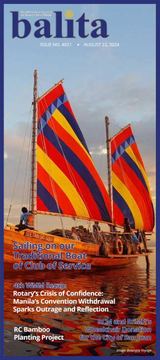
A Random Conversations and Musings column on the balangay, the traditional boat of the planned cruise, and the Philippines' seafaring history.
Fellowship activities are a fantastic way to bond and connect with fellow Manila Rotarians, deepen relationships, and strengthen friendships. In our club, we have at least two groups which members can join and actively participate in: a) The World Famous RCM Chorale (for those who love to sing) and b) The RCM Golf Club (for those who are addicted to the greens and fairways).
These fellowship activities allow members to break the monotony of structured weekly meetings which, although a must in the life of a Manila Rotarian, ruefully do not afford that much opportunity to develop new relationships and get to know more about the Club’s Star Rotarians.
It is thus laudable that President Jujut and Program Committee Chair Caloy have thoughtfully scheduled a fellowship activity this week. The fellowship at the Manila Yacht Club promises to be an exciting one, highlighted by the scheduled balangay cruise along the bay.
This traditional boat is truly fascinating as it is historic. These sturdy boats were heavily used by the various ethnic groups in our country, especially in the Visayas and Mindanao islands, either as inter-island trading ship or cargo transport. The fact that they were also used as warships definitely adds to its historical splendor and significance.
When Ferdinand Magellan set foot in our islands in 1521, the Venetian chronicler Antonio Pigafetta called the boats balangai or balanghai. This means that this word was, at that early stage, already introduced and known to the European visitors.
With these historical lashed-lug boats being heavily used in the Philippine islands long before the European colonization, it is unsurprising that the oldest known balangays were found in Agusan del Norte. These are the eleven Butuan boats which have been carbon-dated individually from 689 to 988 CE. It is said that large amounts of trade goods from East Asia, Southeast Asia, and as far as Persia were found together with these boats, which tells us that pre-colonial Filipino merchants actually reached as far as the Middle East in their trading activities. This strikingly highlights our history as a seafaring nation.
To this day, the Philippines continues to be the world's leading supplier of seafarers, with hundreds of thousands of Filipinos working in the maritime industry. In 2022, the Philippine Overseas Employment Administration deployed over 489,000 seafarers to countries worldwide. Today, the Philippines continues to rank first in terms of the number of seafarers and officers.
In fine, from the pre-colonial balangays to the modern cargo ships of this century, we Filipinos have truly shown our mettle in sea travel, and have undeniably become the backbone of the global maritime industry.
 4th WMM Recap: Rotary’s Crisis of Confidence: Manila’s Convention Withdrawal Sparks Outrage and Reflection
 Press Coverage: Rotary Forum