

Speech Delivered at the Rotary Club of Manila, September 19, 2024
Retired Chief Justice Reynato S. Puno’s speech traces the evolution of the legal regime on warfare and calls for a new world order.
I: Prefatory Statement
Peace is the predicate of progress. Since time immemorial mankind has searched for peace. Their ceaseless search for peace has always ended in the peace of the graveyard. In the book entitled Conflict, the authors General David Petraeus and Andrew Roberts stated that warfare has never ended … “Conflict has continued at least somewhere on the globe every year since the end of the Second World War. The 20th Century was the most brutal of all the many centuries of human existence; it is estimated that more people have already perished violently in the first half of the 20th century than in all the previous centuries put together” (p. 2.).
Two decades inside the 21st century, peace continues to elude us. Consider the ongoing war between Russia and Ukraine. It is now running to 2 ½ years. Ukraine is in near total devastation given the kind of bombs dropped on it by Russia. But its cost to Russia is also bewildering. According to Petraeus and Roberts, “within a month of the invasion of Ukraine, Russia had lost as many military personnel killed as the US had in 20 years in Iraq and by March 2023, the Russian death toll is thought to have reached five times the 13,300 soldiers that the USSR lost after a decade in Afghanistan in the 1980’s” (Ibid., p. 2). The war appears to be escalating. A few days ago, British Prime Minister Keir Starmer and US President Joe Biden discussed the possibility of allowing Ukraine to use long-range missiles against Russia. Putin warned it could unhinge a nuclear conflict.
Or consider the ongoing war between Israel and Hamas in Gaza. This war is on its twelfth month. It was precipitated by Hamas’s surprise attack on Israel that resulted in the deaths of 1,205 people, mostly civilians. They also seized 251 hostages, including two Filipinos. Israel retaliated and in its aftermath, some 41,000 have died. Israel has rejected all calls by the international community for cease-fire until all hostages have been freed. Yesterday, UN Secretary-General António Guterres released a statement that condemned what he called “collective punishment of the people of Gaza by Israel”. Other nations have come to the succor of both Israel and the Hamas. With Israel holding a nuclear card, the conflict can also incinerate the world unless contained.
Or consider the ongoing conflict between China and the Philippines in the West Philippine Sea. It started as a maritime dispute between two countries alone, a dispute which could have been settled under the peaceful mechanism set forth in UNCLOS. Their Arbitration failed. Since then, China has claimed sovereignty and occupied Scarborough Shoal, Ayungin Shoal and threatens to do the same on Escoda Shoal. All shoals are within the EEZ of the Philippines, hence, at the very least, it has sovereign rights on the shoals. In this maritime dispute, the Philippines is fighting a Goliath. The Chinese Coast Guard, Navy and militia have succeeded in blocking almost all efforts of the Philippines to claim sovereign rights on these shoals. China has used water cannons, rammed boats, boarded a Philippine Navy boat, seized firearms of Filipino sailors, etc. All diplomatic protests have proved futile. Consequently, the Philippines has sought the assistance of other countries to protect itself from what it considers as aggression by China. Notably, it has concluded an Enhanced Defense Agreement with the US. Again, this conflict can escalate into an international dispute with some of the countries wielding weapons of mass destruction. The South China Sea is a very important waterway for trade that is vital to the whole world.
II: Evolution of the Legal Regime on Warfare
Mankind’s peace has always been broken by the use of force and by declarations of war. It is interesting to note than from the time of the Roman Republic to the 1648 Peace of Westphalia, war was as an instrument of policy and considered lawful among nations. Albeit, there was the doctrine of “just wars” of St. Augustine that imposed certain restrictions before States can declare war. After the 1648 Peace of Westphalia, however, States no longer followed the doctrine of just war. States considered themselves sovereign and equal and they held that no State had the right to determine whether a war is just or not. By the end of the 18th century and throughout the 19th century, customary international law placed no limitation on the rights of States to resort to war to settle their disputes (Ireland, Public International Law, p. 679, et. seq.).
The devastation of World War I changed this State notion of its unlimited right to declare war. The League of Nations was established and its Covenant outlawed “war of aggression.” The 1928 General Treaty for the Renunciation of War, also known as the Kellogg-Briand Pact, was the first universal treaty that outlawed war. However, it did not provide for sanctions against its violation. With this soft stance on war, the covenant of League of Nations failed to prevent WWII.
The horrors of World War II saw the birth of the UN. Its Charter totally banned the threat and use of force. Article 2 (4) of the Charter states that all members of the UN “shall refrain in their international relations from the threat or use of force against the territorial integrity or political independence of any State or in any other manner incompatible with the purposes of the United Nations.” Further, Article 2 (3) of the Charter provides: “All members shall settle their international disputes by peaceful means in such a manner that international peace and security and justice are not endangered.” These Articles, however, should be read in conjunction with Article 51 of the Charter which reads: “Nothing in the present Charter shall impair the inherent right of individual or collective self-defense if an armed attack occurs against Members of the United Nations, until the Security Council has taken measures necessary to maintain international peace and security. Measures taken by Members in the exercise of this right of self-defense shall be immediately reported to the Security Council and shall not in any way affect the authority and responsibility of the Security Council under the present Charter to take at any time such action as it deems necessary in order to maintain or restore international peace and security”.
It took centuries for States to dump their right to wage war and agree to a total prohibition of war.
III: Application of Article 2 (3) in relation to Article 51 and its problems
Since 1945 and for nearly seven decades, these articles in the UN Charter have set the legal regime that determines the propriety of the use of force and validates the exercise of self-defense in interstate relationship. The outlawing of war by the UN Charter may have prevented the occurrence of WWIII but certainly, it failed to solve the problem of obliterating mini wars or the illegal use of force as well as unlawful claims of the right of self-defense in inter-state relationship. Consequently, international peace remains a chimera in the world today.
It will require volumes to dissect the problems States have encountered in the implementation of these provisions and why they failed to prevent wars among our States. Let me just mention some of the major ones.
First, there is the controversy on the meaning of “armed attack”. Under Article 51 of the Charter, it is an “armed attack” that will trigger the right of self-defense. Literally, it contemplates the use of “armed” force. Some States, however, take the view that economic measures or non-violent actions that can infringe other provisions of the UN Charter or customary international law on State obligations should justify the invocation of the right to self-defense.
Second, there is the controversy on whether there is a de minimis threshold on the scale and effects of the “armed attack”. There is what is known as “accumulation of events” theory or needle prick theory that posits the view that several minor attacks or incidents may be accumulated and used to justify the exercise of the right of self-defense.
Third, there is the controversy on the timing of the armed attack which will trigger the exercise of the right of self-defense. Again, literally read, the right of the self-defense can be exercised only “if an armed attack occurs.” The 9/11 attack on the United States as well as the availability of weapons of mass destruction to terrorist groups, gave birth to the concept of anticipatory self defense. According to this school of thought, an imminent use of force, especially involving weapons of mass destruction, can trigger the right of self-defense of the targeted state. In other words, the targeted State need not wait for the armed attack to occur. A corollary school of thought, known as preemptive self-defense, goes further. It posits the theory that even if the armed attack is not imminent but may take place at some point in the future if no action is taken, that should justify the exercise of the right of self-defense. This position was taken by Israel in attacking an Iraq nuclear reactor that was still under construction but designed to produce nuclear weapons that would subsequently be used against it.
Let me just refer to one more controversial area in the application of Article 51 of the Charter. Customary international law further requires two conditions to be fulfilled to justify the exercise of self-defense: proportionality and necessity. The requirement of proportionality demands that self-defense measures should be geared towards stopping or repelling the armed attack. If the attack has ceased, the alleged self-defense actions of the victim state will be dismissed as punitive or retaliatory and will be qualified as reprisal and no longer acts of self-defense. In other words, they cannot justify the need to deter future attacks or eliminate their danger. Quare: Does this apply to the Israel-Hamas ongoing dispute?
Also, there is the requirement of necessity as a restriction on the right to exercise the right of self-defense. This requirement means that the right can only be used as a last resort, only when peaceful means have been reasonably exhausted or when diplomatic efforts have proved futile. The requirement also demands that self-defense should be undertaken while the original armed attack is still in progress; there should be a close proximity in time between the start of the armed attack and the response in self-defense (Ireland, supra).
These different interpretations have proved detrimental to mankind’s search for international peace. They have been used by some powerful countries to avoid the State duty not to use force or threat of force. They have been used by other countries to violate the requirements for the legitimate use of the right of self-defense. They have violated the norms set by Article 51 of the Charter especially with the use of their veto power in the UN Security Council. Thus today, we suffer from a world of new disorder.
IV: We Need a New World Order
As discussed, the legal regimen provided in the UN Charter has not eliminated the threat or the use of force, hence, the proliferation of inter-state wars. In the coming years, the existing legal regimen will prove to be more useless considering the novel means of warfare being brought by technology, especially artificial intelligence. As well put by author Mark Galeotti, viz.
Economic sanctions, targeted assassinations and political-influence campaigns are becoming more common, more alluring and, in some cases, less detectable then actions on the usual battlegrounds of land, sea, air and space. Perpetual low-level conflict masked by plausible deniability both de-intensifies war and make it more ubiquitous. Disconnected from traditional battlefields, such actions comprise a form a warfare where computers, currencies and public opinion become primary battlegrounds, with little definitive indication of final success or failure. This has been termed ‘the weaponization of everything’, and we can assume it to be a growing phenomenon.
Needless to state, we need to change our world order to eliminate the use of force, violence and wars in inter-state relationship. Our present world order does not work because it is founded on power imbalance—only a handful of powerful countries dictate its direction, more specifically the five (5) countries that wield the veto power in the UN Security Council. It excludes the legion of powerless nations in decision-making. Our world order does not work because it fails to appreciate the interconnectedness of all nations and the commonality of the problems they face like climate change, poverty, pandemic, etc. Our world order does not work because it continues to perpetuate narrow national interest instead of recognizing divergent values and interests. Our world order does not work because it is built on the values of competition, not cooperation, secrecy instead of transparency and accountability.
This is our challenge and it is a challenge that needs our urgent attention. Good day to all.
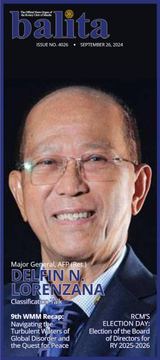
 Delfin N. Lorenzana
 Navigating the Turbulent Waters of Global Disorder and the Quest for Peace