

Sanctuary and Spark
A Meditation on the Soul of Rotary

Prologue
THERE are Thursdays that arrive and depart with little consequence, marked only by the silent ticking of a clock or the gentle rustle of a polo leaf on McKinley Road. But some Thursdays transcend mere calendar dates. They become witness. Testament. Living archive.
June 5, 2025, was such a day.
On that afternoon, beneath the vaulted ceiling of the Manila Polo Club, a cross-generational tapestry of statesmen, businessmen, idealists, and servants of the public good gathered once again. Not merely to share a meal or exchange handshakes—but to wrestle with memory, purpose, and future.
It was the 34th Weekly Membership Meeting of the Rotary Club of Manila—Asia’s first, and still, for many, its foremost.

But what made this meeting different—indeed, unforgettable—was not its agenda, nor even its awards. It was the presence of its people. The interweaving of eras. The candor of its reckoning. The spirit of respectful critique, of soul-searching reflection, of revival through memory.
If the past had something to teach, then the present listened. And if the present dared to dream, the past did not interrupt.
This is the story of that meeting—told not as a record of proceedings, but as a long conversation between generations, held in the language of stories, speeches, silences, and songs.
Part I: The Ritual of Belonging
It began, as it always did, with a bell.

At precisely 12:30 PM, President Eduardo “Jujut” Enriquez III called the assembly to order—not with fanfare, but with the quiet dignity of ritual. In the world of Rotary, it is never the grandeur of the gesture but the constancy of tradition that lends it weight. And so began the meeting—not merely convened, but consecrated.
Vice President-Elect Ricardo “Ricky” S.B. Guevarra’s invocation was not perfunctory. It was intimate, rooted in the quiet faith that men carry with them like worn photographs—evidence of a life lived for others. There was prayer, not merely for guidance, but for gratitude—for another Thursday given, another chapter to write.
The Philippine National Anthem played, not as backdrop, but as binding thread. A collective standing not just of feet, but of fidelity. And then, as if to remind the room that service must be sung as much as it is spoken, the Rotary Club of Manila’s World-Famous Music Chorale performed the club hymn. No orchestra, no spotlight—just harmony. And harmony, after all, was the unspoken prayer of the day.
The Four-Way Test followed—intoned by President-elect Atty. Raoul C. Creencia with solemn clarity. These weren’t rhetorical flourishes; they were vows. Spoken not to impress, but to remind.
And then came the roll call of souls. Past Vice President Fausto D.R. Preysler Jr., himself a bridge between generations, acknowledged guests and visiting Rotarians. Names were mentioned, hands were lifted, nods exchanged—each one a link in the chain of Rotary's long, unbroken fellowship.

The Welcome Song, again from the Chorale, felt less like a performance and more like a benediction. Hospitality here was not just etiquette—it was ethos.
By this point, a stranger might have said the meeting had barely begun. But a Rotarian would have known better. The soul of the meeting had already arrived—gathered quietly in the rituals that affirmed: we belong, we remember, we continue.
Part II: The Past Speaks
It was during the President’s Time that a new thread was woven into the day’s narrative. President Jujut Enriquez, fresh from the District 3810 Awarding Ceremony just five days prior, brought with him not just news—but honor. Manila Rotary, once again, had taken home the district’s highest awards. Platinum citations, recognitions of excellence, affirmations of impact. And yet, even he seemed to hint that plaques and banners—while deserved—were not the heart of the matter.
Then came the moment everyone had been waiting for: PAST… PRESENT… FUSION: The RCM Continuing Story. It was more than a theme. It was an invocation of time itself.

PDG Vicente “Vince” J. Carlos, the first speaker, did not so much deliver a speech as open a time capsule. His words were not scripted—they were remembered. At 80 years of age, he did not recount events; he relived them.
His journey began in 1975, at 29, when Rotary had no Rotaract, no emails, and certainly no women. What it had was 340 men—giants of banking, medicine, industry, politics, law, and the arts—gathered weekly at the Manila Hilton. Back then, attendance was not a suggestion; it was a summons. To miss four meetings was to invite expulsion.
PDG Vince painted a portrait of a Rotary where ideas sparked under chandeliers, where investment deals were made over coffee, and where service and stature walked side by side. His reminiscence wasn’t nostalgic for the sake of sentiment. It was a reminder that greatness is never accidental. It is chosen. Cultivated. Attended.
He spoke, too, of the waning of that era. The quieter rooms. The fading sense of obligation. The encroaching absence of the old fining sessions.
But he ended, not with lament—but with blessing. “May the Rotary Club of Manila continue for another 100 years,” he said. And the room, for a moment, believed it would.

Part III: The Present Answers
If PDG Vince Carlos was the voice of heritage—firm, elegiac, expansive—then PP Domingo “Boy” Guevara was the unflinching conscience. His voice, too, bore the weathering of years, but it crackled with the electricity of challenge. Where Vince serenaded the past, Boy pierced the present.
He began not with a sermon, but a story. A handshake, he reminded the audience, was a gesture dating back 3,200 years. It was not just etiquette—it was covenant. An open hand said, “I come to you with no weapon.” A shaken hand said, “We are allies, not adversaries.”
So he asked, gently but with purpose, that everyone around the table shake hands—physically and symbolically. And they did. In that moment, the room softened. The formality fractured. The fraternity returned.
But Boy, ever the steward of truth, followed gentleness with grit. He acknowledged the excellence of President Jujut’s administration, particularly the recent Platinum Award. But he posed a question that lingered long after his speech ended: What good are these awards if we do not act and behave like good Rotarians?

It was a dagger—not of cruelty, but of accountability.
He scanned the room, noting how few of the newly inducted Star Rotarians and Directors were present. “Overcommitment or undercommitment,” he said, was today’s modern affliction. In a world of endless invitations, Rotary was often relegated to obligation—not honored as privilege.
Then, with the humility only an elder could possess, he pointed not fingers, but outstretched arms. Respect, he said, was the missing word. Respect for time. Respect for fellowship. Respect for a phone call returned, a message answered, a presence made known—not for vanity, but for continuity.
And then he told a joke—but in jest, as in truth, he unearthed something sobering. “Rotary Club of Manila was once so desperate, we elected a priest as president,” he laughed. And yet, that priest—Father Reyes—did what lawyers and doctors before him could not: he brought the divine back to Rotary.
The story brought laughter. But beneath it, a lesson: the club’s soul must be shepherded, not merely structured.

When he concluded, the room was silent—not out of boredom, but of reflection. It was the kind of silence that said: he wasn’t wrong.
Part IV: The Inner Voice
Then, quietly, came Past Vice President Reginald “Reggie” Yu, ironically, the most impactful speaker of the afternoon. He approached the microphone without the vintage gravitas of Vince, nor the prophetic urgency of Boy. But what he possessed was clarity. Clarity honed not by decades, but by distance—standing at the border between legacy and renewal.
He began with grace—deference to those who spoke before, and gratitude for the invitation to speak at all. “Perhaps I was asked,” he mused, “not to speak from above, but from within.” And in that single line, the purpose of his presence became clear. He was not a historian. He was not a critic. He was a mirror.
What followed was not a speech—it was a diagnosis. Not with cold detachment, but with lived sincerity.
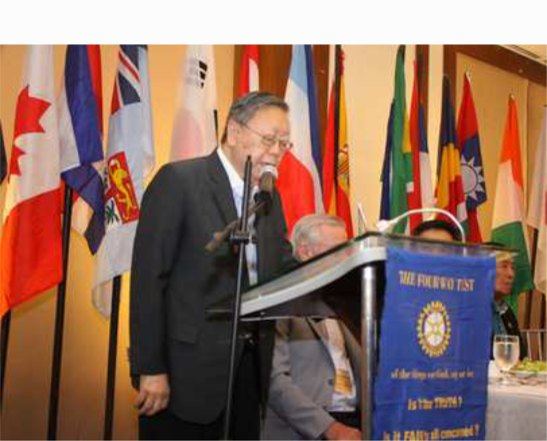
Reggie identified three challenges confronting the Rotary Club of Manila today—a generational divide, a cultural shift, and internal tensions. But rather than scold, he sought to understand.
The generational divide, he explained, was not a war. It was a waltz. The elders led with wisdom, the youth with energy. “The challenge,” he said, “is finding that rhythm together.” It was a plea not to protect turf—but to share it.
The cultural shift was harder to name, but impossible to ignore. “Today’s professionals,” he said, “do not seek prestige or protocol—but purpose.” And so, he asked—Are our meetings something people look forward to? Do our projects answer today’s questions—or yesterday’s?
The third challenge—the most painful—he addressed with rare courage. “Let us speak plainly,” he said. “Internal tensions exist.” Rivalries. Unspoken factions. Leadership debates that leave bruises. He did not call out names; he called in hearts. Because his goal was not to punish—but to purify.
And yet, Reggie’s was not a lament. It was a call. He offered a path forward—not in strategy, but in small, human acts. Reach out. Listen. Lead by example.

He quoted a past president who had once dismissed outreach as “nursemaiding.” Reggie disagreed. “Rotary is not just a commitment,” he said. “It is a community. And community must be nurtured—not commanded.”
And finally, he offered a benediction for the future: “Many say the best of Rotary is behind us. But I say—the best is yet to come.”
In that moment, applause broke not out of courtesy, but recognition. He had not merely described the present. He had captured its soul.
Part V: New Blood, Old Souls
Then came the newcomers. Not in seniority—but in sincerity.

First was Star Rotarian Stefan Yordonav. Bulgarian by birth, Filipino by fate, Rotarian by heart.
His English, charmingly accented, carried the ring of earnest discovery. “Joining the Rotary Club of Manila,” he said, “was like winning the lottery.” His voice—unsure at first—soon found its rhythm. He spoke not of structures, but of spirit. Not of critique, but of gratitude.
He had found in Rotary a bridge to his new homeland. A lens through which he could understand the Philippines. A compass by which he could live with deeper purpose.
He recalled the inspection of the Pasig River—how he had seen, smelled, and touched the very air where service meets suffering. “Rotary,” he said, “offers more than meetings. It offers impact.”
And then he smiled and said something many had forgotten to say: “Since joining, I’ve found real friends.” It was simple. But not small.

Then came Jonas R. Gonzales. His delivery was polished, his thoughts composed. But beneath that poise was a powerful undercurrent of humility.
He called Rotary his “third space”—a phrase borrowed from Starbucks, yes, but repurposed into something profound. Not home, not work—but a sacred in-between. A space for connection. Reflection. Renewal.
And then, with the brevity of belief, he said it: Rotary doesn’t just participate in the world—it shapes it.
He stood not with notes, but with knowing.
What he delivered was neither speech nor summary. It was spiritual synthesis. With the calm of a sage and the candor of a brother, he reminded everyone that what had just taken place was not mere oratory. It was, in his words, “a tension between tradition and purpose.”

His insight was clear: the future of Rotary lies not in chasing relevance, but in embodying it. Not in fearing change, but in managing continuity. “The past,” he said, “is not something we leave behind. It is something we carry forward.”
In his final lines, he made a promise—not to change the world, but to serve it. Quietly. Purposefully. Together.
Part VI: The Spirit Speaks
And then, a silhouette.
The final speaker, as it turns out, had not been intended to speak at all. The silhouette on the program cover—the faceless guest with a question mark—was meant to be none other than the Cardinal of Manila. But illness had intervened. Absence, once again, had become the last uninvited guest.

And so, the role fell to the program’s silent architect—Chairman Caloy Serapio.
And then, drawing from both Chinese proverbs and the Catholic Conclave, he named the process for what it was: an evolution. He traced its contours—identification, crystallization, differentiation, confrontation, reconciliation… and ultimately, unification.
He ended not with warning—but with hope. “The boy that PVP Reggie once was,” he said, “is no longer the man he is now. And the man he is now will not be the elder he will become.”
The same, he said, is true of Rotary Club of Manila. We are the same—and not the same. We are old—and ever new.
He named the Club’s roots not as policy, but as principle. Its foundation not as history, but as love. Rotary, he said, was never built merely on minutes and motions—but on men. Gentlemen. Brothers.

Part VII: The Closing, Which Was Not an End
The afternoon concluded, as it began—not with ceremony, but with quiet conviction.
A video presentation played—a montage of the past year. Smiles, meetings, outreach, floods, fires, laughter. It wasn’t nostalgia. It was a ledger of labor. A map of meaning. A reminder that behind every acronym and committee lay lives touched, hopes lifted.
President Jujut Enriquez returned to the podium—not with speeches, but with thanks. Certificates were given, applause returned. There was no standing ovation. It wasn’t needed. The reverence was already standing in the air.
At 2:00 PM, he adjourned the meeting. But no one really left. Not in spirit. Not in memory. Not in the quiet, sacred work that would begin again—next Thursday.

Part VIII: Epilogue – The Stillness After the Sound
When the hall had emptied, and the silverware had been cleared, and the last Rotarian had offered his final handshake for the day, the room at the Manila Polo Club exhaled.
It exhaled the weight of words, the gravity of legacy, the gentle friction of introspection. The echo of speeches still lingered in the wood-paneled walls, in the corners where elder Rotarians once conspired about service projects, in the still air that had been stirred not only by conversation, but by candor.
This was not a typical Thursday. This was not simply Meeting #34. This was a meeting that asked questions. Not the kind one answers with numbers—but the kind that haunt, nourish, and propel.
Questions like: What does it mean to belong? How do we honor the past without entombing the future? Can respect be resurrected in a generation that favors speed over structure, convenience over commitment? Is our club merely aging—or is it evolving?

No one left that meeting with all the answers. But perhaps, they left with something better—a hunger for better questions, and the resolve to walk toward them together.
Part IX: Closing Reflections – Six Voices, One Club
PDG Vince Carlos reminded the club of its former magnitude. In his recollection of the Hilton days and the roll call of titans, he reoriented the room to an era when Rotary wasn’t just prestigious—it was magnetic. When a handshake in that room could launch a company, or comfort a nation. But his reflection was not merely a eulogy for a golden age—it was a reminder that greatness, once achieved, can be pursued again.
PP Boy Guevara, in contrast, was not wistful. He was surgical. The power of his talk lay in its simplicity. If Vince sang a hymn, Boy rang a bell. And he did so with grace, but not compromise. His call was not merely to memory—but to manners. His provocation not against change—but against indifference.
PVP Reggie Yu, the bridge between pillars and pioneers, offered not just critique, but covenant. His vision was of Rotary as sanctuary—not empire. As conversation—not confrontation. His reflection held the mirror up to the soul of the club—and found it worth keeping, worth renewing.

STAR Rtn. Stefan Yordonav, the grateful immigrant-turned-Rotarian, saw in Rotary what many had forgotten: a gift. Not an entitlement. He reminded the club that belonging is never automatic—it is always a miracle.
STAR Rtn. Jonas Gonzales, with his clarity and calm, framed Rotary as a “third space”—that rarest of places where identity is neither professional nor domestic, but purposeful. Where strangers become brothers, and meetings become meaning.
And finally, Chairman Caloy Serapio, who stepped into a silhouette meant for a cardinal, showed that sometimes, God speaks not through robes or rings, but through reason and reflection. His message was soft, yet seismic. He reminded the club that growth and conflict are not enemies. They are co-authors of evolution.
Part X: Thematic Analysis – The Fusion That Is Still Unfolding
1. The Dance Between Tradition and Relevance

At the heart of the meeting’s theme—Past, Present, Fusion—was an unresolved, essential tension.
Rotary Club of Manila is a club with an illustrious ancestry. Its very name evokes reverence. But it now sits at a crossroad where memory can either inspire or immobilize.
Tradition, as evoked by Vince and Boy, is not mere nostalgia—it is institutional wisdom. But as Reggie pointed out, relevance must also speak. If we cling only to yesterday’s rituals, we risk becoming caretakers of a museum. But if we disregard them altogether, we risk becoming unmoored.
The challenge is not binary. It is fusion.
Fusion is not compromise. It is chemistry. It is the ability to mix legacy and innovation until they produce something stronger. Something enduring.

2. The Crisis of Presence
One word haunted the meeting more than any other: attendance. Not as a metric. But as a metaphor.
To be absent is not merely to skip a lunch. It is to miss a moment. To withdraw from a table of stories, advice, partnership, and fellowship. The empty seat becomes a symbol of disconnection—not from duty, but from each other.
But as Boy implied—and Reggie echoed—presence must be more than physical. It must be attentive, respectful, and warm. We do not simply “attend” Rotary. We inhabit it. We offer our spirit—not just our signatures.
3. The Fragility of Fellowship
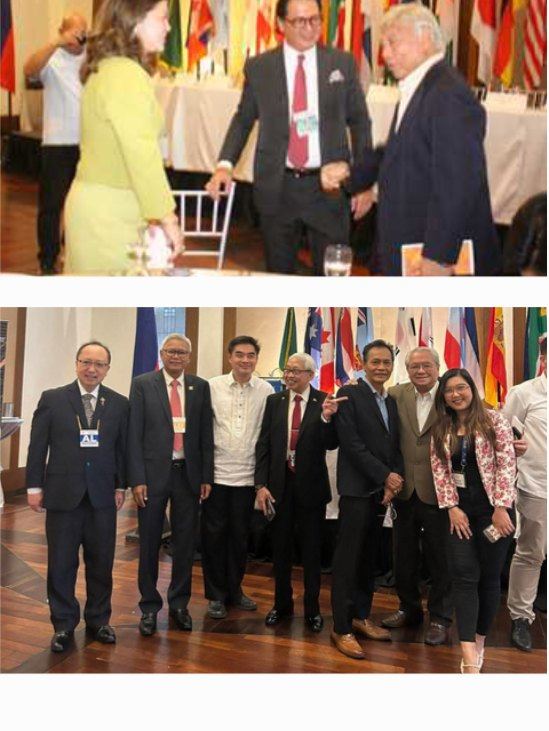
The club has seen internal tensions. No family does not. But the question posed by the speakers was not whether conflict exists—but how it is handled.
Fellowship is not a given. It must be cultivated.
Rotary is built on four questions—but perhaps, as Reggie implied, it begins with one: Do I see you as a friend?
To answer yes, we must listen when others speak. We must reach out when others disappear. We must forgive when tempers rise. Otherwise, we trade brotherhood for bureaucracy.
4. The Power of Story

What united all the speeches—whether from octogenarians or newcomers—was story. Not policy. Not procedure. But narrative.
We remember Vince’s table of titans. Boy’s forgotten phone calls. Reggie’s plea for empathy. Stefan’s lottery. Jonas’s third space. Caloy’s Chinese proverb.
This is how culture is passed—not through bullet points, but through parables.
Rotary must continue to create space for story. Not just for the polished, but for the personal. Because in telling our stories, we invite others to find their place in it.
Coda: A Prayer for the 107th Year

As the Rotary Club of Manila enters its 107th year, the question is not whether it will survive. Institutions with deep roots rarely perish.
The question is: Will it thrive?
Will it attract men and women not just of wealth, but of wonder? Will it remember its roots while reaching new branches? Will it grow not just in awards—but in warmth? Will it become the third space that Jonas described, the sanctuary that Reggie longs for, the cathedral of service that Boy and Vince built?
Only time will tell.
But if June 5, 2025 was any indication—if the words spoken, the hands shaken, and the truths shared are anything to go by—then perhaps the best of Rotary Club of Manila is not behind it. Perhaps the best is rising.
In the eyes of a young Rotarian. In the voice of a forgotten friend. In the silence between speeches, where meaning lives. And in the spirit that gathers—every Thursday, still.
 Editorial