

Manila Unfiltered: Mayor Isko’s Bold Blueprint for Change
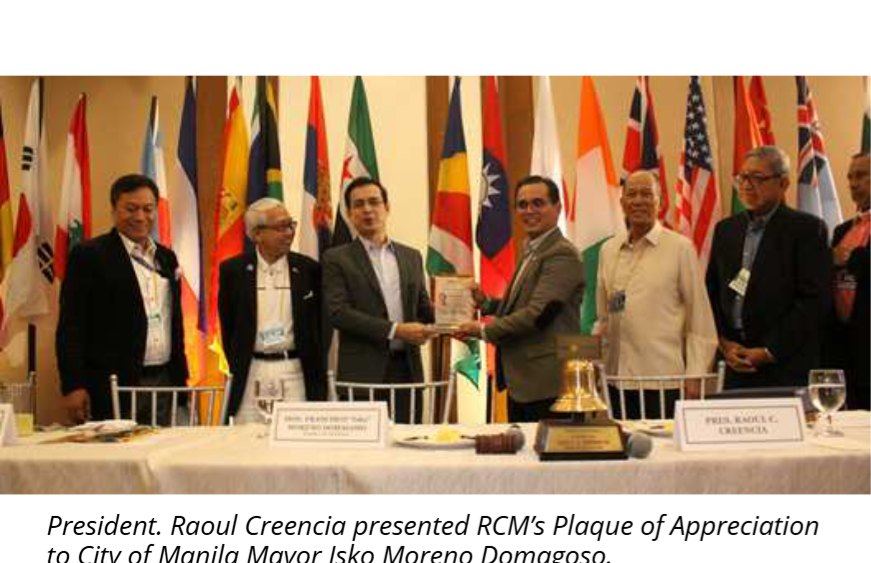
Mayor Isko Moreno delivered a report card of his first two weeks back in office at RCM’s July 17 meeting at the Manila Polo Club.

There are Thursdays when time seems to idle and routine takes center stage. And then there are Thursdays like July 17, 2025 — when the Rotary Club of Manila’s 3rd Weekly Membership Meeting burst into a full-fledged civic encounter, filled with candor, conviction, and the raw pulse of leadership in action.
The setting was the stately Manila Polo Club, where the elite walls echoed not with horseplay, but with hard truths and hopeful blueprints for the city of Manila.

Presided over by President Raoul Creencia, the meeting was called to order at precisely 12:30 PM, a tone of solemnity established early on through the heartfelt invocation led by Vice-President Ricky Guevara, followed by the spirited renditions of the Philippine National Anthem and the Rotary Club of Manila Hymn, performed by the World Famous RCM Music Chorale.
STAR Rotarian Val Bagatsing stood with steady pride to recite the Four-Way Test, that enduring moral compass of all Rotarians.

As the guests and members settled in, Director Edwin Hernandez, moderator for the day, extended warm acknowledgements — punctuated by a heartfelt birthday tribute to PDG Rudy Bediones, serenaded by the Chorale in a resounding chorus of Maligayang Bati.
The President’s Time and A Mayor’s Report Card

President Raoul’s time on the podium was succinct, a precursor to the momentous address that would follow. When he yielded the stage to Board Legal Adviser Atty. Carlos “Caloy” Serapio for the introduction of the day’s Guest of Honor and Speaker, the mood shifted from ceremonial to anticipatory.
And then he rose — The Honorable Francisco “Isko” Moreno Domagoso, former mayor, former presidential aspirant, and once again the steward of Manila’s destiny. Dressed simply, speaking freely, Mayor Isko stepped not onto a podium but into the lives and livelihoods of the city’s stakeholders.

He began not with a slogan, but with self-deprecation, humor, and a deep-seated honesty rarely seen in political theater. “My English is good for two minutes,” he chuckled, before proceeding to deliver an unfiltered, unvarnished report card of his first two weeks back in office.
From Mountains of Trash to a Masterplan of Hope

Isko did not mince words. “I was standing on a heap of trash… and a mountain of debt,” he confessed, his voice firm, his body language resolute. The city’s financial standing? A staggering deficit of ₱10.2 billion. Garbage? So overwhelming it needed backhoes and bulldozers — equipment not used since World War II.
And yet, there was no blame game. Only accountability.

He outlined Executive Order No. 3, mandating cleanup drives across 896 barangays every Saturday morning. He spoke of resurrecting the forgotten virtues of GMRC — Good Manners and Right Conduct — and of how governance, like discipline, must be habitual, daily, second nature. He invoked the “Broken Windows” Theory, citing New York’s transformation in the 1980s as a model to emulate.
Then, with clinical precision, he ticked off what had transpired in just 14 days:

78 meetings
16 field inspections

25 executive orders signed
Multiple fires responded to

Command conferences with police and health boards convened
His voice rose and fell, not with flourish but with frustration turned into focus. The city’s sewer system? “Disconnected pipes,” he said, “government agencies not talking to each other.” But at least, he added with a note of hope, “we now have a master plan — a bible for future generations.”

Certainty in the City of Contrasts
Manila has always been a city of contradictions — a place where colonial architecture casts shadows on crumbling sidewalks, where gleaming high-rises overlook informal settlements, and where commerce and chaos dance daily in tight embrace. It is a city constantly on the brink: of brilliance or breakdown, depending on the hour, the weather, or the will of its leaders.

Mayor Isko Moreno knows this Manila well — not from the comfort of car windows, but from its asphalt alleys, its flooded underpasses, its sleepless barangays. In his return to the Rotary podium, he didn’t mask the dysfunction with euphemisms. Instead, he confronted it head-on with perhaps the most radical promise a Filipino politician can make: certainty.
“I cannot always stop a crime from happening,” he admitted. “But I can guarantee — we will chase you. We will catch you. We will bring you to justice.”
The crowd grew still. This was not a boast. It was a commitment. A warning. A vow.
In a city where unpredictability is often the norm — from traffic to trash, from permits to politics — Mayor Isko’s focus on certainty was both revolutionary and refreshing. He promised that under his watch, governance would no longer be capricious. No more moving the goalposts in the middle of the game. No more “wink-wink” enforcement or sudden shifts in policy that leave businesses reeling and citizens disillusioned.

He recalled case after case — not from briefing papers, but from memory:
A 35-year-old cold case, the accused now behind bars.

A heinous TNVS crime, solved within days of his return, with the victim’s remains recovered through persistence and compassion.
A curfew ordinance for minors reintroduced not as nostalgia, but as a safeguard — an effort to protect children from the perils of late-night streets and rekindle the forgotten rhythms of family life.

But even more compelling was the moral texture of his message. Law and order, to him, were not merely functions of patrols or penal codes. They were extensions of a deeper principle: respect for life, for law, and for livelihood. “In Manila,” he said with steel in his tone, “we may not always prevent evil — but we will not let it hide.”
He spoke of noise not as nuisance but as a form of governance — a signal that people are still engaged, still watching, still demanding better. Open governance, he explained, is not about Facebook fame. “We’re not actors anymore,” he quipped. “We’re public servants. And the public has every right to know what we are doing.”

It was governance deglamorized — honest, hard-won, and human.
He painted a portrait of a city both bruised and breathing, held together not by perfection but by persistence. A place where government offices stayed open late into the night. Where leaders exchanged bureaucracy for boots-on-the-ground urgency. Where sweeping, de-clogging, and enforcing were not mere tasks but metaphors for deeper institutional reform.

Manila, as he described it, is not Dasmariñas Village. It is not BGC. It is raw, ragged, and real. But it is not hopeless. Not anymore.
Because in this city of stark contrasts — between old and new, rich and poor, chaos and order — Mayor Isko was offering one thing that cuts across all lines: certainty. A certainty of consequence. A certainty of rules. A certainty that even amid disorder, someone is watching, listening, working, and — most of all — caring.

And in a nation weary of ambiguity and spectacle, that certainty may be the boldest promise of all.
To the Rotarians — many of whom are business owners — he extended a candid invitation: “Come back to Manila. Put up your shops again.”

He spoke of the revival of the e-BOS (Electronic Business One-Stop Shop) system, which, in just ten days, collected ₱103 million and welcomed 433 new businesses. “We can’t provide jobs forever,” he declared. “That’s your role. Our role is to make doing business easier.”
A Leader’s Plea, a City’s Promise

Mayor Isko Moreno’s address did not end with applause; it ended with an invocation — not of faith, but of collective responsibility. Beneath the sharp wit and street-smart anecdotes was a deeper appeal: for unity in rebuilding a city too often romanticized in memory but neglected in the present.
“I cannot do it alone,” he declared — not as a catchphrase, but as a confession. Stripped of bravado, it was the voice of a leader who understood that transformational governance cannot be the work of one man, no matter how driven. It must be the undertaking of a community — of citizens who care enough to clean, invest, mentor, build, and believe again.

“I will not promise a perfect government,” he reiterated. “Only Jesus is perfect. But I will promise certainty. Clarity. And consistency. We will not change the rules in the middle of the ballgame.”
This was not a performance. It was a plea with purpose. He didn’t ask for applause; he asked for accountability. He didn’t promise perfection; he pledged persistence.

His voice, worn but unwavering, rose with urgency as he looked squarely at the city’s business leaders, entrepreneurs, and civic partners seated before him. “Balik na kayo,” he said, half-pleading, half-challenging. “Sayang naman.”
In those words echoed more than nostalgia for the Manila of yesteryears. It was a call to return — not just physically, but emotionally and economically. To come back with hope. To re-invest not just in property but in possibility. To help stitch together the frayed seams of the capital with enterprise, decency, and resolve.

He spoke of the Minimum Basic Needs — housing, healthcare, education, and jobs — and emphasized the truth that governments cannot carry the burden of employment alone. “Jobs are created by business, not bureaucracy,” he said with conviction. “And it is our duty in government to clear the path, to ensure fairness, and to protect your efforts — not frustrate them.”
This was Isko’s Manila 2.0: stripped of illusions, anchored in urgency, and steered by principles learned not in think tanks but in real trenches — from the slums of Tondo to the seat of City Hall. It is a Manila that knows it is old, dusty, difficult — but also rich in soul, alive with stories, and worthy of salvation.

There, at the threshold between aspiration and action, stood a leader bearing not just statistics or slogans, but truths. A leader asking for partnership, not patronage. A leader inviting others to reimagine the old city of Manila as something more than traffic and trash — but as a terrain of tenacity where, together, real change could finally take root.
The message was clear: This is a city worth fighting for. But it cannot — and will not — rise on the shoulders of the mayor alone. It needs its dreamers, its doers, its Rotarians.

And perhaps, on that July afternoon at the Manila Polo Club, a new covenant was quietly forged — between City Hall and civil society, between yesterday’s fatigue and tomorrow’s faith. A promise not of perfection, but of progress. Together.
Coda: A Club, A City, and the Courage to Begin Again
The 3rd Weekly Membership Meeting of the Rotary Club of Manila was more than an agenda checked off or a lunch well served. It was, in every sense, a town hall within a gentlemen’s club — where suits met sweat, and polite applause gave way to real conversations about potholes, policies, and people.
Through the voice of a returning mayor, the city of Manila bared its scars — but also its spirit. As the meeting adjourned and members mingled, one could almost feel a shared undercurrent of resolve. For if Manila is to rise again, it must not rest on the shoulders of one man, but on the enduring efforts of many. In this chamber of Rotarians, at least, that partnership had already begun.

 Editorial
 President’s Message
 RCManila Board of Directors and Officers Hold Second Regular Meeting