

Bridging Islands, Building Futures: The 22nd Weekly Membership Meeting of the Rotary Club of Manila

The chandeliers of the Manila Polo Club shimmered softly as Rotarians, partners, and distinguished guests gathered for the 22nd Weekly Membership Meeting of the Rotary Club of Manila. There was an anticipatory hum in the air — not merely for fellowship, which the Club does so well — but for substance. The afternoon promised both.
At exactly 12:30 PM, Director Edwin Hernandez gaveled the meeting to order, drawing the room into a shared moment of purpose. Club Secretary Antonilo DC. “Anton” Mauricio led the invocation, a solemn prayer that anchored the gathering in gratitude and service. The Philippine National Anthem followed, voices rising in unison, before the RCM World-Famous Music Chorale lent its harmonies to the Rotary Club of Manila Hymn and the Four-Way Test — words that have guided generations of Rotarians in their public and private dealings. Club Treasurer Paul Joseph M. “PJ” Garcia acknowledged the guests, ensuring that each visiting Rotarian and dignitary felt not merely welcomed, but embraced. Deputy Sergeant-at-Arms John Michael “John” Cutter, who moderated the program, shepherded the flow of the afternoon with calm precision. The Chorale’s welcome song warmed the hall, and the Club paused to honor its February celebrants: Rotarian Nico Hallare, Past Internal Auditor Jordan Pizarras, and Rotarian Dr. Jun Aventura, whose birthdays were marked with music and applause.

It was a meeting suffused with fellowship—but also with gravity. For the Club was about to hear from one of the most consequential development institutions headquartered in its own city.
The President’s Time

Director Edwin Hernandez, presiding in the President’s stead as President Raoul Creencia was en route to Baguio to represent RCM at the Rotary Club of Baguio's 88th Anniversary, took the podium during President’s Time. He reflected on Rotary’s enduring relevance in a world of accelerating change, reminding members that leadership today requires both imagination and institutional partnership. Development, he noted, is not a spectator sport. It is a shared responsibility — one that demands collaboration between civil society, government, and multilateral institutions.
That sentiment proved an apt prelude to the main address.

Introducing the Voice of Development
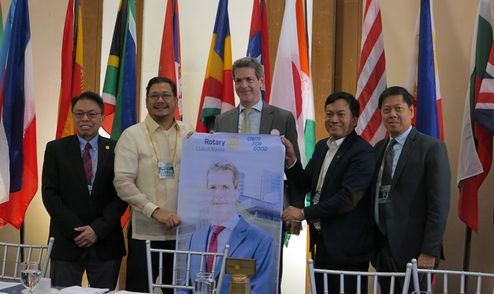
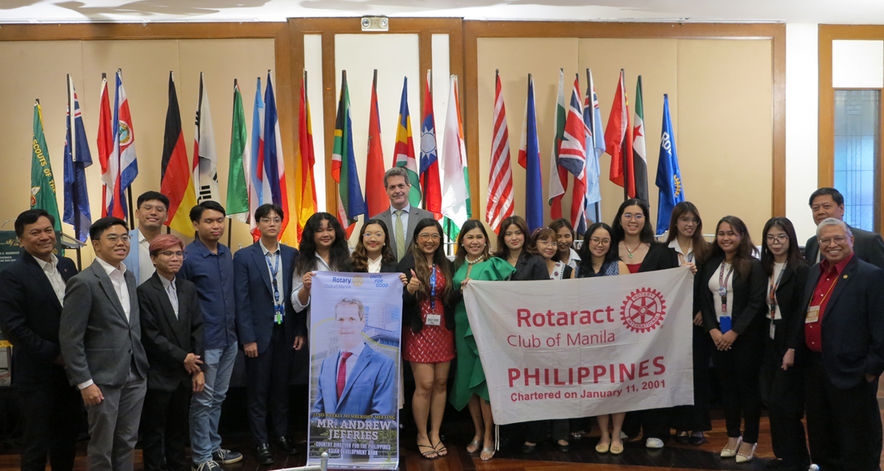
Past Vice-President Joel C. Valdes introduced the Guest of Honor and Speaker, Mr. Andrew Jeffries, Country Director for the Philippines of the Asian Development Bank. The title of his address — “Asian Development Bank: Overview – Key Priorities and Initiatives” — belied the sweep and immediacy of the issues he would cover.

A Bank Founded in Manila, Shaping a Region
Mr. Jeffries began with perspective. The Asian Development Bank (ADB), founded in 1966, now counts 69 member countries, 50 of them within the Asia-Pacific region, and 41 borrowing members. Headquartered in Manila, ADB has grown into one of the world’s preeminent multilateral development institutions.

He described its core business in three succinct words: Finance. Knowledge. Partnerships.
• Finance, through sovereign and non-sovereign lending.

• Knowledge, drawn from crosscountry experience and practical lessons.
• Partnerships, which mobilize additional capital and expertise far beyond ADB’s own balance sheet.

In 2024 alone, ADB committed $24.3 billion in loans, grants, and investments, and mobilized an additional $14.9 billion in cofinancing. These are not abstract figures; they are arteries of development, carrying opportunity into economies that need long-term, patient capital. The Philippines, as a founding member and host country, occupies a special place. It holds 2.377% of ADB’s shares and remains one of its largest clients. In fact, the country is ADB’s second-largest portfolio in the Asia-Pacific region — second only to India — with an active portfolio of $12.5 billion as of December 2025.
Mr. Jeffries structured his remarks around ADB’s partnership strategy with the Philippines—aligned with the Philippine Development Plan and anchored on three pillars:

• Intensifying Social and Human Capital Development
• Boosting Economic Competitiveness and Quality Infrastructure

• Nature-Based Development and Disaster Resilience
Pillar I: Investing in Human Capital

Here, ADB supports the Pantawid Pamilyang Pilipino Program (4Ps), the Walang Gutom (Zero Hunger) initiative, universal health care, and JobStart Philippines.
Mr. Jeffries underscored that poverty reduction and productivity enhancement are inseparable. Social protection is not charity — it is economic strategy. When vulnerable households receive electronic food vouchers or access to healthcare, they do not merely survive; they stabilize communities and sustain domestic demand.

Pillar II: Transformative Infrastructure
The second pillar drew audible interest from the room. ADB is financing portions of the North–South Commuter Railway, the largest ADB project in the AsiaPacific region at $7 billion. The project will link Clark to Calamba, reshaping mobility across Luzon.

He also highlighted the Davao Public Transport Modernization, the first citywide modernization program of its kind in the Philippines, and the ambitious Bataan–Cavite Interlink Bridge, envisioned as one of the world’s longest bridges of its type.
Infrastructure, he reminded the audience, is not merely concrete and steel. It is connectivity—economic, geographic, and social. In an archipelagic nation, it determines whether farmers reach markets, whether labor reaches opportunity, and whether regions prosper together.

Pillar III: Climate and Disaster Resilience
The Philippines, battered by over 20 typhoons annually, stands at the frontlines of climate risk. ADB’s programs include flood resilience and adaptation projects, climate change action programs, marine ecosystem initiatives, and renewable energy ventures such as rooftop solar and electric mobility ecosystems.
Under Strategy 2030, ADB aims for climate finance to reach half of its total committed financing by 2030, with cumulative climate financing exceeding $100 billion. The message was unmistakable: climate action is no longer peripheral — it is central to development.
ASEAN 2026: The Philippines at the Helm

With the Philippines chairing ASEAN in 2026, Mr. Jeffries detailed ADB’s integrated support package to help deliver key policy outcomes and flagship events across finance, green economy, energy connectivity, tourism, social protection, digital transformation, and cross-cutting regional resilience.
Regional cooperation, he emphasized, is embedded in ADB’s charter. It is not optional. It is foundational.

The Economic Outlook: Fundamentals and Fragility
Turning to the macroeconomic outlook, Mr. Jeffries spoke candidlyabout the Philippines’ recent growth performance and expectations of a rebound. Domestic consumption — about 70% of GDP — remains a stabilizing force, bolstered by remittances. Yet infrastructure investment momentum and global trade fragmentation remain variables to watch.

The fundamentals, he assured the audience, are sound: affirmed credit ratings, a liquid banking sector, easing inflation, and policy space for interest rate adjustments. But growth, he cautioned, is not automatic. It requires execution — particularly in infrastructure and MSME support.
On that note, he offered a compelling example: an upcoming supply-chain finance facility designed to channel affordable working capital to micro, small, and medium enterprises by sharing credit risk with local banks. In a country where MSMEs comprise 99% of enterprises yet receive less than 10% of formal financing, such mechanisms could be transformative.

A Dialogue of Institutions
The Open Forum that followed was animated. Rotarians posed questions on infrastructure decongestion, the future of NAIA modernization, the role of private capital, and the geopolitical implications of regional fragmentation. Mr. Jeffries responded with clarity and candor, weaving data with institutional insight.

Mr. Jeffries engaged in a Q&A session with PP Archit Bartolome, Treas. PJ Garcia, Sec. Anton Mauricio, PDG Alex Cureg, and PDG Obet Pagdanganan.
At the conclusion, Director Edwin Hernandez presented Mr. Jeffries with a Certificate of Appreciation — a symbol not merely of gratitude, but of alignment. Rotary’s commitment to “Service Above Self” found resonance in ADB’s mandate to foster inclusive, resilient growth.

At 2:00 PM, Director Hernandez adjourned the meeting.
The Larger Meaning

The 22nd Weekly Membership Meeting was not simply another date on the Club calendar. It was a reminder that the Rotary Club of Manila, founded in 1919, continues to convene voices that shape the destiny of nations. In welcoming the Country Director of the Asian Development Bank, the Club affirmed its place at the intersection of civic leadership and economic transformation.
Bridges were discussed — literal and metaphorical. Railways, bridges, and flood barriers. But also bridges between institutions, between public and private sectors, between local needs and regional vision.

In a hall filled with Rotarians — men and women committed to ethical leadership—the message was clear: development is collective work. And in Manila, where ADB was born and Rotary took root over a century ago, the partnership between service and strategy continues to build futures worthy of the next generation.
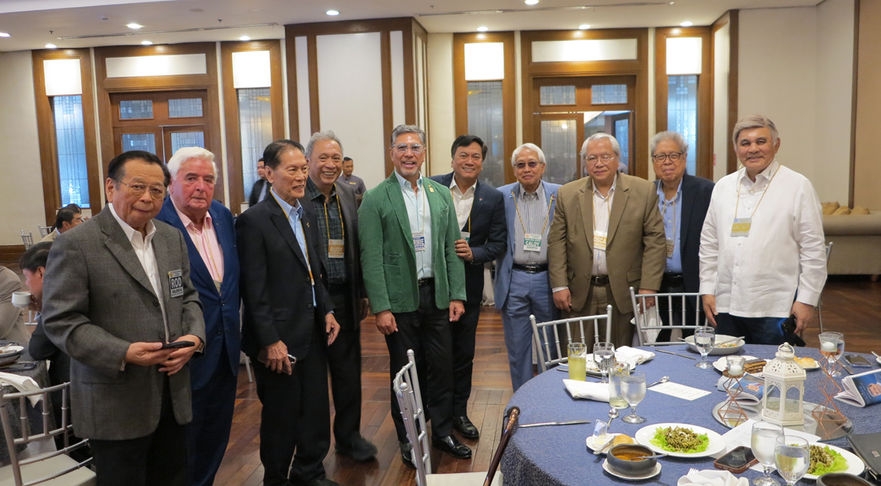
Meeting Fellowship






 Editorial
 President’s Message