

The TOWER Awards: In Praise of the Nation’s Quiet Builders
From the humble beginnings of recognizing ten outstanding Filipino workers in 1976, the TOWER Awards has grown into one of the country’s most enduring tributes to labor excellence—continuing its mission decades later by honoring workers whose innovation, dedication, and craftsmanship uplift Philippine industry and nation-building.
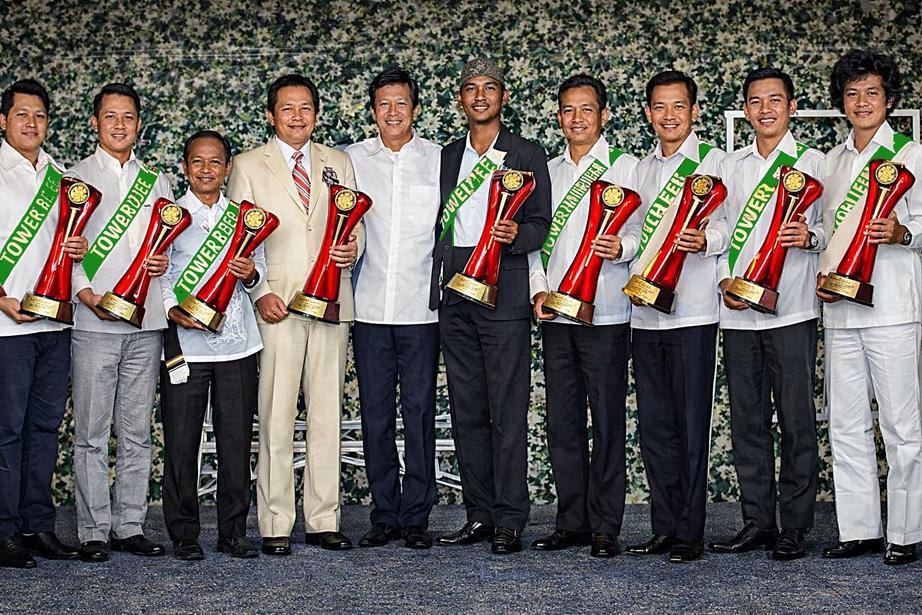
THERE are stories that shape a nation, and there are stories that sustain it. The latter are seldom told.
They unfold not in the glare of public attention, but in factory floors and shipyards, in workshops thick with the scent of metal and wood, in fields under the unforgiving sun, in control rooms where precision is the difference between order and failure. These are the stories of workers whose names rarely make headlines, yet whose labor quietly anchors the life of a country.

It is to these men and women that the TOWER Awards — The Outstanding Workers of the Republic — has, for over half a century, paid its enduring tribute. Conceived in 1975 by the Rotary Club of Manila, in partnership with the government’s labor institutions and organized labor, the Awards were born in a time when the dignity of work demanded not only recognition, but restoration. Under the stewardship of visionary leaders of that era, the initiative sought to affirm a simple but profound truth: that excellence is not defined by rank, but by the discipline, integrity, and mastery with which one performs even the most modest of tasks.
From its earliest staging, the TOWER Awards was never intended to be a mere ceremonial exercise. It was a statement. A deliberate act of elevating the worker — of placing the machinist, the welder, the farmer, the technician — on a platform where their contributions could be seen, acknowledged, and celebrated. It quickly became one of the defining highlights of the nation’s Labor Day observance. National leaders themselves bore witness to these ceremonies, underscoring a powerful convergence between civic recognition and public policy. Around this time, landmark efforts were undertaken to strengthen employer-employee relations, emphasizing harmony, mutual respect, and shared responsibility in the workplace.

Yet beyond these milestones, the true measure of the TOWER Awards lay not in the prominence of its ceremonies, but in the quiet transformation it inspired.
For the awardees, recognition often came not with fanfare, but with something far more enduring: dignity. A machinist who had spent years perfecting his craft would find his work validated. A seamstress, whose hands had long labored in anonymity, would see her skill honored before a national audience. A miner, a fisherman, a lineman — each would be lifted, if only for a moment, into the light. And in that moment, something shifted. The Awards elevated not only individuals, but the very perception of labor itself — within companies, within communities, and within families. It affirmed that the work of one’s hands, when done with excellence, carries with it a nobility equal to any profession.

As the Philippine economy evolved, so too did the TOWER Awards. What began as a recognition of blue-collar excellence gradually expanded to include non-supervisory white-collar workers, acknowledging the rise of new industries and the changing nature of work. From manufacturing floors to digital platforms, from traditional trades to emerging sectors, the Awards adapted, reflecting the dynamic character of the Filipino workforce.
There were years when the program fell silent, its cadence interrupted by shifting priorities and changing times. Yet each revival carried with it renewed purpose. The call was always the same: to restore focus on productivity, to celebrate innovation at every level, and to remind the nation that progress is built not only on vision, but on execution.

By the time the Rotary Club of Manila reached its centennial milestone, the TOWER Awards had become more than a program. It had become a legacy. A defining expression of the Club’s commitment to service — not in abstraction, but in the lived realities of the Filipino worker. The Centennial Edition of the Awards was staged with deliberate intent, supported by key institutional partners. It was not merely a celebration of history, but a reaffirmation of purpose: that even in an age of globalization and technological disruption, the human element of work — the skill, the discipline, the quiet perseverance — remains at the heart of economic progress.
In the years that followed, the world would face one of its greatest disruptions. The global pandemic reshaped industries, displaced livelihoods, and tested the limits of resilience. And yet, when the TOWER Awards resumed after a brief hiatus, its relevance had never been more evident. For it was during this period that the true heroes of the workplace emerged — not in titles, but in action. Workers who adapted to new realities, who continued to show up despite uncertainty, who found ways to sustain operations, protect communities, and keep the machinery of society moving. They were no longer invisible. They were essential.

To date, hundreds of individuals have been recognized through the TOWER Awards. Each name represents not just a profession, but a story — a life defined by diligence, by quiet innovation, by an unwavering commitment to doing one’s work well. And yet, the Awards themselves do not claim to complete the story. They simply illuminate it.
For in every corner of the nation, there remain countless others — unnamed, unheralded — whose labor continues to shape the country in ways both seen and unseen. The TOWER Awards stands for them as well.

Not merely as recognition, but as reminder. That in the end, the strength of a nation rests not only on those who lead, but on those who build.
Faces of Excellence: The Men and Women Behind the TOWER Awards
What distinguishes the TOWER Awards is not merely the diversity of professions it recognizes — but the consistency of values it upholds. Across five decades, whether machinist or engineer, farmer or technician, a pattern emerges:
Work done with precision
Responsibility carried without complaint
Excellence pursued without expectation of recognition
And yet, recognition came. Not to elevate one above others, but to remind all that dignity resides in the work itself.
From the shoemaker in Leyte in 1975 to the systems specialist of today’s digital economy, the TOWER Awards has quietly built a living archive of Filipino excellence — one worker, one story, one legacy at a time.
 TOWER Awards: RCM’s Signature Celebration of Work, Honor, and Nationhood
 TOWER Awards 2026 Messages