

Cold Beer Across the Centuries
A look at the long history of beer, from ancient Sumer to Filipino drinking traditions and the story of San Miguel.
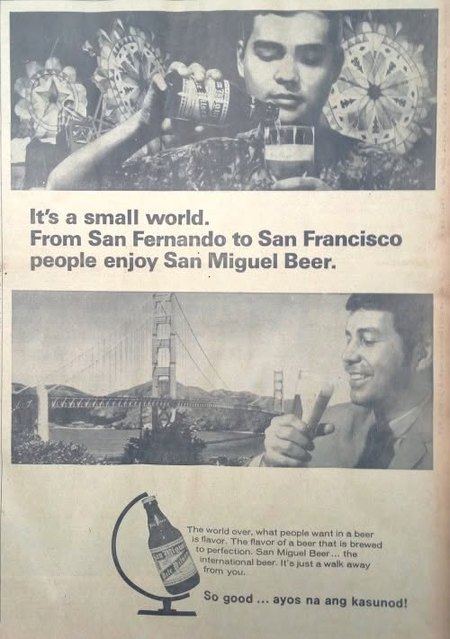
There is an old saying, usually pinned on Benjamin Franklin and almost certainly not his, that beer is proof God loves us and wants us to be happy. A Filipino would probably add an amendment: "and wants us to share it, preferably with pulutan." Having spent almost three decades in diplomacy, I can say with confidence that few instruments of goodwill have worked as reliably as a shared round of beer. More so if enjoyed after a round of golf.
Beer has been around for quite some time now. Fermented grain drinks turn up in archaeological finds in China, dating as far back as circa 7000 BCE.
The Sumerians, around 1800 BCE, left us a hymn to Ninkasi, goddess of beer, which doubled as a recipe. It may be the world's first cookbook entry, set to music. The Egyptians went a step further and rationed beer to the workers who built their monuments. That was arguably history's first labor contract with benefits.
Medieval monks refined the craft, and in 1516 Bavaria's rulers decreed that beer should contain only water, barley, and hops. Yeast was not understood until Pasteur's time, so those lawmakers never knew that the one ingredient they left off the list was doing most of the work. It is a reminder that in both diplomacy and brewing, the unseen party often does the heavy lifting.
In the Philippines, we have had our own tradition of creating libations, albeit of the stronger kind than beer. Long before the first beer brewery was established, communities fermented palm sap into tuba, coconut sap into lambanog, sugarcane juice into basi, and rice into tapuey. What is distinctively Filipino is how we drink. The inuman is a social occasion, traditionally with the glass passed around the circle a la tagay-tagay. Of course, concerns for hygiene and personal sensibilities have relegated this tradition to disuse; what remains constant is that stories get better and taller with each round and the pulutan keep coming such that inuman becomes indistinguishable from kainan.
Alejandro Roces once wrote that a Filipino drinks only on three occasions: when he is happy, when he is sad, and when he is neither. National Artist Nick Joaquin, perhaps the finest Filipino writer in English, was as famous for his devotion to beer as for his prose. He was said to take one in the morning while writing, another in the afternoon at the Free Press office, and then much more when he heads out for the evening. Fellow drinkers recall that he drank it chilled and was amused by those who put ice in it. It seems that good writing, like good beer, benefits from patience and the right temperature. I have yet to imbibe with the great Tony Lopez, Amado Valdez, Vee David, and other RCMers who love putting ink on paper or characters on word processing apps. I'm sure they would have a lot of stories to tell and I'd love to see how those stories get more embellished as the drinks continue to flow.
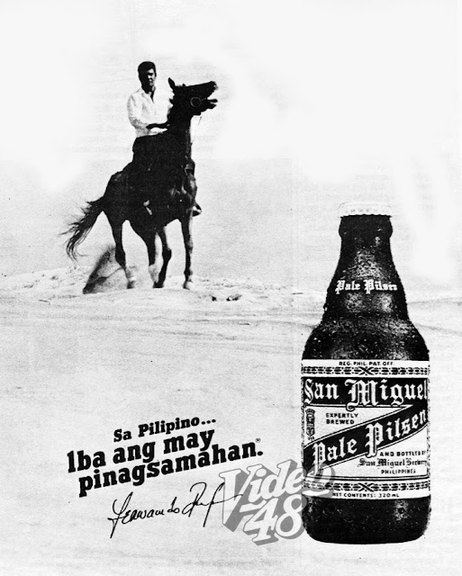
Speaking of stories and beer, my favorite San Miguel Beer story is supposed to have happened at the end of the Second World War. When war broke out, the Japanese military seized San Miguel to brew beer for its own forces. It also commandeered the Japanese-owned Balintawak Beer Brewery in Polo, and the two breweries operated at a high capacity despite the difficulty of sourcing raw materials. When the Philippines was liberated, Don Andrés Soriano reclaimed the company. Balintawak's leftover stock was sitting there, and he could have rebottled it under the San Miguel label. He chose instead to give all of it to American and Filipino troops, who finished it off in two short weeks of revelry. The Balintawak brewery itself was later absorbed into San Miguel and became the Polo Brewery.
La Fábrica de Cerveza San Miguel opened on September 29, 1890, the feast of Michaelmas, under a royal grant from Spain. It was Southeast Asia's first brewery, founded by Don Enrique María Barretto de Ycaza near Malacañang Palace and named for the Manila district where he lived and worked. Oktoberfest enthusiasts will be pleased to learn that a German brewmaster, Ludwig Kiene, joined the early team, so there is a little Bavaria in the origin of the Filipino pint.
After six years, the young brewery was outselling imported brands five to one, and by the outbreak of World War I it was exporting to Hong Kong, Shanghai and Guam. In 1937 it invested in a brewery in Kansas City, making it the first Asian beer brewed in the United States. It then opened a brewery in Hong Kong in 1948 and one in Lérida, Spain, in 1957. Spaniards sipping San Miguel today are drinking a brand that, in a delightful reversal of colonial history, sailed back to Europe from Manila.
I write this as the Rotary Club of Manila, in keeping with a longstanding tradition, foregoes its usual weekly meeting format in favor of the Oktoberfest celebration organized by German Club Manila, Inc. It is interesting to note that Oktoberfest began as a royal wedding reception. On October 12, 1810, Munich celebrated the marriage of Crown Prince Ludwig and Princess Therese with a horse race on the fields outside the city, which are still called the Theresienwiese, or "Wiesn" to locals. The party was so successful that Munich decided to repeat it the following year, and nobody has had the heart to stop since. It is a wedding reception that has not ended. Can't say the same for many marriages!
Today the festival draws millions of visitors, who consume beer by the liter, served in the famous one-liter Maßkrugen. In a very German act of problem-solving, the organizers moved the "October" festival into late September for better weather. This year's festival has only just wrapped up, which means somewhere in Munich a great many people are still recovering.
To those of us in Manila who are being true to the festival's name and zeitgeist. We wish you a memorable fellowship and extend you felicitations that are as warm as your beer is cold. May tonight's fellowship prove that a friendship between peoples is best sustained the way all good friendships are, over a table laden with good food and with a cold glass of drink in hand.
 Understanding the West Philippine Sea
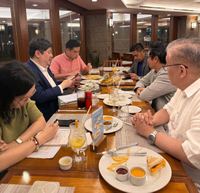 PE/Dir. Teddy Kalaw Convenes Board of Directors for RY 2027-2028
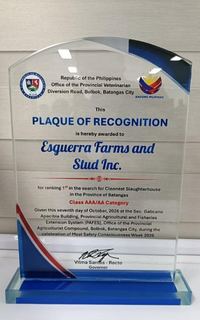 DGN Herminio Esguerra's Esguerra Farms and Stud Inc. Ranks First for Cleanest Slaughterhouse in Batangas