

Snippets from 1,100 Miles Away
The Rotary Club of Manila's editor-in-chief writes from Phnom Penh about ASEAN unity, Philippine-Cambodian ties, and his new role as the Philippines' ambassador to Cambodia.
I write to you, dear brothers in Rotary, from Cambodia's capital city, Phnom Penh, which is roughly 1,100 miles from Manila. While that may be a considerable distance, both cities are in the same geographic region, Southeast Asia, which now embraces eleven countries into an economic, socio-cultural, and politico-security community. There is so much more that unites the Philippines and Cambodia than what divides us, and these connections are at once bilateral and regional, with both being members of the Association of Southeast Asian Nations (ASEAN).
* * * * *
Speaking of ASEAN, this month is the first anniversary of Timor-Leste's acceptance as a full member, completing the vision of Southeast Asia as one family of more than 680 million people, of eleven countries choosing cooperation over rivalry. At its core, ASEAN is built on unity in diversity, its members differing in size, political system, faith, language and stage of development. And yet this disparate group committed to resolving differences through dialogue, consensus and mutual respect. This approach underpins ASEAN centrality, the idea that the region should shape its own future and serve as a trusted convener where major powers can engage with one another on peaceful terms. The ASEAN Community Vision 2045 gives this ambition a long-term direction. It calls for a community that is politically cohesive, economically integrated, socially inclusive and resilient in the face of fast-changing global challenges.
* * * * *
Meanwhile, the Treaty of Amity and Cooperation (TAC) provides the legal framework for countries outside the region to commit to mutual respect for sovereignty and territorial integrity, non-interference in each other's internal affairs, the peaceful settlement of disputes, and renunciation of the threat or use of force in the region. Established in 1976 and amended in 1987, 1998 and 2010, the TAC embodies the principles of peaceful coexistence and friendly cooperation, and is legally binding on its parties both within the region and beyond. On 24 July 2026, Lithuania, Poland, Romania and Sweden signed their instruments of accession in Manila, bringing the number of High Contracting Parties to 62, in the treaty's 50th anniversary year.
* * * * *
The Philippines, a founding member of ASEAN in 1967, has long seen the association as a cornerstone of its foreign policy, and it brings that commitment to its 2026 chairship under the theme "Navigating Our Future, Together," with three priorities: Peace and Security Anchors, Prosperity Corridors, and People Empowerment. Beyond those three pillars, Manila also promised a stronger push on the responsible and ethical use of artificial intelligence and on maritime cooperation anchored in international law and ASEAN centrality. Its most ambitious security goal was to conclude the long-stalled Code of Conduct (COC) on the South China Sea this year.
With a few more weeks to go for the Philippines as ASEAN Chair, the institutional and economic agenda is largely on track, while the ambitious security goals remain unresolved, with the COC and the Myanmar issues still evolving as this is written. Meanwhile, the dispute over the land and sea borders between Thailand and Cambodia continues to play out, with international law of the sea mechanisms proving more effective than the bilateral arrangements for the border on land. The November summit will be the final criterion for how the year is to be judged for both ASEAN as a community and the Philippines as Chair.
* * * * *
Bilaterally, the Philippines and Cambodia have stepped up economic linkages these past several weeks. Cambodia started exporting greater quantities of rice to the Philippines, with the Cambodia Rice Federation (CRF) saying that total export for 2026 could reach 209,446 tonnes, roughly 60 times the 2025 numbers.
Meanwhile, Philippine energy company Citadel Pacific Ltd. acquired the Caltex fuels business from Chevron and will now supply over 100 service stations in the Kingdom through its subsidiary Isla Energy.
On the education frontier, the Overseas Cambodian Investment Corporation (OCIC) and World Citi Colleges International, Inc. (WCCI) signed an agreement to establish WCC International Aero Tech University (WCC IATU) in Phnom Penh. The university will expand access to specialized aviation education in Cambodia, offering courses such as Bachelor of Science in Aircraft Maintenance Engineering, Bachelor of Science in Airline Operations Management, and Bachelor of Science in Tourism Management.
There is still so much possibility on the horizon despite lowered economic growth forecasts for both countries and the looming effects of the super El Niño. There is a wide nexus where economic interests could align, and it would be powered by private businesses who find complementarity with one another's business models. As the Latin maxims would say: Audentes fortuna iuvat; Qui audet adipiscitur.
* * * * *
I hope you will forgive me for sounding so bullish about Philippine-Cambodian business opportunities. I presented my credentials to His Majesty King Norodom Sihamoni yesterday, allowing me to officially discharge my duties as our republic's ambassador to this kingdom. RCMers can now use me as a resource in case they plan to enter or expand into the Cambodian market or, on the reverse, bring Cambodian brands into the Philippine market. I will be very happy to discharge my economic diplomacy duties to your benefit and I hope to welcome those who will venture out here to our newly renovated chancery.
* * * * *
I have to thank our publisher, Pres. Reginald T. Yu, the Board, and Club Secretary Albert Alday for including me among the Club awardees for the First Quarter. It means a lot considering that I am an absentee editor-in-chief. I share this award therefore to the editorial board and most especially to the technical working group composed of Rhea, Anna, Lhea, Mareth, Jonathan and anyone else in the group that I may have missed. Thank you for keeping Balita running despite my limitations.
I wish you all an engaging meeting and discussion with our guest speaker, and I hope you all get your lunch on time!
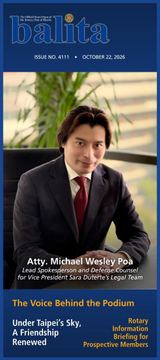
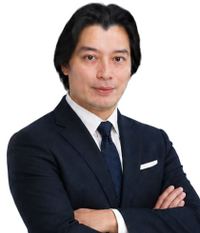 The Voice Behind the Podium
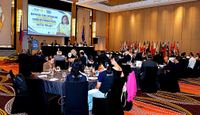 The Voice Behind the Podium
 Rotary Information Briefing for Prospective Members
