
STAR Rtn. Luis Angelo “L.A.” L. Sevilla Engineered His Way to Success
In an interview, STAR Rtn. L.A. Sevilla, President of F.R. Sevilla Industrial and Development Corporation and a two-time World Debate Champion, talks about engineering, debate, teaching and Rotary.
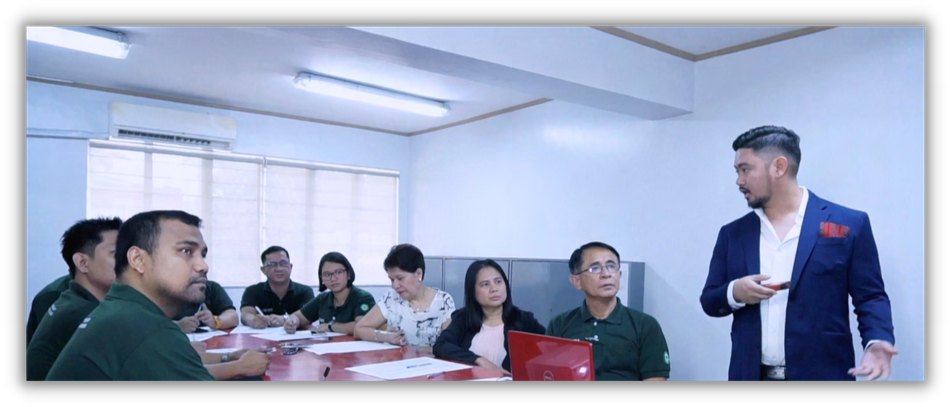
It is very easy to think that children born into a successful family business are off to a relatively effortless start, with a great opportunity to carry on and just grow the family’s business legacy, without having to worry about starting from scratch. This was not the case for STAR Rtn. L.A. Sevilla. He witnessed the humble beginnings of their family business. After passing the mechanical engineering licensure examinations, he rolled up his sleeves, stepped up and climbed up the rungs of the family business ladder. He now works as President at F.R. Sevilla Industrial and Development Corporation. Read on to find out how he engineered his way to the top, and how he embraced teaching others.
A two-time World Debate Champion (first in ASPAC Yamagata, Japan in 2014 and then in Kaoshiung, Taiwan 2016), STAR Rtn. L.A. also shares in this interview the various topics he had debated throughout his debate career, and the most memorable one. Get to know more about engineer-debater-teacher STAR Rtn. L.A. Sevilla.

Rhea Vitto Tabora (RVT): Why did you select mechanical engineering as your major?
Luis Angelo “L.A.” Sevilla (LAS): Growing up, I was fond of discovering how things work. I was fascinated by science, dinosaurs, outer space, and technology in general. I remember feeling a sense of achievement at the age of eight, when I was able to fix our television by tinkering with the components at the back. It helped a lot in my decision making that our family business specializes in electro-mechanical works. I’ve been exposed to the construction industry early, visiting our fabrication plant as early as 10 years old, and inspecting project sites during high school. Taking up Mechanical Engineering was a calling and also a responsibility to continue what my dad had built.

RVT: What was the path you took to get to where you are today?
LAS: People can easily assume that children born in a successful family business grew up with a silver spoon in their mouth. For me, I was fortunate enough to experience the humble beginnings of our company. We were living in an apartment and I remember my mom had to help out in the finances of the family by selling encyclopedias, clothes, and whatever opportunity there may be. I also witnessed our small office space in Roosevelt which we were just renting. After passing the licensure exams for Mechanical Engineering, I worked in our fabrication plant as a Quality Assurance/Quality Control Engineer (QAQC) which helped me familiarize myself with the products and processes of FR Sevilla. The first project assigned to me was the Marco Polo Hotel in Ortigas. I was able to witness the hotel being built from the ground up and it made me appreciate the engineering field even more. To understand the basis of the plans we execute, I had to work in a Mechanical Engineering Consultancy firm. I worked there for over a year then went back to our company and became a Project Director. This experience allowed me to travel and inspect our projects in Cebu, Bacolod, Iloilo, CDO, and Davao.

In 2013, I joined JCI Manila and became a really active member so much so that I served on its Board in 2015, 2016, and as President in 2019. The accolades gathered were invaluable compared to the lessons I learned and the friendships formed in all those years.
During the latter part of 2017, my dad asked me if I was still busy. To my surprise, I did not expect it to be a proposal to appoint me as President of the company the following year. I had to reverse engineer my way to learning the other aspects of the business and found myself establishing several innovations in the company—the F.R. Sevilla Training Center and the Research and Development Department. The aim of the former is to equip our workers with the necessary skills to become skilled workers. This solved the difficulty of hiring skilled workers as they tend to look for greener pastures outside the Philippines. The latter creates a culture of innovation within the company. Since its inception in 2018, the R&D has produced several tools that led to more efficient work methodologies.

RVT: What was your most successful engineering project?
LAS: Solaire in 2011. It was the first billion-peso project we undertook. In terms of manpower, we had about a thousand men onboard during the peak of the project. The HVAC system of this building is very complex as it introduced the DOAS (Dedicated Outdoor Air System) in its air-conditioning system. The size of one equipment is as big as a two-storey house. People are allowed to smoke inside the casino area since the air-conditioning system has ionizers and air purifiers embedded.

RVT: What are you passionate about?
LAS: I realized I had a passion in teaching when we began training high school kids in debate when I was in college. I came to a realization when I noticed that we’ve spent hours training them without getting anything in return, but we still do it anyway. Another exemplification of this value was when I taught my dormmates several engineering subjects when we were reviewing for our board exams. I always say that I learn twice as much when teaching, and that was my secret why I passed the board exams. Both experiences made me realize also that I genuinely wanted to see others succeed, and I wanted to become part of that success.

RVT: What in your life do you feel most grateful about?
LAS: I am grateful for a lot of things, really. We are living in unprecedented times, and being able to breathe properly is a blessing in itself. But to be more specific, let me enumerate some of the things that I’m thankful for.

Becoming a dad. It’s a huge blessing that God entrusted us with a life that we will raise in a Godly manner. I’m thankful that we’ve kept our business afloat and even becoming a blessing to the suppliers and subcontractors who were affected by the pandemic. I am most grateful to the support of my parents who allowed me to do the things I want to do and for believing in my capabilities.
RVT: What do you usually do when you are not working?

LAS: When I’m not working, you’ll see me at home playing with my kids. When they’re asleep, I would normally play video games or binge watch with my wife. With all the hustle and bustle of the construction scene, staying at home is what I look forward to. Before the pandemic hit, I play a lot of golf and basketball and I travel a lot, too.
RVT: What was the most interesting debate topic you have answered and how did you handle it?

LAS: I consider debating as a sport of the mind. The time spent on training, reading, and competing creates the same adrenaline rush as any athlete would feel in a competition. There are so many topics that I’ve debated on throughout my debate career, from socio-legal, sports, environment, equality, technology, economics, pop-culture, and so on and so forth. Anything under the sun, basically. My favorite of which are topics that weigh the rights of minorities over the larger populace. In life, we are sometimes clouded by our own biases that we see the world as black and white. I learned in debate that issues should be argued in extents and degrees.
One memorable debate topic is about a mandatory death penalty for drug traffickers. We were on the affirmative side and argued to not look at drug trafficking in isolation or its impact as a single drug offense. Ultimately, the punishment should be harsh enough to deter the crime because it cripples societies, damages families, fuels crime, and disrupts trust and security. We argued that certain rights become meaningless, like the right to property in ghetto areas where addicts regularly break into homes, or the right to freedom of movement becomes meaningless when you’re too scared to use public transport or go out in the city at night.
RVT: How did joining the Rotary Club of Manila open a new chapter in your life?
LAS: I would like to think of Rotary Club of Manila as the extension to the Jaycees particularly JCI Manilla. Both organizations are the first in Asia, and one of the founders of JCI Manila came from RCM. I observed that the traditions and protocols are very much similar. This is the reason why joining RCM felt right and I felt right at home. So, for me, it’s not really about opening a new chapter in my life but continuing what I’ve been doing for the past eight years, which is to serve.

RVT: What is that one thing you like to do in a day that makes you happy?
LAS: I enjoy watching my kids grow more than anything. Seeing them smile and learn new things. Aside from that, drinking a good cup of coffee, being able to break a sweat, and solving a problem at work.

RVT: What’s the most important thing that people should know about you?
LAS: I’m a student of life. I’m always excited to learn new things and experience new things. I would rather spend on memorable experiences than material things. Some of the key lessons I’ve learned thus far are:
valuing a gentleman’s agreement
the value of delayed gratification. You value something more when you work hard for it.
omoiyari (Japanese term for putting yourself in other people’s shoes)
humility. God opposes the proud but gives grace to the humble (James 4:6)
God’s timing is always perfect.
I learned a lot of things during my time in the Jaycees as well. But one important lesson I learned is that Service to Humanity is the best work of life!

 The Week That Was