

His Father’s Son
Straight from the Horse’s Mouth: a profile of Senator Ferdinand “Bongbong” Marcos Jr. and his political comeback, based on his talk at the Anvil Business Club forum.
Philippine politics has a paradoxical way of being modest with its gifts and blunt with its reckonings. Good news comes like a breeze you feel but don't notice; it is the source of wonderful promises and the cause of big disappointments. It is not simply the purveyor of hope but likewise the cause of despair. It is the jumping board of gross graft and corrupt practices instead of a response to the call of what is right, proper, and just.
Scholars can endlessly debate whether the Marcos Years were the most muscular expression of national interest in the last half-century or have been the country's darkest period that left a torn nation still struggling for economic and political recovery. Whichever side of the political divide one may espouse, the incontrovertible truth lies in the fact that the Marcos legacy, woven deep into Filipino society, has had an indelible imprint into Filipino society that will likely last generations.
The most telling manifestation of Marcos’ specter lies in the persona of his progeny, the controversial FERDINAND “BONGBONG” MARCOS JR. When the elder Marcos was still in power, few believed that his son would amount to anything much without his father and namesake. Yet, almost 30 years on, Bongbong Marcos is now a senator, and he has made the biggest – albeit unsuccessful – step in what has been a remarkable political comeback by running for Vice-President in the 2016 national elections. Recently, he has announced his bid to secure the coveted presidential slot in 2022. Throughout these past few years, has done it without his father, who died in 1989, by his side.
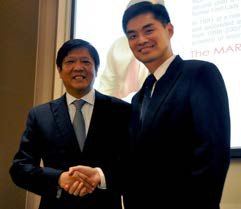
I was formally introduced to Senator Bongbong during a speaking engagement at a jam-packed crowd during the Anvil Business Club’s penultimate forum way back in 2015, when I served as Club President. Senator Marcos laid out his wish for the country in a sweeping tone reminiscent of his father’s self-assured bluster. “In simple terms, my vision of our country is one that can overcome its economic and social challenges by drawing on our own strengths and drawing on our unity,” he began. “It is a vision of the Philippines that is prosperous, rich in opportunity, home to happy, morally upright, and productive citizens whose lives are meaningful because theirs is a just society, because theirs is a nation that has become great again.”
Working towards making this dream a fruition, however, would not be easy, he added. “It is... a task so daunting,” he opined, “that it has continually remained a puzzling mystery and has challenged even the great leaders of our history… 26% of the Filipino people are poor, while 11% of Filipinos live in extreme poverty. And further compounding our problem is the grave inequality that pervades in our society now.” With an unemployment rate of 6.6% – a figure that translates to 3 million able-bodied Filipinos who are without jobs – and a 17% underemployment figure, Senator Marcos concluded that the perceived lack of sufficient local opportunities “precisely and singularly explains the phenomenon of why more than 5,000 Filipinos leave the country EVERY SINGLE DAY to become OFWs.”
Turning to the members of the Anvil Business Club, the Vice-Presidential aspirant admonished the young entrepreneurs and professionals to “take the lead in nation-building, from boosting the economy, via genuine poverty alleviation, to attaining a just and equitable society – all in conscious pursuit of what is called an ‘inclusive growth’ of our economy.” He enumerated a few key important mechanisms within the framework of business that entrepreneurs can help in achieving these goals: tax payments, delivery of basic services to the people, job creation and maintenance. In this regard, he encouraged businessmen to:
1. Contribute their fair and accurate share in the revenue collection of government;
2. Continue generating local employment opportunities for Filipinos, while upholding the value and dignity of the Filipino human capital, as an indispensable component of any commercial endeavor; and,
3. Provide basic services that are safe, high-quality and affordable, and that ultimately improve the lives and the conditions of living of the people, particularly betting on the country’s agricultural potential, as part of their innovative and diverse entrepreneurial vision.
Eloquent, accommodating, and almost candid to a fault, Senator Marcos readily answered questions thrown to him from the audience, ranging from the serious – such as the issues surrounding the crafting of a more constitutionally-sound alternative to the Bangsamoro Basic Law; to the mundane – such as whether or not he has a half-sister, who is now the lead bet to become the country's next president. To be sure, Senator Marcos has found a rapidly growing number of adherents to his cause; a large segment of which comes from the “millennial” age demographic – roughly those who were not yet born when their family already left for Honolulu in exile.
As his surname continues to strike a contentious chord in a nation still in dispute over its true legacy in history, it remains to be seen if his political journey – eerily similar as his father – would be successful. Nevertheless, his 31-year sterling track record in public service – first as a two-term Congressman (just a year after returning from exile in 1991), where he wrote a total of 32 house bills and co-authored 111 more; then as governor where he transformed Ilocos Norte from a sleepy, tobacco-dependent agricultural province into a bustling commercial hub, and steered the nation's biggest wind energy project; and now, as Senator, where he proved to be a prolific legislator, having authored 52 bills and co-authored 4, with one enacted into law in the 16th Congress alone – has indubitably pushed forward an image of an eminent contender and a fastidious administrator. Truth be told, every other vice-presidential candidate will be hard pressed to match his performance in terms of sheer legislative output and acumen, experience in local governance, and scope and breadth of governance platform. But, for many, credentials do not matter as much as his name, which nips at his heels wherever he goes. “My father cast a very, very big shadow, and it is inevitable that I'll be under that shadow,” he assented.
Whether or not this election will actually yield a mandate for his policies, he is sure to claim one for his style, because he stuck to it against all odds, much advice and the lessons of history. With his familiar comportment that evening, Senator Bongbong Marcos has proved to all and sundry that he is, indeed, his father’s son.

 PDG Vicente “Vince” J. Carlos
 President’s Corner
 The Week That Was