

STAR Rotarian Shigeru Shimoda: Making Waves Overseas
His early exposure outside his home country influenced STAR Rotarian Shigeru Shimoda to follow his father’s footsteps – work in the same field and make a mark abroad.

One can say STAR Rotarian Shimoda had his fair share of experiences and challenges that no ordinary Japanese got to encounter—he lived the Nigerian ‘olden days’ lifestyle when he was still a child, witnessed first-hand South Africa’s historical turning point with the release of Nelson Mandela from 27 years in prison, and faced extreme challenges managing a vast forest plantation project in Sumatra. Now serving as President and Chief Executive Officer of Marubeni Philippines Corporation, STAR Rotarian Shimoda’s passion and commitment to make a difference has driven him to achieve greater heights.
In this interview, STAR Rotarian Shimoda shares some highlights of his life and career, his success habits, and, on a lighter note, where he looks forward to going most when the pandemic is over.

Rhea Vitto Tabora (RVT): Please tell us a little about yourself.
Shigeru SHIMODA (SS): I was born in Shibuya, Tokyo, Japan on December 30, 1965. Our family lived in Lagos, Nigeria in West Africa for two years from 1976 to 1978 because of my father’s work with Mitsubishi Corporation – a large trading and investment firm in Japan and is in fact the biggest competitor of Marubeni Corporation where I am connected. Those were exciting times for me. There was no telephone line, no supply of potable water (we were boiling water to drink), and there were rolling blackouts (we were using candles). During my elementary days, there were only two students in my grade level in the Japanese school (I was self- learning), and only 7 to 13-year-old students were in the school bus – no adults – traveling along the long and bumpy road going to school. It was also where I first encountered western music (the Beatles, WINGS, ABBA, KISS and Queen) and learned tennis. Those incredible experiences formed my character and confirmed my determination to work in the same field as my father’s.

After going back to Tokyo, I studied very hard to catch up. I entered KEIO Highschool in 1981 and joined the school tennis team. In April 1984, I entered the Faculty of Economics in KEIO University. I continued playing tennis in the school’s club until graduation in March 1988. In April 1988, I joined Marubeni Corporation and was assigned to Wood Chip Department. I married my girlfriend, Mie, whom I met in Marubeni’s office and tennis team, on December 12, 1992. After a few months, I was transferred to Johannesburg Branch in the Republic of South Africa (RSA) as Manager of the Forest Products Department. Since Mr. Nelson Mandela had been released and the apartheid was dismantled, economic sanction was lifted. I was then assigned as the first secondee from Forest Products Division to RSA. I never experienced such a strong enthusiasm among the people when Mr. Mandela became the first black president. During our five years in South Africa, my wife and I had our two sons. One unforgettable experience was enjoying cheese and wine in Stellenbosch, one of the most beautiful wine regions in South Africa.
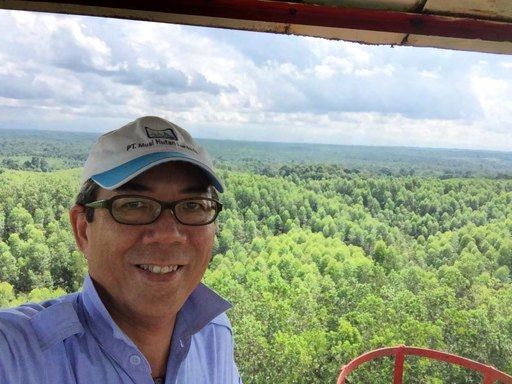
Our daughter was born in 2001 after we came back to Tokyo. In 2005, I had my second overseas assignment – in South Sumatra, Indonesia where I managed and developed industrial forest plantation as the first President Director appointed by Marubeni when we took majority share of the company PT Musi Hutan Persada. It was the biggest challenge for me – planting and growing trees in the gross concession area of 296,400 hectares; driving and checking in the large-scale area almost every day; making sure the quality and quantity of all the field works are properly done; controlling pest and disease; pursuing higher productivity and improving efficiency; and fighting with some local communities who try to encroach on our land and set forest fire. We successfully established a healthy eucalyptus plantation forest with net planted area of 120,000 hectares (1.7 times larger than the entire Singapore) under the strong teamwork of Indonesian managers and staff, Japanese young staff and quality Filipino foresters.

After three years in Sumatra, I returned to Tokyo Headquarters in 2008. My second appointment as President Director of such plantation company in 2014 was welcomed by my old friends and colleagues in Sumatra. After over four years in the forest, I was appointed as General Manager of Wood Chip and Construction Material Department in Tokyo Headquarters to manage woodchip trade, tree plantation project in Western Australia, joint venture of construction wood material and biomass fuel. I then moved to Manila in July 2020 when I was appointed President and CEO of Marubeni Philippines Corporation.
RVT: Marubeni is involved in various sectors in the Philippines. What are some of the ways your company is making a difference in the country?
SS: For Marubeni, equally critical as business aspect is how our investments would contribute to the lives of the Filipino people in general. In power, for example, our power plants ensure the stable and affordable supply of electricity in the Luzon grid and support long-term rural electrification projects. We make efforts to introduce technology that would improve water quality in the areas served by the Maynilad Water Services, Inc. where Marubeni is a stakeholder. At the same time, our recently completed LRT Line 2 East Extension project provides safe, fast and modern mode of transportation to people living in the rising urban areas of Marikina and Antipolo who can now travel to the City of Manila in 40 minutes instead of three hours by bus or jeepney. Marubeni’s foothold in healthcare, Medi Linx Laboratory, Inc., uses state-of-the-art Japanese technology to accurately and timely interpret laboratory tests. Through an affiliate company, we are introducing a digital currency platform for maritime seafarers to easily receive their salaries and send money to their families while onboard the ship. LendPinoy of AND Financing Corporation, another Marubeni affiliate, is offering fresh consumer financing products to advocate financial inclusion among the unbanked sectors of the economy. Our latest project in New Clark City will create a Smart City that is safe, efficient and environment friendly. In addition to these, Marubeni made a commitment to help transform the lives of the underprivileged sector of the society through education in the Philippines. The Marubeni Scholarship Foundation has granted over 3,000 scholarships to students in technical schools, and for two years now, is focused on delivering electronic tablets to rural public schools for the online learning of grade six pupils.
RVT: Which among the projects that you have worked on do you find to be particularly interesting?

SS: Having worked in the forest plantation for a number of years, I am a huge advocate of sustainability. The current trend of upcycling adds a very exciting concept that would impact favorably in pursuit of a 3R-oriented recycling society. Although the project is yet to materialize, I am hoping to introduce an upcycling model in the Philippines.
RVT: What do you consider to be the highlight of your life?

SS: Experiences and challenges (above mentioned) that ordinary Japanese do not experience.
RVT: What are your success habits?

SS: People are impressed by a movie, novel, comic, cartoon or story of a great person, and then imagine, “how nice if I can be like that character.” Try to do the same as what the character does. Do not think it’s only a movie, or only a novel.
RVT: What is one thing you miss most in your home country that you cannot find here in the Philippines?

SS: Four seasons. Having seasonal ingredients, changing clothes in a closet seasonally, changing of colors in town.
RVT: When this pandemic is over, where will you go and why?

SS: Nature, beaches and historical heritage sites in the Philippines. While I am in such a beautiful country, due to the pandemic, my northernmost point in the country is Baguio and the southernmost is Semirara island. Just recently, I left Luzon for the first time.
RVT: What are your interests and hobbies? What do you do when you are not at work?

SS: Chatting with my family through SNS, reading books (while imagining the things I’m reading – from the colorful settings to the lively characters and the way they speak and behave), and playing some golf (I stopped playing for 15 years and resumed only when I came to Manila).
RVT: What is something you think everyone should do at least once in their lives?

SS: To focus on a project or target with strong determination and sense of mission. Control yourself and never accept an issue easily.
RVT: What ignited your interest in joining the Rotary Club of Manila?
SS: Even in Japan, Rotary Club is well-known for its civic activities during disasters. My grandfather was one of the founders of the Rotary Club Fukushima, Japan which was established in 1951. When I arrived in Manila in July 2020, I didn’t know a lot of people. I am passionate about connecting with people, exchanging opinions and creating solutions, so I was delighted to be invited by Mr. Nick Locsin to join. Since then, I have made a lot of good interactions with the other members.

 President’s Corner
 The Week That Was