

Editor's Note
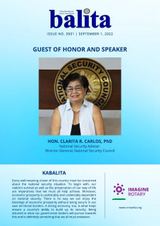
Editor-in-Chief Raoul C. Creencia examines how the concept of national security has evolved and the questions it raises for the Philippines.

The sweeping wave of globalization and liberalization, coupled with the rapidly expanding internet facility and other technological advances have all shaped our world in a way that we now find it imperative to redefine and re-examine old thoughts and concepts. One of which is how we view “national security” and its ever-evolving scope. Do we view it purely in terms of armies, war planes, and gunships, or do we also see it in non-military terms? Moreover, do we treat it as a goal or as a consequence?
National security used to be viewed purely in a politico-military sense. In fact, there are times when it is defined excessively in military terms by government leaders and policy makers. Today, the term encompasses all aspects of interactions between nations. As currently understood, it refers now not just to the security of nations and their respective territories, but also includes, among others, environmental security, ecological balance, public infrastructure security, energy security, cyber security, and human security. Our interconnected and brave new world has posed new challenges on how each state ensures their respective security goals and objectives, as well as the preservation of their unique values and way of life. This challenge is especially more daunting for developing countries like the Philippines because truly, in the absence of national security, it is meaningless to talk of development.
One thing is sure. It is not just the duty of the government, but of every citizen of each state, to ensure the security and defense of its territorial integrity and sovereignty. In fact, for 17th century philosopher Thomas Hobbes, security was an absolute value; and in exchange for providing it, the state is justified in asking its citizens for anything that would ensure such security. According to Hobbes, without security, our life “will be solitary, poor, nasty, brutish, and short” (The Leviathan [1651] Part I, Ch. XIII).
Given this philosophical standpoint, would our national leaders lean towards relying heavily on the citizenry and make a Hobbesian choice? Will the citizens of this country be asked and tasked to do more? By this, what will constitute “more”? Will these additional requirements or impositions restrict each citizen’s mobility, choices, or rights? This usually triggers a debate between liberty and security.
Also, for a developing country like the Philippines with limited economic resources, there will certainly be a debate about priorities in allocating our meager public funds. To beef up our security, do we increase our outlays for our military forces? Or do we instead earmark more funds for programs that create more jobs? Do we modernize our military, or do we increase our ability to, say, produce bulk potable drinking water for our increasing populace? Which expenditure will enhance security more?
It would therefore be interesting to hear the government leaders’ views and plans on the matter of handling, pursuing, and sustaining our country’s national security needs and requirements.
 President's Diary
 The Week That Was