
Across the Aisle: A Panel Discussion on U.S. 2024 Elections
As the U.S. elections of November 4, 2024 approach, the editorial looks at what the outcome could mean for the Philippines in trade, defense, migration and climate policy.
AS THE world turns its attention to the United States’ upcoming Presidential and Vice-Presidential elections on November 4, 2024, the implications of this historic event extend far beyond American borders. For a country like the Philippines, whose ties with the U.S. have spanned centuries, the outcome of these elections holds significant weight in shaping the future of U.S.-Philippines relations.
The United States is one of the Philippines' most important trading partners, with billions of dollars exchanged annually in goods and services. Both Democratic and Republican parties have distinct approaches to international trade. A Democratic administration may seek to preserve or even enhance the current free trade frameworks, while adding more stringent labor and environmental standards to trade agreements. In contrast, Republicans, especially under a Trump-aligned candidate, could emphasize renegotiating trade deals in favor of protecting U.S. industries, which could lead to more protectionist measures. These contrasting approaches could significantly impact sectors in the Philippines reliant on U.S. markets, such as electronics and textiles, potentially altering export dynamics. The election outcome will shape how favorable or challenging the trade environment between the two nations becomes in the coming years.
The U.S.-Philippines defense alliance, cemented through the Mutual Defense Treaty (MDT) and the Visiting Forces Agreement (VFA), remains a cornerstone of regional security. The election’s outcome could recalibrate this relationship depending on the incoming administration’s view of America's global military presence. A Democratic administration may continue to emphasize multilateralism and regional alliances, reinforcing support for joint military exercises and maritime cooperation in the South China Sea. On the other hand, a Republican presidency might adopt a more isolationist stance, reducing America’s global commitments, which could create uncertainty in the Indo-Pacific security framework, especially with increasing Chinese aggression in contested waters. How this plays out will influence both U.S. military aid to the Philippines and the broader strategic calculus in Southeast Asia.
Beyond trade and security, millions of Filipinos living in the U.S., as well as Filipino-Americans, stand to be directly affected by the election results. Policies on immigration, taxation, and employment have long shaped the lives of Overseas Filipino Workers (OFWs) and immigrants. A Republican administration might push for stricter immigration controls and reforms that could affect both Filipino workers and professionals in the U.S. Democrats, in contrast, may focus on expanding pathways to citizenship and labor protections for immigrants. These decisions will ripple through Filipino communities both in America and at home, impacting remittances—a critical driver of the Philippine economy.
In the realm of environmental policy, a Democratic administration would likely pursue stronger climate action, potentially investing in green technologies and renewable energy sources. This could open avenues for Filipino industries engaged in sustainable practices. In contrast, a Republican administration may deprioritize climate initiatives in favor of traditional energy sectors like coal and oil, which could slow the global shift toward sustainable development. For the Philippines, one of the countries most vulnerable to climate change, this divergence in policy could have profound effects on environmental resilience and collaboration with the U.S.
The Rotary Club of Manila’s “Across the Aisle” discussion will attempt to provide a balanced platform for exploring these critical issues. By presenting perspectives from both Republicans and Democrats, the event aims to deepen the understanding of how U.S. policies, under different political leaderships, could influence the Philippines. Each speaker will address not only the broader political landscape but also specific policies and their potential effects on Americans living overseas and the U.S.-Philippines relationship.
The discussion will culminate in an interactive Q&A session, allowing participants to engage with the speakers directly and explore how the election may impact their businesses, industries, and communities. It is a rare opportunity to gain firsthand insights from key representatives and to reflect on the future of U.S.-Philippines relations, whatever the election outcome may be.
As the U.S. approaches a pivotal electoral moment, the reverberations will undoubtedly be felt across the globe, particularly in the Philippines, where U.S. policies and leadership have long influenced trade, defense, and economic conditions. Whether it is through fostering stronger alliances, reshaping trade relations, or altering defense strategies, the result of the U.S. 2024 Presidential and Vice-Presidential elections will have lasting implications for the future of U.S.-Philippines ties.
In a world marked by geopolitical shifts and economic uncertainty, it is crucial for the Philippines to remain attuned to the changes on the global stage. The Rotary Club of Manila’s upcoming panel discussion offers a timely and meaningful way to engage with these complex dynamics, empowering Filipino leaders and stakeholders with the knowledge to navigate whatever may come. As we look ahead, one thing is clear: the outcome of this U.S. election will not just be a moment in history — it will shape the trajectory of the Philippines’ future for years to come.
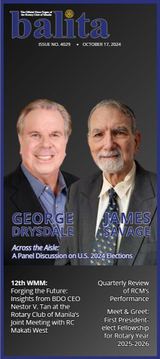
 James “Jay” Savage
 George M. Drysdale
 Forging the Future: Insights from BDO CEO Nestor V. Tan at the Rotary Club of Manila’s Joint Meeting with RC Makati West