
Editorial
Ambassador MaryKay L. Carlson’s address to the Rotary Club of Manila comes in the aftermath of the U.S. Presidential elections.
THE recently concluded United States Presidential elections have reverberated across the globe, leaving not only Americans but the international community contemplating the consequences of a deeply divided electorate. In a world still reeling from economic upheavals, geopolitical uncertainty, and the lingering effects of the global pandemic, the election results carry profound significance — none more so than in countries like the Philippines, whose historical, diplomatic, and economic ties to the United States run deep.
Amidst the shifting sands of political change in Washington, the arrival of Her Excellency Ambassador MaryKay L. Carlson as the guest-of-honor and speaker at the Rotary Club of Manila comes at a critical juncture. Her presence at the prestigious gathering served as a reaffirmation of the enduring alliance between the Philippines and the United States, a relationship forged through shared history, mutual defense, and close economic collaboration. As the torch of leadership passes from one American president to another, the Ambassador’s message highlights the importance of continuity, partnership, and the collective pursuit of peace and prosperity in the face of unprecedented global challenges.
The U.S. elections showcased the vibrancy — and volatility — of democracy in action. With fiercely debated issues such as healthcare, climate change, immigration, and foreign policy taking center stage, the American people have spoken, casting their votes not only for their domestic future but also for the role the United States will play on the world stage. For the Philippines, this electoral outcome is more than an overseas event — it signals a potential recalibration of the critical partnership that has shaped our nation’s defense, economic development, and regional diplomacy for over a century.
Her Excellency Ambassador Carlson's address to the Rotary Club of Manila could not have come at a more pivotal moment. As the official representative of the United States to the Philippines, she carries the weight of her nation’s goodwill and intent, articulating a vision of continued cooperation amidst evolving challenges. In her capable hands, the diplomatic dialogue between our two nations remains robust, alive with possibility, and grounded in the enduring values of democracy, human rights, and mutual respect.
The Rotary Club of Manila, the oldest Rotary Club in Asia, has long been a bastion of civic leadership and international discourse, providing a unique platform for meaningful conversations on matters of national and global importance. The decision to host Ambassador Carlson as the keynote speaker demonstrates the club's commitment to fostering not only local change but also global understanding.
In addressing the club, Ambassador Carlson likely emphasized that the friendship between the U.S. and the Philippines is not just a relic of the past but a living, evolving partnership poised to confront the challenges of the future. Indeed, as the Philippines continues to navigate its own path to economic recovery in the wake of the COVID-19 pandemic, the value of this alliance cannot be overstated. U.S. investments in the Philippines — whether in trade, technology, or defense — play an indispensable role in fortifying the country’s foundations for growth.
With an evolving geopolitical landscape, marked by the rise of new powers in the Indo-Pacific and growing concerns over regional security, the strength of the U.S.-Philippine defense cooperation remains vital to preserving peace and stability in the region. It is no secret that American assistance, through the Mutual Defense Treaty and other bilateral agreements, has been instrumental in enabling the Philippines to address internal security threats, from terrorism to maritime challenges. But beyond defense, the partnership extends into realms that touch the daily lives of Filipinos — education, health, trade, and governance. These are areas where U.S. influence, leadership, and support have long contributed to the country’s development.
Yet, the significance of the U.S. elections is not limited to the realm of security or economics. It reverberates in the deeper, more profound spheres of values and identity. The U.S., long regarded as the bastion of democracy, now grapples with internal divisions that echo across the globe, challenging long-held notions of stability and unity. As a developing democracy, the Philippines has much to learn from the American experience — its triumphs, but also its struggles. In this sense, the electoral process we have witnessed across the Pacific holds lessons for us all, urging us to reflect on the nature of governance, the importance of civic engagement, and the delicate balance of power and accountability.
Ambassador Carlson’s role as a diplomat goes beyond political rhetoric; she represents the human face of diplomacy, one that seeks to foster relationships, bridge divides, and ensure that the ties between nations remain unbroken in times of turbulence. In her capacity as the U.S. Ambassador to the Philippines, she not only speaks for the government she represents but also for the shared aspirations of the Filipino and American people — a future of prosperity, peace, and cooperation. Her remarks at the Rotary Club of Manila undoubtedly underscored the shared sacrifices and triumphs that have brought our nations together, and the mutual respect that will sustain this partnership through the challenges that lie ahead.
As the Philippines looks toward its own political future, with national elections on the horizon, the lessons from America’s democratic process will weigh heavily on the minds of both leaders and citizens. The enduring friendship between our two countries, championed by diplomats like Ambassador Carlson, offers a beacon of hope — a reminder that even in times of uncertainty, alliances built on trust, respect, and common purpose will endure.
The Rotary Club of Manila has, once again, provided a forum for these important discussions to take place. Ambassador Carlson’s presence signifies more than a diplomatic courtesy; it represents a renewal of commitment, a pledge that as the world changes, the partnership between the Philippines and the United States will remain steadfast.
In the aftermath of the U.S. Presidential elections, as the world waits to see how America’s new leadership will chart its course, the Philippines must stand ready — ready to seize opportunities, ready to strengthen its own democratic institutions, and ready to deepen its relationship with its oldest ally. For in this partnership lies not only the history of two nations but the promise of a shared future.
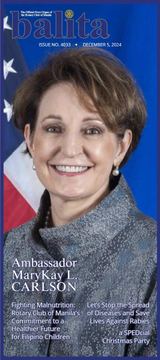
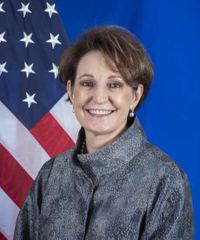 Her Excellency MaryKay L. Carlson
 Santiago Trillana Academy Concert Chorus
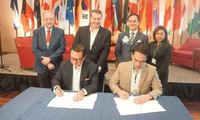 Fighting Malnutrition: Rotary Club of Manila's Commitment to a Healthier Future for Filipino Children