

Rotary in the Time of Upheaval: PRID Raffy Garcia Unfolds a Story of Courage and Conviction
At the 8th Weekly Membership Meeting, Rtn. John Simon told the story of Pertua and PRID Raffy Garcia III spoke on turbulence within Rotary International.

WHEN the gavel struck at the Manila Polo Club, the familiar hum of fellowship and purpose filled the air once again. The Rotary Club of Manila — Asia’s first and oldest — assembled not merely to share lunch or laughter, but to listen, to understand, and to be moved. Presiding over the meeting was President Raoul C. Creencia, who called the august body to order with the quiet dignity befitting an institution of legacy and leadership.
The invocation by STAR Rotarian Delfin “Del” Lorenzana, the solemn strains of the National Anthem, and the resonant chorus of the RCM Hymn reminded all present of the twin pillars upon which Rotary stands — faith and service.

When Rtn. Nicolo "Nic" Hallare led the Four-Way Test, one could sense an almost liturgical cadence: “Is it the Truth? Is it Fair to all concerned?” — questions that would echo later, in unexpected gravity, during the day’s keynote address.
As the RCM World Famous Music Chorale serenaded the birthday celebrants, the afternoon seemed set to follow the familiar cadence of Rotary fellowship — music, camaraderie, and meaningful projects. Yet, before the Guest of Honor would take the stage, another kind of story unfolded — one that embodied Filipino ingenuity, perseverance, and pride.

The Engineer Who Dreamed of Perpetual Motion
Rtn. Juanito “John” A. Simon, a Filipino mechanical engineer, took to the podium for his Classification Talk — his voice calm yet animated with passion. His story was not that of an overnight success, but of a mind that refused to stop tinkering, a heart that never stopped believing that Filipino invention could stand shoulder to shoulder with the best in the world.

Long before graduation, Simon had already been enamored by metals and machines. He worked as an apprentice in a small welding shop, where sparks became his first teachers and oil-stained hands his first laboratory. After earning his degree, he moved to the United States, where destiny placed him at the research wing of a global oil company. His task: to improve fuel additives.
But Simon’s curiosity ran deeper than formula. “What happens when the fuel runs out?” he wondered. “Should the benefits disappear with it?”

That question would define his life’s work. He envisioned an additive that would remain within the engine — one that would make engines last longer, run smoother, and consume less fuel. Through years of experimentation, he created what he called Tribotec, inspired by tribology — the science of friction and lubrication. In 1986, he brought the idea home to the Philippines and christened it Per’tua, short for perpetual — the dream of an engine that never wears down.
Pinoy Disruption

Stories about Pertua spread like folklore across garages, racetracks, and highways. A car drained completely of oil ran from Long Beach to San Francisco without faltering. A truck, leaking oil through a busted pipe, still made it back to its garahe without engine damage. Even the U.S. military, Simon shared, once tested Pertua on Apache helicopters — and were impressed enough to consider adopting it.
In the Philippines, it became the lubricant of legend, passed from mechanic to mechanic, whispered about by jeepney drivers and motor enthusiasts alike. There were no billboards, no glitzy TV ads — just word of mouth, fueled by trust and performance.

Pertua’s rise in the early ’90s coincided with a nation recovering from economic turbulence. During the post-Martial Law years, when brand-new cars were scarce and Filipinos relied on secondhand vehicles, Pertua became a symbol of diskarte — that irrepressible Filipino knack for making things work, even when the odds don’t.
Though the company went through highs and lows over the decades, its legacy endured. Under new management, Pertua was rebranded, its product line expanded, and its distribution modernized. With a 500% increase in factory output last year, Pertua is now tapping new markets, even venturing into industrial and home applications.

But Simon remains restless. Recently, he proposed to the Department of Energy a system that could reduce the immense amount of waste oil discarded daily by power plants. Even now, nearly four decades after his invention, he continues to push the boundaries of efficiency and sustainability.
As he ended his talk, a quiet awe settled over the audience. Here was a Filipino who had not only invented but endured — whose creation had outlasted trends, recessions, and generations of engines. His message resonated beyond mechanics: perseverance is perpetual.

Of Service and Significance
President Raoul’s address followed, brimming with momentum and mission. He spoke of the upcoming animal welfare partnership with PETA, the tree-planting drive spearheaded by Rtn. Rafael Ignacio S. Dionisio, and the forthcoming MOA signing between RCM, its Foundation, and three new partners: Reading Specialists, TopHealth Medical Clinic, and Dualtech.

Each partnership was a testament to Rotary’s living creed — to serve not in words, but in deeds.
Rtn. Romy Nones then offered an insightful overview of the Leon Lambert Fellows Program, reminding all that true leadership is not self-proclaimed, but recognized in service.

And then came the moment of anticipation—the introduction by Director-Elect Caloy Serapio of the Guest of Honor and Speaker: PRID Rafael M. “Raffy” Garcia III, a Filipino whose leadership had shaped Rotary International at its very core.
A Voice from the Inside: PRID Raffy Garcia Speaks

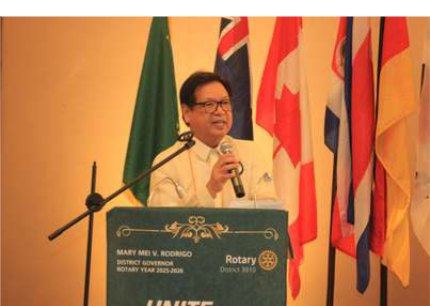
When PRID Raffy Garcia III stood at the lectern, the room stilled with that special silence reserved for those who have truly been there — men who have looked into the heart of institutions and seen both their greatness and their frailties.
“Good afternoon,” he began, his baritone steady and unhurried. “It’s always a joy to come home to the Rotary Club of Manila.”

He greeted friends and stalwarts of the movement — Chairman Susing Pineda, Co-Chair Romy Nones, President Raoul Creencia, President-Elect Reggie Yu, District Governor Jackie Rodriguez, and a host of familiar names.
“I’ve been attending your meetings since the days of the Manila Hilton,” he recalled, drawing nostalgic smiles from the old guard. “Then the Manila Hotel, then New World. And now, here we are — at the Polo Club, where it’s easier to park and harder to forget.”
The laughter subsided, and Garcia’s tone deepened.
“Rotary International,” he said gravely, “is in the midst of its most turbulent chapter in recent memory. Some of these storms are acts of nature. But others — are man-made.”

He spoke of a brewing crisis at Rotary’s highest echelons: the sudden resignation of Mário César Martins de Camargo, a Brazilian leader once hailed as a reformist visionary and now remembered as the President who never was.
Garcia painted the portrait of a man molded by enterprise and idealism. “Mário was born into a family of printers. His father founded Gráfica Bandeirantes, one of Brazil’s foremost printing companies. He studied law and business in São Paulo, trained in the U.S. and Germany, and was a Rotary Youth Exchange scholar in Minnesota.”

At 23, Mário had joined Rotary and, over the decades, served as Director, Trustee, Facilitator, and Chair of countless committees. “He was brilliant,” Garcia said. “And fearless.”
But courage, as in many institutions, has a cost. Mário’s call for reform — his demand to restructure the powerful office of Rotary’s General Secretary — would trigger an institutional revolt. He argued that Rotary had become too heavy, too top-down, too costly. “He believed we were serving the bureaucracy more than the mission,” Garcia explained.

His dissent did not sit well with Evanston. At one fateful board meeting, Garcia recounted, when Mário attempted to voice opposition to the renewal of General Secretary John Hewko’s contract, then-RI President Gordon McInally cut him off:
“You are just a President-Nominee. You have no standing in this meeting. Please leave.”

The audience gasped softly.
“That,” Garcia said, his voice low and deliberate, “was the moment the knives came out.”

In June, barely two weeks before he was to assume the presidency, Mário called Garcia in desperation. “Raffy, Raffy, they are asking me to resign,” he said. “Seven past presidents gave me seven hours — or they will announce whatever they claim to know about me.”
Garcia, stunned, pressed for details. “He told me they accused him of everything — from passport suspension to bankruptcy. But he was at home in Brazil. He wasn’t arrested. He hadn’t done anything wrong.”

The silence that followed was heavy. “He resigned,” Garcia finally said. “And the institution lost a brave reformer.”
His successor, Francesco Arezzo of Italy, Garcia described with affection. “He is kind, cultured, and well-meaning — but he speaks mostly in Italian. He tries English,” he smiled, “but you will need subtitles.”

The next president after him, Olayinka Hakeem Babalola of Nigeria, is another of Garcia’s close friends — an engineer and Shell executive, deeply spiritual and earnest. “But his English, too, is imperfect,” Raffy said lightly. “When he speaks, you must listen not just with your ears — but with your heart.”
He paused, letting the laughter fade into thought. “What you see here,” he said, “is Rotary’s paradox. We are an organization of 1.4 million people in over 200 countries — and yet, at the top, we are still learning how to listen to one another.”

It was an observation that struck deep — a blend of candor and compassion, spoken by a man who loved the organization too much to flatter it.
Then came the confession: “Even I,” he said softly, “have thought of leaving. I’ve served decades. I’ve given three million dollars. But sometimes, it feels like we’ve lost our way.”

A ripple of silence swept across the hall. “But then,” Garcia smiled faintly, “I remember why we joined — to serve. Not to surrender.”
When Justice Falters and Conviction Prevails

Having peeled back the layers of global intrigue, Garcia turned his gaze homeward — to a controversy closer to the heart of Philippine Rotary.
“I want to speak about something that happened right here,” he began. “Something that should concern every Rotarian who values fairness.”

The audience leaned forward. The tone was no longer reflective but resolute.
“I’m talking about our very own District Governor, Jackie Rodriguez,” he said. “After ten months of dedicated service — ten months of carrying this district on his shoulders — he was removed. Just like that. Two months before the end of his term.”

A stunned hush filled the room.
Garcia continued: “It was unjust. And, frankly, uncalled for. Because that someone they replaced him with? She was the same one whispering the wrong advice that led to the very errors they used against him.”

The weight of his words hung like a gavel suspended in midair.
“This is what disheartens me,” he said. “When politics and pettiness overshadow principle. When service becomes secondary to ego. Rotary is not a playground for power — it is a proving ground for integrity.”

He straightened, eyes sweeping across the hall. “I will not promise miracles,” he declared, “but I will speak with those who can make this right. I will knock on the door of President Stephanie Urchick herself, and if need be, remind her that justice — like service — must never be delayed.”
The audience broke into spontaneous applause. It was not the polite applause of diplomacy, but the fierce affirmation of men and women who had seen courage in real time. For a moment, the Manila Polo Club felt less like a luncheon hall and more like a tribunal of conscience — one where truth had been spoken, and a flicker of faith restored.

Then, softening, Garcia ended with a touch of humor and hope. “I may have thought of resigning,” he said, “but I suppose I’m too invested — both emotionally and financially.” Laughter erupted. “So I’ll stay. But perhaps with a smaller checkbook.”
He concluded by sharing his latest project — a traveling Rotary museum in honor of the late PRIP Matt Caparas. “We will bring it across the Philippines, then install it permanently in Malolos, Bulacan,” he said. “So future Rotarians may see how Rotary used to be — when Rotary was Rotary.”

The hall stood in ovation.
Epilogue: Light Beyond the Storm

When President Raoul Creencia presented the Certificate of Appreciation, the gesture was more than ceremonial — it was a benediction of gratitude to a man who had dared to speak truth in a time of quiet disillusionment.
As Rotarians filed out beneath the warm afternoon light, they carried with them not just stories, but reflections — on service, courage, and conviction. In the course of a single meeting, they had witnessed two archetypes of greatness: the Filipino engineer who defied limits, and the Filipino Rotarian who defied silence.
Both, in their own way, embodied the spirit of the Four-Way Test — not as a slogan, but as a compass pointing always toward what is true, fair, and beneficial to all concerned.
For amid the noise of change and the weight of tradition, the message of the day lingered like a quiet vow:
When the world grows heavy with doubt, it is the voice of integrity that keeps the engine of humanity running.

 Membership Committee Meeting