

Reclaiming Fiscal Integrity: Benjamin Diokno’s Ten Commandments for the Nation’s Purse
Dr. Benjamin E. Diokno of the Bangko Sentral ng Pilipinas Monetary Board was guest of honor and speaker at the Rotary Club of Manila’s 10th Weekly Membership Meeting.

WHEN the gavel struck at the Manila Polo Club, the Rotary Club of Manila’s 10th Weekly Membership Meeting came to life with the crisp resonance of purpose. President Raoul C. Creencia called the assembly to order, setting the tone for an afternoon steeped in insight and gravitas. Beneath the soft glimmer of chandeliers and the murmur of Rotarians and guests, one could sense anticipation — for the guest speaker that day was not merely a man of numbers, but of principles: Dr. Benjamin E. Diokno, Member of the Monetary Board of the Bangko Sentral ng Pilipinas, and one of the nation’s most seasoned economic minds.
The Anatomy of a Budget
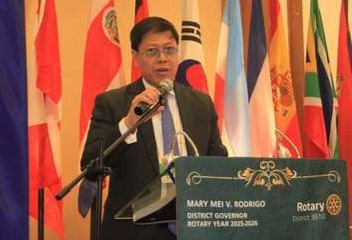
In his calm, professorial cadence, Dr. Diokno began not with figures but with philosophy. “The national budget,” he declared, “is the most consequential task of Congress — its justification for existence.” Having crafted thirteen of the thirty-nine national budgets since the 1986 People Power Revolution, Diokno spoke with the rare authority of one who has not merely studied fiscal policy but shaped it. His narrative spanned four presidencies — Aquino, Estrada, Duterte, and Marcos Jr. — each chapter yielding lessons on prudence, discipline, and political will.
He recounted his authorship of the first-ever Multi-Year Fiscal Program — a six-year roadmap for national expenditure and development. “A president serves for six years,” he explained. “He must focus on what can be done within those six years. Not on who will succeed him.” That document, later adopted by Congress, set ambitious but clear targets: to reduce the deficit-to-GDP ratio to 3%, bring debt down to 60% of GDP, and attain upper-middle-income status by 2028. “But today,” Diokno cautioned, “all those targets are now in doubt.” The deviation, he said, was not due to economic impossibility — but to political compromise.

When Congress Plays Architect
It was here that his tone sharpened, his economist’s neutrality giving way to quiet conviction. “In recent years, the President’s budget has been routinely mangled by Congress,” he lamented. “The clear winner: the Department of Public Works and Highways.”

He revealed that in successive years, Congress inflated the DPWH budget by as much as 34% in 2023, 21% in 2024, and 21% again in 2025—while slashing the Department of Transportation’s allocations by over 50%. “That is why our infrastructure dreams — the North-South Railway, the Metro Subway — remain dreams. They have no funds for right-of-way acquisitions. Congress cut them out.”
Equally troubling was the ballooning of “unprogrammed appropriations” — a fiscal catch-all that grew unchecked from ₱588 billion to over ₱800 billion in a single year. “And you know why,” Diokno said pointedly. “That’s where they get their post-projects.”

The Ten Commandments of Fiscal Integrity
Then came what Diokno called his “Ten Commandments” — a distilled manifesto for restoring fiscal responsibility, forged from decades of experience and disillusionment alike.

1. Respect the Process. “The DBCC — the Development Budget Coordination Committee — crafts the budget aligned with macroeconomic targets. Tinkering after that undermines months of technical work.”
2. Defend the President’s Budget. “If a Secretary cannot live within his ceiling, he should be fired. Lobbying Congress for more funds is an act of disloyalty.”

3. Honor Foreign-Assisted Projects. “They are well-studied, high-yield, and ready for execution. Replacing them with local, politically motivated projects delays progress and wastes borrowed money.”
4. Accept Congress’s Right to Amend — but Wisely. “Amendments are allowed only if they improve the President’s proposal.”

5. Make the Budget Public. “Transparency begins with uploading the House-approved General Appropriations Bill for all citizens to see.”
6. Respect the Senate’s Role. “Let the Senate propose amendments — but require that these be transparent and justified, not concealed in technical jargon.”

7. Publish the Senate Version. “Accountability thrives in sunlight. The public must know what changes were made, and by whom.”
8. Open the Bicameral Conference to the Public. “The bicam should reconcile differences, not invent new provisions. Minutes should be public, proceedings recorded, and the Budget Secretary allowed to observe.”

9. Use the Line-Item Veto. “Our President has the power to surgically remove pork from the budget. He must use it.”
10. Uphold Checks and Balances. “Congress may override a veto — but at great political cost. The Constitution designed it that way, not for convenience, but for courage.”

It was a manifesto not of theory but of practice — a plea for institutional memory in a system that too easily forgets.
The Moral Mathematics of Governance

In the hush that followed, Diokno’s final words hung in the air like a quiet challenge. “When you deviate from the plan,” he said, “you delay the nation’s progress. You trade sustainability for expediency. And in the end, it is the Filipino people who pay the price.” His lecture was less an indictment than a moral equation — a reminder that economics, when stripped to its essence, is an ethical discipline. “Budgeting,” he seemed to suggest, “is not about numbers, but about choices — what we value, and who we serve.”
A Rotarian’s Legacy

For many Rotarians present, the afternoon was also a homecoming of sorts. Few remembered that Benjamin Diokno once served as Vice-President of the Rotary Club of Manila, long before the corridors of power beckoned. Yet in his speech, that Rotarian spirit — the commitment to truth, transparency, and service — shone undimmed.
President Raoul Creencia presented the Certificate of Appreciation amid warm applause, but the greater applause came in the silence that followed — the silence of reflection, of a room momentarily stilled by clarity. As the meeting adjourned, one could sense that the Rotarians did not merely hear a lecture on fiscal policy — they witnessed a masterclass in civic conscience.

Epilogue
In an era when political noise often drowns out reason, Dr. Benjamin E. Diokno’s message resounded as both caution and compass: that integrity, not ideology, must anchor our nation’s budget. And that in the ledger of history, it is not the numbers that will endure — but the values they represent.


 Tereso O. Panga
 President’s Message