

Editorial

Reginald T. Yu
Editor-in-Chief
There are moments in the life of an institution when a speaker is not merely a guest, but a lens — through which we see our own country more clearly.
We are honored to welcome Mr. Andrew Jeffries, Country Director for the Philippines of the Asian Development Bank (ADB), as our Guest of Honor and Speaker. His presence is not simply ceremonial. It is consequential.
For when ADB speaks, the region listens. The Philippines stands at a pivotal juncture. We are a nation of youthful demographics, expanding digital connectivity, sustained infrastructure ambitions, and a services sector that continues to power growth. Yet we also confront structural challenges that cannot be ignored — inequality, climate vulnerability, fiscal pressures, and the urgent need to create quality employment at scale.
Development today can no longer be measured by growth rates alone. It must be measured by resilience, inclusivity, and long-term competitiveness. Prosperity that is not widely shared is fragile. Growth that does not account for climate risk is temporary. Reform delayed is opportunity diminished.
In this context, the insights of the Asian Development Bank are more than economic commentary. They are strategic signposts. ADB is not merely a financier; it is a development partner that shapes infrastructure pipelines, advises on governance and fiscal reforms, supports climate adaptation, and catalyzes private investment across the region. Its perspective situates the Philippines within the broader arc of Asian economic transformation.
The Philippine economy has demonstrated admirable resilience. Domestic demand remains strong. Public infrastructure investment continues to anchor policy direction. Yet resilience is not immunity. Global uncertainties — geopolitical tensions, commodity volatility, and shifting financial conditions — require vigilance and discipline. Sound fiscal management, productivity-enhancing investments, and regulatory clarity are essential if growth is to be sustained and inclusive.

Equally pressing is the climate imperative. The Philippines remains one of the most climate-vulnerable nations in the world. Flooding, typhoons, and environmental degradation are not distant scenarios; they are lived realities. Development must therefore be climate-conscious by design. Infrastructure must be built not only for expansion, but for endurance. Economic strategy must integrate sustainability, not treat it as an afterthought.
The role of the private sector and civic institutions in this equation cannot be overstated. Development is not the sole responsibility of government or multilateral institutions. It is a shared undertaking. When global capital aligns with national priorities, when policy reform is matched by entrepreneurial dynamism, and when civic organizations convene dialogue and accountability, transformation becomes possible.
This is why welcoming Mr. Jeffries is more than a courtesy — it is an opportunity. We look forward to gaining first-hand insights on development priorities, the economic outlook, and what lies ahead for the Philippines. We hope for candor as much as encouragement. The Philippines does not need flattery; it needs clarity. Where must reforms accelerate? Where can we unlock greater competitiveness? How do we ensure that growth translates into opportunity across regions and sectors?
The question before us is not whether the Philippines will grow. It is how it will grow — and for whom.
Will growth be inclusive? Will it generate dignified work? Will it narrow regional disparities? Will it withstand climate shocks? Will it position the Philippines as a resilient and innovation-driven economy in Asia?
In hosting the Country Director of the Asian Development Bank, we engage not only with an institution, but with the architecture of our nation’s future.
May this conversation sharpen our understanding, deepen our resolve, and translate insight into action. For development is not a projection on a slide deck. It is a deliberate choice — made through policy, partnership, and principle.
And the future of the Philippines depends on how wisely we choose.
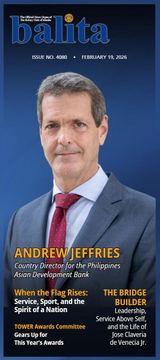
 Andrew Jeffries
 When the Flag Rises: Service, Sport, and the Spirit of a Nation
 TOWER Awards Committee Gears Up for This Year’s Awards