

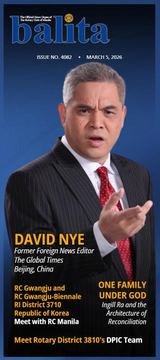
ONE FAMILY UNDER GOD | Ingill Ra and the Architecture of Reconciliation

The room at the Rotary Club of Manila was filled with the quiet expectancy of people accustomed to listening to leaders. Business executives, diplomats, academics, civic workers, and young professionals sat shoulder to shoulder, their conversations slowly tapering into attentive silence. When Ingill Ra rose to speak, he did not carry himself with the theatrical confidence of a politician, nor with the detached polish of a career diplomat. There was instead a gentleness to his presence, a gravity shaped less by rank than by lived history.
He began not with himself, but with a war.
Seventy-four years earlier, he reminded them, the Korean Peninsula had stood at the edge of extinction. A young dictator, backed by the forces of a global ideological struggle, had sought to seize the entire land. Cities burned. Families fled. Refugees poured southward in desperate waves. The fate of a nation hung by a thread near the port city of Busan, where a narrow perimeter became the last line of defense.
Then he spoke of a people who crossed the sea.
More than 7,000 young Filipinos — many scarcely older than the students now listening to him — had left their homes to fight for a country they had never seen. They came not for territory, not for conquest, but to defend human lives and the principle that freedom should not be extinguished by force. Among them was a teenage war correspondent named Benigno “Ninoy” Aquino Jr., carrying a pen and a camera instead of a rifle. Among them was a young officer named Fidel V. Ramos, who would one day lead the Philippines as President.
“As I stand here today,” Ingill Ra told them, “my very life is part of the legacy of your fathers and grandfathers. Without their sacrifice, the Korea you know today would not exist. And without them, I might not be standing before you.”
Then, in a seamless turn, he reached further back — far beyond modern war, beyond the Cold War, beyond even the founding of the Korean state.
He spoke of an ancient Korean ideal, older than written history: Hongik Ingan — to live for the benefit of all humanity. It was, he said, the moral DNA of his people, the reason Korea had endured invasion after invasion without becoming an aggressor itself, the reason the Korean dream could never be satisfied with prosperity alone. A nation, he insisted, was not meant merely to survive or to succeed. It was meant to serve.
And then he spoke of the Philippines.
Of a people whose national ethos — Maka-Diyos, Maka-Tao, MakaKalikasan, Maka-Bansa — declared, in a language of faith and community, the same truth: that human dignity flows from God, that every person is worthy of respect, that creation is to be cared for, and that love of country is ultimately a moral calling, not a tribal one.
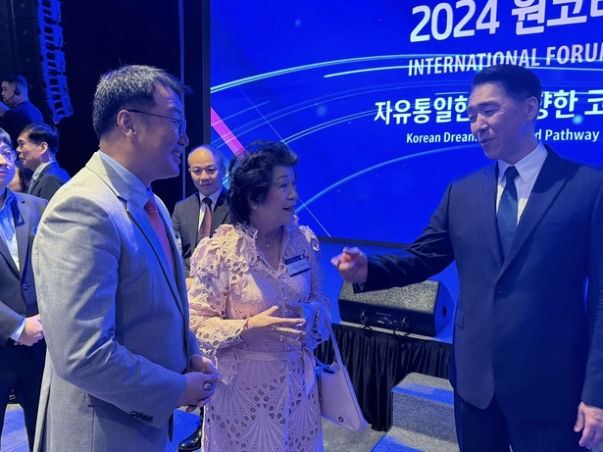
“These values,” he said softly, “are not only for your nation. They are a gift to the world.”
“Finally, his voice carried the weight of a personal plea. Two months later, he explained, Koreans would gather near the Demilitarized Zone, the most heavily armed border on earth, to pray and to declare their longing for a unified peninsula. Not for conquest. Not for ideology. But for reconciliation. For the healing of a family torn in two by history.
“Come with us,” he invited. “Not with weapons, as your ancestors once did, but with values. With prayer. With the conviction that we are not enemies
divided by systems, but brothers and sisters under one God.
In that moment, the room was no longer merely a meeting hall. It had become a bridge between generations and nations, between war and peace, between memory and hope.

For the man who stood before them had once been a child in a one-room house on a hillside in Busan, raised by a pastor and an insurance agent, shaped by poverty, discipline, and faith. He had grown up in the long shadow of a war he did not fight but would spend his life trying to heal. He would become a scholar, a humanitarian, a peacebuilder, a husband, a father, and a bridge between civilizations.
This is the story of that journey.
This is the story of Ingill Ra.
A Nation Divided, a Boy on the Hill
In the late 1960s, high above the port city of Busan, there was a hillside community called Beomnaetgol. It was a place of narrow alleys and tightly packed homes, built by families who had fled south during the Korean War and never truly left its shadow. From certain angles, one could glimpse the sea — a wide, blue promise of openness and possibility. But daily life in Beomnaetgol was shaped less by beauty than by survival.

It was here, in 1969, that Ingill Ra was born.
The war had ended sixteen years earlier, but its presence lingered everywhere — in the missing fathers, in the patched roofs, in the stooped posture of men who had learned to endure without complaint. Korea was rebuilding with astonishing speed, yet communities like Beomnaetgol still lived in the long echo of displacement. Families worked from early morning until late at night in factories, docks, and small shops, doing whatever was necessary to feed their children and keep hope alive.
The Ra family of five lived in a single room. It was their bedroom, living room, dining area, and study all at once. Privacy was a luxury; resilience was a necessity. The young Ingill learned early that life was not about abundance, but about sharing — of space, of food, of silence, of dreams.
His father was the pastor of a small local church, a place of deep spiritual and historical meaning for the neighborhood. The church itself carried the memory of flight and faith. Its founder had escaped from North Korea during the war, crossing the 38th parallel with little more than the clothes on his back and an unshakeable conviction that God had spared him for a purpose. Local legend held that this pastor had once prayed for world peace
on a nearby rock and drawn water from a well that villagers still regarded with reverence.

Because of that history, the church became a quiet point of pilgrimage. From time to time, foreign visitors — missionaries, scholars, believers from Europe and America — made their way up the hillside. For the residents of Beomnaetgol, these moments felt almost unreal. The world, which seemed so distant and unreachable, suddenly stood in their narrow streets, speaking strange languages and carrying cameras, Bibles, and questions
For a small boy growing up among factory whistles and prayer hymns, these encounters planted a subtle but lasting seed: the sense that even the most modest community could be connected to something far larger than itself.
His father was not a gentle man in the way modern parenting manuals might prescribe. He did not play games or offer easy praise. Instead, he taught discipline, responsibility, and reverence for learning. On newspaper sheets spread across the floor, he showed Ingill how to grind ink and practice calligraphy. The repetitive movement of brush on paper demanded patience and precision — qualities that would later become central to his life.
On Sundays, as the pastor prepared lessons for children’s Bible school, he would draw large scenes from Scripture.
Young Ingill was asked to color them in. It was a simple task, yet it quietly taught him the power of teaching, the beauty of images, and the sacredness of helping others understand stories larger than themselves.

His mother was different. Where his father embodied moral rigor, she radiated gentleness and warmth. To support the family, she worked as an insurance agent, often returning home late in the evening, weary yet uncomplaining. On rare occasions, she would arrive carrying a precious treasure: fried chicken. In a household where every coin mattered, this small indulgence felt like a feast. Decades later, Ingill would recall those evenings not merely as memories of food, but as moments of tenderness — a mother’s quiet way of saying, “We are okay. We are together.”
Faith in the Ra household was not confined to Sunday sermons. It permeated daily decisions, sacrifices, and aspirations. When Ingill was only three years old, his mother left home for three years to serve in rural education and community development on Jeju Island. She worked among poor farming families, teaching, organizing, and sharing her faith. During that time, father and son lived alone in a single-room residence attached to the church.
The experience marked him more deeply than he realized at the time. Loneliness became familiar. So did responsibility. In the quiet evenings, the small boy watched his father prepare sermons and prayers, sensing that life, at its core, was about answering a call larger than one’s own comfort.
His father’s sense of public duty extended beyond the pulpit. In the tense years of Cold War division, when North Korea’s threats were felt as a constant shadow, he participated in civic campaigns, standing in busy public squares and urging passersby to sign petitions. At times, he asked his young son to stand in his place, holding placards, embodying a message he was still too young to fully understand.
For the child, it was frightening and embarrassing. Yet those moments planted an indelible lesson: that leadership sometimes meant standing alone, that conviction demanded visibility, and that even a single figure in a crowded square could carry a moral voice.

The Korea in which Ingill Ra grew up was transforming at a pace few nations had ever known. Every decade reshaped the country’s skyline and self-understanding. Factories rose where ruins had been. Universities expanded. The dream of prosperity slowly took form. But beneath this “miracle on the Han River” lay unresolved wounds — ideological division, religious suspicion, economic inequality.
His family’s church, because of its unique history and theology, was often labeled “heretical” by mainstream denominations. As a child, Ingill witnessed how easily faith — meant to unite — could become a source of mistrust and exclusion. He also saw how political ideologies divided neighbors, sometimes even families, along the fault line between democracy and communism.
These experiences did not make him cynical. They made him searching.
He saw a nation that had learned to work
tirelessly, yet still struggled to reconcile. A people who had endured invasion and poverty, yet carried deep reservoirs of compassion and endurance. A culture whose ancient values spoke of benefiting all humanity, even as modern history fractured it into hostile halves.

Long before he could articulate it, a question began to form in his heart: Was Korea’s destiny merely to become wealthy and powerful, or was it to heal — to itself and to the world?
Years later, when he would stand before international audiences, speak of Hongik Ingan, of “One Family Under God,” of a unified peninsula as a moral beacon, those ideas would not emerge from abstract theory. They would rise from the memory of a hillside in Busan, from a one-room home, from a pastor’s ink-stained hands, a mother’s late-night footsteps, and a child holding a placard in a public square, learning — before he could fully name it — that history, faith, and responsibility were inseparably intertwined.
The Discipline of Faith, the Tenderness of a Mother
If the hillside of Beomnaetgol taught Ingill Ra resilience, it was his parents who gave that resilience its moral shape.
His father’s world was one of structure, principle, and unyielding duty. A pastor formed by war, displacement, and the austere spirituality of a divided nation, he believed that character was not cultivated through comfort but through discipline. He rose early, prayed long, and expected

formed by war, displacement, and the austere spirituality of a divided nation, he believed that character was not cultivated through comfort but through discipline. He rose early, prayed long, and expected much — of himself first, and then of those around him. Love, in his vocabulary, was not expressed through embraces or praise, but through preparation: preparing the through study, the hand through practice, and the soul through obedience to a higher calling.
The calligraphy lessons were not merely artistic exercises. They were spiritual training. Each stroke had to be deliberate, each line balanced, each movement restrained. Ink could not be wasted; mistakes could not be erased. In that quiet ritual of brush and paper, Ingill learned concentration, humility before tradition, and respect for the slow formation of mastery. Long before he would write academic dissertations or address international assemblies, he had learned that words carried weight — and that they must be formed with care.
On Sundays, when his father sketched biblical scenes for the children’s classes and entrusted the coloring to his son, another lesson was quietly imparted: that leadership is also an act of service, that teaching is an offering, and that truth must be made visible and accessible. The child did not yet grasp theology, but he sensed that stories — sacred or secular — had the power to shape hearts. If the father represented moral spine, the mother embodied moral warmth.
Her gentleness did not mean weakness. To support the family, she entered the competitive world of insurance sales, navigating rejection and long hours with quiet perseverance. She returned home tired but never bitter. She listened. She encouraged. She prayed. In a household marked by scarcity, she became the custodian of hope.
The fried chicken she sometimes brought home became legendary in family memory not because of its taste, but because of its symbolism. It was an announcement, wordless yet profound: that even in hardship, there could be moments of celebration; that love could be expressed through the smallest gestures; that joy was not the enemy of discipline but its reward.

Her faith was practical and sacrificial. When she left for Jeju Island to serve poor rural communities, it was not an escape from family responsibility but an extension of it. She believed that faith demanded engagement with suffering, not retreat from it. For three years, she lived among farmers, teaching, organizing, and sharing the same gospel she had taught her own children.
For young Ingill, her absence was painful, yet formative. Living alone with his father in the church residence, he learned self-reliance, but also the cost of calling. Ministry was not an abstraction; it meant separation, uncertainty, and trust in God when human presence was limited.
The contrast between his parents’ temperaments — his father’s stern integrity and his mother’s tender endurance — created in him a balanced moral architecture. From one, he learned conviction; from the other, compassion. From one, the courage to stand firm; from the other, the wisdom to embrace gently.
It was in this environment that he first encountered the paradox that would later define his leadership: that strength without love becomes harsh, and love without strength becomes fragile. True moral authority, he would come to believe, arises only when the two are held together.
Religious division added another layer to his formative years. The church his father served, rooted in a unique spiritual lineage, often stood at the margins of mainstream Korean Christianity. Labels were applied. Suspicions circulated. Even as a child, Ingill sensed the quiet pain of being misunderstood for one’s beliefs.
Yet instead of breeding resentment, this experience sharpened his sensitivity to exclusion. He learned how easily communities draw boundaries, how quickly “us” and “them” can replace shared humanity. He also learned, through his parents’ example, that faithfulness does not depend on approval, and that integrity often requires patience in the face of misjudgment.
Meanwhile, the ideological division of the Korean Peninsula formed the background music of daily life. The names of Kim Il-sung and the North were spoken with a mixture of fear and anger. Anti-communist campaigns filled the streets. The memory of invasion was still raw. In school and church alike, the narrative of national survival was inseparable from moral duty.
His father’s participation in petition drives and public demonstrations was not political theater. It was, for him, a form of pastoral responsibility — defending not only a state, but a way of life grounded in freedom of conscience and faith. When he asked his young son to stand briefly in his place, he was not seeking symbolism. He was, perhaps unconsciously, inducting him into a lineage of public responsibility.
These early experiences forged in Ingill a quiet seriousness. He was not a carefree child. He was observant, reflective, and unusually attuned to the emotional undercurrents of adults. He watched how faith could divide and heal, how ideology could harden and mobilize, how sacrifice could be both noble and costly.
Yet within this seriousness there grew a widening horizon.

Foreign visitors to the church fascinated him. Their accents, their clothing, their stories of distant lands stirred an imagination that reached beyond the hills of Busan. The realization dawned, slowly but unmistakably, that his small community was part of a vast human family — that suffering, hope, and faith were shared across borders.
The seeds of global consciousness, of a life that would one day move between continents and cultures, were planted not in a university classroom but in a humble sanctuary on a hillside, where refugees prayed, pilgrims passed through, and a boy learned that the world was both broken and bound together by invisible threads of meaning.
Years later, when he would speak of “One Family Under God,” it would not be rhetoric. It would be the distilled wisdom of a childhood shaped by disciplined faith and gentle love, by a father who taught him to stand, and a mother who taught him to care.
The Awakening of a Global Mind
By the time Ingill Ra entered university, South Korea was already in the midst of its astonishing transformation. The nation that had once struggled simply to survive was now racing toward industrial strength and global relevance. Campuses buzzed with debates about democracy, development, and identity. Young people spoke passionately about justice, freedom, and the kind of country Korea ought to become.

For Ingill, university was not merely an academic passage; it was an expansion of the moral and geographical map he had begun to draw in childhood. The questions that had lingered quietly in his heart — about division, faith, and the human family — now found intellectual and experiential outlets.
He began his formal studies in theology, partly in response to his parents’ hopes, but more deeply because he sought a framework that could make sense of suffering, meaning, and responsibility. Theology, for him, was never a retreat into abstraction. It was a way of confronting the deepest wounds of history and the highest aspirations of the human spirit.
Yet books alone could not satisfy the restlessness growing within him. The world he had glimpsed through foreign visitors to his father’s church now beckoned with greater urgency. He wanted to see how other societies lived, struggled, and reconciled. He wanted to test his faith and ideals against real human conditions.
The defining moment came shortly after university, when he and a group of friends made what seemed, to many, an impractical and even reckless decision: they would form a volunteer team and travel to Africa.
They had no institutional sponsor. No wealthy benefactor. No assured funding. All they possessed was conviction and youth. If they were to go, they would have to earn every dollar themselves.

What followed became one of the most formative chapters of his life.
They went into the streets, setting up small stands in busy areas, selling whatever they could make or find — simple goods, handmade items, small tokens. When supplies ran out, they searched fields for four-leaf clovers,
pressing them into bookmarks and offering them to passersby. They knocked on doors, one by one, explaining their purpose with humility and persistence. They approached small shop owners late at night, long after business hours, and asked for support.
It was exhausting, often discouraging work. Yet something extraordinary happened. Ordinary people responded. Some bought what they were selling. Others simply gave. Many listened, encouraged, and wished them well.
From this, Ingill learned a lesson that would become foundational to his understanding of leadership: when a vision is rooted in genuine service, it awakens generosity. Trust, he realized, is not demanded; it is earned through sincerity and perseverance.

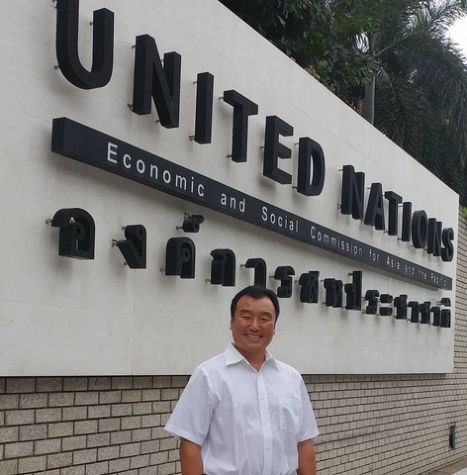
Their journey did not go directly to Africa. They first traveled through parts of Western Europe, eager to learn how communities organized themselves, how civil society functioned, and how nations rebuilt after conflict. They visited Germany, France, Switzerland, and Italy. In Geneva, they stood before the United Nations — a place that symbolized, for the young Korean who had grown up in a divided land, both the fragility and the possibility of global cooperation.
The sight of flags from around the world gathered in one place stirred him deeply. It was here that the abstract idea of “the international community” became tangible. Nations, he saw, could choose dialogue over domination, collaboration over conflict
When they finally reached Africa, the experience was both humbling and clarifying. Poverty was no longer a statistic; it had faces, voices, and stories. Yet so did dignity, resilience, and joy. Communities with little material wealth often possessed rich social bonds and spiritual depth.
They committed themselves to small but meaningful projects — what they called “villages of peace” — focused on education, community development, and cultural exchange. They were not saviors. They were learners and partners, discovering that true service begins with listening.
These months abroad reshaped Ingill’s sense of scale and responsibility. The struggles of Beomnaetgol, once the center of his world, now appeared as part of a much larger human story. The ideological division of Korea, while unique in its historical form, echoed a universal pattern of fractured identities and unhealed memories.

He returned to Korea with a broadened horizon and a deepened resolve. Faith, he now understood, could not remain confined within denominational walls. It had to speak to global suffering, to cultural difference, and to the shared longing for peace.
This awakening did not lead him away from scholarship; it redirected it. He began to seek an education that could integrate spiritual insight with social reality. Theology alone, he felt, was not sufficient to address the complexities of family breakdown, community conflict, and national division. He turned to social work, specializing in family therapy, to understand how relationships fracture and how they can be restored.
Later, he would pursue religious education in the United States, immersing himself in a pluralistic environment where dialogue between faiths was not optional but essential. There, he learned that harmony requires more than tolerance; it requires the courage to cross boundaries and the humility to learn from difference.
discovered, through service and encounter, that the world was both deeply wounded and profoundly interconnected.
It was the awakening of a global mind, but also of a global heart.

Love, Calling, and the Cost of Service
If service and study gave Ingill Ra a global horizon, it was love and family that gave his vision its deepest human grounding.
He met Angie at a time when his life was still being shaped by questions of calling and direction. She came from a devout Christian family, one that had known greater material comfort than his own, yet she carried herself without a trace of entitlement. Her faith was not ornamental; it was interior, disciplined, and quietly strong. Trained in fine arts, she possessed an artist’s sensitivity and a contemplative spirit, shaped by years of study in both Korea and Japan. Where Ingill was analytical and driven by ideas, Angie moved through the world with intuitive depth, perceiving emotion, beauty, and meaning in subtle forms.
Before marriage, she had once said that if God had prepared a spouse for her, even someone with physical limitations or a difficult path, she would receive that person with trust. It was a statement of surrender rather than romance, of vocation rather than fantasy. When she and Ingill began to discern their life together, he sensed something he had rarely felt before: not excitement alone, but a quiet certainty. In a life shaped by discipline and responsibility, this was a new language of grace.
Their early married years were anything but easy.

After completing seminary, Ingill began ministry in a small pioneering church near a university. The work was demanding, the resources scarce, the future uncertain. They lived in cramped quarters, navigating the insecurities of young adulthood with little financial stability. The rhythms of pastoral life — late-night counseling, endless meetings, the emotional burdens of congregants — quickly consumed his time and energy.
Unconsciously, he placed his calling above everything else. The church came first. Ministry came first. Vision came first. Love, he assumed, would simply endure.
In this, he was repeating a pattern he had witnessed in childhood. His father had devoted himself wholly to the church, while his mother carried the weight of family survival. Sacrifice had been normalized. Emotional absence had been quietly accepted as the price of faithfulness.
But Angie had not grown up in hardship. She had not been formed by scarcity, nor by the assumption that endurance must always be silent. She was strong, but she was also sensitive. And what pained her most was not the lack of comfort, but the feeling of being unseen — of standing beside a man who spoke of love and service to the world, yet struggled to offer the same attentiveness at home.
The birth of their child intensified both the joy and the tension. Fatherhood brought Ingill a new awareness of responsibility, but it also exposed his immaturity.

He loved his family deeply, yet he had not yet learned how to balance vision with presence, mission with tenderness.
It was a season of quiet conflict, not of dramatic arguments, but of unspoken loneliness. Angie remained faithful, supportive, and prayerful, yet the cost of that faithfulness was heavy. Only later would he fully recognize how much she had carried, and how patient her love had been.
In time, the mirror of her endurance forced him to confront himself.
He began to see that peacebuilding, reconciliation, and moral leadership could not be abstract ideals lived only in public arenas. They had to be practiced in the smallest, most intimate spaces. The family, he realized, was the first classroom of peace, the first society in which justice, sacrifice, and empathy were tested.
Repentance, in this context, was not theatrical. It was slow and humbling. It meant learning to listen, to apologize, to make space, to reorient priorities. It meant recognizing that a life lived “for the sake of the world” loses its moral authority if it neglects the one person to whom one has vowed lifelong care.

Angie’s role in his life was not merely supportive; it was formative. Her art, which often explored themes of journey, fragility, and hope, became a silent dialogue with his own search for meaning. Through her eyes, he learned to see the human soul not as a problem to be solved, but as a mystery to be cherished.
Marriage, for him, became a school of reconciliation more demanding than any diplomatic negotiation, and more sacred than any institutional mission. It taught him that love is not proven by intention but by consistency; not by words but by presence.
Later, when he would speak to young leaders about moral and innovative leadership, he would do so not as a theoretician, but as one who had learned — through failure and forgiveness — that the credibility of public service is forged in private faithfulness.
In Angie, he found not only a companion, but a quiet theologian of life, one who taught him that peace is not first built between nations, but between two hearts learning to walk together in patience, humility, and trust.
Scholar of Reconciliation

By the time Ingill Ra completed his formal studies, he no longer thought of education as a ladder of degrees. He understood it as a convergence — a long, inward process by which experience, faith, and disciplined inquiry fused into a single moral vision. What emerged from that convergence was not simply expertise, but a philosophy of reconciliation.
Theology had taught him how civilizations interpret suffering and hope, how sacred narratives shape the way people endure loss and imagine redemption. Family therapy had shown him how wounds travel across generations, how silence can be as destructive as open conflict, and how healing begins only when pain is acknowledged and dignity restored. Interfaith education had revealed that truth does not fear dialogue, and that faith matures when it learns to listen with humility. Public administration, finally, exposed the architecture of power — how institutions preserve memory, how policies shape behavior, and how civil society, more than governments alone, determines the moral direction of a nation.
Gradually, he came to see a profound parallel. Nations, like families, fracture not primarily because of ideology, but because of unhealed fear. And reunification, like reconciliation in a household, cannot be imposed by authority. It must be prepared in the heart.
This insight became the core of his thinking. Korea’s division, he concluded, was not merely geopolitical. It was psychological and spiritual. Two systems had hardened into two identities. Each had learned to survive by defining itself against the other. Over decades, this survival instinct had become a narrative of destiny, reinforced by education, propaganda, and collective memory. No treaty alone could undo that.
What was required was a transformation of moral imagination — a way for Koreans, North and South, to see one another again not as enemies shaped by ideology, but as members of a single historical family shaped by suffering and endurance.

Here, his understanding of Hongik Ingan deepened. It ceased to be only an ancient founding ideal and became a framework for public life. A nation, he came to believe, is not fully mature when it is merely strong or prosperous. It is mature when it is generous. Not when it dominates, but when it serves. Not when it is unified by fear, but when it is unified by shared responsibility for the human family.
This led him to a conviction that would shape all his later work: reunification is not the end of the Korean journey, but the beginning of its true civilizational mission. A reunited Korea, in his vision, would not exist for itself alone.
It would exist to embody a moral lesson for a divided world — that historical wounds can be healed without erasing identity, and that power can be reconciled with compassion
In his comparative study of divided and democratizing societies, he observed that lasting transformation never came from elite negotiation alone. It emerged when ordinary citizens began to see themselves as moral stakeholders in the nation’s future. Taiwan’s democratic transition, South Africa’s truth and reconciliation process, and post-war Europe’s integration all revealed the same pattern: peace endured only when it was carried by conscience, not merely by constitutions.
From this synthesis arose what he would later describe as Moral and Innovative Leadership. Leadership, in this sense, had to be moral because it must be rooted in conscience before it is expressed in policy. It had to be innovative because historical wounds cannot be healed with inherited formulas. They require new languages of trust, new structures of cooperation, and new stories of shared destiny.

Reconciliation, in his framework, was never sentimental. It was architectural. It involved the slow rebuilding of trust, the reshaping of collective memory, and the formation of citizens who could imagine unity not as surrender, but as responsibility. It required patient education, cultural empathy, and institutions that rewarded cooperation rather than fear. Above all, it required time, because neither families nor nations are healed in a single conversation or a single summit.
This is why Ingill Ra never reduced peace to diplomacy alone. He invested instead in youth, educators, faith leaders, artists, athletes, and civic organizers — the quiet shapers of a future moral consciousness. He believed that before borders can change, hearts must change; before systems can be unified, memory must be reconciled.
In this sense, he was not merely a scholar who studied reconciliation. He became a thinker of healing as civilization-building. Where others spoke of security, he spoke of trust. Where others spoke of ideology, he spoke of identity. Where others spoke of victory, he spoke of belonging.
And where history had taught Koreans to endure division, he sought to teach them something more demanding: to imagine reunion — not as the triumph of one system over another, but as the restoration of a family long separated, finally learning to recognize itself again.
From Village to World Stage

By the time Ingill Ra entered the arena of international institutions, he no longer saw the world as a collection of disconnected problems. He saw it as a web of relationships — some broken, some fragile, some waiting to be restored. His years of study had prepared his mind; his years of service had prepared his heart. What remained was the testing ground where ideals meet reality.
One of the first global platforms where this synthesis took form was the world of sport.
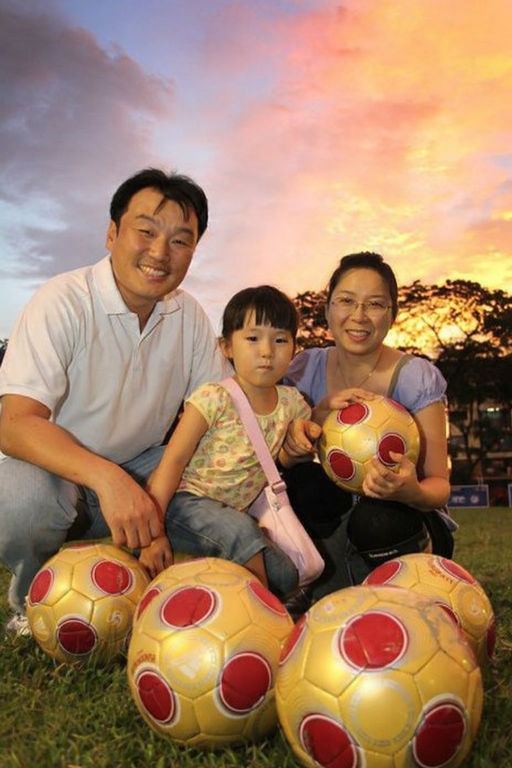
At the Asian Football Confederation (AFC), where he served as Director of Social Responsibility, he encountered a realm that spoke a language understood across borders, cultures, and creeds. Football fields, he realized, could become classrooms of character and laboratories of peace. The roar of a crowd, the discipline of training, the shared joy of victory and the shared pain of loss — these were universal experiences, capable of uniting young people long before they learned the vocabularies of politics or religion.
It was in this context that he conceived and launched “Midnight Football,” a program designed for youth in vulnerable urban communities. In many cities, the hours after dark were the most dangerous — when crime, drugs, and violence lured the restless and the forgotten. Rather than responding with punishment alone, he and his colleagues asked a different question: What if the night could be reclaimed as a space of belonging rather than fear?
They worked with police, schools, and neighborhood leaders. On game nights, residents parked their motorcycles around makeshift fields, turning on their headlights to illuminate the pitch. Under those beams of light, boys who might otherwise have drifted into gangs or detention centers learned teamwork, discipline, and trust. Parents and officers stood side by side, not as adversaries but as guardians of a shared future.

One message he received from a young participant, newly released from juvenile detention, stayed with him: a simple note saying he was coming home and wanted to return to the team. It was not eloquent. It did not need to be. It carried the quiet miracle of hope — the sense that someone still believed he belonged.
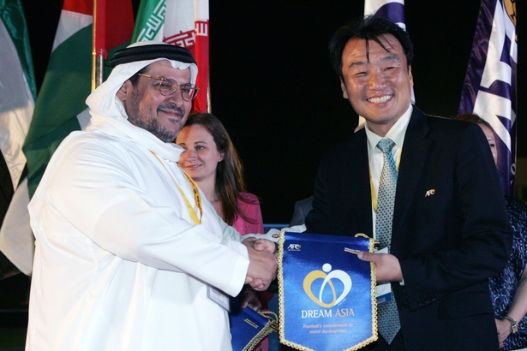
Around the same period, Ingill helped organize the first regional football tournament for persons with disabilities, bringing athletes from more than fifty Asian nations to Abu Dhabi. What began as an event became a movement. Barriers that had long kept people with disabilities at the margins of sport began to fall. National federations revised policies, opened facilities, and invested in inclusive programs.
To see ambassadors, government officials, families, and athletes celebrate together was to witness a living parable: that dignity does not depend on physical perfection, and that society is healed when the most vulnerable are welcomed into its center.
From the stadium, his path led to the United Nations system.
At the Food and Agriculture Organization (FAO), where he served as Director of Resource Mobilization and External Cooperation, he encountered a different, yet equally fundamental, truth: that peace begins with bread. “Food is love,” his colleagues often said, and he came to understand the depth of that phrase. Hunger is not merely a biological condition; it is a moral emergency.

A child who goes to sleep hungry does not have the luxury of contemplating ideals of democracy or reconciliation.
Yet he also learned that compassion, if not coupled with empowerment, can become dependency. Sustainable peace, he believed, required capacity-building — training farmers, strengthening fisheries, restoring forests, and enabling communities to provide for themselves with dignity. Aid, in this vision, was not charity alone; it was partnership.
His travels with the UN and other organizations took him to remote regions, conflict zones, and communities rebuilding after disaster. In Mongolia, after a long and exhausting assignment, he experienced an act of hospitality that crystallized his faith in the goodness of ordinary people. A stranger at the airport insisted on taking him not to a hotel, but to his own modest home. There, the man’s wife prepared meals, offered their bed, and treated him as family.
Only later did they explain why. Years earlier, they had worked in Korea, where an employer had welcomed them with the same warmth. This, they said, was their chance to repay that kindness.
To Ingill, it was a living illustration of moral reciprocity across borders — a reminder that one act of love can travel silently through time and space, returning when least expected.

In conflict-affected areas, including parts of the Middle East and the Korean Peninsula, he worked with partners to build sports facilities, schools, and community centers. These were not mere structures; they were statements of hope, spaces where children from opposing sides could meet not as enemies, but as teammates.
Gradually, his leadership style evolved. If in his early years he had been driven by vision and urgency, now he learned the deeper power of listening. Every culture, he discovered, carries its own wisdom, its own rhythm of trust. Solutions imposed from outside rarely endure. Transformation, to be authentic, must be owned from within.
Language barriers humbled him. Even in English, the global lingua franca, accents and idioms demanded patience and attentiveness. Communication, he learned, is an act of respect before it is an exchange of information.
Through these experiences, a pattern became clear. Whether in a Mongolian home, a Palestinian playground, an African village, or an Asian metropolis, the same human longings surfaced: to be seen, to be valued, to belong, to hope. And everywhere, he found that when people were approached not as problems to be fixed but as partners to be honored, something remarkable happened. Trust grew. Creativity emerged. Communities found their own paths toward healing.
The boy from Beomnaetgol, who had once looked out at the distant sea and wondered about the wider world, now moved across continents with a single conviction: that humanity, in all its diversity and division, was still one family — capable of extraordinary cruelty, yes, but also of extraordinary compassion.
The Korean Dream and the Wound of Division
For all his travels and global engagements, the deepest question of Ingill Ra’s life remained rooted in the soil of his own divided homeland.
Korea’s partition was not, for him, an abstract geopolitical arrangement. It was a wound carried in memory, culture, and family history. He had grown up hearing stories of flight and loss, of relatives separated by an invisible line, of a war that never truly ended but merely hardened into an armistice. The Demilitarized Zone, silent yet heavily armed, stood as both a physical barrier and a moral symbol — a reminder that ideology, once absolutized, could fracture a people for generations.
In 2002, when he visited Pyongyang and Jeongju, the division ceased to be theoretical. He met teachers, farmers, and families whose faces, language, and manner were unmistakably his own. In them he saw not enemies, but kin — brothers and sisters shaped by the same history, separated by forces far larger than themselves. In that encounter, reunification became not a political aspiration but a human imperative, like the longing to be reunited with a longlost member of one’s own family.
It was around this period that he encountered the vision of the “Korean Dream” as articulated by Dr. Hyun Jin Preston Moon, founder of the Global Peace Foundation. This vision reimagined Korea’s future not in terms of economic ascent alone — remarkable as that ascent had been — but as a moral and civic calling. It spoke of reconciliation after division, dignity after suffering, and a national destiny rooted in service to the global community.

For Ingill Ra, the Korean Dream was not a personal concept to originate or promote, but a shared vision to steward. It gave language and structure to what his own life had already been teaching him: that Korea’s story was not meant to culminate merely in prosperity or power, but in healing; not merely in invaded so many times in its history had rarely, if ever, become an aggressor itself. It was a civilization shaped less by conquest than by endurance, less by domination than by moral resilience.
security, but in a renewed vocation to serve humanity.
This vision resonated deeply with the ancient Korean ideal of Hongik Ingan — “to benefit all humanity.” Rooted in the founding narrative of the Korean people, this principle had long defined Korea’s moral DNA. It explained, in part, why a nation that had been
invaded so many times in its history had rarely, if ever, become an aggressor itself. It was a civilization shaped less by conquest than by endurance, less by domination than by moral resilience
Through the lens of the Korean Dream, Hongik Ingan ceased to be only an ancient maxim and became a framework for Korea’s future. A unified Korea, in this understanding, would not exist merely to resolve a security problem or to complete a national project. It would exist to fulfill a civilizational responsibility: to stand as a bridge between ideologies, cultures, and civilizations, and to demonstrate that historical wounds can be healed without erasing identity, and that power can be reconciled with compassion.

This was why, in his work, Ingill Ra consistently emphasized that reunification could not be reduced to diplomacy or economics. Like reconciliation in a family, it required healing of memory, transformation of narratives, and the rebuilding of trust. Decades of separation had created two systems, but more deeply, two psychological worlds. Each had learned to define itself against the other. No agreement alone could dissolve that. What was needed was a change of moral imagination — a rediscovery of shared identity beneath imposed division.
In this sense, reunification was not, for him, the final goal, but the threshold of a larger mission. A Korea restored to unity would be called not inward, but outward — to offer the world the fruits of its suffering: a mature commitment to peace, a deepened sense of human dignity, and a renewed devotion to the idea that nations, like individuals, find their highest purpose not in self-assertion, but in living for the sake of others.
Thus, the Korean Dream as he embraced it was never a nationalist slogan. It was a civilizational hope, grounded in history, faith, and moral responsibility — a vision entrusted to him and to his generation not to own, but to carry forward, for Korea and for the human family it was called to serve.
The Philippines: A Brother Nation
If Korea was the wound that shaped Ingill Ra’s life, the Philippines became the mirror in which that wound found unexpected healing.

If Korea was the wound that shaped Ingill Ra’s life, the PhFrom his earliest visits, he felt a familiarity that went beyond hospitality. It was not only the warmth of Filipino smiles or the ease of conversation, but a deeper resonance — a sense that the two nations shared a history written not merely in treaties, but in sacrifice.ilippines became the mirror in which that wound found unexpected healing.
Whenever he spoke of the Korean War, he did so with reverence. Sixteen nations had answered the call to defend a small peninsula at the edge of Asia, but among them, the Philippines held a singular place in his heart. Exactly 7,420 young Filipino soldiers crossed the sea in 1950, leaving behind families, farms, and classrooms to fight for a people they had never met. Around 299 wounded were wounded and 112 did not return. Those who did carried memories of frozen mountains, sudden battles, and the quiet heroism of comradeship.
To Ingill, their presence in Korea was not an episode of military history; it was an act of moral kinship. “Without them,” he often said, “my life, and the life of my nation, might not have been possible.
Two figures embodied this shared destiny for him
One was a seventeen-year-old war correspondent, Benigno “Ninoy” Aquino Jr., who arrived in Korea armed not with a rifle, but with a pen and a camera. Too young to fight, he chose instead to bear witness — to tell the story of Filipino courage and Korean suffering. Decades later, his image

would appear on the Philippine 500- peso bill, a quiet reminder that truth and sacrifice are forms of service as noble as combat.
The other was a young officer named Fidel V. Ramos, a graduate of West Point who would later become President of the Philippines. In Korea, Ramos commanded troops against overwhelming odds, demonstrating a leadership forged in discipline and resolve. For Ingill, the arc of Ramos’s life — from the battlefield to the presidency — symbolized how courage in defense of others could mature into statesmanship in service of one’s own people.
These stories were not, for him, nostalgic tributes. They were moral touchstones. They illustrated what he believed to be the highest form of patriotism: love of one’s own nation expressed through responsibility toward another.
In the Philippines, he also encountered a living tradition of faith that resonated deeply with his own. Churches stood at the heart of communities. Prayer was woven into public life. Even amid poverty and political turmoil, a profound trust in God animated daily existence. It reminded him of his own childhood in Busan, where faith had been both refuge and compass.
What moved him most, however, was the Filipino understanding of family and community. The concept of kapwa — the other as another self — echoed the Korean sense of jeong, the deep emotional bond that arises from shared life and shared struggle. In both cultures, relationship preceded contract, and loyalty was measured not by convenience, but by presence.

This cultural consonance found institutional expression in his growing relationship with Rotary in the Philippines, particularly with the Rotary Club of Manila. From his first visit to a weekly meeting, he sensed that Rotary was more than a service organization; it was a fellowship bound by ethical commitment. The Four-Way Test, with its simple yet demanding questions — Is it the truth? Is it fair to all concerned? Will it build goodwill and better friendships? Will it be beneficial to all concerned? — struck him as a secular articulation of the very values he had been preaching across cultures.
Through Rotary, he and his wife engaged in projects that brought service from abstraction into intimacy. One of the most formative was their involvement with a hospice for children.
Angie, with her background in fine arts, taught painting to the young patients and later participated in charity exhibitions to support the center. Together, they witnessed not only the vulnerability of life, but the quiet heroism of caregivers and volunteers who returned week after week, year after year, offering presence where cure was no longer possible.
In those rooms, filled with fragile bodies and luminous spirits, Ingill felt again the convergence of all the themes that had shaped his life: suffering and dignity, faith and action, the global and the personal. The children were not beneficiaries of charity; they were teachers of courage. Their parents were not objects of pity; they were models of love refined by pain.
As his work with the Global Peace Foundation deepened in the Philippines, he began to see the nation’s potential role in the broader architecture of peace. Mindanao’s long journey from conflict toward dialogue, marked by the collaboration of Christian, Muslim, and indigenous leaders, appeared to him as a microcosm of what the world itself needed to learn. Peace there had not been achieved by decree alone, but by the patient weaving of trust among communities, by the recognition of shared suffering, and by the courage to imagine a common future.

He often spoke of the Philippines as a “teacher nation” — one that, through its history and values, could offer the world a model of coexistence rooted in faith, hospitality, and resilience. Its educational ideals — Maka-Diyos, Maka-Tao, Maka-Kalikasan, MakaBansa — seemed to him not merely national mottos, but universal principles: reverence for God, respect for humanity, care for creation, and love of country understood as moral responsibility rather than narrow nationalism.
In this light, the relationship between Korea and the Philippines assumed a new, almost providential dimension. One nation carried the wound of division and the longing for reunification. The other carried a tradition of spiritual depth and communal solidarity. Together, he believed, they could form a bridge — between North and South, between past and future, between faith and policy.
When he invited Filipino friends and colleagues to stand with Korea in its dream of peaceful reunification, he did so not as a diplomat seeking support, but as a brother appealing to shared values. The same hands that had once held rifles in defense of Korean freedom, he now asked to hold a vision of reconciliation grounded in faith and human dignity.
In this partnership, Ingill Ra saw not strategy, but destiny: two peoples, bound by history and hope, called to remind a fractured world that sacrifice can give birth to solidarity, and that nations, like families, can choose to live not for themselves alone, but for the sake of others.
Moral and Innovative Leadership

By the time Ingill Ra assumed broader responsibilities within the Global Peace Foundation as Regional President for the Asia–Pacific, his understanding of leadership had been refined by decades of experience across cultures, institutions, and generations. He no longer thought of leadership primarily as authority or position. He understood it as moral influence — an ability to awaken vision, to cultivate responsibility, and to draw out the best from others in service of a shared future.
He often described himself, half in jest, as a “pathfinder rather than a commander.” In meetings with government officials, educators, religious leaders, youth organizers, and business executives, he rarely imposed conclusions. Instead, he asked questions, listened carefully, and sought to surface the deeper values that already
lived in the room. Only when people recognized their own moral stake in an issue, he believed, could genuine and lasting change begin.
This philosophy found its most vivid expression in his work with young people.
Across the Asia–Pacific — particularly in the Philippines, India, Indonesia, Malaysia, Cambodia, and Thailand — he devoted immense energy to leadership formation. One of the flagship initiatives under his guidance was the Global Youth Summit (GYS), which by 2024 had reached more than 12,000 young leaders across seventeen cities in the Philippines alone

What distinguished these gatherings from conventional conferences was not their scale, but their spirit. Instead of asking students and young professionals to come to a single capital city, his team went to them — into provincial universities, community centers, faith institutions, and even informal settlements. Each summit was anchored on a concrete social challenge, often aligned with a specific Sustainable Development Goal: education, poverty alleviation, environmental stewardship, interfaith harmony, mental health, or community resilience.
There, in classrooms and town halls, Muslim and Christian students sat side by side. Indigenous youth spoke of ancestral wisdom and modern aspirations. Young women stepped forward as leaders in spaces where tradition had once confined them to silence. Dialogue was not an academic exercise; it was an encounter of stories, hopes, and responsibilities
Ingill insisted that the youth not be treated as future leaders, but as leaders now. They were encouraged to design and implement community projects, supported by small seed grants and mentorship. The message was clear: leadership is not defined by age or title, but by the courage to act for the common good.
From these experiences emerged what he articulated as Moral and Innovative Leadership
“Moral,” because it begins with the recognition of human dignity, the courage to stand for truth, and the willingness to serve something larger than oneself.

“Innovative,” because it refuses to be trapped by inherited patterns of conflict or apathy, and instead seeks new ways of collaboration, communication, and problem-solving rooted in local culture and creativity.
For him, innovation without morality risked becoming cleverness without conscience. Morality without innovation risked becoming nostalgia without relevance. The future, he believed, demanded both.
One moment in India crystallized this synthesis.
Invited to speak before a gathering of scholars and national leaders on the future of peace in the Indo-Pacific, he prepared a carefully structured lecture. Yet as he stood before the audience, he felt compelled to set his notes aside. Instead, he spoke from the heart about Vasudhaiva Kutumbakam — the ancient Indian principle that “the world is one family.” He drew parallels to Korea’s Hongik Ingan and to the Global Peace Foundation’s vision of One Family Under God. He spoke of civilizations not as rivals, but as complementary moral traditions, each bearing wisdom for a wounded world.
The response was profound. Among those present was the granddaughter of Mahatma Gandhi, who later remarked that the address had been delivered “from the heart, not from notes.” The following day, the President of the National Federation of Indian

Universities approached him with an unexpected proposal: that he be honored with the 2025 Best Speaker Award — not as a personal accolade, but as a symbol of the academic community’s alignment with a valuesbased movement for peace.
Such moments did not inflate his sense of self; they deepened his sense of responsibility. Recognition, he believed, is never an endpoint. It is a summons to greater fidelity to one’s calling.
Across the region, his leadership was marked by a distinctive blend of urgency and patience. Urgency, because he believed the challenges facing humanity — polarization, ecological crisis, violent extremism, and the erosion of trust — could not wait. Patience, because he knew that moral transformation cannot be rushed. It must be cultivated, like character in a child or trust in a community.
In countless conversations with young people, he returned to the same themes: purpose, dignity, and service. He urged them to see themselves not merely as citizens of a nation, but as stewards of a civilization. He reminded them that history is shaped not only by those who hold power, but by those who hold conscience.
Often, after his talks, students would linger. Some shared their struggles — family pressures, doubts about the future, disillusionment with politics. Others spoke of awakening, of a renewed desire to live for something larger than personal success. A few, with a mixture of awe and determination, would say, “We want to live a life like yours.”

These encounters moved him deeply, not because they affirmed his achievements, but because they revealed the hunger of a generation for meaning. He understood that what they were truly seeking was not a model to imitate, but a vision to inhabit — a sense that their lives, too, could become bridges between peoples, healers of wounds, builders of peace.
For Ingill Ra, this was the true measure of leadership: not the number of programs launched or positions held, but the number of hearts awakened to responsibility, and the number of minds liberated to imagine a world reconciled.
One Family Under God — Legacy and Benediction
As Ingill Ra reflects on a life that has carried him from a one-room home on a Busan hillside to the halls of international institutions, from refugee memories to global peace platforms, he does not speak first of accomplishments. He speaks of gratitude.
Gratitude for a father who taught him to stand with conviction, even when standing meant standing alone.

Gratitude for a mother who embodied quiet sacrifice and whose tenderness revealed that love is often expressed in small, faithful acts.
Gratitude for a wife whose patience and artistry taught him that peace begins not in treaties but in relationships, not in speeches but in presence.
Gratitude for a nation that rose from ruins with discipline and hope, and for another nation — the Philippines — that once crossed the sea to defend Korea’s very right to exist.
He often says that his deepest strength, even now, comes not from institutions or titles, but from the constancy of prayer and the companionship of Angie, who has walked with him through every season, every transition, every doubt. Each morning begins in the same way: a moment of stillness, an offering of the day to God, a prayer for leaders and young people across the countries he
loves. It is a simple ritual, but it anchors a life lived across time zones and cultures.
For all his global engagements, his most demanding discipline has remained the practice of kindness in ordinary encounters. Taxi drivers, hotel staff, young volunteers, government officials, students — he believes the moral quality of leadership is revealed not on stages, but in these unscripted moments. Vision, he has learned, collapses if it is not sustained by humility. Grand ideals lose their credibility if they are not lived in small gestures of respect.
When asked what he is most grateful for, he often answers in an unexpected way: for questions.
For the questions that unsettled him as a child in a divided land. For the questions that drove him across continents as a young volunteer. For the questions that pushed him into disciplines beyond theology, into social work, education, and public policy. For the questions young people now ask him about purpose, justice, and the future.
To be questioned, he believes, is to be invited into meaning. It is to be reminded that one’s life is part of a larger conversation that stretches across generations.
And when he speaks of legacy, he does not speak of monuments or programs bearing his name. He returns instead to an image that has accompanied him through the years, shaped in part by his wife’s art and poetry: the image of a small fish swimming within a vast current, or a wildflower carried by the wind.
Each human life, he reflects, is fragile and brief, yet not insignificant. We move within a great river of history, often unaware of how our small acts of faithfulness, courage, or compassion contribute to a larger movement of healing.
This vision found lyrical expression in a poem written by Angie, shared during one of her exhibitions — lines that have become, for them, a kind of benediction:
Across the rough wilderness, you came like a flower in flight. Even the shadow of a single petal shines with light, whispers the gentle wind.
From the first moment of your journey, with a small body and all your strength, you swam forward.
Even in sharp, crashing waves, your path became a soft current, says the kind wind.
In these words, Ingill sees his own story, and the story of every person who chooses to live not for self alone, but for the sake of others. A small body, moving forward with all its strength. A fragile life, carried by a purpose larger than itself. A current of goodness, barely visible perhaps, yet real.
From Beomnaetgol to New York, from Africa to the United Nations, from football fields to peace summits, from a divided peninsula to the dream of reunification, his life has traced one continuous arc: the conviction that humanity is not destined for perpetual fracture, that history need not end in hostility, and that faith — when joined to courage, discipline, and love — can become a force for reconciliation.
“Hongik Ingan,” the ancient Korean ideal of living for the benefit of all humanity, and “Maka-Diyos, MakaTao, Maka-Kalikasan, Maka-Bansa,” the Filipino vision of a people rooted in God, dignity, creation, and nationhood, converge in a single phrase that has come to define his life’s work:
One Family Under God.
It is not a slogan. It is a hope shaped by war and healed by service.
It is a theology tested by history and refined by relationships. It is a dream that sees in every culture, every faith, every nation, not a rival to be defeated, but a brother or sister to be embraced.
And so, the boy who once stood in a public square holding a petition board, uncertain and afraid, now stands before the world with a different message — spoken not with placards, but with a life:
That peace is possible. That reconciliation is worth the cost. That small lives, lived with faithfulness, can become part of a great current of renewal. Like a wildflower carried by the wind. Like a small fish swimming steadily toward the open sea
 Editorial
 Guest Speaker