

At the Crossroads of Sovereignty and Truth: The Rotary Club of Manila’s 23rd Weekly Membership Meeting

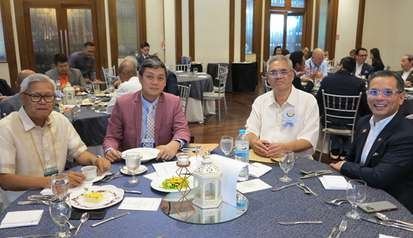
At 12:30 PM, beneath the stately chandeliers and quiet elegance of the Manila Polo Club, President Raoul C. Creencia called the 23rd Weekly Membership Meeting of the Rotary Club of Manila to order. It was a gathering that felt both familiar and consequential — a convergence of fellowship and public discourse that has long defined the traditions of Asia’s first Rotary club.
Outside, the late February sun filtered gently through the polo grounds. Inside, the room was filled with the steady hum of conversation among Rotarians, guests, and visiting dignitaries. The Rotary Club of Manila has always been more than a venue for luncheon meetings; it has served for more than a century as a forum where ideas, policy, and conscience meet. This particular Thursday would prove to be no exception.
Moderating the program was STAR Rotarian Chris C. Tamesis, whose composed presence guided the meeting with both warmth and efficiency.
Fellowship, Reflection, and the Rotary Spirit

The meeting began with the familiar rituals that anchor Rotary gatherings across the world.
The invocation was delivered by STAR Rotarian Francisco Roberto D. C. Mauricio, whose prayer invited reflection on gratitude, stewardship, and the responsibility of leadership. His words carried the quiet reminder that service, in Rotary, begins with humility before it becomes action.
Members rose for the Philippine National Anthem, followed by the stirring strains of the Rotary Club of Manila Hymn, performed by the RCM World-Famous Music Chorale. Their voices echoed through the hall with a tone of pride and camaraderie, reinforcing the shared identity that binds generations of Rotarians.
The recitation of The Four-Way Test was led by Vice President Karlo Eugene Josef M. Castro, whose clear cadence reminded those present of Rotary’s enduring ethical compass:

Of the things we think, say, or do:
Is it the truth?
Is it fair to all concerned?
Will it build goodwill and better friendships?

Will it be beneficial to all concerned?
These words — simple yet profound —continue to guide Rotarians across continents and cultures.
Guests were warmly acknowledged by Moderator Chris Tamesis, reflecting Rotary’s longstanding tradition of hospitality. The RCM World-Famous Music Chorale returned with a spirited Welcome Song, setting a tone of celebration for the afternoon.
The meeting also honored several birthday celebrants, including STAR Rotarian Coco Mauricio, Rotarian Raji Mendoza, Past Vice President Fausto Preysler, and Rotarian Jonas Gonzales. The traditional rendition of Maligayang Bati / Happy Birthday added a lighthearted moment to the proceedings.

President’s Time: Stewardship of a Living Institution
During President’s Time, President Raoul Creencia addressed the membership with a tone that balanced optimism and vigilance.
Rotary clubs, he noted, must continually adapt to a rapidly shifting world — one defined by geopolitical tensions, technological disruption, and evolving civic responsibilities.
The Rotary Club of Manila, founded in 1919, has witnessed nearly every chapter of modern Philippine history: colonial transition, independence, war, reconstruction, and democratic renewal. Through each era, the club has sought to remain both a moral compass and a convening force for dialogue.

This meeting would soon remind everyone present why such dialogue matters.
Introducing the Voice of the Afternoon
The afternoon’s guest speaker was introduced by Director-Elect Carlos G. Serapio, whose introduction captured both the professional stature and intellectual courage of the guest.
The speaker, Mr. David Nye, is a former Foreign News Editor of The Global Times in Beijing, China, a journalist whose career has placed him at the crossroads of international politics, media narratives, and the evolving power dynamics of the 21st century.

His address carried a title that immediately signaled the gravity of the discussion ahead:
“Narratives and National Interest: The Philippines in an Era of Global Influence.”
What followed was not merely a speech. It was a sobering reflection on the complex battlefield where geopolitics, propaganda, and national identity now intersect.
Narratives, Sovereignty, and the Invisible Battlefield

Mr. Nye began with a vivid image that set the tone for the entire address: the Philippines standing at a crossroads where the salt spray of the West Philippine Sea meets the silent digital currents of psychological warfare.
In his telling, the conflict surrounding the West Philippine Sea is not simply a territorial dispute. It is a layered struggle unfolding simultaneously across physical, informational, and psychological domains.
He described two parallel fronts confronting the Philippines.
The first is visible: maritime confrontations, gray-zone tactics, and acts of intimidation in contested waters.

The second is invisible: a war of narratives unfolding in media platforms, social networks, and public discourse.
The danger, he argued, is that nations can lose the second war long before the first one is fought.
Gray Zone Tactics and the Strategy of Pressure
According to Nye, the maritime actions of the People’s Republic of China in the West Philippine Sea illustrate what strategic scholars call “gray zone tactics.”

These are actions carefully calibrated to remain below the threshold of open warfare, yet sufficiently aggressive to achieve strategic goals.
Among the examples he cited were:
• harassment of Filipino fishermen
• environmental destruction of coral reefs

• water cannon attacks on Philippine resupply missions
• maritime intimidation by large coast guard vessels
These acts, he emphasized, are not isolated incidents.
They are components of a strategy designed to normalize encroachment and slowly reshape international perception of ownership.

The ultimate objective is not necessarily to win a dramatic confrontation — but to create a new status quo.
The Psychological Objective
Yet Nye stressed that the physical confrontations at sea serve a deeper purpose.
Their real function is psychological.

Repeated intimidation is designed to produce a sense of helplessness — a narrative that a smaller nation cannot stand against a superpower.
This is where the second front of the conflict emerges: information warfare.
He described how propaganda networks attempt to frame the issue as a stark choice:
“Submission or War.”

In this false narrative, any defense of Philippine sovereignty is portrayed as reckless warmongering, while surrender is rebranded as “pragmatic peace.”
Such framing, he explained, is a classic psychological tactic intended to divide public opinion and paralyze policy decisions.
The Role of Disinformation
Nye warned that the battlefield of influence has expanded dramatically in the digital age. Through networks of online trolls, coordinated messaging campaigns, and sympathetic influencers, narratives can be amplified with astonishing speed.

These campaigns often promote defeatist rhetoric, question the legitimacy of Philippine defense policies, and portray foreign dominance as inevitable.
By repeating such messages frequently enough, the objective is to reshape public perception.
But the antidote, Nye argued, lies in transparency.
He praised the Philippine government’s strategy of inviting journalists to accompany maritime patrols and document confrontations at sea.

When the world sees video footage of water cannons or aggressive maneuvers, propaganda loses its power.
“Light,” he said, “is the most effective disinfectant against disinformation.”
The Challenge of Internal Vulnerability
Perhaps the most uncomfortable part of Nye’s speech addressed the issue of internal complicity. He spoke candidly about what intelligence experts call a “Fifth Column”—individuals or institutions within a country that inadvertently or deliberately advance the interests of a foreign power.

Such influence can manifest through political lobbying, economic incentives, and strategic investments designed to shape decision-making at multiple levels of government.
Nye warned that influence operations often target local political structures, where financial incentives can create pockets of support that undermine national policy.
He also referenced the complex role of Philippine Offshore Gaming Operators (POGOs), which in some cases facilitated flows of unregulated capital and the presence of foreign actors operating outside Philippine regulatory oversight.
These developments, he suggested, highlight the need for vigilance in protecting strategic sectors such as telecommunications, infrastructure, and energy.

Economic Independence as National Defense
Nye argued that sovereignty in the modern era cannot rely solely on military strength.
Economic resilience, he said, is equally critical.
The Philippines must continue expanding trade partnerships with countries that respect international law and territorial sovereignty — including Japan, Australia, the European Union, and fellow ASEAN members.

When a nation’s economy depends excessively on a single partner, that dependency can become a geopolitical lever.
True independence requires diversified partnerships.
Asymmetric Defense
From a strategic standpoint, Nye emphasized the importance of asymmetric defense capabilities.

Rather than attempting to match the naval strength of a much larger power, smaller states can develop systems designed to raise the cost of aggression.
These include:
• coastal defense systems
• drone surveillance

• cyber-security infrastructure
• intelligence coordination with allies
In such an approach, deterrence is achieved not by size but by strategic complexity.
Educating the Next Generation

A particularly compelling part of Nye’s message focused on civic education.
He described the 2016 Arbitral Ruling under the United Nations Convention on the Law of the Sea as a legal milestone that affirms Philippine rights in the West Philippine Sea.
For Nye, the ruling is not simply a legal document — it is a symbol of national dignity and international law.
He urged that future generations of Filipinos must understand its significance.

A nation aware of its rights, he said, is far harder to manipulate.
A Call for National Unity
Nye concluded with a message that transcended politics.
The struggle over the West Philippine Sea, he argued, should not be viewed through partisan lenses.

It is not about being “pro-American” or “pro-Chinese.”
It is about being pro-Filipino.
The ocean, he observed, does not recognize political parties. When sovereignty erodes, it erodes for every citizen.
He ended with a stirring reminder:
The Philippines endured centuries of colonial rule. Its people fought hard for independence.
To surrender sovereignty now — whether through intimidation or persuasion — would betray that long struggle.
The Filipino spirit, he declared, cannot be bought.
Dialogue and Reflection

Following the address, the meeting opened into a lively Open Forum, where Rotarians engaged the speaker with thoughtful questions about geopolitics, media narratives, and the responsibilities of democratic societies in the age of digital information warfare.
The exchange reflected the Rotary Club of Manila’s enduring role as a forum for serious civic conversation.
Mr. David Nye engaged in a Q&A session with Sec. Anton Mauricio, PD Abe Pascual, DE Caloy Serapio, PIA Jordan Pizarras, STAR Rtn. Coco Mauricio, and PVP Joel Valdes.
President Raoul Creencia later presented a Certificate of Appreciation to Mr. Nye in recognition of his insightful and thought-provoking address.

A Meeting that Echoes Beyond the Hall
At 2:00 PM, President Raoul formally adjourned the meeting.
Yet the ideas shared that afternoon lingered long after the final applause.
For over a century, the Rotary Club of Manila has brought together leaders not only to exchange pleasantries but to confront the questions that shape the nation’s future.

On that Thursday in March, the conversation turned toward one of the defining challenges of our time:
How a nation protects not only its territory — but its truth, its sovereignty, and its sense of self in a world where power increasingly moves through narratives.
And as Rotarians departed the Manila Polo Club that afternoon, many carried with them a renewed awareness that defending the Philippines today requires more than ships and diplomacy.
It requires clarity of mind, courage of conviction, and unity of purpose.
Meeting Fellowship

 The State of the Nation in AI
 STEWARD OF CONTINUITY | Alberto Gatmaitan Romulo and the Discipline of Public Service
 District Activities and Events