

Editorial

Reginald T. Yu
Editor-in-Chief
The relationship between China and the Philippines has always been complex — rooted in centuries of commerce, migration, and cultural exchange, yet shaped in modern times by strategic rivalry and shifting geopolitical realities. Today, however, that relationship is entering an even more complicated chapter.
The Iran war and the resulting global oil crisis have introduced a new dimension to the strategic calculations of both nations. What once revolved primarily around maritime disputes and economic engagement must now be viewed within a wider global framework— one defined by energy security, supply chain disruption, and the urgent need for regional stability.
In this context, the upcoming visit and address of His Excellency Ambassador Jing Quan, Ambassador Extraordinary and Plenipotentiary of China to the Philippines, at the 25th Weekly Membership Meeting of the Rotary Club of Manila, comes at a moment of unusual global uncertainty.
Understanding the future of China– Philippines relations today requires looking beyond the West Philippine Sea and examining the wider geopolitical forces that are reshaping the world.
A Global Crisis Reaches Asia
The ongoing war involving Iran has triggered what analysts are calling one of the largest disruptions to global energy markets in history. Oil supplies have been severely affected as conflict threatens shipping through the Strait of Hormuz, a maritime chokepoint through which roughly 20% of the world’s oil supply normally passes.
The resulting supply shock has already driven crude prices above $100 per barrel, with some projections warning of even higher levels if the conflict continues.
For Asia, the consequences are immediate and profound. Most Asian economies are net importers of energy, making them particularly vulnerable to oil price spikes and supply disruptions.
Few countries feel this pressure more acutely than the Philippines.
The Philippines imports nearly 90 percent of its oil from the Middle East, meaning that any disruption in that region reverberates quickly through the domestic economy.
When oil prices surge, the effect cascades through every sector of society — from transport fares to food prices, from electricity costs to industrial production.
In short, geopolitical conflict thousands of kilometers away quickly becomes inflation at the pump and higher prices at the market for ordinary Filipinos.
The Economic Dimension of China–Philippines Relations
This energy crisis is not only an economic challenge — it is also a diplomatic one.
China is the world’s largest importer of oil, and like the Philippines, it relies heavily on energy shipments passing through the same vulnerable maritime corridors. The conflict has already forced Chinese refiners to reduce operations amid supply disruptions.
This shared vulnerability to energy shocks creates an unexpected point of common interest between Manila and Beijing.
Both countries have strong incentives to maintain stable maritime trade routes, open shipping lanes, and predictable energy markets.
While the two nations may disagree on maritime sovereignty issues in the South China Sea, they share an equally strong interest in preventing global conflicts from disrupting the economic lifelines of Asia.
The Iran crisis therefore highlights an important reality: regional cooperation is no longer merely a diplomatic ideal—it is an economic necessity.
ASEAN and the Call for Stability
Across Southeast Asia, governments are increasingly alarmed by the economic consequences of the Middle East conflict.
ASEAN foreign ministers recently called for an immediate halt to the escalation, warning that rising oil prices and disrupted shipping routes threaten trade and economic stability throughout the region.
The Philippines, as a key ASEAN member and maritime nation, finds itself in a particularly delicate position. On one hand, Manila must defend
its sovereignty and uphold international law in the West Philippine Sea. On the other hand, it must also maintain working relations with China — the region’s largest economy and one of its most important trading partners.
The Iran war reinforces the need for strategic maturity in diplomacy.
Confrontation in one region of the world is already causing economic disruption in another. Escalation in Asia would only multiply those consequences.
A Region of Interdependence
The Indo-Pacific today is defined by interdependence as much as by rivalry. China remains one of the Philippines’ largest trading partners, while Filipino exports — from agricultural goods to electronics — continue to flow into Chinese markets.
At the same time, the Philippines maintains strong alliances with the United States and other democratic partners.
This dual reality often creates the impression that the Philippines must choose between competing powers. In truth, the challenge is far more nuanced.
The Philippines must pursue strategic balance — maintaining strong alliances while also preserving constructive engagement with China.
In an interconnected world, economic prosperity often depends on cooperation even among nations with political disagreements.
The Energy Wake-Up Call
If there is one lesson from the Iran war, it is this: energy security is national security.
The Philippines’ heavy dependence on imported fuel leaves it particularly vulnerable to geopolitical shocks.
For Manila, this crisis may accelerate efforts to diversify energy sources, expand renewable energy investments, and strengthen strategic reserves.
China, too, is facing similar pressures.
Both countries therefore share an incentive to pursue long-term strategies that reduce vulnerability to external energy disruptions.
Ironically, global crises sometimes create opportunities for cooperation that geopolitical rivalry alone might not produce.
Dialogue in an Age of Uncertainty
This is why diplomatic engagement remains essential.
Forums such as the Rotary Club of Manila play a unique role in fostering dialogue between leaders from different sectors — government, business, academia, and civil society.
The visit of Ambassador Jing Quan is not merely ceremonial.
It represents an opportunity to discuss difficult issues candidly while exploring areas of cooperation in trade, economic stability, regional security, and energy resilience.
In times of geopolitical uncertainty, dialogue itself becomes a form of diplomacy.
The Path Forward
China and the Philippines will remain neighbors long after the present geopolitical crises have passed.
Their relationship will continue to evolve — sometimes cooperative, sometimes contentious — but always consequential for the future of Southeast Asia.
The Iran war reminds us that the world’s challenges are increasingly interconnected. Conflict in the Middle East can disrupt shipping in Asia, alter energy prices in Manila, and reshape economic policy in Beijing.
In such a world, diplomacy must rise above short-term tensions and focus on long-term stability.
The real test of leadership lies not in avoiding disagreements but in managing them responsibly.
A Shared Responsibility for Peace
For both China and the Philippines, the stakes are clear.
A stable region ensures economic growth, energy security, and prosperity for millions of people.
A destabilized region risks undermining decades of progress.
The challenge before both nations is therefore not merely geopolitical. It is profoundly human.
At its heart lies a simple question:
Can neighbors with different strategic interests still work together to preserve peace and prosperity in a turbulent world?
The answer will shape the future not only of the South China Sea — but of the entire Indo-Pacific region.
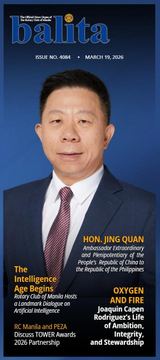
 Hon. Jing Quan
 The Intelligence Age Begins: Rotary Club of Manila Hosts a Landmark Dialogue on Artificial Intelligence
 Rotary Club of Manila and PEZA Discuss TOWER Awards 2026 Partnership