

The Intelligence Age Begins: Rotary Club of Manila Hosts a Landmark Dialogue on Artificial Intelligence

The 24th Weekly Membership Meeting of the Rotary Club of Manila gathered Rotarians, guests, and distinguished thought leaders at the historic Manila Polo Club for a timely and farreaching conversation on one of the most transformative forces of our time — Artificial Intelligence.
Presided over by Rotary Club of Manila President Raoul C. Creencia, the meeting underscored Rotary’s enduring tradition of convening leaders to examine issues that will shape the future of society. With Club Secretary Antonilo D.C. “Anton” Mauricio serving as moderator, the program seamlessly blended Rotary’s cherished traditions of fellowship and ceremony with a compelling discussion about the opportunities and challenges presented by the rapidly emerging Intelligence Age.

Opening Ceremonies and Fellowship
The meeting began with registration and fellowship over lunch, a moment that allowed Rotarians and guests to reconnect and strengthen the friendships that form the bedrock of the organization’s service mission.

President Raoul C. Creencia formally called the meeting to order and welcomed the assembly to an afternoon that promised both intellectual stimulation and meaningful dialogue.
The invocation was delivered by Director-Elect Delfin N. “Del” Lorenzana, whose prayer invited reflection on wisdom, humility, and responsibility in leadership— qualities that are increasingly vital in a world being reshaped by technological change.

Members then rose for the Philippine National Anthem, reaffirming Rotary’s deep commitment to the nation and its future. The RCM World-Famous Music Chorale followed with a stirring rendition of the Rotary Club of Manila Hymn, reminding those present of the Club’s proud legacy as the oldest Rotary club in Asia.
Rotarian Steve “Momo” Mommaerts then led the members in the recitation of The Four-Way Test, Rotary’s timeless ethical guide that calls upon every Rotarian to measure actions and decisions against the highest standards of truth, fairness, goodwill, and benefit to all concerned.

Secretary Antonilo D.C. “Anton” Mauricio then offered the Acknowledgement of Guests, warmly recognizing visiting Rotarians, distinguished speakers, and friends of the Club.
The RCM World-Famous Music Chorale returned to the stage to perform the Welcome Song, further reinforcing the sense of camaraderie and fellowship that has long characterized Rotary gatherings.

Celebrating Rotary Fellowship
The meeting also paused to celebrate several Rotarians marking birthdays during the week.

Those recognized included DGND Hermie Esguerra, Rotarians Brendan Egan, JB Pallasigue, Ben Ibuyan, and STAR Rotarian Winston Ginez.
The RCM World-Famous Chorale led the traditional “Maligayang Bati / Happy Birthday” tribute, a cheerful interlude that reminded everyone present that Rotary is not only an organization of service and leadership but also a fellowship of enduring friendship.

President’s Time
During President’s Time, President Raoul C. Creencia reflected on the responsibility of leaders to remain attentive to the forces shaping society’s future. In a rapidly evolving world, he noted, civic organizations must continually expand their understanding of emerging developments — particularly those that promise to transform economies, institutions, and everyday life.

Artificial Intelligence, he observed, represents one of the defining issues of our era. The technology’s ability to reshape industries, education, governance, and communication means that conversations about AI can no longer remain confined to technical circles. They must involve leaders from every sector of society.
This perspective set the stage for the afternoon’s centerpiece discussion.

Introducing the Panel “The State of the Nation in AI”
The panel discussion, introduced by Club Secretary Anton Mauricio, focused on the theme “The State of the Nation in AI.”

The speakers represented the Global AI Council Philippines, a multidisciplinary initiative that brings together experts from technology, law, business, and public policy to help shape the country’s approach to artificial intelligence.
The distinguished panelists included:

Dr. Donald Patrick Lim, Chairman and Co-Founder of the Global AI Council Philippines.
Atty. Mark S. Gorriceta, Corporate Secretary and Co-Founder of the Global AI Council Philippines.

Ms. Catherine S. Jalandoni, Founder and President of the Global AI Council Philippines.
Together, the panelists offered a broad and insightful perspective on how the Philippines must prepare for the profound transformations brought about by AI.

Entering the Intelligence Age Dr. Donald Patrick Lim’s Strategic Perspective
Dr. Donald Patrick Lim began the discussion with a thoughtful preamble that framed artificial intelligence as a defining force of the present rather than a distant possibility.

AI, he emphasized, is already transforming how businesses operate, how governments serve citizens, how students learn, and how societies make decisions. For that reason, the real question facing the world today is no longer whether AI will change the world. The more urgent question is how societies will shape AI so that it improves the world rather than harms it.
For the Philippines, artificial intelligence presents both tremendous opportunity and serious challenge.

The country possesses important advantages, including a young and digitally savvy population, a globally competitive workforce, and a vibrant ecosystem of technology entrepreneurs. For many years these strengths helped establish the Philippines as a global leader in outsourcing, customer support, and digital services.
Yet the very technologies that created these industries are now disrupting them.

Lim explained that AI systems capable of translating languages instantly and performing sophisticated knowledge work are gradually eroding the traditional advantages of English proficiency and service specialization. In this new environment, countries can no longer rely solely on their workforce’s communication skills. They must instead develop the capacity to create, design, and deploy AI-enabled technologies themselves.
In other words, the Philippines must move beyond being merely a user of AI tools and instead aspire to become a builder of AI-driven industries.

Education and the Foundations of Intelligence
One of the most important themes of Lim’s presentation concerned education and workforce preparation.

Although many governments have begun discussing the inclusion of artificial intelligence in school curricula, Lim argued that the most urgent priority is actually far more fundamental.
Before students can master AI, they must develop the ability to think clearly, reason logically, and solve problems independently.

He explained that even highly capable university students often struggle with basic mental calculations or analytical reasoning because of an overreliance on digital tools. Without strong foundational skills in mathematics and logical thinking, students may find themselves ill-equipped to design or guide AI systems effectively.
Thus, rather than rushing prematurely into specialized technical instruction, the country must strengthen the basic intellectual foundations that enable students to process information, identify problems, and formulate solutions.

Artificial intelligence, Lim emphasized, is ultimately shaped not by machines but by the questions humans ask and the decisions humans make.
Three Principles for Responsible AI Development

According to Lim, responsible AI development must be anchored on three essential principles.
First, technology must place humans first. Artificial intelligence should enhance human potential and creativity rather than undermine human dignity or displace meaningful work without consideration of social consequences.

Second, AI must be used responsibly and ethically. Systems must operate transparently, and their outputs must be accountable to the public.
Third, artificial intelligence must contribute to national competitiveness. Nations that harness AI effectively will lead the next era of economic growth, while those that fail to adapt risk falling behind.

For Lim, these principles underscore the importance of collaboration across sectors. Governments, businesses, universities, and civil society must work together to ensure that the benefits of AI are distributed widely and responsibly.
Technology, Law, and Governance Atty. Mark S. Gorriceta’s Perspective

The second speaker, Atty. Mark S. Gorriceta, brought a legal and policy perspective to the discussion.
A pioneer in technology law in the Philippines, Gorriceta has been deeply involved in shaping the country’s regulatory framework for emerging technologies. His work spans areas such as blockchain, cryptocurrency, e-commerce, digital banking, and cybersecurity.

He explained that artificial intelligence has quickly become a major legislative concern, with numerous bills currently being discussed in Congress. Many of these proposals, Gorriceta noted, approach AI primarily from a defensive standpoint, focusing on the possibility that automation could displace jobs. While such concerns are understandable, he cautioned that regulation must not focus exclusively on job protection.
Artificial intelligence also raises important questions about governance, trust, literacy, transparency, and the spread of misinformation. Deepfakes and automated social media manipulation, for example, present serious challenges for democratic societies.

Gorriceta emphasized that legislation must balance two equally important goals. On one hand, governments must protect citizens from potential harm and ensure that AI systems are used responsibly. On the other hand, policymakers must avoid stifling innovation by regulating technologies that are still rapidly evolving.
Crafting effective AI policy therefore requires careful judgment and continuous dialogue between lawmakers, industry experts, and civil society.

The Philippines and ASEAN AI Leadership
Gorriceta also discussed the Philippines’ opportunity to play a significant role in shaping the future of artificial intelligence within Southeast Asia.

With the country serving as ASEAN Chair, the Philippines has a unique platform from which to contribute to regional discussions on technology governance and innovation.
Developing a coherent ASEAN framework for AI will be essential in promoting collaboration, sharing best practices, and ensuring that the region remains competitive in the global digital economy.

If approached strategically, Gorriceta suggested, artificial intelligence could become not only a technological tool but also a diplomatic and economic bridge connecting ASEAN nations in shared development.
A Mother’s Motivation Catherine S. Jalandoni on Building the Future

The final speaker, Ms. Catherine S. Jalandoni, offered a deeply personal perspective that brought emotional resonance to the discussion.
As Founder and President of the Global AI Council Philippines, she explained that her involvement in AI advocacy began not from technological curiosity but from a very human concern: the future of her children.

As a mother of five, she realized that the technologies being developed today will define the world in which the next generation will live and work. That realization prompted her to ask a simple but urgent question: what can be done today to ensure that the Philippines is prepared for that future?
When the Global AI Council Philippines was formed, the group quickly discovered that even experts from different industries lacked clear answers to many of the questions surrounding artificial intelligence.

Instead of waiting for solutions from elsewhere, the organization decided to begin a national conversation. Its mission was to break down silos, connect stakeholders, and encourage collaboration among government agencies, private industry, academic institutions, and civic organizations.
Jalandoni emphasized that the work has been largely voluntary and driven by a shared sense of responsibility. The initiative has received no guarantees of reward, yet many leaders have stepped forward to contribute their time and expertise because they recognize the stakes involved.

Artificial intelligence, she observed, was introduced into the world without clear guardrails. Now the challenge is to establish those guardrails while the technology continues to evolve.
This task requires leadership, cooperation, and courage.

A Nation Beginning to Move
Despite the complexity of the challenge, Jalandoni expressed optimism about the progress already made.
Within a year, the Global AI Council Philippines has helped bring together national government leaders, local government units, members of Congress, and private sector organizations to begin addressing the opportunities and risks of artificial intelligence.
The goal is not perfection but momentum.
As AI continues to advance, the Philippines must move quickly to develop its own strategies for innovation, workforce development, and responsible governance.
The country’s greatest asset, she concluded, remains its people — their creativity, resilience, and willingness to collaborate in pursuit of a better future.
Open Forum and Dialogue
The panel discussion concluded with an Open Forum, during which Rotarians engaged the speakers with thoughtful questions and reflections.
The conversation ranged widely across topics such as workforce transformation, education reform, technological ethics, and the potential role of AI in strengthening economic competitiveness.
Participants recognized that artificial intelligence will inevitably reshape industries and institutions. Yet they also affirmed that the direction of this transformation will depend on human choices, values, and leadership.
Recognition and Appreciation
Following the discussion, President Raoul C. Creencia presented Certificates of Appreciation to the three panelists in recognition of their valuable insights and contributions to the Club’s continuing educational mission.
Their participation reflected Rotary’s commitment to fostering dialogue that bridges professional expertise with civic responsibility.
Rotary and the Future
The 24th Weekly Membership Meeting of the Rotary Club of Manila demonstrated once again the organization’s enduring role as a forum for thoughtful engagement with the issues shaping the modern world.
Artificial intelligence may be driven by complex algorithms and advanced computing power, but its ultimate impact will be determined by human judgment.
By bringing together leaders from technology, law, business, and civil society, the Rotary Club of Manila reaffirmed its belief that progress must be guided by ethics, collaboration, and a commitment to the common good.
As the world stands at the threshold of the Intelligence Age, Rotary’s timeless principle of Service Above Self remains as relevant as ever — reminding us that technological advancement must always serve humanity’s highest aspirations.
Meeting Fellowship
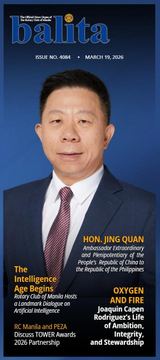
 Hon. Jing Quan
 Rotary Club of Manila and PEZA Discuss TOWER Awards 2026 Partnership
 OXYGEN AND FIRE | Joaquin Capen Rodriguez’s Life of Ambition, Integrity, and Stewardship