

When History Calls: How the Rotary Club of Manila Reimagined a 107-Year Legacy
The club's 107th induction on July 2, 2026 began with a dawn oath-taking at the Rizal Monument and ended with a celebration at The Manila Hotel.

There are occasions that simply occupy a place in the calendar.
And then there are those rare moments that quietly alter the trajectory of an institution.
For the Rotary Club of Manila, July 2, 2026, belonged unmistakably to the latter.

It was, on paper, merely another induction ceremony — the formal passing of leadership from one president to the next. But by the time the sun had risen over Luneta and finally set beyond the chandeliers of The Manila Hotel, something far more significant had unfolded.
It became a meditation on history.
On stewardship.

On what it means to inherit an institution that has already lived for more than a century — and yet must somehow continue finding new ways to inspire.
Asia's First Rotary Club had not merely installed its 107th President.
It had reintroduced itself to its own history.

A Different Beginning
Ironically, none of this was how it was originally supposed to happen.
The new President had envisioned something almost radically simple.

His earliest concept was not grandeur but humility.
Instead of a ballroom filled with dignitaries, he imagined taking his oath at Hospicio de San Jose, surrounded by the children whose lives Rotary seeks to improve.
No elaborate production.

No glittering ceremony.
Just service.
Afterward, everyone would share a modest meal together.

It would have been an unmistakable statement that Rotary exists not for spectacle but for compassion.
It was, by every measure, a beautiful idea.
Yet the Rotary Club of Manila carries a burden that few organizations possess.

Its history demands something more.
Founded in 1919, it is not merely another Rotary club. It is the oldest in Asia — the Mother Club from which hundreds of Rotary clubs across the continent trace their roots.
Its ceremonies have never belonged solely to its members.

They belong to Rotary's collective memory.
Senior leaders gently reminded the incoming President of this reality.
The Rotary Club of Manila has always been expected to lead.

Its traditions establish benchmarks.
Its standards become examples.
Its ceremonies become institutional statements.

Gradually, the vision evolved.
An Oath Before the Nation's Hero
If Rotary International had chosen "Create Lasting Impact" as its worldwide theme, perhaps there could be no more meaningful backdrop than the monument of a man whose own sacrifice continues to shape the nation.

Thus was born one of the most extraordinary ideas in the club's modern history.
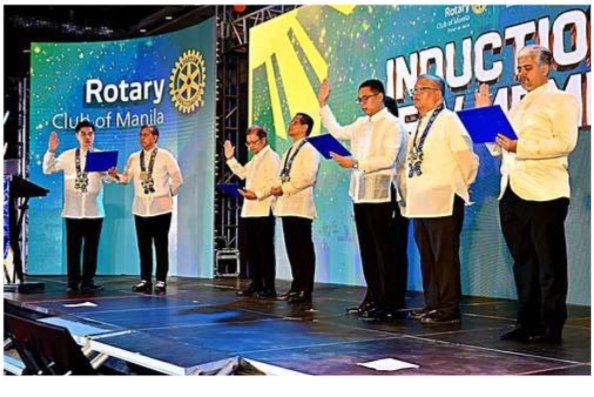
At dawn on July 2, under the first light of morning, the Board of Directors, Officers, and Foundation Trustees assembled before the Rizal Monument.
There, beneath the silent gaze of Dr. Jose Rizal, they took their oath.

It was the first induction ceremony of its kind in the Rotary Club of Manila's 107-year existence.
The symbolism was unmistakable.
Leadership was no longer confined within the walls of a hotel ballroom.

It became a public covenant.
The participation of Manila Mayor Francisco "Isko Moreno" Domagoso further underscored the enduring partnership between the city and Asia's First Rotary Club.
For those who witnessed it, the ceremony possessed an uncommon stillness.

The absence of fanfare amplified its solemnity.
History, patriotism, and service converged in one unforgettable morning.
The Invisible Mountain

Spectators often remember ceremonies.
They rarely see the mountains climbed to create them.
Behind every elegant moment lies months of unseen labor.

The dawn oath-taking required permits from numerous government agencies, painstaking coordination with civic authorities, traffic management, security planning, protocol officers, and logistical teams.
Every approval represented another hurdle.
Every revision demanded another meeting.

Every distinguished guest required careful scheduling.
Simultaneously, preparations were underway for an evening celebration worthy of the Rotary Club of Manila's place in history.
It was, in many respects, two major events compressed into a single day.

Such undertakings rarely succeed through inspiration alone.
They succeed because countless individuals quietly refuse to accept mediocrity.
The Architects Behind the Vision

Every landmark event has its visible moments.
Far fewer people see those who quietly make those moments possible.
Behind the Rotary Club of Manila's historic induction stood Past District Governor Alexander Cureg, who served as Induction Chairman and became the steady force that transformed an ambitious vision into a flawless reality. While others witnessed the elegance of the ceremonies, he carried the enormous responsibility of ensuring that every moving part — programming, protocol, logistics, production, fundraising, and coordination — worked in harmony. His leadership was never loud, but it was unmistakable. Calm under pressure, meticulous in preparation, and unwavering in his pursuit of excellence, he provided the steady hand that allowed an unprecedented undertaking to unfold with remarkable precision. If the ceremonies appeared effortless, it was because months of painstaking work had been orchestrated long before the first guest arrived.

Equally deserving of recognition was Rotarian Lawrence "Lance" Tan, whose creativity, determination, and relentless execution gave life to what many initially believed impossible. It was Lance who spearheaded the historic dawn oath-taking at the Rizal Monument — the first in the Rotary Club of Manila's 107-year history. Coordinating multiple government agencies, navigating permits and protocols, and harmonizing the countless logistical details required to stage a ceremonial induction at one of the nation's most sacred landmarks demanded exceptional perseverance. Through his efforts, an inspired idea became a defining milestone not only for the club but for Rotary history in the Philippines.
Together, PDG Alex Cureg and Rtn. Lance Tan demonstrated a timeless truth about leadership: history is rarely shaped by a single individual. It is built by dedicated people who willingly carry enormous responsibilities, often behind the scenes, so that others may experience moments that appear effortless. Their work ensured that July 2, 2026, would be remembered not simply as another induction ceremony, but as one of the most significant milestones in the modern history of Asia's First Rotary Club.
More Than an Anniversary

The evening celebration at The Manila Hotel reflected that same philosophy.
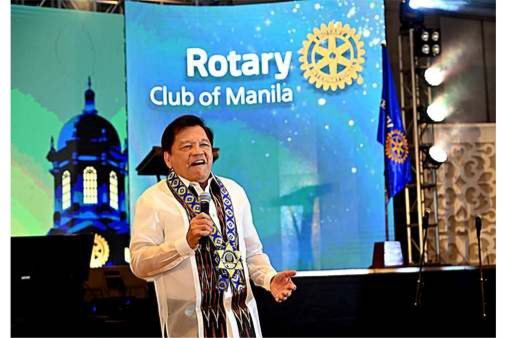
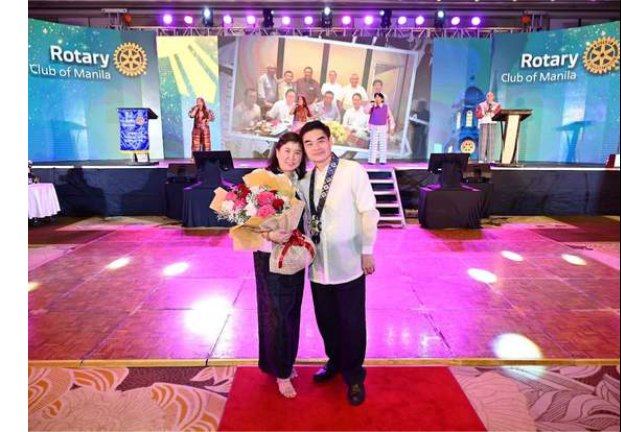
The spacious Fiesta Pavilion welcomed more than 440 guests, transforming what had been envisioned as a club induction into something resembling a district-wide convention.
The room itself became a portrait of relationships built over decades.

Present were Rotary leaders from across District 3810, Past Presidents, Past District Governors, civic leaders, university classmates, business colleagues, and friends representing organizations that had intersected with the President's own journey — from JCI Manila and JCI Senate Manila to the Philippine Paint and Coatings Association, the Anvil Business Club, and the Philippine Hong Tei Cultural Association.
Their presence revealed something fundamental about leadership.
No meaningful journey is ever traveled alone.

Every chapter leaves behind companions.
Every season of service creates friendships that outlive the office itself.
Honoring Those Who Came Before

The ceremonies never allowed the evening to become merely celebratory.
Instead, they continually returned to one central idea:
Legacy.

Past President Domingo S. Guevara and Dr. Jaime C. Laya were honored for fifty years of Rotary service — a reminder that institutions are ultimately sustained not by speeches but by decades of faithful commitment.
Immediate Past President Raoul C. Creencia received the Leadership Award in recognition of a year that strengthened the club and laid the groundwork for future initiatives.
New members were welcomed into the Rotary family.

The message was unmistakable.
A healthy institution simultaneously remembers its elders while embracing its future.
Voices That Challenged

The evening's distinguished speakers reinforced that narrative.
His Eminence Pablo Virgilio Cardinal David challenged Rotarians to embrace humility, moral courage, and compassion.
District Governor Dr. Maria Rosa "Bing" Carrion reminded members that Rotary's greatest achievements are always collective.

Rotary International Director-Elect Engr. Edna Sutter urged members to think beyond their own clubs and dedicate themselves to creating impact that outlives individual terms.
Together, the speakers transformed the induction from ceremonial obligation into moral reflection.
Leadership, they suggested, is not measured by applause.

It is measured by what remains after the applause ends.
Music as Institutional Memory
One of the evening's most memorable features came not through speeches but through music.

The Rotary Club of Manila World Famous Music Chorale, under the leadership of Past Director Oscar del Rosario and Maestro Domino Marcos, once again reminded everyone why it occupies such a cherished place within the club's identity.
Its performances transcended entertainment.
They became expressions of institutional memory.

Music accomplished what speeches sometimes cannot.
It connected generations.
It transformed fellowship into shared emotion.

Adding to the celebration were performances by the internationally acclaimed vocal group The CompanY, renowned theater actress Carla Guevara-Laforteza, and former Senator Atty. Joey Lina, now President of The Manila Hotel.
Their unexpected appearances infused warmth, spontaneity, and delight into an evening already rich with symbolism.
Showing Up

Perhaps the evening's greatest achievement cannot be measured in program schedules or attendance figures.
It can be measured in something far simpler.
Presence.

In the days before July 2, many worried that major demonstrations scheduled within Manila would significantly affect attendance.
Traffic.
Mobility.

Security.
Logistics.
There were genuine reasons for concern.
Yet people came.
Not reluctantly.
Not sparsely.

They arrived early.
They filled the ballroom.
They demonstrated, through their very presence, that institutions endure because people choose to believe in them.
Attendance became affirmation.
Support became testimony.
The Power of Unity

Threaded throughout every ceremony was the President's chosen theme:
Rotary T.U.R.N. — Toward a Unified Rotary Nation.
It is a deceptively simple phrase.

Yet beneath it lies an enduring truth.
Rotary has never been built upon individual accomplishment.
Its greatest projects emerge from collective purpose.
Its finest traditions are sustained by shared responsibility.
Its future depends not upon one President, but upon many servants moving in the same direction.
That philosophy became visible throughout the event.

The Board of Directors worked as partners rather than spectators.
Committee members carried enormous responsibilities without seeking recognition.
Volunteers performed countless invisible tasks.

Sponsors, Secretariat personnel, Foundation officers, government partners, performers, and donors collectively transformed an ambitious vision into reality.
History rarely remembers every name.
But history is always built by many hands.

The Meaning of Stewardship
Perhaps the most compelling lesson from July 2 lies not in what was celebrated but in what was inherited.
Every President receives a gavel.

Few inherit a legacy spanning more than a century.
That distinction changes everything.
It shifts leadership away from ownership toward stewardship.

The Rotary Club of Manila has survived wars, occupations, revolutions, economic crises, pandemics, and generations of changing leadership because each generation understood a simple truth:
They were never owners.
Only caretakers.
Their task was never merely to preserve the institution.
It was to strengthen it before passing it onward.
After the Applause
Every ceremony eventually concludes.
Lights dim.
Music ends.
Photographs are archived.
Guests depart.
The applause fades into memory.
What remains is work.
That is perhaps the lasting significance of July 2, 2026.
Its greatest achievement was not producing memorable photographs or an elegant celebration.
It was reminding an institution why it exists.
When future Rotarians revisit this day, they may remember the unprecedented dawn oath-taking before the Rizal Monument.
They may remember the crowded ballroom at The Manila Hotel.
They may remember stirring speeches and unforgettable music.
But perhaps what they will remember most is something less visible.
They will remember the moment when Asia's First Rotary Club looked back upon 107 years of history — not as a monument to preserve, but as a promise to fulfill.
For institutions, like nations, are ultimately judged not by how faithfully they commemorate the past, but by how courageously they prepare the future.
And on that remarkable day in July, the Rotary Club of Manila did both.

 Editorial: Disruption, Anyone?
 Invocation