

A Full House For Hope
Senator Risa Hontiveros addressed the Club's most heavily attended weekly meeting of the year, where RCM and JCI Manila signed a Memorandum of Agreement.

AT the Rotary Club of Manila’s most heavily attended weekly meeting of the year, Senator Ana Theresia “Risa” N. Hontiveros challenged Rotarians, business leaders, professionals, and civic organizations to help build a Philippines where institutions work, opportunities are shared, and leadership answers not only to the law but also to conscience. The occasion also marked a new chapter in civic cooperation as the Rotary Club of Manila and JCI Manila formalized their commitment to pursue meaningful programs together.
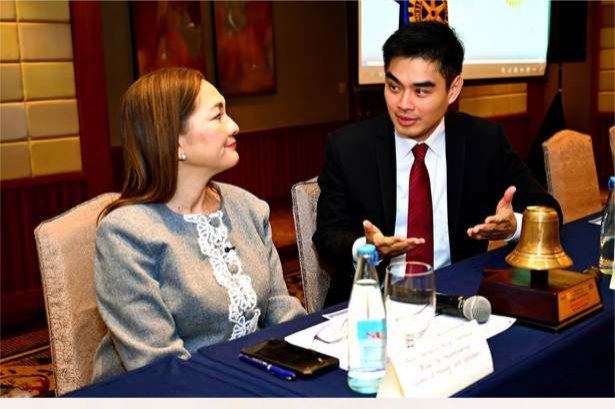
The Makati Rooms A and B of Makati Shangri-La were filled to capacity on August 27, 2026, as the Rotary Club of Manila welcomed Senator Risa as Guest of Honor and Speaker at its 8th Weekly Membership Meeting.
With more than 100 Rotarians, Rotaractors, JCI members, civic leaders, distinguished guests, and representatives of the media in attendance, it became the Club’s most jam-packed weekly meeting of Rotary Year 2026—2027 thus far.
Long before RCM President Reginald T. Yu called the meeting to order at noon, the room was already alive with anticipation. Conversations moved from table to table, Rotaractors mingled with senior Rotarians, media representatives prepared their equipment and coordinated their coverage, and guests eagerly awaited the opportunity to hear directly from one of the country’s most prominent legislators at a particularly consequential moment in national life.

The extraordinary turnout reflected not only the stature of the guest but also something deeper: Filipinos continue to hunger for serious, direct, and principled conversations about the future of their country.
It was more than a well-attended luncheon. It was a gathering of people who understood that the issues confronting the nation cannot be left entirely to politicians, bureaucrats, or government institutions. They require the participation of business leaders, professionals, civic organizations, young people, the media, and ordinary citizens.
For the Rotary Club of Manila, the first Rotary club in Asia, this is precisely what its weekly meetings seek to accomplish. The Club aims not merely to bring distinguished personalities before its members, but to create a forum where national concerns can be examined thoughtfully, different perspectives can be heard respectfully, and ideas can ultimately be translated into purposeful action.
Under the Club’s theme, T.U.R.N., or Toward a Unified Rotary Nation, and Rotary International’s call to Create Lasting Impact, the afternoon became a powerful reflection on what a better Philippines should look like and what citizens and institutions must do to help build it.

A Meeting Grounded in Rotary’s Values
President Yu formally called the meeting to order at 12:00 noon.
Past RCMFI President Wilfredo M. Peliño led the invocation, followed by the Philippine National Anthem and the Rotary Club of Manila Hymn. The RCM World-Famous Music Chorale once again lent dignity, warmth, and fellowship to the proceedings.
Rotarian J. Alfonso L. Katigbak led the recitation of The Four-Way Test, while STAR Rotarian Hridesh “Raj” Parwani welcomed the visiting Rotarians and guests. The Chorale also serenaded the week’s birthday celebrants, Rotarian Emil Lao and Rotarian John Tan.

These traditions may be familiar to those who regularly attend Rotary meetings, but on this particular afternoon, The Four-Way Test assumed even greater significance.
“Is it the truth?”
“Is it fair to all concerned?”
“Will it build goodwill and better friendships?”

“Will it be beneficial to all concerned?”
These questions provided an appropriate moral framework for the address that followed. Senator Risa would later speak about truth, fairness, institutional integrity, due process, public accountability, and leadership that places the common good above personal or partisan advantage.
Her message demonstrated how relevant The Four-Way Test remains not only to the conduct of Rotarians but also to the manner in which institutions are governed, businesses are managed, public authority is exercised, and citizens participate in democracy.
Practicing Democracy Within the Institution

The meeting also marked an important moment in the continuing democratic life of the Rotary Club of Manila.
Immediate Past President Raoul C. Creencia, chairman of the Club’s Commission on Elections, formally opened the nomination proceedings for the Rotary Club of Manila’s officers for Rotary Year 2027-2028.
This part of the program may have been brief, but its institutional importance could not be underestimated. Even as the Club prepared to hear from a national leader about the demands of democracy and accountable government, its members were attending to the orderly succession of leadership within their own organization.
Leadership in Rotary is never a permanent entitlement. It is a trust conferred for a limited period. Each president and Board of Directors is given an opportunity to strengthen the institution, expand its service, preserve its traditions, and prepare the next generation to assume responsibility.

The opening of nominations reminded members that institutions endure when their stakeholders respect established processes, develop future leaders, and recognize that the organization must always remain greater than any individual who temporarily occupies its highest office.
Asking What “Better” Really Means
Former Philippine Ambassador to Russia Victor G. Garcia III introduced Senator Risa, whose career in public service has been closely associated with the defense of women, children, workers, consumers, and other vulnerable sectors, as well as with health, education, good governance, and human rights.
Assistant Club Secretary Jonas R. Gonzales served as moderator and host for the featured portion of the program.

The theme of Senator Risa’s address was “Legislating Hope. Building a Better Philippines.”
As a legislator, she could easily have devoted her entire address to enumerating the laws she had helped pass, the measures she continues to pursue, and the reforms she believes Congress should prioritize.
Instead, she focused on the final three words of the theme: “a better Philippines.”
She asked a deceptively simple but profoundly important question: What does “better” actually mean for an ordinary Filipino?

For far too many Filipinos, she observed, the idea of a better life has become painfully modest. Sometimes, it simply means surviving until the next day. It means paying the bills, staying within a very limited budget, avoiding illness, making it to the next payday, or finding enough food to place on the family table for one more night.
For families constantly living on the edge, hope may be reduced to a quiet prayer before going to sleep that tomorrow will not be as difficult as today.
Her words compelled the audience to look beyond abstract indicators of development. Economic growth, legislative productivity, infrastructure expenditure, and investment statistics mean little if Filipino families remain unable to experience greater security, dignity, and hope in their daily lives.
As Senator Risa declared:

“A better Philippines is one where people can reasonably expect that if we work hard, life tomorrow can be less difficult, induce less anxiety, allow for more space for hope than today.”
A better Philippines, in her vision, is one where a person does not need wealth, political access, a powerful surname, or the right connections to receive fair treatment.
It is a country where entrepreneurs can establish businesses without cultivating patrons; where women can go to work without fear of harassment; where consumers are protected instead of treated as prey; where employees receive a fair share of the value they help create; and where families can plan for the coming year instead of constantly worrying about whether they can survive the coming week.
These should not be extraordinary privileges. They should be ordinary expectations in a country whose institutions genuinely serve its people.

Institutions Must Work
At the center of Senator Risa’s message was a straightforward but demanding proposition: the country’s institutions must work.
Filipinos should not have to know someone powerful for government to work for them. The rules should not change according to a person’s surname, wealth, political connections, or whoever happens to occupy Malacañang.
Corruption and impunity, she reminded the audience, are not issues separate from economic development. They directly weaken every system they touch.
When corruption is tolerated, infrastructure becomes slower and more expensive. Public services become thinner. Opportunities narrow. Trust deteriorates. Long-term planning gives way to short-term survival.
No national development strategy, regardless of how ambitious or carefully designed, can prosper if the institutions responsible for implementing it have been hollowed out by patronage, impunity, and the theft of public trust.
When institutions function properly, however, talent, hard work, entrepreneurship, and innovation are given a fighting chance against inherited privilege and political access.
This message was particularly relevant to the business executives, professionals, civic leaders, and institution-builders in the room.

A level playing field is not merely an academic concept. It determines whether businesses compete on merit, whether small suppliers receive genuine opportunities, whether employees are treated fairly, and whether investors can make long-term decisions based on stable and consistently enforced rules.
True prosperity cannot be measured by growth figures alone. It must travel, as Senator Risa said, “from the boardroom to the factory floor,” from financial centers to farms, communities, cooperatives, and small enterprises, until it finally reaches the family table.
The real evidence of progress can be found in better wages, more affordable household expenses, good schools, decent health care, reliable public services, and the confidence of families that tomorrow can genuinely be better than today.
Turning Principles Into Real Protection

Senator Risa situated her legislative work within this broader vision of human dignity and institutional responsibility.
She spoke about the Safe Spaces Act, more popularly known as the Bawal Bastos Law, which seeks to protect dignity and safety in streets, schools, workplaces, public spaces, and online environments.
She discussed the Expanded Solo Parents Welfare Act, which recognizes that families come in different forms and that individuals raising children largely on their own deserve meaningful assistance and protection.
She also referred to initiatives to strengthen consumer protection as scams, fraud, and other forms of exploitation increasingly move into digital spaces. She highlighted the importance of supporting cooperatives and micro, small, and medium enterprises, promoting affordable and reliable energy, and ensuring that new technologies and economic opportunities reach communities that are often the last to benefit.

At first glance, these may appear to be separate legislative concerns. Women’s safety, family welfare, consumer protection, energy, livelihood, technology, and small-business development may fall under different committees and government agencies.
Yet Senator Risa brought them together under one coherent principle: institutions must protect people from abuse, give everyone a fair opportunity to prosper, and enable every Filipino to live with dignity.
The Space Between Law and Conscience
Perhaps the most compelling part of Senator Risa’s address was her acknowledgment of the limitations of legislation itself.

Good laws can protect rights, correct injustice, open opportunities, and restrain abuses of power. But even the best-written law cannot manufacture every virtue that a nation requires.
Society can legislate against corruption, but it cannot legislate integrity into the human heart.
It can prohibit harassment, but it cannot manufacture respect.
It can protect fair competition, but it cannot force every business leader to place the common good above every short-term advantage.

As Senator Risa memorably stated: “The law can establish the floor; it cannot, by itself, build everything that must rise above it.”
This insight resonated deeply with the Rotarians in attendance.
The decisive tests of leadership often take place in the vast space between what the law permits and what conscience demands. Not everything that is legally permissible is necessarily fair, ethical, or beneficial to society. Conversely, some of the most courageous decisions leaders must make are not compelled by law but arise from a deeper sense of duty.
Leadership rarely presents perfectly clear choices. The most consequential decisions often involve competing interests, incomplete information, intense pressure, and consequences that cannot be predicted with certainty.

In such moments, leadership requires patience to understand a problem before rushing toward a solution. It requires clarity to separate what is true from what is merely loud, popular, or convenient. It requires the humility to listen to people with whom one disagrees and the honesty to change course when evidence shows that one is wrong.
Most of all, it requires the courage to choose the responsible course even when the easier choice is more personally advantageous.
This was where Senator Risa’s message converged most powerfully with Rotary’s ideal of Service Above Self.
A Challenge to Business and Civic Leaders

Senator Risa did not place the entire burden of nation-building on Congress, Malacañang, the courts, or government agencies.
She directed her challenge to the business executives, professionals, civic leaders, and community builders in the room.
Many of those present lead companies, professional associations, civic organizations, and community institutions. They decide whom to employ and promote, which suppliers to support, where to invest, what standards to enforce, and which practices to tolerate.
Some have access to rooms that most Filipinos will never enter. With that access comes a responsibility to use influence deliberately and conscientiously.

Senator Risa challenged business and civic leaders to demand clear and equal rules from government, reject special arrangements created for the well-connected, and refuse to treat corruption as merely another cost of doing business.
She urged them to create workplaces where misconduct has real consequences, give small and local suppliers a genuine opportunity to compete, pay people fairly, invest in their development, protect consumers, and use their voices in shaping public policy.
Most significantly, she asked them not merely to advocate for policies that make business easier, but to support policies that make the Philippines better.
When institutions are tested, citizens and leaders must defend those institutions. They must insist on evidence, due process, and accountability regardless of the personalities involved, the political interests at stake, or whether a particular result favors their preferred side.

Democracy does not require unanimity. It requires principled disagreement within a shared commitment to truth, fairness, due process, and institutional integrity.
Service Above Self, therefore, cannot be confined to philanthropy. Feeding the hungry, educating children, responding to disasters, protecting communities, and caring for the vulnerable remain indispensable expressions of Rotary service.
But Service Above Self also asks those who possess influence how they exercise that influence when no law forces them to do what is right.
Bringing Together Two Traditions of Service

The afternoon acquired additional institutional significance when the Rotary Club of Manila and JCI Manila signed a Memorandum of Agreement establishing a framework for cooperation on future community-service and civic initiatives.
JCI Manila President Edison “Eds” Ke signed on behalf of JCI Manila, while President Yu signed on behalf of the Rotary Club of Manila.
The partnership carried special personal meaning for President Yu because he is not only President of the Rotary Club of Manila but also a JCI Senator. He previously served three terms as an officer of the JCI Manila Board of Directors and later became President of JCI Senate Manila. The values and experiences he gained through the Junior Chamber movement profoundly influenced his understanding of leadership, active citizenship, and community service.
JCI teaches that leadership is best developed through action. It calls upon young active citizens to identify problems, mobilize people, develop solutions, and create positive change.

Rotary, meanwhile, brings together established leaders in business, the professions, and public service under the enduring principle of Service Above Self.
The two organizations come from distinct traditions, but they share a common passion: improving lives through organized, purposeful, and sustainable community service.
For President Yu, the signing represented more than an agreement between two civic organizations. It created a bridge between two important chapters of his own leadership journey.
He had witnessed how JCI develops young people by entrusting them with real responsibility. He had likewise experienced how Rotary transforms professional fellowship into sustained humanitarian action.

By bringing these two institutions together, the partnership creates opportunities for the energy, imagination, and leadership potential of JCI members to work alongside the experience, networks, and service infrastructure of Rotarians.
The agreement provides an umbrella framework through which JCI Manila and RCM may identify and pursue measurable initiatives in such areas as disaster preparedness and resilience, education, health, environmental protection, livelihood development, peacebuilding, animal welfare, and other mutually approved community concerns.
Each specific undertaking will be separately evaluated, approved, and documented, with clearly defined objectives, beneficiaries, responsibilities, resources, safeguards, and measures of success.
This structure is intended to ensure that the partnership will not be merely ceremonial. It seeks to produce well-governed projects with meaningful, measurable, and lasting results.

The signing also carried a message for the Rotaractors who attended the meeting. Civic leadership is not confined to one organization, one generation, or one institutional tradition. Communities benefit most when service organizations cooperate, learn from one another, and combine their complementary strengths.
JCI Manila can help engage a younger generation of active citizens. The Rotary Club of Manila can provide continuity, professional expertise, institutional experience, and access to Rotary’s wider network of clubs and service partners.
Together, the two organizations can extend the reach of their programs and create a stronger leadership pipeline for civic involvement.
At a meeting devoted to building a better Philippines, the Memorandum of Agreement gave concrete form to the principle that nation-building does not belong to government alone. It demonstrated the willingness of both organizations to move beyond conversation and begin constructing partnerships capable of turning shared ideals into shared action.

Dialogue in a Crowded Room
The open forum that followed Senator Risa’s address allowed the overflowing audience to engage with her ideas in the setting Rotary provides best: a candid but civil exchange among people from different professions, generations, and perspectives.
With Rotarians, Rotaractors, JCI members, guests, and members of the media all present, the discussion affirmed the continuing relevance of civic organizations as conveners of meaningful democratic dialogue.
The audience had not come merely to see a nationally prominent personality. Its members came to listen, reflect, and examine their own responsibilities.
For the young leaders and Rotaractors present, the meeting offered a close view of public leadership exercised on the national stage. For business and professional leaders, Senator Risa’s address presented a more personal challenge: to consider whether their own decisions strengthen or weaken the fair, humane, and accountable society they expect government to create.
The presence of the media extended the reach of the conversation beyond the walls of Makati Shangri-La. The meeting’s deepest impact, however, was felt inside the room, in the encounter between public policy and personal responsibility.
Senator Risa’s message allowed no one the comfort of believing that government alone is responsible for the country’s failures or that government alone can secure its future.
A Defining Meeting for the Rotary Year
Before the meeting concluded, President Yu presented Senator Risa with the Rotary Club of Manila’s Certificate of Appreciation in recognition of her presence and thought-provoking address.
President Yu adjourned the formal meeting at 1:30 p.m., but the ideas raised that afternoon remained with the audience.
The 8th Weekly Membership Meeting was a significant milestone for Rotary Year 2026-2027. The more than 100 people who filled the venue demonstrated the Rotary Club of Manila’s continuing convening power and the public’s appetite for direct engagement with national leaders.
Attendance, however, becomes truly meaningful only when it is converted into attention, reflection, cooperation, and action.
The gathering also illustrated the deeper promise of T.U.R.N., or Toward a Unified Rotary Nation.
Unity does not require uniformity of opinion. It means gathering people of different backgrounds and perspectives around shared democratic principles, a commitment to truth and fairness, and a willingness to place the common good above narrow advantage.
It means creating a space where dissent remains respectful, leadership remains accountable, and service grows from charitable activity into ethical citizenship.
The agreement with JCI Manila brought that aspiration into the realm of concrete action. By joining forces with an organization that shares its passion for community service and leadership development, the Rotary Club of Manila widened the circle of people capable of creating lasting impact.
Senator Risa concluded her address by reminding the audience that every generation inherits institutions it did not create, problems it did not choose, and possibilities uniquely its own. The responsibility of each generation is to meet that inheritance with clarity and foresight and to leave behind a country more capable, more just, and more humane than the one entrusted to it.
That challenge lingered after the final gavel.
A better Philippines will require better laws and stronger institutions. But it will also be built in workplaces, boardrooms, professional organizations, youth movements, civic clubs, and communities. It will be built wherever Filipinos possess the power to influence what comes next.
On an afternoon when every seat seemed spoken for, the Rotary Club of Manila did more than host its biggest weekly gathering of the year.
The Club listened to a national leader explain that hope must be supported by institutions, that law must be strengthened by conscience, and that influence must be exercised with responsibility.
It carried out its own democratic process through the nomination of future Club officers.
It opened its doors to Rotaractors, JCI members, the media, and the wider community.
Through its agreement with JCI Manila, it affirmed that shared service can unite organizations, bridge generations, and transform goodwill into measurable action.
For President Yu, both as President of the Rotary Club of Manila and as a JCI Senator, the occasion carried deeply personal meaning. It brought together two institutions that had helped shape his understanding of leadership and service.
More importantly, it served as a reminder that titles, affiliations, and achievements matter only to the extent that they are used to improve the lives of others.
The question left with the audience was therefore both national and personal: Given the influence, opportunities, and responsibilities entrusted to each person, what kind of Philippines are they helping to leave behind?

 Editorial: Honor, Excellence, and Now, Service
 Guest Speaker: Atty. Angelo A. Jimenez
 Club Administration