

A Long Walk Toward Hope: Rotary Club of Manila Visits Bayanan Elementary School in Baco, Oriental Mindoro
Rotary Club of Manila Visits Bayanan Elementary School in Baco, Oriental Mindoro

For most children, going to school begins with a short walk or a familiar ride. For many pupils of Bayanan Elementary School in Baco, Oriental Mindoro, it begins with an extraordinary test of endurance.
Some children trek for as long as three hours each day through rocky terrain, often without adequate footwear and exposed to harsh weather. Along the way, they must cross the Bayanan River on a rickety makeshift bamboo bridge, an already dangerous passage made even more treacherous by rain and rising water. Yet they continue to come.
They walk because, at the end of that difficult journey, stands their school and the hope of a better future.
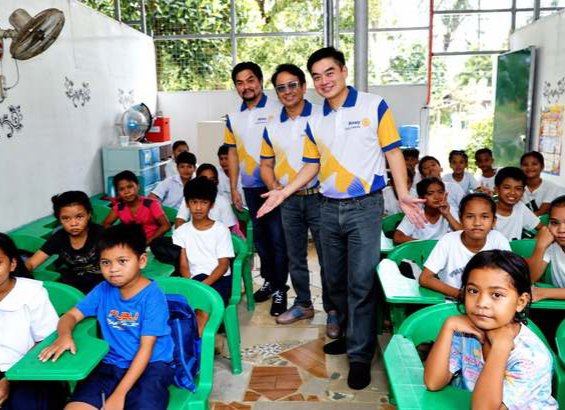
On September 1, the Rotary Club of Manila conducted an ocular inspection of Bayanan Elementary School, located in one of Baco's most remote barangays and within the ancestral domain of the Mangyan indigenous people.

The RCM delegation was led by President Reginald T. Yu, together with Director Nico Valencia, Director Teddy Kalaw, Club Secretary Albert Alday, Club Auditor Gani Macatoman, and RCM Global Grant Chair Aries Balanay.
Each member of the delegation came with a shared resolve: to see the conditions firsthand, listen directly to the school and community leaders, identify the most urgent needs, and determine how Rotary could help turn a long-delayed aspiration into concrete action.
The school currently serves approximately 197 pupils from Nursery to Grade 6, about 75 percent of whom are Mangyan children from geographically isolated communities.
What the delegation witnessed was both moving and deeply concerning.
A School in Urgent Need
The two-classroom building has serious structural and functional deficiencies. It has no ceiling, only makeshift windows and doors, and a roof that leaks whenever it rains. There is also no proper partition between the two classrooms, causing lessons and classroom activities to overlap and making it difficult for pupils to concentrate.
The school's comfort rooms likewise require significant improvement to provide children with safe, sanitary, and dignified facilities.
These are more than defects in a building. A leaking roof means lessons are interrupted by rain. A missing ceiling leaves children exposed to uncomfortable conditions. Inadequate doors and windows offer little protection from the elements. Poor sanitation affects the health, dignity, and attendance of the pupils.

For children who already endure an arduous journey just to attend class, these conditions impose yet another obstacle to learning.
Listening to the Community
During the ocular, the delegation interviewed Mrs. Ednalin Dunday, School Head of Bayanan Elementary School, and Barangay Chairman Nitoy A. Remnayon regarding the school's needs and the daily circumstances of its students.
Mrs. Dunday, who has led the school since 2013, has witnessed generations of pupils arrive after long and exhausting journeys, determined to learn despite poverty, distance, difficult terrain, and inadequate facilities.

Her appeal was not for luxury or convenience, but for the most basic conditions necessary for education: a roof that does not leak, classrooms with ceilings and proper partitions, secure doors and windows, and functional comfort rooms.
Barangay Chairman Remnayon likewise described the hardships faced by families in the area. Their accounts confirmed what the RCM delegation saw firsthand.
The needs of Bayanan Elementary School are urgent, genuine, and long overdue.
The ocular visit allowed the Rotary Club of Manila not only to document the physical state of the school, but also to listen to the people whose lives are directly affected by it.

Behind every damaged wall is a teacher struggling to conduct a lesson. Behind every leaking roof is a child trying to protect a notebook from the rain. Behind every request for assistance is a community that has waited patiently for someone to listen and act.
From Inspection to Immediate Action
The Rotary Club of Manila's visit did not end with documenting the school's condition.
Acting on Mrs. Dunday's request, the Club immediately began addressing a crucial requirement that had long delayed government intervention: the formal donation of the land on which the school stands.

Director Nico Valencia was asked to facilitate the securing of a Deed of Donation from the Valencia family, which owns the property occupied by the school. Once completed, the deed will be submitted to the Department of Education, enabling the agency to begin the formal process of mobilizing the construction and rehabilitation of the school's infrastructure.
This intervention could finally remove the legal and administrative obstacle that has prevented the long-awaited improvement of Bayanan Elementary School.
By helping bring together the school, the landowners, the community, and the Department of Education, the Rotary Club of Manila hopes to transform years of waiting into meaningful and lasting action.
A Comprehensive Commitment

The proposed rehabilitation will include:
Installation of classroom ceilings;
Repair of the leaking roof;
Installation of proper doors and windows;

Replacement of the partition between the two classrooms; and
Improvement of the school's comfort rooms.
The Rotary Club of Manila has also committed to undertake two auxiliary projects:
Installation of a Rotary Four-Way Test marker; and

Donation of diapers and milk to families and children in need.
The Four-Way Test marker will be more than a symbol of Rotary's presence. It will serve as a daily reminder that education is also about character, truth, fairness, goodwill, friendship, and concern for the welfare of others.
The donation of diapers and milk recognizes that the well-being of pupils is closely connected to the circumstances of their families and the larger community. These necessities will provide practical assistance to households facing economic hardship, particularly those caring for infants and young children.
Together, these initiatives reflect a holistic approach to service. They will improve the school's physical condition while also responding to the values and everyday needs of the community.

More Than a Building
At first glance, the project may appear to be about repairing a roof, installing ceilings, replacing doors and windows, building proper partitions, and improving comfort rooms.
Its true purpose, however, goes much deeper.
It is about telling every child in Bayanan that the hardships of geography should not determine the quality of education available to them.

It is about honoring parents who send their children to school despite the dangers of the journey. It is about supporting teachers who continue to serve under difficult conditions. It is also about standing with the Mangyan people and affirming that indigenous children deserve the same opportunities, protection, and dignity as every Filipino learner.
After walking for as long as three hours, crossing rocky terrain, enduring the elements, and navigating a precarious bamboo bridge, these children deserve to arrive at a school that is safe and worthy of their courage.
Their perseverance should not be met by a leaking roof.
Their determination should not be rewarded with makeshift doors and windows.

Their dreams should not be confined within classrooms lacking the most basic facilities.
As Nelson Mandela once said: “Education is the most powerful weapon which you can use to change the world.”
For the children of Bayanan, repairing a classroom is not merely rebuilding a structure. It is strengthening their chance to change their lives and transform their community.
Building a Bridge to a Better Future
The September 1 ocular marked an important beginning. It transformed a long-standing concern into a concrete course of action.
There remains much work to be done. Documents must be completed, government processes followed, resources mobilized, and the rehabilitation carried out. But for Bayanan Elementary School, the path forward is finally becoming clearer.
The fragile bamboo bridge crossed by the children every day is a powerful symbol of their present reality. Through this project, the Rotary Club of Manila hopes to build another kind of bridge, one connecting a remote indigenous community to opportunity, support, and a future filled with hope.
Sometimes, creating lasting impact means traveling beyond the paved road, crossing rivers, entering distant communities, and listening to people who have waited far too long to be heard.
In Bayanan, the Rotary Club of Manila found 197 compelling reasons to act. Each child represents a dream worth protecting, a mind worth nurturing, and a future worth building. By helping restore their school and extending assistance to their community, Rotary is not merely repairing two classrooms and a comfort room. It is rebuilding confidence, renewing hope, and affirming a fundamental truth:
No child should have to struggle so hard to reach a school that cannot adequately shelter them.
And no community, no matter how remote, should ever be beyond the reach of compassion and service.

 The Fourth Estate and the Weight It Carries
 A Brave New World