
A Lifeline for Newborns
International partnership equips the country’s leading public hospital with specialized technology for critically ill newborns.

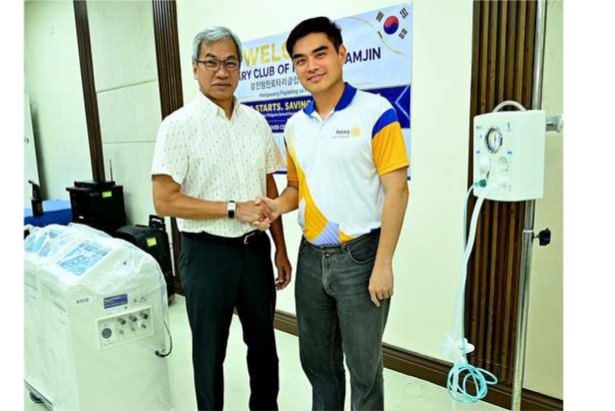
The Rotary Club of Manila and the Rotary Club of Kangjin-Tamjin in South Korea have turned over two units of specialized neonatal hyperbaric equipment to the University of the Philippines–Philippine General Hospital (UP-PGH), strengthening the hospital’s capacity to care for newborns facing severe and potentially life-threatening medical conditions.
The approximately US$50,000 donation was made through Rotary Global Grant No. 2682583, titled “Strengthening Neonatal Intensive Care Through Life-Saving Equipment Support.” The project brought together Rotarians from the Philippines and South Korea, Rotary International Districts 3810 and 3610, The Rotary Foundation World Fund, and UP-PGH physicians and administrators.

The turnover ceremony marked the culmination of more than a year of planning, international coordination, grant preparation, procurement, and delivery. It was witnessed by hospital officials, medical professionals, district leaders, and an 18-member delegation from the Rotary Club of Kangjin-Tamjin.
While the ceremony recognized the institutions and individuals behind the undertaking, its central purpose was the welfare of the critically ill infants treated at PGH and the families who depend on the country’s premier public tertiary hospital for specialized care.

Responding to an Urgent Neonatal Need
Among the serious conditions confronting neonatal specialists is hypoxic-ischemic encephalopathy, or HIE, a type of brain injury caused by insufficient oxygen and blood flow around the time of birth. Without prompt and appropriate medical intervention, the condition can result in permanent neurological disability or death.
Figures presented by UP-PGH underscored the urgency of strengthening neonatal care. The hospital recorded six HIE cases in 2024, with a case-fatality rate of 33.33 percent. In 2025, the number rose to 22 cases, ten of which resulted in death, raising the fatality rate to 45.5 percent.
For the hospital’s medical personnel, such statistics represent far more than clinical data. Each case involves a newborn struggling to survive and a family abruptly confronted with fear and uncertainty during what should have been a joyful time.

The donated equipment is intended to give trained medical teams an additional option in carefully selected cases requiring treatment under controlled hyperbaric conditions. Hyperbaric oxygen therapy uses a pressurized environment to increase the amount of oxygen delivered to tissues suffering from inadequate circulation or oxygenation. Depending on the condition and the clinical judgment of specialists, it may be used as an adjunctive intervention to support tissue recovery, reduce inflammation, and protect areas threatened by serious injury.
Treating a newborn in a hyperbaric environment presents exceptional challenges. Premature and critically ill infants may weigh only a few kilograms, have immature lungs and organs, and require uninterrupted monitoring, temperature control, and respiratory support. The placement of medical lines, transportation of the patient, maintenance of body heat, and management of changing pressure must all be handled with exacting care.

Unlike conventional hyperbaric facilities, which are generally designed for adults, the donated units were developed to meet the highly specialized requirements of neonatal patients. Their controlled environment allows infants to remain closely monitored and properly supported throughout treatment.
Hospital officials and project partners emphasized that hyperbaric oxygen therapy is not a routine treatment for newborns and must not be administered indiscriminately. Its use requires strict medical judgment, trained specialists, and careful evaluation of the risks associated with oxygen exposure, pressure, transportation, and thermoregulation. In appropriate cases, however, it may offer additional support for serious conditions involving ischemia, thrombosis, compromised tissue, difficult surgical wounds, and certain injuries linked to oxygen deprivation.

A Project Spanning Two Rotary Years
The partnership began in July 2025 through the shared vision and initiative of then-Rotary Club of Manila President Raoul C. Creencia and his South Korean counterpart, then-Rotary Club of Kangjin-Tamjin President Bang Jae Nam. Recognizing an urgent need at PGH, the two leaders began discussions on how their clubs could combine their resources, experience, and international goodwill.

Those conversations led to the signing of a Memorandum of Agreement and the preparation of an application to The Rotary Foundation. The Global Grant was approved in May 2026, transforming the proposal into a formal commitment. Rotary International District 3610 in South Korea, Rotary International District 3810 in the Philippines, the Rotary Club of Kangjin-Tamjin, and The Rotary Foundation World Fund pooled their resources for the project.
As a new Rotary year began, responsibility for completing the undertaking passed to Rotary Club of Manila President Reginald T. Yu and Rotary Club of Kangjin-Tamjin President Kim Hong Un. The transition demonstrated the continuity essential to major service initiatives. Although club presidents and boards change at the end of each Rotary year, projects of lasting importance must retain their momentum. Creencia and Bang conceived and initiated the partnership, while Yu and Kim carried it through to completion.

The equipment’s journey to Manila was not without setbacks. Deliveries had to be completed in stages, and a typhoon disrupted an initial shipment. Despite the delay, the participating clubs and their partners continued coordinating until both units reached PGH.
International Friendship to Service

The turnover was made more significant by the presence of the 18-member delegation from Kangjin-Tamjin, led by President Kim and joined by Immediate Past President Bang, several past presidents, club members, and spouses. Their visit affirmed that the initiative was more than a transfer of medical equipment. It reflected a friendship between two Rotary clubs whose members were separated by geography and language but united by a shared concern for vulnerable children.
During the ceremony, Creencia traced the project’s beginnings and recounted the partnership formed with Bang. UP-PGH medical professionals, meanwhile, explained the clinical need for the equipment and its potential role in the hospital’s neonatal services.

The program culminated in the unveiling of the Global Grant and Four-Way Test Marker. Creencia and Bang, who initiated the undertaking, were joined by Yu and Kim, the incumbent presidents who oversaw its completion. The marker records the participating clubs, districts, and project partners, but it also stands as a reminder of the principles underlying their collaboration: recognizing a genuine need, responding fairly to patients with limited means, building goodwill across national boundaries, and undertaking action beneficial to the most vulnerable.
The Korean delegates and their Filipino hosts also shared meals, conversations, music, and fellowship during the visit. Such exchanges deepened the trust that enables international service projects to endure beyond formal agreements and funding arrangements.

Expanding the Possibilities
UP-PGH serves as a national referral center and a vital lifeline for Filipinos who cannot afford highly specialized private medical treatment. Its physicians and nurses routinely manage some of the country’s most complex cases, including critically ill and premature newborns.

Medical expertise, however, must be supported by technology equal to the complexity of the conditions being treated. By providing equipment designed specifically for newborn patients in a hyperbaric setting, the Rotary partnership expands the range of interventions that PGH specialists may consider in rare and critical cases.
The donation also reinforces a fundamental principle of equitable health care: a child’s chance of survival should not be determined by the family’s financial circumstances. Illness does not discriminate according to income, and neither should access to potentially life-saving treatment.

Long after the speeches and ceremonial photographs have faded from memory, the equipment will remain at PGH for the moments when a medical team must explore every appropriate option to save a newborn. Its most important work will likely take place away from the cameras—in the middle of the night, under the supervision of trained specialists, while anxious parents wait outside the neonatal intensive care unit.
The Rotarians who made the project possible may never know the names of every child who benefits from the donation. They may not witness the moment an infant begins breathing without assistance, grasps a parent’s finger, or is finally declared stable enough to go home. Yet those unseen outcomes will be the project’s true measure of success.

Every newborn life preserved carries countless possibilities: first steps, school days, birthdays, friendships, families, and future acts of service that have yet to be written.
Global Grant No. 2682583 is therefore more than a story about medical technology. It is a story of leadership sustained across successive terms, an international friendship transformed into concrete action, and two Rotary clubs joining their resources to protect lives at their most fragile beginning.

At UP-PGH, that partnership has placed advanced equipment in the hands of skilled medical professionals and extended another measure of hope to critically ill newborns and their families. In doing so, the project has given lasting meaning to Rotary’s commitment to service—not merely changing lives, but helping life itself continue.

 A Healthy Tension: Balancing National Ambition and Local Autonomy
 Atty. Roseller "Boots" Rodriguez
 Find the Courage to Say No