

Elections, Accountability, and the Health of Institutions
An editorial argues that clean, credible elections and strong accountability mechanisms together determine the health of any institution, from Rotary clubs to nations.

Every institution that exists to serve the collective good - whether it is a sovereign nation of a hundred million or a Rotary Club of twenty members – undertakes an act of collective trust: the election of its leaders. It is easy to treat this as procedural requirement, a formality to be gotten through before the "real work" begins. This is a mistake. The manner in which an institution chooses its leaders says more about its health than almost anything else it does, because the election is the one moment when power is transferred by consent rather than seized, inherited, or assumed.
This is why the qualities of clean, orderly, transparent, and credible elections are not decorative virtues but load-bearing ones. A clean election - free of fraud, coercion, and vote-buying - ensures that the outcome reflects what members or citizens actually chose, not what was engineered for them. An orderly election - governed by clear rules, known in advance and applied evenhandedly - protects the process from arbitrariness and prevents the strong from rewriting procedure mid-contest to favor themselves.
Transparency, the willingness to let the count and the process be observed, converts trust from something demanded into something earned. And credibility is the sum of all three: an election whose result the losing side can accept, not because they were placated, but because they were genuinely convinced the process was fair.
Strip any one of these away and something essential breaks. A club that quietly manipulates its election of officers may still function day to day, but it forfeits the moral authority to ask its members for real sacrifice or real deference. A nation that does the same forfeits far more - the peaceful transfer of power itself, which is arguably the single most important function any political system performs. History offers no shortage of examples of what fills the vacuum when that function fails: not stability, but suspicion, fragmentation, and often violence. The scale differs; the underlying logic does not.
But an election well conducted only solves the first half of the problem. It answers the question of who shall lead. It does not, by itself, answer the far more enduring question of whether that leadership will be exercised well. This is where the conversation must pivot from elections to accountability.

Every officer sworn in - whether by raising a hand at a club induction or taking an oath before a nation - makes a promise that exceeds the moment of the ceremony. An oath is not a ritual to be discharged once and then forgotten; it is a standing obligation, renewed in every decision the officeholder makes for the duration of their term. The trouble is that human institutions cannot rely on the durability of anyone's conscience alone, however sincere it may be at the outset.
Power has a way of narrowing the field of vision of even well-intentioned people, and time has a way of dulling the memory of promises made in more solemn moments. This is not a cynical claim about human nature so much as a realistic one, and it is precisely why every mature institution builds structures that do not depend on trust alone.
This is the raison d'être of checks and balances. In a Rotary Club, it might be as modest as an audit committee that reviews the treasurer's books, bylaws that impose term limits, or a membership empowered to question decisions at club assemblies. In a sovereign nation, it takes the more elaborate form of separate branches of government, a free press, special courts, and institutions of oversight and audit. The specific architecture varies enormously by scale and context, but the underlying logic is identical: authority that is not checked eventually becomes authority that is unaccountable, and authority that is unaccountable will, sooner or later, be misused - not necessarily out of malice, but simply because nothing stood in the way of drift, complacency, or self-interest.
It is worth being honest about what checks and balances actually accomplish. They do not eliminate the possibility of bad leadership; no system can promise that. What they do is ensure that bad leadership meets resistance rather than a clear path - that a decision made in error or in bad faith can be questioned, reviewed, reversed, or ultimately answered for, rather than simply absorbed into the institution as a fait accompli. Accountability, in this sense, is not an insult to the officeholder's integrity. It is the mechanism that allows integrity to be verified rather than merely assumed, and it is often the very thing that protects honest leaders from the pressures and temptations that might otherwise erode them over time.
Seen this way, clean elections and robust accountability are not two separate concerns but two halves of the same commitment: that authority in any institution - however large its territorial domain or however modest its membership size - must be both earned and answerable. An election without accountability produces leaders with a mandate but no restraint. Accountability without a credible election produces oversight over an authority nobody genuinely consented to in the first place. It is only when both are present - a trustworthy beginning and a disciplined middle - that an institution can reasonably ask its members, or its citizens, for the deeper things it ultimately needs from them: not mere compliance, but confidence, cooperation, and communion.
It is apropos that today's regular meeting of the Rotary Club of Manila, which features its annual ritual of electing the members of the Club's succeeding Board, has Atty. Maria Rowena Amelia "Bing" V. Guanzon as Guest of Honor and Speaker. She is a former Commissioner of both the Commission on Audit (COA) and the Commission on Elections, two constitutional commissions that oversee exactly what we discussed above – accountability of public officials and clean and orderly elections. I hope today's attendees will seize the moment and ask her the burning questions of the day.

 Atty. Maria Rowena Amelia V. Guanzon: Lawyer • Public Servant • Governance, Women's Rights & PWD Advocate
 What Is Built in Capas Should Also Build Capas
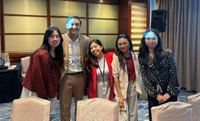 Mid-Autumn Festival Dice Game Fellowship