

What Is Built in Capas Should Also Build Capas
Mayor Roseller "Boots" Rodriguez brings the host community's voice into the national conversation on Pax Silica

The Rotary Club of Manila devoted its 11th Weekly Membership Meeting of Rotary Year 2026–2027 to one of the country's most consequential emerging development questions: how can the Philippines pursue technological and industrial progress without leaving behind the communities that must live with its effects?
The gathering featured Attorney Roseller "Boots" Rodriguez, Municipal Mayor of Capas, Tarlac, as Guest of Honor and Speaker. Before an audience that included business leaders, lawyers, former public officials, past and present leaders of the Bases Conversion and Development Authority, and fellow Rotarians, Mayor Rodriguez presented the perspective of the municipality that will physically host Pax Silica within New Clark City.

The afternoon began with registration and fellowship over lunch. At 12:15 p.m., Rotary Club of Manila President Reginald T. Yu formally called the meeting to order. STAR Rotarian Myles Seymour Y. Tan led the invocation, followed by the Philippine National Anthem and the Rotary Club of Manila Hymn, rendered with characteristic warmth by the Club's World-Famous Music Chorale.
Vice President Karlo Eugene Josef M. Castro led the recitation of the Four-Way Test, while Past Director John M. Cutter introduced the visiting Rotarians and guests. The Chorale welcomed them in song and later led the celebration of the week's birthday celebrants, Past Treasurer Lito Sibayan and Rotarian Inov Talusan.

For a few joyful moments, the serious discussions of the afternoon gave way to warm smiles and heartfelt celebration. Gathered around our birthday celebrants, we were reminded that the Rotary Club of Manila is sustained not only by the causes we pursue, but also by the friendships we nurture, the milestones we honor, and the simple happiness of sharing life's meaningful moments together.
During the President's Time, President Reggie Yu shared with the membership the club's ongoing initiatives to uplift flood-distressed barangays in Calumpit, Bulacan, and provided a preview of the forthcoming membership meeting's guest of honor and speaker.

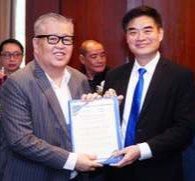
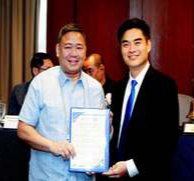
In appreciation of their generous financial contribution to the Rotary Club of Manila's "Kalinga sa Calumpit" flood-relief mission, President Reginald Yu presents Certificate of Appreciation to DGN Hermie Esguerra, PDG Alex Cureg, IPP Raoul Creencia, VP Karlo Castro, Dir. Mike Albaña, Sec. Albert Alday, PD Noy Benedicto, PD Oscar del Rosario, PD Issam Eldebs, PD Phillip Ong, PS Anton Mauricio, PAS Paco Magsaysay and STAR Rtn Myles Tan.
Following the President's Time, Rotarian Rowel Janson S. Ong introduced the guest speaker as a lawyer, community advocate, and local chief executive whose work has encompassed education, health care, agriculture, infrastructure, public safety, and community development. His introduction established the central point of the afternoon: Mayor Rodriguez was not speaking simply as an observer of Pax Silica, but as the elected representative of the people who would experience its consequences most directly.

A Local Voice in a National Undertaking
Mayor Rodriguez opened with a touch of humor, admitting that he had felt nervous upon entering what he called a "lion's den." He knew that many members of the Rotary Club of Manila were distinguished business leaders, and he suspected that some might have grown wary of politicians. His anxiety eased when he recognized familiar faces, among them Immediate Past President Raoul Creencia, his former San Beda College of Law classmate Attorney Winston Ginez, and his friend Juanito Ho, who helped facilitate his appearance before the Club.

The lighthearted beginning soon gave way to a serious and carefully reasoned presentation. Mayor Rodriguez made the position of Capas clear from the outset. The municipality does not oppose development. It recognizes the opportunities that innovation, industrialization, technological advancement, and responsible investment can bring to the country. Capas welcomes investments that can create employment, strengthen local industries, and contribute to sustainable economic growth.
The duty of a host municipality, however, differs from that of a project developer or a national government agency. While developers naturally examine investment, construction, and economic output, the local government must ask what the project will mean for the people who already live on the land, draw water from its rivers and wells, cultivate its fields, and depend upon the municipality's public services.

For Mayor Rodriguez, the central question was not whether Pax Silica promised development. It plainly did. The more difficult question was whether Capas possessed enough information, authority, and institutional support to host that development responsibly.
He organized the municipal perspective around six practical questions. What can Capas actually do about a project situated inside New Clark City? Will the people and businesses of Capas share meaningfully in its benefits? What will happen to farmers whose land or livelihood may be affected? How will existing or pending ancestral domain claims be protected? Can the municipality independently assess the project's water and power requirements? Finally, can Capas rely upon the national government and BCDA to honor their commitments across changing officials and administrations?

These questions, he stressed, were not designed to obstruct progress. They were the questions that responsible governance required.
Beyond Its Authority

New Clark City occupies an unusual position. It lies geographically within Capas, yet BCDA principally administers and develops it. The municipal government therefore has limited, and in some instances no direct, authority over important decisions made within the development.
The effects of those decisions do not remain inside institutional boundaries. They eventually reach the residents, farmers, Indigenous Peoples, environment, roads, emergency services, and other public systems of Capas.

Mayor Rodriguez described this as an anomalous arrangement. Projects can arise within the municipality without passing through its regulatory offices. Permits, clearances, and certifications may be processed outside the local government, while information about projects and development areas must sometimes be formally requested from BCDA. When residents begin to raise concerns, however, they bring those concerns to their municipal government.
The mayor acknowledged that Capas should not pretend to exercise powers that the law does not give it. Its proper role is to coordinate with the relevant agencies, represent its constituents, document local impacts, and elevate concerns to the authorities with jurisdiction. Yet the municipality cannot perform even these duties effectively if crucial information reaches it late or remains unavailable.

The issue, therefore, is not whether Capas can control New Clark City. The issue is how Capas can fulfill its responsibilities as host when many of the decisions affecting its people lie outside its direct mandate.
The Benefit Cannot Be Distant

Mayor Rodriguez next examined the economic promise of Pax Silica. The project may attract industries, create employment, and generate new business activity, but its location within Capas does not automatically guarantee that its value will remain there.
Under the special economic zone framework, the municipality must contend with national laws that affect its ability to collect business and real property taxes. Capas could conceivably host a major industrial undertaking while much of the resulting value flows elsewhere.

This raised several questions. Will Capaseños possess the training and qualifications required for the jobs created by Pax Silica? Will local entrepreneurs and established businesses gain access to its supply chains? Will the benefits received by the municipality be proportionate to the land, resources, infrastructure, public acceptance, and future room for growth that it is being asked to provide?
The mayor's formulation captured the principle with unusual clarity: "If the impact is local, the benefit cannot be distant."

Capas may have to absorb new demands on public services, infrastructure, housing, traffic management, environmental protection, and community relations. If the project also narrows other choices for the municipality's future development, then the return must be durable and broadly shared.
"What is built in Capas," he declared, "should build Capas also."

People Already on the Ground
Behind the maps and development plans are communities that have occupied and cultivated the area for many years, some even before it became part of the Clark Special Economic Zone.
Mayor Rodriguez called particular attention to the farmers in and around the proposed project site. Their lives depend upon agricultural land, groundwater, rivers, and established livelihood systems. Development must therefore identify who may be affected, determine the rights they possess, and provide concrete assistance before clearing or displacement begins.
Affected farmers, tenants, and occupants should receive clear assurances regarding financial assistance, relocation options, or alternative livelihood programs. Such commitments cannot remain as general promises in planning documents. People should never discover only after work has commenced that their homes, farms, or means of living have been placed in jeopardy.

Progress need not erase livelihoods, he argued. Development and the protection of people's means of living must proceed together.
The same seriousness must govern the treatment of Indigenous Peoples. BCDA has publicly stated that Pax Silica will not displace Indigenous communities. The National Commission on Indigenous Peoples, however, identified Sapang Kawayan, Binyayan, and Manabayukan as communities within or near potentially affected areas. It also confirmed the presence of existing or pending ancestral domain matters involving BCDA and military reservation lands.

Rather than prejudge the issue, Mayor Rodriguez proposed a practical process. The government should obtain the exact footprint of Pax Silica, secure the relevant ancestral domain and pending claim maps from the NCIP, overlay the maps, and determine whether an actual overlap or impact exists. If ancestral domain claims apply, the appropriate processes under the Indigenous Peoples' Rights Act must be followed.
The mayor reminded the audience that the impact upon an Indigenous community cannot be measured only by counting the houses that stand within a project boundary. Cultivation areas, traditional-use lands, and culturally significant places must also form part of the assessment.

To our Indigenous Peoples, land is life.
A modern agricultural zone or an alternative livelihood package may not adequately compensate for the loss of land bound to identity, culture, memory, and community life. Any program must therefore respond to the distinct circumstances and traditions of the Indigenous Peoples concerned.

Water as the Most Urgent Concern
Of all the possible effects of Pax Silica, Mayor Rodriguez identified water as his most pressing concern.

Capas already experiences periods during the dry season when farmers struggle to draw enough water from the ground. Some households have encountered similar difficulty. The municipality does not yet possess sufficient scientific information about the volume and long-term condition of its groundwater resources.
Pax Silica, also referred to during the discussion as the Clark Advanced Manufacturing Plant or CAMP, is expected to require substantial quantities of water and electricity. BCDA has presented projections, but Mayor Rodriguez argued that headline figures alone cannot establish whether Capas is truly prepared.
The municipality needs to know where the water will come from, what will happen during dry periods, whether domestic and agricultural users will have to compete with industrial demand, and how wastewater will be treated. It must also understand the sources of electricity, the project's effect upon existing consumers, and any additional grid or generation infrastructure that will be required.
Rainwater harvesting, while potentially useful, also raises questions. Rain captured for industrial use would otherwise have fallen within the Capas watershed and helped replenish groundwater. Agriculture in the affected areas already depends upon deep wells, shallow wells, and the Bangut River.

The municipality is therefore seeking more than verbal assurance. It wants the scientific studies and technical information needed to evaluate the consequences independently.
Economic development should never force surrounding communities to compete with industry for the most basic resources of life.

Trust Across Generations
Mayor Rodriguez's final question concerned trust. He clarified that he was not accusing BCDA or the national government of bad faith. His concern centered on transparency, accountability, and the durability of commitments.

Capas is being asked to rely upon studies it did not prepare, projections it did not generate, and promises that future officials or administrations may have to fulfill. Water, power, environmental assessment, infrastructure, and industrial development often fall under separate agencies. Without an integrated and consolidated plan, the host municipality could inherit the consequences of assumptions that later prove mistaken.
BCDA and Capas do not possess the same ability to leave those consequences behind. Officials may change and agencies may revise their priorities, but the people of Capas will remain. If decisions concerning water, land, livelihoods, public services, or environmental protection prove flawed, the municipality will continue dealing with their effects.

The project therefore carries an intergenerational responsibility. The natural resources involved are held in trust not only for present communities, but also for people yet unborn. The question extends beyond immediate economic gain. It asks whether today's decision-makers have sufficient moral authority to expose future generations to environmental risks that may become irreversible.
The true test, Mayor Rodriguez observed, will come when protecting the community requires more time, a redesign, additional expense, or changes to a project timetable. In that moment, will the concerns of Capas still carry equal weight, or will the municipality simply be expected to absorb the adjustment?

For now, he said, Capas does not know.
Of Competing Histories and Shared Responsibilities

Past Director Issam "Sam" Eldebs moderated an energetic open forum that brought several dimensions of the issue into sharper focus.
Past District Governor Alex Cureg asked whether Capas could stop the project if the national government decided to proceed. Mayor Rodriguez answered candidly that it probably could not. BCDA had already indicated during a dialogue in June that the project would continue even if Capas maintained its position. The mayor emphasized, however, that he was not seeking to halt Pax Silica. He wanted meaningful consultation and enough information to identify reasonable adjustments that could protect the community without compromising the undertaking.

Past Director Attorney Amado D. Valdez drew a comparison with the Tennessee Valley Authority in the United States and asked what future the mayor envisioned for Capas. Mayor Rodriguez replied that the municipality could not anchor its progress entirely upon New Clark City. Because Capas was not consistently informed about the development's projects, it had to rely on its own programs and efforts. Any economic
spillover from New Clark City would be welcome, but the municipality could not surrender responsibility for charting its own future.

Director Abdulgani Macatoman asked the mayor to identify Pax Silica's greatest possible negative impact. Mayor Rodriguez again pointed to water. During dry periods, farmers and some households already struggle to obtain groundwater. Without a credible scientific assessment of available resources and projected industrial consumption, the municipality cannot know the magnitude of the risk.
The discussion gained further historical depth when Past President Archit Bartolome, the first Chairman of BCDA and organizer of the Clark Development Corporation, explained the original national purpose of converting former American military bases into productive economic zones capable of generating employment and improving lives. He noted BCDA's title over the land and the distinct legal character of the economic zone.

Mayor Rodriguez acknowledged BCDA's authority but returned to the situation of farmers who had occupied and cultivated portions of the area before its declaration as part of the economic zone. He referred to the historical circumstances surrounding the concurrence of the Capas municipal council and reiterated that the local government was asking BCDA to behave as a good neighbor by communicating its plans and discussing possible adjustments.
Director Delfin Lorenzana, who served as BCDA Chairman from 2022 to 2024, offered another institutional perspective. He recalled that relatively few people remained within New Clark City and that BCDA had provided payments to occupants who agreed to relocate. He urged the surrounding municipalities to develop their own areas so that they could benefit from the growth of New Clark City rather than allow a modern urban center to become surrounded by neglected communities.

Mayor Rodriguez responded from personal memory. Born and raised in Capas, he knew the area and remembered visiting it in his youth. Farmers were present, he said, and their existence should not be dismissed. He also recognized a positive distinction in BCDA's approach, noting that the agency provides financial assistance to farmers displaced by its projects. Occupants of military reservation land, by contrast, may receive no similar compensation.
Juanito Ho then spoke about the need to bridge the gap between Capas, Tarlac, and BCDA. Having known Mayor Rodriguez before he entered the mayoralty, he described him as civil, cautious, respectful, and motivated by concern for his constituents rather than personal opposition. He urged the audience to listen to the uncomfortable questions being raised, because genuine cooperation could not begin by avoiding them.

Guenter Matschuck praised the mayor's analytical presentation and encouraged Capas to support its position with an independent, internationally credible technical study. Facts, comparable experiences, expert analysis, and adequate resources, he suggested, would allow the municipality to engage national agencies on more equal footing.
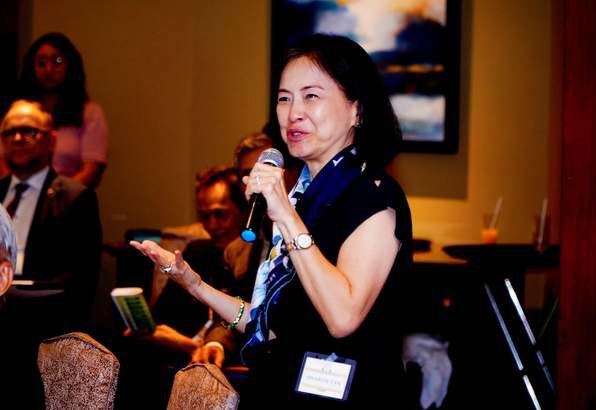
Sharon Tan brought the conversation to the national question of agriculture and food security. She noted that any effect upon farmers must be viewed alongside climate change, destructive typhoons, flooding, geopolitical uncertainty, and the rising cost of food. The issue was not whether Pax Silica was inherently bad, but how government, industry, and agricultural communities could work together so that technological development did not weaken the country's ability to provide affordable food.
Development That Allows Communities to Grow
In his conclusion, Mayor Rodriguez returned to the balanced position with which he began. Capas welcomes development and wants Pax Silica to succeed. Success, however, must rest upon adequate information, meaningful consultation, clear institutional responsibilities, environmental safeguards, and concrete mechanisms that allow local communities to participate in the benefits.

The municipality's initial assessment had necessarily relied upon incomplete information. Since its dialogue with BCDA in June, Capas had received limited details concerning the precise project site, projected employment, water and power requirements, affected agricultural areas, possible relocation sites, mitigation measures, and other safeguards.
The dialogue was appreciated, but one hour of discussion could not replace continuing verification, coordination, and consultation. As of the meeting date, no formal and comprehensive public consultation specifically involving the communities potentially affected by Pax Silica had taken place. Inter-agency briefings have value, but they cannot substitute for direct engagement with farmers, Indigenous Peoples, barangays, residents, and other affected sectors.

Consultation must occur while decisions can still be influenced. Once plans have been finalized and consequences have become irreversible, consultation loses much of its meaning.
Capas rejects the false choice between progress and community welfare. It seeks sustainable development that meets present needs without diminishing the ability of future generations to meet their own. Investments attracted, facilities constructed, technologies transferred, and industries established will certainly form part of Pax Silica's record. For the host municipality, however, another measure will matter just as deeply: whether the people who were already there were heard, protected, and given a genuine opportunity to grow with the development around them.

"That," Mayor Rodriguez said, "is the kind of development Capas is prepared to support."
At the close of the discussion, Past Director Eldebs observed that the mayor had won the respect and sympathy of the audience. The Club presented Mayor Rodriguez with a Certificate of Appreciation in gratitude for the insight and candor he brought to the meeting.

President Reginald T. Yu then formally adjourned the gathering. The afternoon ended without pretending that every disagreement had been settled. It achieved something more valuable: a room of national leaders, business figures, local officials, and concerned citizens had listened to competing histories and confronted difficult questions together.
In doing so, the Rotary Club of Manila gave the host community a place in the national conversation. It affirmed that great projects earn public confidence not only through the scale of what they promise, but also through the care with which they treat the people, livelihoods, and natural resources placed in their path.

It was a privilege to stand with Mayor Roseller "Boots" Rodriguez, whose candid and courageous presentation reminded us that genuine progress must be measured not only by the scale of our technological ambition, but also by how faithfully we listen to the communities most affected by it. The promise of Pax Silica can be fully realized only when national development respects local autonomy, protects farmers and Indigenous Peoples, safeguards vital resources, and allows the people of Capas to grow alongside the industries rising in their midst. - President Reginald Yu
Around the Rotary Club of Manila table, fellowship creates the trust that makes honest dialogue possible. We may bring different experiences and perspectives, but we are united by one purpose: to listen with respect, learn from one another, and transform meaningful conversations into service that creates lasting impact.

Around this table, fellowship opened the way for thoughtful conversation and genuine connection. Rotarians and guests brought different experiences and perspectives to the discussion, yet shared a common hope: that progress must serve people, strengthen communities, and leave behind a future worthy of the generations who will inherit it.
When Rotarians stand beside their younger Rotaract counterparts, experience meets fresh vision and service becomes a legacy carried forward. In this shared journey, one generation offers wisdom and guidance while the next brings new energy and possibility, united by the conviction that leadership finds its deepest purpose in serving others.


 Elections, Accountability, and the Health of Institutions
 Atty. Maria Rowena Amelia V. Guanzon: Lawyer • Public Servant • Governance, Women's Rights & PWD Advocate
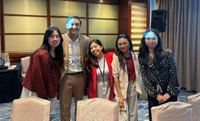 Mid-Autumn Festival Dice Game Fellowship