

Fairness Beyond Politics
President Reginald Yu reflects on fairness and due process after Atty. Michael Wesley Poa's talk at the club's weekly meeting.

At our fifteenth Weekly Membership Meeting at Fairmont Makati on October 22, 2026, I found myself returning to a question that grew more demanding as the afternoon unfolded: "How firmly do we believe in fairness when it protects someone we oppose?" Attorney Michael Poa's remarks brought that question into focus. What began as a discussion of law, leadership, and public trust became, for me, a reflection on the standards we uphold when political convictions pull us toward judgment.
As President of the Rotary Club of Manila, I regarded his visit as an opportunity to examine a difficult national issue through direct conversation. Attorney Poa came as lead spokesperson and defense counsel for Vice President Sara Duterte's legal team, a role that placed his perspective within a contested public debate. Our responsibility as listeners was to understand his arguments, question them thoughtfully, and consider the principles they raised without confusing an advocate's explanation with a settled conclusion.

He opened with humor and a preference for a longer question-and-answer session. That willingness to engage gave the gathering a conversational character, allowing serious concerns to emerge without making disagreement feel unwelcome. His account of becoming interested in law while watching former President Joseph Ejercito Estrada's impeachment trial also offered a personal beginning. Years after observing lawyers argue before the nation, he had found himself carrying a similar responsibility under public scrutiny.
His first central point was that rules matter. Explaining the respective roles of the House of Representatives and the Senate of the Philippines, he described impeachment as a mechanism that serves accountability while providing safeguards against arbitrary removal. I understood his larger argument to be about consistency: procedures earn their authority through faithful application, especially when following them becomes inconvenient.

That lesson reached beyond government. In our professions, organizations, and communities, rules establish expectations before conflict tests our willingness to honor them. If we insist on safeguards when they protect us but dismiss them when they protect another person, we diminish their credibility. Listening to him, I was reminded that institutional integrity depends on our conduct when the result we want is uncertain.
He then translated due process into a more immediate human experience. He described a person waking to accusations, seeing a photograph circulate online, and facing public condemnation before having a meaningful opportunity to respond. The example was familiar enough to be unsettling. In the speed of public reaction, an allegation can harden into an accepted story while the person concerned is still preparing an answer.

What challenged me most was his observation that people often defend due process selectively. We demand it for those we support and grow impatient with it for those we dislike. I took this as an invitation to examine my own instincts, because moral certainty can sometimes conceal an unwillingness to listen. A serious commitment to accountability requires the patience to hear a defense and weigh it honestly.
Attorney Poa's description of wearing "two hats" in "two courts" revealed the practical difficulty of that commitment. As counsel, he must protect his client's legal position; as spokesperson, he must address a public that expects immediate explanations. The demands of a formal proceeding and the court of public opinion do not always move together. A careful answer may seem evasive, while an impulsive answer may create consequences that extend far beyond an interview.

I recognized in that tension a familiar burden of leadership. There are moments when people want more certainty than the available information can support. The temptation is to supply it, particularly when confidence attracts approval. His account reminded me that responsible communication includes the discipline to acknowledge limits and reserve judgment where the facts remain incomplete.
One of his most instructive examples concerned an interview in which he agreed with a point attributed to the opposing side. He explained that defending a client did not require him to deny a correct argument or mislead the public. I found that distinction valuable in a climate where agreement is so easily mistaken for surrender. Credibility grows when listeners can see that accuracy matters more than the convenience of an answer.

His concern also extended to future lawyers and future proceedings. The positions taken during a controversy help shape the standards inherited by those who follow. I thought about how this applies within our own institutions, where repeated choices become habits and habits become culture. The exceptions we permit today can quietly become tomorrow's expectations.
When Attorney Poa connected these ideas to Rotary's The Four Way Test, his message acquired a particularly meaningful frame. Truth, fairness, goodwill, and benefit to all concerned became practical guides for receiving accusations, assessing procedures, and participating in public discussion. I was reminded that the test asks more of us than familiarity with its words. Its value emerges through the care we bring to difficult decisions.


For me, that application began with the ordinary act of sharing an opinion. Before repeating an accusation or posting a reaction, I can ask whether I understand enough to contribute responsibly. I can consider whether my language helps clarify the issue and whether I remain open to information that might change my view. Such restraint may seem modest, but it matters in an environment that rewards immediate certainty.
The open forum tested the substance of his remarks. Members asked about political possibilities, allegations against his client, the fairness of proceedings, and the consequences of dropped charges. Attorney Poa answered from his position as an advocate, sometimes explaining the defense's concerns and sometimes declining to speculate. I appreciated the exchanges because they made the boundaries of his role visible while allowing our members to press for greater clarity.

His answer to a question about fairness
was particularly notable. He acknowledged the presiding officer's efforts to balance the proceedings and distinguished an unfavorable decision from proof of unfairness. Where the defense believed an error had occurred, he spoke of pursuing legal remedies. I took from this a useful reminder that disappointment deserves examination before it becomes an accusation against an entire institution.


The discussion of dropped charges raised another difficulty of a highly public proceeding. Attorney Poa explained the defense's concern that allegations already heard by the public could remain influential even without the rebuttal the team had intended to present. His explanation made me reflect on the uneven life of information. Accusations often travel farther than clarifications, placing a continuing responsibility on listeners to revisit conclusions as the record develops.
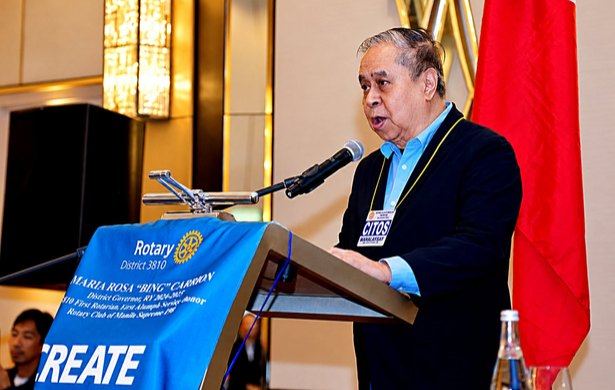
Atty. Citos Manalaysay's question widened the conversation to the nation's daily needs. He asked whether impeachment, as implemented, strengthened accountability or diverted attention from pressing concerns and deepened division. Attorney Poa defended the need for an accountability mechanism while acknowledging the cost of prolonged political conflict. His references to people concerned about food, school expenses, and household income brought the discussion back to the lives government is meant to serve.

That exchange stayed with me because it placed political controversy beside ordinary necessity. The work of accountability must proceed alongside the continuing obligations of governance. For families trying to make ends meet, the significance of institutional conflict is inseparable from its effect on opportunity, stability, and public service. Leadership must keep those lives within view even when national attention is fixed elsewhere.
Director Atty. Caloy Serapio's questions about sovereignty and institutional power carried us into more difficult territory. Attorney Poa offered the defense's position on procedural concerns and discussed consultation with constituents as a possible safeguard. I heard the exchange as an acknowledgment of the distance that can exist between democratic principles and political practice. That distance deserves scrutiny, together with the patience to pursue improvement without pretending that easy answers are available.

By the end of the afternoon, I had come to value the conversation as much for the questions it sharpened as for the answers it supplied. Attorney Poa had explained his principles, defended his positions, and acknowledged limits to what he could responsibly address. Our members had listened and challenged him with seriousness. The meeting demonstrated how a civic gathering can make room for disagreement that deepens understanding.
I left with a renewed appreciation for the fairness we owe one another. It asks us to verify before repeating, listen before deciding, and acknowledge a sound argument regardless of its source. As a Rotarian and a leader, I want those habits to remain present when the next difficult conversation arrives. The real test will come when patience is uncomfortable, judgment feels easy, and fairness requires me to pause.

 Pasko Na
 Jose Mari L. Chan, Filipino Singer, Songwriter, and Businessman
 Cogs in the Wheel
