

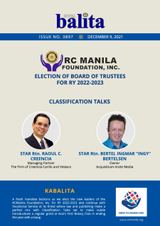
STAR Rotarian Raoul C. Creencia: A Lawyer Who Writes
In an interview, STAR Rtn. Raoul C. Creencia shares his career journey, what it takes to become a lawyer, and his favorite pastimes.

Words are a lawyer’s tool of the trade. From writing letters to clients to preparing pleadings, writing is an integral part of lawyering. And lawyers are expected to be excellent, persuasive and proficient writers. STAR Rotarian Raoul C. Creencia does this kind of writing, and so much more. He writes poems and songs too. He wrote some songs for his family and some hymns for the institutions he was – or continues to be – associated with. Among his compositions is the hymn of the Office of the Government Corporate Counsel (OGCC) which he wrote in 2011 and is still being sung during the flag-raising ceremony every Monday.
As a lawyer, he has done it all – from immersing in private practice when he founded his firm in 1996, to getting involved in various government projects as the Government Corporate Counsel of the OGCC and as Undersecretary of the Department of Transportation (DOTr), to teaching at the San Sebastian Institute of Law and conducting lectures in various mandatory continuing legal education (MCLE) programs for lawyers.

Be inspired as STAR Rtn. Raoul shares his career journey in this interview. He also shares what it takes to become a lawyer. And no, it’s not just passing all the subjects – it’s embracing and living the “7Ps”. Read on to find out more about him and his professional philosophy as well as his favorite pastimes.
Rhea Vitto Tabora (RVT): Please tell us a bit about yourself.

Raoul C. Creencia (RCC): My name is Raoul, the second child in a brood of three. I was born and grew up in Tacloban City, and I eventually got my pre-law and law degrees in Manila. I married my college sweetheart, Mylene “Myls” Marcia, also a lawyer and presently the Managing Partner of Fortun Narvasa and Salazar Law Offices. Myls and I are blessed with a daughter Melissa Rica “Mikee” and she is currently pursuing her further studies in Sydney, Australia.
At present, I am the Managing Partner of Creencia Carillo and Velasco; and I am both inspired and proud to still be with the same core team which I put together when I founded the Firm in 1996.

RVT: Why did you go into law practice? Have you always wanted to become a lawyer?
RCC: I was already in my college sophomore year when I decided to become a lawyer. It was the mid-1980s and the country was going through a pivotal and steering phase. It was then that I became more fascinated and captivated by the power and intricacies of the law – how it impacts the life of an individual, and how it influences the journey and molds the destiny of a country. When I was in high school, I actually considered becoming a civil engineer; but it was my older brother who eventually pursued that career. When I entered college, I thought of becoming a reporter or broadcast journalist. But instead of taking up journalism, I decided to major in political science as my pre-law degree.

RVT: What do you wish you knew about practicing law before you got into it?
RCC: If there is one thing I wish I knew beforehand, it is how imperfect our legal system is, and how frustrating it can sometimes be for those who have less in life to truly achieve more in law. Ruefully, we are poorly ranking globally in terms of efficiency of our criminal justice system, as well as our observance of Rule of Law.

RVT: Which legal practice area are you into and why did you choose it?
RCC: During the early years of my practice, I was involved in civil, criminal, and commercial litigation, as well as corporate advisory work. During my stint as Government Corporate Counsel and later, as Transportation Undersecretary (Legal and Procurement), I was involved in various government infrastructure projects, numerous Public-Private Partnership projects, and dealt with major government procurement issues. When I went back to private practice, my team and I began handling these types of projects and procurements, this time representing the private sector. My Firm also continues to handle litigation and arbitration cases.

RVT: Without divulging sensitive details, can you share your most interesting/memorable case?
RCC: As a rookie lawyer, I assisted the country’s best lawyers in assisting an embattled client in what was then the most celebrated tax evasion case. It was truly memorable as I had the opportunity to work with a seasoned litigator (and an iconic figure in the law profession) and saw firsthand how he prepared for every hearing, and the amount of research that goes into every pleading.

I also had the opportunity to handle estate-related cases of well-known historical figures. There were other equally – if not more – fulfilling ones, such as the case we successfully handled (pro-bono) for a seafarer against a big corporate employer. The years when I served as chief counsel of government corporations and financial institutions were also very fulfilling, as the cases and issues which I handled had huge economic and social impact. Successfully recovering the government’s multi-billion shares in a publicly listed corporation is also one case which will be forever etched in my memory.
RVT: Law school is tough, passing the bar exam isn’t easy, and practicing law is probably one of the most difficult professions. What does it take to become a lawyer?

RCC: In all these phases – law school, bar exam preparations, and law practice – there is no substitute to hard work and lots of prayers. The 5Ps – the mantra that I was taught when I was young – became handy during these phases. The term 5Ps means “prior planning prevents poor performance.” I would later expand this to 7Ps, that is, “prior planning and pious prayers prevent poor performance.”
You are correct, law school is tough, especially prior to the google and internet era. We actually had to go to the library to do our research. In my case, I was also working during my first two years in law school. For a law student to survive, it is not enough to pass all subjects. As all law students know, one is required to meet a certain average grade (or QPI) to qualify to re-enroll. But instead of stressing myself with my studies, I decided to just enjoy the ride, while making sure that I was getting decent grades and meeting the required QPI. I decided to enjoy my stay in law school by involving myself in a lot of extra-curricular activities. I was very much involved in the debating club, Law Student Government (President), Association of Law Students of the Philippines (National Chairman), and the ASEAN Law Students Association (Vice-Chairman). It was also in law school where I developed life-long friends.

RVT: What do you think would you be doing if you weren't at your current profession?
RCC: I would probably be a full-time professor and a businessman.

RVT: If you could give one piece of advice to an aspiring lawyer, what would it be?
RCC: Let me give three pieces of advice. First, as a lawyer, one’s fealty is to the law. Always, the law. Second, a lawyer must serve his clients to best of his ability. The mantra of our Firm in this regard has always been “hindi pwede ang pwede na.” The legal compass that we provide the clients must be grounded on research and law, and should aim to serve their best interest. Third, at one point of your career, serve the country and join the government. The bigger arena of charity is in government service.
RVT: What are your interests and hobbies? What do you do when you are not at work?
RCC: My wife and I are into bowling and golf. I am currently the President of the Quezon City Bowlers Club (QCBC). I am also a member of the San Beda Law Golf Club. A round of golf with my wife or with my golf buddies has become a weekend ritual. I resumed playing golf in the middle of this year, after eleven years of absence. We are hoping that tenpin bowling venues (being an indoor sport) will begin to normally operate next year.
I also write poems and songs, and have been doing so since high school. I have poems and songs dedicated to my wife, a lullaby for my daughter, a song each for my dear Tatay and Nanay, a song for my Titas, a song for the Lord of Divine Mercy Parish (upon the request of our Parish Priest), and several others. I wrote the hymn of the Office of the Government Corporate Counsel (OGCC) in 2011, which, to date, is still being sung every Monday during the flag ceremony. I composed the Graduation Song of San Beda Law Batch 1993, as well as the Silver Jubilee song in 2017. More recently, I composed the hymn of GREENPRO, the Guild of Real Estate Entrepreneurs and Professions, where I sit as a Trustee and Corporate Secretary. The GREENPRO hymn was launched last Friday, December 3.
I also love photography, although I have not been able to spend time for it in recent years. At home, my wife and I enjoy listening to my vinyl collection.
RVT: What ignited your interest in joining the Rotary Club of Manila?
RCC: When I was invited by Life Changing President Chito, I somehow knew I would be making a life-changing decision. Rotary has always appealed to me. Like all Rotarians, I believe that every great dream begins with a dreamer. This is why I am honored to have been invited and be part of the Rotary Club of Manila, which I know is composed of dreamers and achievers, a group of fine gentlemen who have all found themselves while losing themselves in the service of others – the kind of service that is meant to change lives.
 President’s Corner