

Baptized by Steel, Guided by Faith: The Life Journey of Domingo San Buenaventura Guevara Jr.
From assembling the first Volkswagen Kombis in the Philippines to serving as RCM President in 1996, Domingo “Boy” Guevara Jr. reflects on business, service and faith.

ON the surface, childhood summers should have been the stuff of innocence: games with neighborhood friends, lazy afternoons, endless stretches of play. For Domingo “Boy” San Buenaventura Guevara Jr., however, summers were about something else — work. From the fourth grade until the day he graduated from high school, vacations were measured not by leisure but by labor. While other children were escaping to the beaches, Boy was immersed in the machinery of enterprise, apprenticed into the world his father had built brick by brick.
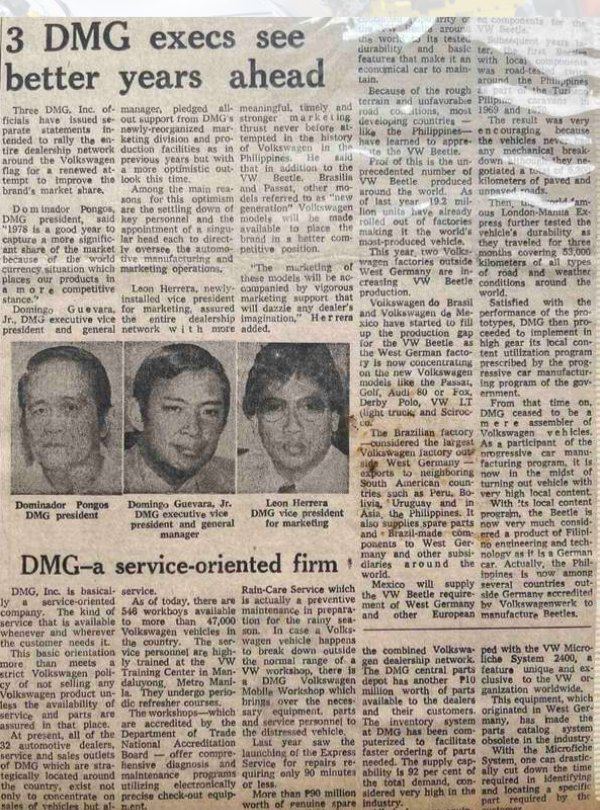
That father was no ordinary man. Domingo Mariano Guevara Sr. was one of the Philippines’ boldest industrial pioneers, a restless mind who dared to believe that Filipinos could build with their own hands what the world thought they could only import. Radiowealth produced televisions that flickered in Filipino living rooms. DMG introduced the Volkswagen Beetle and Kombi to Philippine roads. Sakbayan, literally Sasakyan ng Bayan — the People’s Car — offered a Filipino response to mobility needs. Trakbayan sought to adapt the rugged concept of trucking to local terrains. These ventures were more than just companies; they were statements of sovereignty in an era when the Philippine economy was dominated by foreign brands and imported goods.

For the young boy who bore his father’s name, the effect was profound. He grew up not only within a family but within a vision — one that combined nation-building with enterprise, integrity with ambition.
“Truthfully,” he admits with a laugh, “I learned all my vices at FEMA” — referring to the Far East Military Academy, where he spent his first year of high school. “But at Ateneo I learned loyalty, integrity, spirituality, and study discipline.” Between the stern regimen of FEMA and the Jesuit ethos of Ateneo de Manila, the contours of his character were formed. His sense of purpose, his very ambition for life, crystallized during those years in Loyola Heights.

Even at play, he was surrounded by the future he was being groomed to inherit. He remembers the Mandaluyong of his youth, a landscape that looked nothing like the teeming metropolis of today. The DMG Center stood amid expanses of land his father had purchased from Don Francisco Ortigas — sixteen hectares for less than a peso per square meter. Along Libertad Street, later renamed Domingo M. Guevara Street in honor of his father, rain would flood the canals and young Boy would delight in catching fish. That very street now stands as a living monument, but to him it carries memories of boyhood, of muddy feet, of the curious way history can transform personal playgrounds into public legacies.
His father’s world was not merely inherited — it was participated in. By the summer of 1957, while still a high schooler, Boy was working side by side with two German technicians and a team of Filipino workers to assemble the very first Volkswagen Kombis in the Philippines. He was barely a teenager, but he was tightening bolts, hammering steel into shape, and painting vehicles that would soon hit the nation’s roads. It was sweaty, dirty, exhausting work — and it lit a fire inside him. “I decided then,” he says, “that my life will be the business of Volkswagen.”

The boy had found his calling, not in the comforts of privilege but in the clang of steel and the scent of primer paint. In many ways, it was a mirror of his father’s own path: conviction through action, identity forged not by words but by labor. If Domingo Sr. taught by example, then Boy absorbed the lesson fully.
Yet, beneath the pride ran another current: the shadow of politics, the reminder that in the Philippines, entrepreneurship could never be divorced from power. The boy would later watch as his father’s enterprises — so full of promise — were crippled during the Martial Law years, when cronies bent the rules and fairness was cast aside. It was then that the most sobering lesson was passed down, one that cut as deep as any bolt or weld: “Do not fight City Hall or their cronies.”

And so, the roots of legacy were laid. Summers of work, the disciplines of Ateneo, the memory of fields and floods in Mandaluyong, the clang of the first Volkswagen Kombis, and the bittersweet wisdom of a father’s struggles — all combined to form the soil in which Domingo Guevara Jr. would grow.
For him, the name he carried was not just heritage. It was both anchor and compass: Domingo Mariano Guevara, son of a pioneer, destined to wrestle with history, and to leave his own imprint on the canvas of a nation still struggling to find its industrial soul.

The Making of a Young Leader
Education, for Boy Guevara, was never a straight line — it was a mosaic of experiences, each school adding a brushstroke to the canvas of his formation. He began in the modest halls of St. John’s Academy in San Juan, where he spent his earliest years until the fourth grade. From there, his parents placed him in Ateneo de Manila’s Padre Faura campus, an institution that would eventually leave the deepest imprint on his spirit. But the journey was punctuated by detours — one year at the Far East Military Academy (FEMA), a crucible of harsh discipline and temptations alike, before returning to Ateneo at Loyola Heights for the remainder of high school and the start of college.

“I learned all my major vices at FEMA,” he admits with a disarming candor. But if FEMA left its scratches, Ateneo left its armor. From the Jesuit priests, he absorbed loyalty and integrity; from the rhythms of the classroom and chapel, he gained a sense of study discipline and spirituality. These were not abstract lessons. They were practices, drilled into daily life — rules of honesty, the habit of prayer, the unspoken demand that one’s word must carry the weight of truth. It was in Loyola Heights, during the turbulent years of adolescence, that he first glimpsed the contours of purpose, the stirrings of ambition that would guide him through the decades to come.
By the time he reached his third year of business administration at Ateneo, however, reality intervened. He became a working student, a choice that brought him face-to-face with the grit of responsibility. To finish his degree, he transferred to the University of the East, a different universe altogether from Ateneo’s cloistered quads. UE was teeming with energy, with working-class students who hustled between classes and jobs, with a democratic air far removed from the Jesuit enclaves.

For the young Guevara, the experience was electrifying. He cut a striking figure on campus, always in a crisp white shirt and tie. Fellow students often mistook him for a professor, and on more than one occasion, he was invited to substitute for absent instructors in subjects like Personnel Management and Business Ethics. It was not just a quirk; it was a recognition of his bearing, of the maturity that came from balancing the roles of student, worker, and aspiring leader. He even became a minor celebrity of sorts, frequently invited to social events. Yet what mattered more were the bridges he built with professors who would later join him at DMG as managers — mentors transformed into colleagues, teachers into partners in enterprise.
Still, if Ateneo had instilled faith and discipline, and UE had sharpened his pragmatism and people skills, the most enduring influence came not from professors but from friends. “I cannot recall any real mentors,” he reflects. “But I did have several real BFF who remain my BFF to this day.” In the years after graduation, as he weathered cycles of triumphs and financial setbacks, it was these friends — not the fair-weather ones of school days, but the loyal circle who stood by him — that sustained him. To this day, he nurtures those bonds, organizing monthly mini-reunions of Ateneo High School Batch ’59, gathering classmates for First Friday devotions to the Sacred Heart of Jesus, and rekindling ties with Grupo ’58, the cohort with whom he spent an extra year mastering high school.

Out of these experiences, a personal philosophy emerged, a set of guiding principles that fused the rigor of Jesuit education with the resilience of a working student’s life.
It is better to have tried and failed than to have failed without even trying. The words carried the conviction of someone who had seen how hesitation could paralyze potential.

A percentage of something is better than a hundred percent of nothing. That was the pragmatist speaking, the businessman who knew the arithmetic of compromise.
But there was also the believer: When confronted with a seemingly impossible situation, I always turn to God, let go, and trust Him. Life had already shown him that closed doors could lead to wider windows, that divine timing often mocked human impatience. “Challenges are opportunities,” he insists, “and I fully believe God answers all prayers — but in His own time.”

Even forgiveness, for him, bore the imprint of faith. “I forgive all my transgressors, no matter what they have done, even if done to me personally. I forgive the person but not the action, because God is also just, and any transgressions will always have a consequence.” It was an ethic that combined mercy with justice, humility with accountability.
By the time he left the university halls for good, Domingo Guevara Jr. was more than just the scion of a pioneering industrialist. He was a young man tempered by contrasts: the strictures of Ateneo and the freedoms of UE, the temptations of FEMA and the devotions of First Fridays, the lofty ideals of faith and the gritty arithmetic of survival. He carried within him the paradoxes of the Filipino entrepreneur: deeply spiritual yet relentlessly practical, grounded in tradition yet restless for progress, a man whose values were not inherited but wrestled into being.
The making of a leader, after all, is never a single stroke. It is a mosaic — a discipline here, a setback there, a friendship that endures, a philosophy that hardens into habit. And for Boy, those early years offered the palette from which he would paint the rest of his life.
Baptism by Steel and Fire

The summer of 1957 stands like a milestone in the memory of Boy Guevara. He was only in his second year of high school, yet his hands were already blackened with grease, his lungs filled with the acrid tang of primer paint, his ears ringing from the hiss of welding guns. It was the summer he joined a small crew — two German technicians and about twenty Filipino workers — tasked with assembling the first twenty-four Volkswagen Kombis ever to roll out in the Philippines.
The work was no simulation. There were no safety nets of theory or family privilege to shield him. He unpacked crates from Germany, wiped down rust-flecked panels, and helped fit together steel with makeshift jigs. When parts refused to align, he learned the stubborn craft of hammering them into place. He ground rough edges, sprayed red oxide primer by hand, and guided vehicles into the gas-fired oven that baked their coats of paint into permanence. At the end of the line, he test-drove each unit, coaxing life out of machines that had once been nothing more than scattered parts in wooden crates.
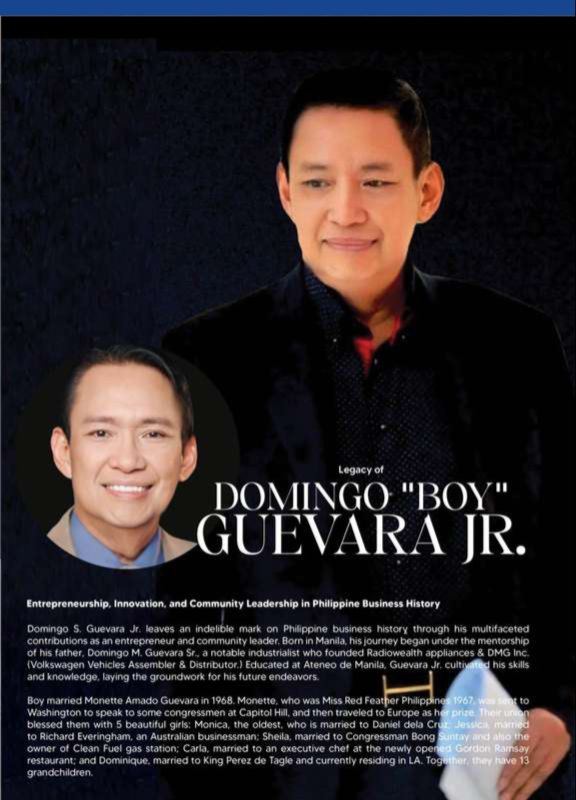
It was, quite literally, a baptism by steel and fire. For many heirs of industrial pioneers, the pathway is boardrooms and titles. For Junior Domingo, it was sweat and grime, long before any corner office. “I was so inspired by this experience,” he recalls, “that I decided then that my life will be the business of Volkswagen.”
The teenager’s conviction would carry him across oceans, into the heart of Volkswagen’s Wolfsburg headquarters in Germany, where he trained after college. For two years, he immersed himself in every dimension of the business — from accounting and pricing to spare parts inventory, from after-sales service to warranty processing. No corner of the operation was left unexplored.
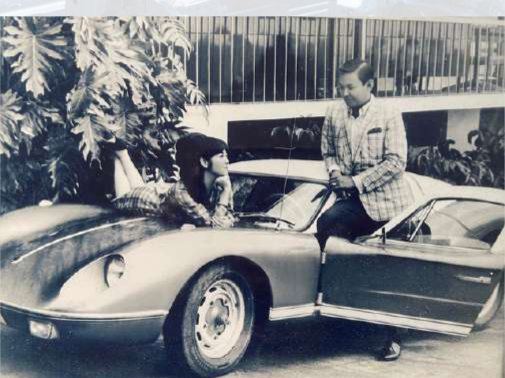
Yet while Volkswagen marked the foundation of his career, the vision that would make his own imprint on Philippine industry came in the form of two words: Sakbayan and Trakbayan.
The Sakbayan was no mere product; it was a statement. Derived from the Filipino translation of Volkswagen — literally Sasakyan ng Bayan or “vehicle of the people” — it symbolized an effort to design a car not just for profit but for national identity. At a time when the country was struggling to define its own economic independence, here was a vehicle that proudly bore a Filipino name, a Filipino concept.

The Trakbayan followed a similar logic: a rugged truck, its very name a Filipinized rendering of “truck,” adapted to the rough roads and conditions of the archipelago. The Trakbayan never went beyond its single German-made prototype, but even its creation was a testament to what could be achieved when local engineers and a visionary heir collaborated across continents. “The Trakbayan,” Guevara recalls, “was made in Germany with collaborations from our Filipino engineers and my own inputs because of my experience in the rough roads of the Philippines.”
These were not just products; they were metaphors. The Sakbayan and Trakbayan embodied the dream of a country that could build, innovate, and define its own destiny rather than merely consume what others produced. In them, one could see the echo of his father’s philosophy: a Filipino-first industrial spirit, bold enough to challenge foreign dominance.
But business, like history, rarely moves in straight lines. The late 1960s and early 1970s brought new tests. By then, Guevara had risen to leadership within DMG, tasked with navigating the turbulent seas of government policy and global competition. His proudest feat in those years was perhaps the most audacious publicity stunt in Philippine automotive history: the London–Manila Express Caravan of 1970.
It was a venture as improbable as it was grand. Four vehicles — a Volkswagen 1300 sedan assembled locally, a Sakbayan, a Sarao jeepney, and a German Kübelwagen — were driven by a team of twelve Filipinos across continents and oceans to prove the durability of Filipino-made and Filipino-adapted vehicles. One route wound east through Eastern Europe, Istanbul, Afghanistan, Pakistan, India, down to Penang and Singapore before shipping to Manila. The other carved westward through Paris, Lisbon, across the Atlantic by ship to Florida, then by road to San Francisco, and onward by sea through Honolulu and Yokohama to the Philippines.

Seventy-nine days later, the four vehicles arrived in Manila within eighteen hours of one another. It was a triumph not only of engineering but of national pride. For Guevara, it symbolized the fusion of grit, teamwork, and vision — Filipinos proving to themselves and to the world that they could traverse the globe on their own terms.
The lesson of that journey was one he would carry for life: that leadership was not about resting on inherited legacies, but about testing them, stretching them, and daring to write new chapters. He would soon face sterner challenges — Martial Law, crony capitalism, financial collapse — that would temper his optimism with caution. But in those years of Volkswagen, Sakbayan, and caravans across continents, he learned the essence of enterprise: that it is forged not in the boardroom alone but in the furnace of risk, experiment, and sweat.

Looking back, one can see why he called those his proudest early milestones. They were not only about vehicles; they were about motion itself — the motion of a nation striving to industrialize, the motion of a family legacy rolling forward, the motion of a young leader discovering his own capacity for resilience.
It was baptism by steel and fire, yes. But it was also initiation into something larger: the unyielding belief that Filipinos could chart their own road, no matter how rough.

Navigating Storms
Every industrial dynasty in the Philippines has faced its crucible, a season when the winds of politics swept across the marketplace and left even the strongest reeling. For the Guevaras, that storm arrived with Martial Law.

In the early 1970s, Domingo Mariano Guevara Sr. still presided over Radiowealth — the country’s boldest experiment in Filipino-made electronics. Unlike imported brands that arrived nearly finished, Radiowealth manufactured televisions almost from scratch. Picture tubes were shaped from raw glass. Printed circuit boards were machine-made. Power transformers and plastic cabinets rolled off factory lines. It was a fully integrated operation, a rare jewel of Philippine industry.
Then came the rival: JBC televisions, brought in under the protection of Ambassador Roberto Benedicto, a powerful crony of Ferdinand Marcos. Unlike Radiowealth’s painstakingly crafted units, JBC televisions were imported in what was euphemistically called “semi-knockdown form.” In reality, the sets were already complete, their internal mechanisms intact. Only the plastic cabinets were detached, reassembled locally with a screwdriver. It was the equivalent of calling a house “locally built” because one screwed the doorknob in after importation.

The government, of course, played along. JBC received preferential import duties despite having no real factory. Radiowealth, which bore the costs of genuine manufacturing, found itself undercut at every turn. Domingo Sr., stubborn in principle, refused to raise his prices to protect his margins. Instead, he chose to match the artificially low prices of Benedicto’s televisions — absorbing losses in the millions, holding the line in the name of fairness and Filipino pride.
For his son, watching these events unfold was a brutal education in the realities of power. Banks, under state influence, began cutting Radiowealth’s credit lines. Cash flow dried up. The empire that had once symbolized Filipino ingenuity now teetered on collapse, not because of market failure, but because the rules had been rewritten to favor the regime’s favorites. The lesson was seared into him like a scar: do not fight City Hall or its cronies.

Yet the pain of those years went deeper than balance sheets. To see one’s father — a man who had built industries out of faith in Filipino talent — forced into retreat was to witness the collision of ideals with the machinery of authoritarian power. For the younger Guevara, it was both sobering and galvanizing. It revealed that in the Philippines, business was never just business. It was politics by another name, a chessboard where pawns could be swept aside if they stood in the wrong square.
Still, resilience defined the family. While Radiowealth faltered, they turned their energy to preserving and reshaping the broader Guevent Group of Companies. What could not be sustained in manufacturing, they sought to balance with investments in real estate, finance, and other ventures less vulnerable to cronyism.

At the same time, they strengthened the family’s philanthropic arm — the D.M. Guevara Foundation. If authoritarian politics stifled enterprise, they would assert their values through service: financing medical missions, providing scholarships for technical schools, and supporting communities ravaged by natural calamities. It was their way of saying that while politics could bend the rules of commerce, it could not dictate the family’s principles. Employees continued to be treated fairly. Training remained a priority. The foundation became a moral anchor, a quiet assertion that the Guevaras would not let corruption erase their commitment to society.
In Mandaluyong, the family found a symbol of renewal. Boy himself pushed for Libertad Street to be renamed in honor of his father. Some councilors attempted to extract “SOP” under the table, but he reported the matter directly to then mayor Benjamin Abalos, who swiftly ensured the resolution’s passage. Soon after, a ceremonial program was held in front of the DMG Center Building, attended by the mayor and councilors. For the Guevaras, it was not just a street sign — it was vindication. The name of Domingo Mariano Guevara would not be erased by politics; it would be etched into the city’s very map.

Whenever he passes the street today, Boy feels both pride and nostalgia. Pride, because the road honors a father who sacrificed wealth rather than compromise integrity. Nostalgia, because he remembers playing as a boy in the flooded canals of that same street, chasing fish after heavy rains, in a neighborhood where houses were still sparse. He recalls his father purchasing sixteen hectares from Don Francisco Ortigas in the 1950s, then subdividing and selling parcels on installment to employees. What was once farmland and mud is now a bustling artery of Metro Manila. Yet for him, the street remains a personal landscape, its every inch inscribed with memory.
Storms do not only destroy; they reveal. Martial Law had stripped away the illusion that business success was insulated from politics. It had shown the Guevaras the cost of integrity in a corrupt system. But it also revealed the core of their identity: fairness, resilience, service, and pride in being Filipino.

For Boy, those years were not the end of the story. They were a testing ground, a crucible that tempered his leadership. He emerged from the storm both chastened and strengthened — wiser to the ways of power, yet still carrying the flame of his father’s vision. The road ahead would not be easy. But like the Kombis he had once helped weld together, he had learned to hold under pressure, to keep moving forward, however rough the terrain.
Jaycee Foundations

Before he ever wore the lapel pin of Rotary, before he presided over boardrooms and steered corporate caravans across continents, Boy Guevara cut his civic teeth in the Makati Jaycees. It was there, among the restless young men of the city’s rising middle class, that he first encountered the intoxicating blend of leadership, camaraderie, and public service. The Jaycees were not merely a club; they were a crucible for testing ideas, forging friendships, and learning the alchemy of teamwork.
For the young Guevara, Jaycee life was a laboratory. Projects were the experiments, members the collaborators, and the community the proving ground. The rules of success were simple yet profound: no project could be accomplished alone. Every initiative required cooperation, fundraising ingenuity, and the commitment of many hands. It was an environment where leadership was not inherited but earned, where titles mattered less than results, and where one quickly discovered that ideas, however noble, were nothing without execution.

Among the many endeavors he spearheaded, one stands out in memory — the Kasalan Bayan. The concept was simple, the impact profound. Two hundred couples, many from the poorer quarters of Makati, were gathered for a mass wedding ceremony. It was a gesture both practical and spiritual, offering dignity and legitimacy to families who had long lived without the sanctity of official vows. For Guevara, it was more than an event; it was an act of bringing people closer to Christ. Though ecumenical in nature, he ensured that every couple received a briefing on Christianity, and some were even baptized before exchanging vows. In that moment, the Jaycees were more than a civic club; they were ministers of grace, architects of community.
The Kasalan Bayan would ripple outward, replicated by other organizations across the country. For Guevara, it was a moment of revelation: that leadership was not about basking in applause but about facilitating transformation in the lives of others.

It was also in Jaycee circles that his business instincts found new applications. Fundraising for projects, negotiating partnerships, mobilizing volunteers — these were the same skills he would later deploy in industry and Rotary. But in the Jaycees, they were stripped of profit motive and directed instead toward public good. The practice of balancing ambition with service, of blending pragmatism with idealism, was a preparation as rigorous as any corporate training program.
The friendships formed there were equally enduring. Jaycee bonds, tested in the fire of late-night planning sessions and the grind of community projects, became lifelong ties. They were networks of trust, reservoirs of goodwill that would sustain him long after titles had faded. When he later encouraged his young managers to join the Jaycees, it was not merely professional development he sought for them; it was the shaping of character, the forging of leaders who understood that success without service was hollow.

Perhaps the most important lesson the Jaycees imparted was teamwork. “During my Jaycee days, no project could be successfully accomplished alone,” he recalls. That ethos of collective effort became the foundation of his managerial style. In business, he demanded cooperation among managers, encouraging them to see themselves not as isolated fiefdoms but as parts of a larger whole. In civic life, it prepared him for the complex choreography of Rotary, where diverse personalities and interests had to be harmonized toward common goals.
Jaycee training also taught him about the delicate balance between celebration and service. The organization was known for its social events, sometimes lavish to the point of extravagance. Guevara appreciated the fellowship but never lost sight of the danger of excess. Even then, he believed that resources should be tightly managed, that socializing should never eclipse the mission of service. It was a conviction that would later color his vision for Rotary — that inductions and balls should avoid ostentation, that funds were better spent alleviating poverty than purchasing gowns and champagne.

Looking back, he often advises younger Jaycees to join Rotary before they become “exhausted Jaycees,” worn down by the endless cycle of projects and socials. He remembers attending the induction of Eric Ke as president of Manila Jaycees and encouraging him to join the Rotary Club of Manila as soon as possible. For Guevara, the Jaycees were a vital foundation, but Rotary was the next horizon — a space for matured leadership, where the lessons of youth could be transmuted into lasting service.
In many ways, the Jaycees gave him his first taste of legacy. The Kombis he assembled might fade, the caravans might pass, but the couples who exchanged vows in the Kasalan Bayan, the young members he mentored into teamwork, the habits of service he cultivated — these endured. They were not stamped in steel or etched on street signs, but written in the fabric of lives uplifted.

For a man who bore the name of a pioneer, the Jaycees offered a different kind of inheritance: not factories and machines, but the wisdom that leadership without service is vanity. It was here that he first glimpsed what it meant to be more than a businessman, more than a son of privilege. It was here that he learned to be a servant-leader.
The Rotarian’s Compass

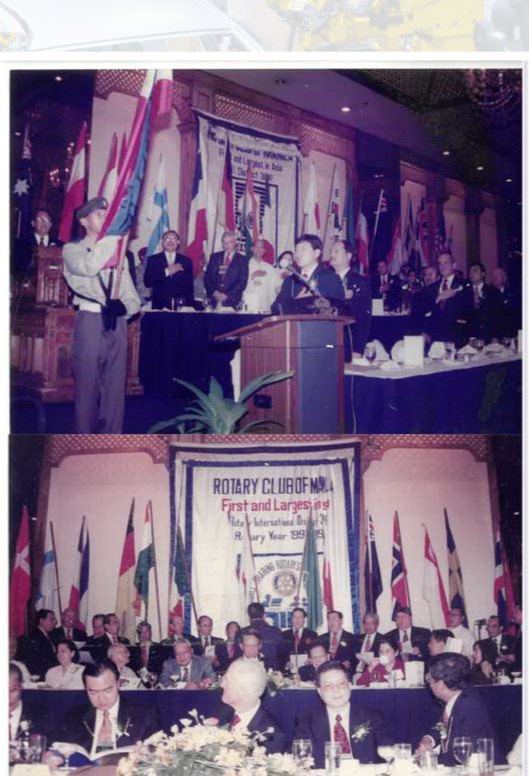
By the mid-1970s, Boy had already proven himself in the crucibles of business and civic training. He had learned resilience in the storms of Martial Law and forged his civic instincts in the Jaycees. But it was in Rotary — specifically the Rotary Club of Manila (RCM), Asia’s first and largest Rotary club — that his sense of leadership and service found its fullest expression.
The invitation came from a friend and competitor: the late Ceferino “Cef” Follosco, then an executive of Ford Philippines and later Undersecretary of Trade. Follosco persisted, undeterred by Guevara’s hesitation. “I was reluctant at first,” Guevara recalls. “Most of the members were already in their late fifties and sixties. I thought perhaps I didn’t belong.” Yet he yielded, and in 1976, he became a Rotarian. It was the start of a journey that would span decades.

Those early days at RCM were a revelation. The club was a formidable gathering of the country’s elite — bank presidents, Supreme Court justices, top businessmen — yet within its walls, hierarchy dissolved into fellowship. “We all addressed each other by nicknames,” Guevara remembers. The weekly Thursday luncheons at Manila Hotel’s Fiesta Pavilion were more than meetings; they were rituals of camaraderie. Guest speakers, or GOHAS (Guests of Honor and Speakers), were eager to be invited. Ferdinand Marcos himself, along with cabinet members and business titans like John Gokongwei, Lucio Tan, Emilio Yap, Jaime Zobel, and Alfonso Yuchengco, regularly graced the podium. To be a GOHAS was a badge of honor, a recognition of stature.
Equally powerful was the culture of accessibility. “You could call any member,” Guevara recalls, “and you were guaranteed to be able to talk to that person within twenty-four hours.” It was a simple tradition, but it symbolized the trust and respect that bound the club together. Outside the meetings, homes opened for “home-sides” and “pillow-ships,” informal fellowships that cemented bonds of friendship. Membership was over four hundred, and attendance often reached seventy percent. Even the cost of lunch — just ₱120 at the Manila Hotel — made participation accessible. Rotary was less about pomp than about presence, less about glamour than about belonging.

Still, leadership was never easy. When Guevara served as Director and later as Sergeant-at-Arms (SAA) and Deputy SAA, he found himself navigating the delicate task of quieting some of the club’s most senior and prominent members during meetings. “It was like walking barefoot on broken glass,” he recalls. Yet with tact and respect, he managed — earning trust without offense, embodying the fine balance between authority and humility.
His defining moment came two decades later, in 1996, when he was overwhelmingly elected as President of RCM. By then, fissures were appearing in Rotary’s landscape. Rivalries between clubs in Manila and Makati were straining relationships. Some clubs resented RCM’s dominance in district and international awards, perceiving it as arrogance. Guevara, ever sensitive to the undercurrents of fellowship, decided to act.

Upon assuming the presidency, he made a startling announcement: RCM would not compete for any major district or international awards during his term. The gesture disarmed critics and won back trust. “RCM had already proven itself,” he explained. “It was time to give others their chance.” Instead, he focused inward, streamlining redundant committees, strengthening active ones, and eliminating unnecessary bureaucracy. The decision restored goodwill and recalibrated RCM’s role — not as a rival, but as a leader by example.
The friendships he nurtured in Rotary were as memorable as any project. He remembers with fondness Cef Follosco, his sponsor; Joe Barredo of Fabar Motors, nicknamed the “Kissing Bandit” for his playful habit of greeting every lady guest — including First Lady Imelda Marcos — with a kiss on the cheek; Nick Villongco of Chrysler Motors; and Dave Sycip of Northern Motors. Even competitors became allies under the Rotary banner, proving that service could transcend rivalry. He recalls approaching Justice Simmie Gopengco, a fellow Rotarian, about a legal case — not to win, but simply to ensure a judgment on its merits. Within weeks, a fair ruling was handed down. Such was the ethos of trust and integrity that defined the club.

For Guevara, Rotary was never about titles or awards but about impact. He admired and quietly supported projects like the Hospicio de San Jose initiative, which he considered a must-continue program. He often contributed financially, believing poverty alleviation should be Rotary’s central mission. He urged future leaders to “clone” the likes of PD Philip Ong, who chaired the project tirelessly, warning against overburdening a few while others remained spectators.
At the same time, he championed simplicity. “Let us avoid unnecessary, ostentatious, and expensive socials,” he insists, “and use saved funds for civic projects.” He had seen how inductions and district balls could devolve into fashion shows of gowns and tuxedos, diverting resources from the poor to the perfumed. His vision for RCM was one of elegance without excess, service without distraction.

Today, he sees hope in the club’s younger members. They may not represent the “cream de la cream” of the country’s top corporations as in earlier days, but they carry within them the potential to be future leaders of the nation. “Old fogies like me,” he says with a smile, “should encourage and guide them.” This is why he continues to attend fellowships, not out of nostalgia but out of duty — to pass on the flame, to remind the next generation of what Rotary once was and what it still can be.
The compass of Rotary, for him, has always pointed to the same true north: honesty, fairness, service above self. It is a compass he has carried into boardrooms, foundations, and family life. And though titles and awards may fade, the friendships, values, and quiet acts of service remain — the true measure of a Rotarian’s life.

Nation, Reform, and Faith
To speak with Boy Guevara about the Philippines is to encounter both the steel of a realist and the fervor of a patriot. He has lived through the promises of postwar industrialization, the suffocation of Martial Law, the uneven dawns of democracy, and the turbulence of globalization. His perspective is that of a man who has seen both the heights of possibility and the depths of betrayal.
At the heart of his critique lies a conviction: that the Philippines has never lacked ingenuity, talent, or ambition — it has lacked the political will to nurture them. His father’s dream was for the country to achieve NIC status, to stand among the Newly Industrialized Countries of Asia like South Korea or Taiwan. That dream remains tantalizingly within reach, he believes, but only if the nation can free itself from the stranglehold of dynastic politics.
“Eighty percent of our leaders are dynastic families,” he says bluntly. “Under our present setup, there can be no president who can control them to think of the national interest. They will always think provincial or regional at best.” His prescription is radical yet simple: pass the long-delayed Anti-Dynasty Law, even if it requires nothing less than a political revolution. For him, it is the single most important reform that could uplift millions of Filipinos, unlocking the door to genuine nation-building.

He is equally unsparing in his assessment of the Philippine business community. “Filipino entrepreneurs today are mostly selfish,” he observes. “They think only of domestic expansion. Very few think international, very few have ambitions of globalization.” In his eyes, this inward-looking stance has made the country vulnerable, shackling its industries to parochial markets while others race to capture global opportunities.
There are exceptions, and he names them with admiration: the Gokongwei Group, the Mabuhay Group of the Chan family, Metro Pacific, the empire of Ricky Razon. These are the firms that dared to think beyond the archipelago, to expand abroad, to welcome foreign partnerships. But too many others, he laments, have chosen to build barriers instead, lobbying against foreign investment rather than embracing the competition that could sharpen them. Perhaps, he muses, the second and third generations of the great business families will finally have the courage to think globally.

Yet Guevara is not merely critical; he is constructive. He has thought deeply about the structures that hold Philippine industry back. For him, the problem is not merely corruption, but the absence of continuity. Agencies like the Board of Investments (BOI) and Department of Trade and Industry (DTI) are capable of crafting long-term incentives, yet every new administration insists on stamping its own “legacy,” discarding the plans of its predecessors. Investors, both local and foreign, are left disillusioned.
His solution is bold: an integrated master plan for industrial zones, crafted jointly by PEZA, TESDA, DOLE, BOI, and other agencies, then enshrined into law and reviewed only every decade. “We need to take the politics out of the equation,” he insists. Only then will budding entrepreneurs be able to grow into giants, secure in the knowledge that policies will not shift with every election.

But even as he speaks with the analytical precision of a businessman, his language is never far from faith. For Guevara, economics and politics may set the stage, but it is God who directs the play. “When confronted with a seemingly impossible situation, I always turn to God, let go, and trust Him,” he says. To him, challenges are not obstacles but opportunities, doors closed only so that bigger windows might open.
It is this faith that sustains his view of governance. He acknowledges with anguish the scandals that have recently rocked the administration — flood control projects, crony deals, even the involvement of powerful relatives. Yet he urges patience and prayer for the president. “We need the whole country to pray for him,” he says, “that the Holy Spirit will give him the necessary strength to punish the guilty parties swiftly. Otherwise, the political capital he has gained may be lost — and with it, his presidency, or even his life.”

To some, such words may sound naïve in the ruthless theater of Philippine politics. But for Guevara, faith is not escapism; it is a form of realism, an acknowledgment that human effort alone is never enough. God is infinitely merciful, he reminds us, but also just. Every action has consequences, whether in business, politics, or personal life.
In the end, his vision for the Philippines is as clear as it is uncompromising: ban dynasties, embrace globalization, craft long-term industrial policies, and trust in God’s justice. It is a vision forged not in academic seminars but in the lived experience of boardrooms, factories, and civic halls. It is the view of a man who has seen both the promise and the peril of this country — and who still believes, against all odds, that a better future is possible.
The Gospel of Leadership
In the end, titles blur. Chairman, president, director, past this, former that — these are the designations that adorn résumés and plaques, but they fade with time. For Boy, what remains is something deeper, something harder to measure yet infinitely more enduring.
Asked which role he cherishes most — businessman, Rotarian, Jaycee, family leader — his answer comes without hesitation: none of the above. The mantle he values most is that of witness, a man unashamed to give glory to God in word and deed. “I am most fulfilled spreading the Word of God through personal experience and practice,” he says, “and I am never ashamed to be verbally thankful for His blessings and mercy.”
This is not the piety of abstraction. It is a creed forged in the furnaces of trial: in the collapse of Radiowealth under Martial Law, in the grinding labor of assembling Kombis as a teenager, in the lonely difficulties of quieting elders as Rotary’s Sergeant-at-Arms, in the humility of setbacks that tested both his finances and his friendships. Through it all, he has seen doors close and windows open, has felt the weight of failure only to find grace waiting on the other side.
What he hopes to pass on — indeed, what he insists on imparting to children, grandchildren, and anyone willing to listen — is simple yet uncompromising: honesty and fairness. To be honest with one’s self, with others, and with God. To deal fairly in business and in life. And above all, to live by Christ’s first commandment: Love thy neighbor as I have loved you.
Leadership, as he sees it, is not about charisma or oratory. It is not about elaborate visions or grand strategies. It is about example. “Honest and fair leadership by example,” he summarizes. That, in a single sentence, is his philosophy. Not theory, but practice. Not ambition, but integrity.
And how does he wish to be remembered by his fellow Rotarians, by the country, by history? The answer is disarmingly modest: as a good servant of God and a Filipino patriot. Nothing more, nothing less. Not the man who led the London-Manila Caravan, nor the president who gave up awards for the sake of fellowship, nor the entrepreneur who tried to globalize the Sakbayan. Simply a servant and a patriot.
Yet the legacy he carries is larger still. It stretches across three generations of Guevaras, from his father’s pioneering factories to his own stewardship of Guevent Investment Development Corporation, and onward to his children and grandchildren. The thread that binds it all is a credo his father thundered in boardrooms and embodied in practice: Filipino First. That phrase, once radical in its defiance of colonial dependence, now stands as the Guevara family’s contribution to Philippine history — a reminder that true progress begins with believing in one’s own people.
But if the past was about asserting national pride, the future, he believes, will be about deepening spiritual trust. To the younger generation of Rotarians and civic leaders, he offers counsel that could sound old-fashioned in a world enamored with technology and speed, yet resonates with timeless force: Learn to trust God.
“God always answers our prayers,” he insists, “but always in His own time. God is infinitely merciful, but He is also just. All our actions have consequences. We must always think of those consequences before we act. Challenges are not obstacles — they are opportunities.”
In these words, one hears not only the wisdom of a businessman or civic leader but the cadence of a preacher, a man convinced that leadership without faith is rudderless, that ambition without consequence is reckless.
And so the life of Domingo San Buenaventura Guevara Jr. — child of privilege, apprentice of steel, witness of storms, builder of projects, servant of clubs, critic of dynasties, and bearer of faith — resolves into a single arc. It is the arc of a man who has sought, in every season, to be faithful: faithful to his father’s legacy, faithful to his country’s promise, faithful to his friends and companions, and faithful above all to God.
The street in Mandaluyong that bears his father’s name is not just a monument to the past; it is a metaphor for continuity. Children once played in its flooded canals. Factories once stood on its muddy edges. Today, traffic flows ceaselessly across it, carrying workers, dreamers, strivers. Life moves forward, as it must. And so does the Guevara story: a family that dared to dream, stumbled against power, persevered in faith, and left behind not just businesses or foundations but a gospel of leadership. A gospel that says: be honest, be fair, love your neighbor, trust God.
That, perhaps, is the truest inheritance. Not the Kombis welded in a sweltering factory. Not the caravans that crossed continents. Not even the corporations that rose and fell. But the quiet conviction that in leading others, one must first be led — by conscience, by integrity, and by the God who answers in His own time.

 Rotary in the Time of Upheaval: PRID Raffy Garcia Unfolds a Story of Courage and Conviction