

A Bridge Well Built: The Life and Legacy of Felicito Cruz Payumo
The Balita pays tribute to the late Rotarian Felicito “Tong” C. Payumo, congressman, SBMA and BCDA chairman and founder of UNC–B.

Editor’s Note: For the first time in its PEOPLE segment, The Balita pays tribute to an illustrious Rotarian who has passed — honoring the life and legacy of the late Felicito “Tong” C. Payumo, a visionary leader whose brilliance, integrity, and service shaped both nation and community. Through this special feature, we remember not only his achievements, but the enduring spirit of purpose that defined his remarkable journey.
HE was a man who moved between worlds — from the quiet rivers of Dinalupihan to the storied halls of Harvard, from the corridors of Congress to the boardrooms that shaped modern Philippine industry.
To those who knew him, Felicito “Tong” Payumo was more than a public servant or a corporate executive; he was a bridge builder in every sense — between ideals and action, intellect and humility, progress and remembrance. His was a life defined not by titles, but by transformation: the transformation of a boy from Bataan into a statesman whose vision continues to ripple through the nation’s infrastructure, economy, and civic conscience.

One of the most contentious issues during President Corazon Aquino’s administration in the mid-1980s was the debate over the U.S. military bases agreement — whether to allow the continued presence of American forces at Subic and Clark. Among the voices that would later shape the nation’s economic and geopolitical landscape was that of Congressman Felicito Cruz Payumo, representing Bataan’s First District. To his constituents, he was simply “Tong”, a name uttered with both familiarity and respect. He would later chair the Subic Bay Metropolitan Authority (SBMA) and, in the twilight of his career, the Bases Conversion and Development Authority (BCDA) — the very institutions that rose from the ashes of those once-divisive debates.
To those who knew him, Tong was the rarest of figures in public life — a thinker who acted, a leader who listened, a servant who led by conscience. He moved through the worlds of business, politics, and community with the same quiet precision that marked every decision he made. There was no bluster, no vanity, no need for spectacle. His was the calm authority of one who understood that real power lies not in command, but in example.
Yet beyond the chambers of policy and the corridors of power, Tong remained profoundly human. He was a husband devoted to Daisy, his life’s quiet anchor; a father who led not by instruction but by example; and later, a grandfather whose gentleness revealed the fullness of his heart. To his family, he was not the congressman or the chairman, but the steady hand that guided, the patient ear that listened, the man whose laughter — rare but genuine — carried the warmth of home.

His faith was constant, though never loud. Each day began and ended with prayer — not for favor, but for guidance. “Gratitude,” he often said, “is the highest form of wisdom.” It was the thread that wove through his entire existence — gratitude for family, for work, for the chance to serve.
For Tong, the work of building never ended. Even after the applause of public life had faded, he continued to construct what mattered most: opportunities for others, education for the young, and dignity for the ordinary Filipino. In his later years, he could often be seen walking quietly across the university grounds he had built, greeting students with a nod and a smile — content that his final bridges were those of knowledge and hope.
This is the story of a man who lived by design — the design of conscience, the geometry of grace. His life was not about the heights he reached, but about the strength of the foundations he laid. For in the end, the bridges that matter most are not the ones that cross rivers, but the ones that cross generations. And this — this enduring span between duty and destiny — is the bridge that Felicito “Tong” Payumo built.

Roots of Duty
The story of Felicito Payumo begins in the fertile plains of Dinalupihan, Bataan, where the scent of newly turned soil mingled with the memory of war. It was March 7, 1939, when he first drew breath — a time when the Philippines was still emerging from the tremors of history, still learning how to rebuild its body and spirit from the ashes of occupation.
In those early years, Dinalupihan was a microcosm of the nation itself: humble, scarred, yet unbroken. Wooden houses perched on stilts above muddy fields. The sound of carabaos plowing through the earth echoed with persistence. Faith was the town’s most precious currency; people prayed as they worked, worked as they prayed. And in that modest rhythm of life, a boy was being shaped not by privilege, but by purpose.

Tong was born to Jose R. Payumo Sr. and Marcela Cruz-Payumo, a couple who embodied dignity in simplicity. His father, a man of steady character and civic devotion, served as the fourteenth Mayor of Dinalupihan in the years following the war. He was a figure of quiet strength — a leader who believed that public office was not an entitlement, but a trust. From him, young Tong absorbed the first lessons of leadership: that it is not power that defines a man, but how gently he wields it.
Marcela, his mother, was the soft voice that balanced the home. If Jose taught him to act with justice, she taught him to act with compassion. Together, they formed the two poles of his moral compass — duty and empathy — guiding him through the contradictions of a changing world.
Even as a child, Tong had a contemplative nature. As a boy, he waded through its rivers barefoot. He would laugh, years later, recalling how he was circumcised on the riverbank without anesthesia, chewing on bayabas leaves to dull the pain. It was, in many ways, his first lesson in endurance. While other boys ran barefoot through the fields chasing dragonflies, he would often sit by the window, sketching imaginary maps of roads and rivers. To his teachers at the Northern Bataan Institute, this quiet intensity was unmistakable. He was curious, precise, and disciplined beyond his years. His classmates would later recall how he approached even the simplest arithmetic problems with the concentration of a scholar twice his age. Long before he learned the philosophies of the Jesuits or the principles of business strategy, he learned courage – raw and unadorned – from the currents of his childhood river.

At fourteen, he graduated valedictorian — a feat that in itself spoke of both his intellect and his humility. When handed his medal, he didn’t smile for the cameras or boast to his peers. He simply bowed his head and whispered a silent prayer of gratitude. That gesture — modest, deliberate, and reverent — was the first public expression of a private creed he would carry all his life: to serve without spectacle, to excel without arrogance.
But education, for Tong, was never an end in itself. It was a means of understanding people — how they lived, what they hoped for, and how systems could be built to help them thrive. He devoured books on history and economics not to display knowledge, but to grasp why societies rose or fell. The devastation of post-war Bataan had imprinted on him a simple yet profound truth: that progress was fragile, and that rebuilding a nation required both intellect and heart.
The Payumo household was one of modest stability. They were not wealthy, but they were rich in principles. Every evening, the family gathered for prayer before dinner — a ritual that taught Tong the rhythm of gratitude and reflection. His father, though often burdened by municipal work, always found time to teach him the importance of fairness and integrity. “A man’s name,” he once told his son, “is the only legacy he can never rebuild once lost.” Tong would remember those words through every decision of his later life.

It was also during these formative years that Tong’s sense of order and responsibility began to crystalize. He kept a small notebook where he listed his daily goals, long before planners became fashionable. Each page began with the same heading: ‘Things to Do for the Day.’ At the bottom of each list, a quiet mantra: ‘Do all with honor.’
He carried this discipline into adolescence, even as the world around him grew louder and more chaotic. The Philippines of the 1950s was a country learning to stand upright amid its newfound independence. The air was thick with optimism, yet also shadowed by uncertainty. For many young men of his generation, ambition meant escape — to Manila, to America, to anywhere the world seemed larger. For Tong, ambition meant return — to build upon what his province had begun, to make progress not an abstraction but a daily reality. When the time came for Tong to leave for college, the people of Dinalupihan gathered to wish him well. His father, standing before the small crowd, placed a hand on his son’s shoulder and said simply, “Go and learn all you can — but remember, you belong to this place.” It was both a blessing and a commandment. And Tong carried it with him like a sacred text. He would go on to fulfill that instruction many times over — in boardrooms, in legislative halls, in the cities and provinces that would one day echo his name. But in that moment, he was still just a young man with a satchel full of dreams and a promise etched into his heart: to return, and to give back.
In Dinalupihan’s fields, the seasons turned as they always had. The carabaos plowed, the sun rose and fell, and the Payumo family continued their quiet rhythm of service. But for the boy who was leaving, the world was about to widen — and with it, the scale of his responsibility.

As the bus carried him out of Bataan and toward Manila, he looked once more at the landscape he called home — the green plains, the chapel steeple, the school that had molded him. He didn’t yet know how far life would take him, or that one day he would return to transform the province itself. All he knew, in that quiet departure, was that every road he would travel, every law he would later write, every bridge he would build, would somehow lead back here.
The Atenean Mind
After high school, Tong’s next chapter was shaped by serendipity. He had been accepted into the University of the Philippines, but fate – every playful – intervened. He boarded the wrong bus and found himself at Ateneo de Manila University instead. There, inside one of the halls, he noticed the Blue Eagle emblem – a symbol that stirred memories of his basketball idols. A Jesuit priest persuaded him to stay and apply. He did, and as with most of life’s accidents, it became one of his most defining turns. When Tong arrived at the Ateneo de Manila University, he was not merely stepping into a campus — he was entering an idea. The Ateneo of the 1950s was a place where intellect and conscience were not opposites but complements, where the pursuit of knowledge was inseparable from the cultivation of character. Its stone buildings, shaded by acacia trees, echoed with both prayer and debate. To study there was to be refined not only in thought but in spirit.

For the young man from Dinalupihan, this environment was both exhilarating and humbling. He carried with him the quiet discipline of the province and the hopes of a family who had sacrificed much so that he could walk those storied corridors. Manila was a different world — louder, quicker, more uncertain — but within the walls of the Ateneo, he found a rhythm that felt both demanding and divine.
It was there that Tong first encountered the full rigor of Jesuit education — a formation that insisted not only on the mastery of facts but on the moral weight of ideas. Each day began with reflection; each subject, no matter how technical, was tethered to a question of purpose. “What does this mean for others?” was the unspoken refrain behind every lesson. For a mind already inclined toward service, it was like discovering a home for his convictions.
He majored in Economics, a field that appealed to both his logic and his compassion. Numbers, for him, were not abstractions — they were the pulse of a nation, the record of its pain and potential. He saw in economic systems a moral dimension: that policy could liberate or confine, that progress meant nothing if it left the poor behind.

By his second year, Tong had already distinguished himself not only as a scholar but as a leader. He joined the Student Council, eventually rising to become its President, where against all odds, he won – defeating a city-bred Manila candidate through grit and grassroots charm. The next morning’s Guidon headline captured the significance of that victory: “A boy from a public high school in a remote municipality in Bataan is chosen by the Ateneo student body to become their leader.” It was more than an election result; it was a statement that brilliance and leadership could emerge from the margins.
As a student leader, he earned a reputation for clarity and fairness. His speeches were never theatrical. He spoke in calm, precise tones — reasoned, deliberate, and always anchored in principle. When students disagreed, he invited dialogue, not division. When others sought applause, he sought understanding. It was the beginning of a lifelong habit: to build consensus before commanding action.
In these years, the world beyond the campus was shifting. The post-war optimism of the 1950s was giving way to the complexities of modernization. The Philippines was awakening to industrial possibilities, but also confronting the shadows of inequality. For Tong, the classroom became a training ground for the conscience. He immersed himself in the study of economics not as an academic pursuit but as a preparation for nation-building.

Ateneo’s emphasis on “cura personalis” — care for the whole person — left an indelible mark on him. It taught him that leadership without empathy is hollow, and that brilliance without humility is dangerous. In philosophy class, he learned about Aristotle’s golden mean; in theology, about St. Ignatius’s spiritual exercises. But what truly stayed with him was a single Jesuit maxim: Ad majorem Dei gloriam — for the greater glory of God. It was not just a motto to recite; it was a compass to live by.
He began to understand leadership as vocation, not ambition. The Jesuits demanded excellence, but not for its own sake. They taught their students that greatness was meaningful only when it served something larger than the self. Tong absorbed this lesson deeply. In a world obsessed with achievement, he began to define success differently: as the alignment of intellect with integrity.
During his final year, Tong completed his thesis on regional economic development — a subject that foreshadowed the work he would later champion in Congress. His analysis combined technical precision with moral purpose. He argued that a nation’s growth must begin at the margins, that prosperity must radiate outward from the provinces, not trickle down from the cities. Decades before “inclusive development” became a policy term, he had already grasped its essence. He graduated cum laude, his academic excellence matched by the quiet respect of his peers and mentors. But the distinction that meant the most to him was not written on his diploma — it was the sense of responsibility that came with it. He knew that education was not a trophy but a trust. His father’s words — “You belong to this place” — echoed louder than ever.

After commencement, while many of his classmates celebrated with plans for careers abroad, Tong went home to Dinalupihan for a short visit. The town was much as he had left it — simpler, slower, but alive with the same warmth. Walking the narrow roads, he greeted farmers by name, paused to speak with vendors, and visited the chapel where his family prayed. To them, he was still “Tong,” the son of the mayor, the boy who studied hard. Yet within him, something had changed. He had seen what education could do — and what it demanded in return.
He spent that summer teaching arithmetic to children in a small community school, volunteering not out of obligation but gratitude. He found joy in the faces of students who learned to read their first English words. It reminded him that the true purpose of learning was to multiply it.
That same year, he received an offer to join Procter & Gamble Philippines as a junior executive. For many, it was a coveted start — a doorway into the corporate world. But Tong hesitated. His instincts leaned toward the public good. Yet he understood that to lead later, he must first learn to manage; to reform systems, he must first understand them. And so, with the blessing of his parents and the counsel of his professors, he accepted.

In Manila’s business district, surrounded by the hum of progress, he began to see another side of the country: the complexity of commerce, the discipline of organization, and the immense responsibility that came with stewardship. At night, he would often reflect on how these systems — if guided by ethics — could transform lives.
Years later, he would describe this period as his apprenticeship in leadership. The Ateneo had formed his mind; the corporate world would test his principles. Between the two, he was forging the kind of equilibrium that would define his entire career: intellect married to conscience, pragmatism balanced by faith.
Looking back, it was clear that his time at Ateneo had not only educated him — it had refined his sense of destiny. It gave him the tools to navigate a complex world and the courage to challenge it when needed. It turned the boy from Dinalupihan into a man ready to engage the nation, one who understood that service is not a sacrifice, but an extension of gratitude.

When he left Ateneo, Tong carried with him more than a degree. He carried a conviction — that the mind is at its noblest when it serves the heart, and that education, in the end, is a lifelong bridge between wisdom and compassion.
And so, the young economist stepped forward into the next chapter of his journey, unaware that the path laid before him — from the classrooms of Loyola Heights to the boardrooms of Makati and beyond — would one day lead him back to his roots, to build not only bridges of concrete and steel, but bridges of hope, opportunity, and faith.
Harvard Horizons

In the summer of 1965, the air in Boston carried the scent of rain and intellect. The Charles River shimmered under the light of ambition, reflecting the brick towers of Harvard and the restless minds within. Among them walked a young Filipino named Felicito Payumo, his steps measured, his purpose clear. He had come not merely to study, but to understand the architecture of progress — how nations were built not by chance, but by design.
The journey from Dinalupihan to Harvard was, in itself, a testament to perseverance. Few from his province had ever reached so far. With an S.C.
Johnson scholarship, made possible by a woman named Florence Glynn whose generosity he never forgot, he entered Harvard Business School, where the world’s most demanding classrooms awaited him.

The rhythm of Harvard was relentless.
His mornings began before dawn. He delivered newspapers through the biting autumn wind and the merciless New England winter, earning enough to survive the months ahead. “I sold the franchise,” he would later joke, “because I didn’t want to deliver papers in the winter anymore.” Case studies replaced lectures; arguments replaced recitations. It was not enough to memorize answers — one had to defend them before a jury of peers.
In his second year, when funds ran short again, family came to his rescue. His elder brother, Jose Jr. or “Tito Pito,” as the family called him, sent proceeds from the family’s rice harvest. His sister Laarni, a medical practitioner in Wisconsin, traveled to Boston to cook for him and keep him company. That gesture of sibling solidarity became one of the few emotional anchors of his life. From that bond grew the closeness that would ripple across generations – the enduring camaraderie among cousins who inherited their parents’ devotion to one another.

In that crucible of thought, Tong flourished. He was not the loudest in class, but his words carried weight.
When he spoke, it was with clarity and restraint, distilling complexity into principle. The professors noticed — not only his analytical skill, but the moral undertone of his reasoning. For Tong, business was never about conquest; it was about contribution. He believed that prosperity without ethics was a form of poverty.
The world was shifting rapidly outside the ivy walls. The 1960s were an age of upheaval — civil rights marches, the Vietnam War, the Cold War’s ideological chessboard. Many of his classmates debated capitalism and communism with abstract detachment. Tong saw beyond the ideologies; he saw people. He understood that the real question was not which system prevailed, but which one preserved human dignity.

Harvard sharpened his intellect, but more profoundly, it reaffirmed his values. The case method, with its insistence on moral judgment under pressure, prepared him for the ethical ambiguities that would later define his public life. He learned that leadership was not about having all the answers, but about asking the right questions — and standing by the truth, even when it was inconvenient.
In evenings spent at the library overlooking Soldiers Field, he would pore over development models, tracing how post-war nations rose from ruin through planning, innovation, and integrity. He admired Japan’s discipline, Singapore’s pragmatism, and America’s drive — but he also saw that each success was rooted in moral coherence. Without trust, systems collapsed; without vision, wealth corrupted. It was a realization that would later shape the laws he wrote for his own country.
Harvard also broadened his view of the Filipino identity. Surrounded by the world’s brightest, he carried the quiet confidence of someone who knew where he came from. He was not intimidated; he was inspired. The contrast between Harvard’s resources and the scarcity back home strengthened his resolve to return. He did not dream of permanence in America — he dreamed of possibility for the Philippines.

When he received his Master of Business Administration in 1967, it was more than an academic milestone. It was a commissioning. Harvard had taught him the language of global leadership — efficiency, strategy, innovation — but his heart translated it into a local dialect of service. He had learned how to manage corporations; soon, he would learn how to rebuild institutions.
In Harvard’s lecture halls, he had once debated whether business could serve both profit and purpose. Years later, standing at the helm of a company that employed thousands, he found his answer in lived experience: it must.
Harvard’s imprint never left him. The discipline of preparation, the humility before facts, the insistence on principle — these became the hallmarks of his later governance. He would recall those lessons not with nostalgia but with gratitude, recognizing that education’s highest purpose was not to elevate the individual, but to empower the collective.

The Executive Years
After graduation, recruiters sought him out. The corporate world beckoned with salaries and prestige, yet he remained deliberate. He wanted to work where the intersection of industry and nationhood was most alive. That led him first to Procter & Gamble, then Mobil in New York, and later with Engineering Equipment Incorporated (EEI), a company already established as a cornerstone of the country’s construction and engineering industries. It was an enterprise that built not only structures but confidence — bridges, power plants, refineries, and factories that defined the Philippines’ infrastructure landscape. For Tong, the decision was more than career strategy; it was apprenticeship for nation-building.
What Harvard had refined in theory, the corporate world now tested in practice. Tong learned to navigate the friction between idealism and reality — between what could be done and what should be done. He discovered that progress required not only intellect, but courage: the courage to hold one’s ground in a boardroom, to protect fairness in negotiations, to lead without arrogance. In those years, the Philippines was beginning to assert its industrial potential. The oil-rich economies of the Middle East were rising, demanding construction expertise, and EEI was positioning itself as a player on the global stage. Tong saw in this not only an opportunity for the company but for Filipino labor itself. He believed that exporting skill was different from exporting bodies — one uplifted the nation’s reputation, the other eroded it. At EEI, he began as a procurement manager, a role far removed from glamour yet close to the pulse of the enterprise. Procurement demanded discipline, judgment, and foresight — the ability to see how every small decision shaped the architecture of larger outcomes. It was in those details that Tong excelled. He knew that the strength of any system lay in its foundation: integrity in process, precision in execution, and clarity in purpose.

His Harvard training soon became evident. Where others saw transactions, he saw systems. He streamlined supply chains, introduced accountability measures, and fostered collaboration across departments long accustomed to silos. Efficiency, for him, was not about speed but about alignment — of people, resources, and values. Within a few years, he was promoted to executive vice president, and eventually, to president and worked closely with the visionary Jimmy Ongpin, who would later become Finance Secretary.
The 1970s proved to be a defining decade. Under his leadership, EEI expanded beyond domestic projects into international ventures, securing contracts across the Middle East, where the oil boom had unleashed unprecedented demand for skilled construction. Filipino engineers and craftsmen, once confined to local sites, now found themselves building the cities of the future — Riyadh, Jeddah, Doha, Abu Dhabi. Tong viewed this expansion not as mere business growth, but as a statement of national capability. Every project completed abroad was, to him, a flag planted quietly in global recognition of Filipino excellence.
But even as he led the company through prosperity, he remained deeply conscious of the human element behind every blueprint. He introduced employee welfare programs that were rare at the time — training scholarships, health benefits, and profit-sharing incentives. To him, loyalty was earned not through command, but through care. “A company’s greatest asset,” he would say in board meetings, “is not its machines, but the men and women who believe in its purpose.”

Under his direction, EEI became a model of corporate stewardship. While other firms measured success by quarterly margins, he measured it by sustainability — how long a company could endure while doing what was right. He saw business as a living organism that thrived only when its conscience was intact. Still, the challenges were formidable. The Philippine economy was volatile, buffeted by political turbulence and external shocks. Inflation rose, contracts fluctuated, and the temptation to cut corners grew strong. Yet Tong refused expedience. He was unwavering in the belief that transparency and discipline were not luxuries but necessities. In moments when compromise seemed convenient, he chose caution over convenience, principle over profit.
His leadership style was deliberate rather than dramatic. He did not raise his voice; he raised standards. Meetings under him were orderly, thoughtful, and punctual. He valued preparation and despised improvisation without insight. His staff learned quickly that he noticed everything — the tone of a report, the accuracy of a figure, the logic of an argument. Yet his criticism was never cruel; it was corrective. He demanded excellence, not ego.
As the company grew, so did its influence. EEI’s ventures in the Middle East brought not only revenue but prestige, as Filipino engineers earned reputations for reliability and resilience. To many, Tong was not just a corporate leader but a mentor who proved that ethical management was not idealism — it was good business.

Outside the walls of EEI, the country was changing. The late 1970s and early 1980s saw increasing unrest, as Filipinos began to question the concentration of power and wealth. For Tong, whose life had been shaped by balance and fairness, the widening social divide was troubling. He had built his career on the principle that growth must be inclusive, that opportunity must reach the margins. The inequality he witnessed around him stirred something deeper — a sense that reform was needed beyond the corporate sphere.
His success had afforded him comfort, but not complacency. Though he lived among Manila’s elite, his heart remained tied to Dinalupihan, to the ordinary workers whose lives mirrored those of his employees. Each visit home reinforced the same question: what good is progress if it leaves people behind? By the early 1980s, Tong had become one of the most respected executives in the country. He had steered EEI through global expansion, economic headwinds, and industry transformation, earning a reputation for both competence and integrity. Yet he felt an unease that success alone could not silence. He had learned how to build organizations; now he wondered how to build institutions. He began to think of leadership not as position but as responsibility — an obligation to use what one had learned for the greater good. The lessons of Dinalupihan, Ateneo, and Harvard converged in his conscience. He could no longer separate enterprise from ethics, or economics from governance. The bridge between business and nationhood had to be crossed, and he knew he was meant to walk it.
In time, that conviction would pull him out of the boardroom and into the halls of Congress, where laws were crafted and the nation’s direction debated. But before that leap, the executive years left him with an enduring truth: that excellence without integrity is transient, and that leadership, at its highest form, is stewardship.

When he finally decided to leave EEI, he did so without fanfare. There were no grand farewells, no orchestrated tributes — only quiet gratitude. He walked away from the company he had shaped not because he was weary, but because he was ready. The foundations of his next calling had been laid in every policy he had crafted, every principle he had upheld, every life he had touched within those walls.
In hindsight, those two decades at EEI were more than a prelude to his political career — they were a rehearsal for statesmanship. The structures he built in concrete were echoes of the systems he would later build in law. The people he led in business were reflections of the citizens he would serve in government. And as he stepped beyond the gates of EEI for the last time, he carried with him not titles or trophies, but something infinitely rarer in public life: the credibility of a man who had proven that progress, when pursued with principle, could indeed endure.
The Call to Serve

Unknown to many, one of Tong Payumo’s earliest legacies of leadership emerged not in the halls of Congress, but in the realm of civic service. During his term as President of the Makati Jaycees in 1972, he conceptualized a nationwide movement that would later be known as “Hakbang ng Bayan,” more popularly called “Alay Lakad.” What began as a simple idea to raise funds for the education and welfare of out-of-school youth quickly evolved into a phenomenon that stirred the social conscience of an entire generation.
The initiative impressed then First Lady Imelda Romualdez Marcos, who saw in it a unifying act of compassion and discipline — a march of citizens walking for a common cause. Under her encouragement, the project was adopted by the National Government, setting a precedent for future public-private collaborations in social mobilization. The Makati Jaycees’ success with Alay Lakad soon inspired similar fund-raising activities across the country, bridging civic spirit with national action.
For this pioneering achievement, the Makati Jaycees was conferred multiple honors, including the Ramon V. Del Rosario Award as the “Most Outstanding Local Chapter of the Philippines,” as well as citations for the “Most Outstanding Public Relations Project of the Philippines” and “Most Outstanding Project in Extension.”

These recognitions stood not merely as trophies, but as affirmations of Payumo’s lifelong philosophy — that great ideas need not be grand to be transformative, and that leadership begins with empathy translated into motion.
By the mid-1980s, Tong’s life seemed firmly anchored in success. He had mastered the corporate world, steered Engineering Equipment Incorporated toward international growth, and gained the respect of an entire generation of professionals who regarded him as a model of integrity. Yet beneath that calm exterior, an unease had begun to stir — a quiet awareness that the problems of his country demanded more than efficiency; they demanded engagement.
His decision to leave the private sector did not arise from ambition, but from loss. In 1986, his older brother, Jose Jr., who had served as mayor of Dinalupihan, was assassinated. The tragedy struck like lightning — sudden, senseless, and irrevocable. It shattered the family’s peace and pierced the veil of comfort Tong had built through years of disciplined work. It was the first time his children saw him cry. For days, he withdrew in silence, grappling with grief and the deeper question it awakened: What good is leadership if it does not protect the lives of those it claims to serve?

That moment of mourning became a turning point. He understood, in a way that only suffering can teach, that there are wounds too deep for private comfort to heal. The only balm, he decided, was service — not as an abstraction, but as a living responsibility. His brother’s unfinished work would become his own.
In the months that followed, friends and local leaders urged him to run for Congress. At first, he resisted. Politics, he believed, was too often a theater of noise where sincerity was drowned out by ambition. But as he looked at the towns and people of Bataan — the farmers without irrigation, the schools without books, the roads that led nowhere — he realized that change could not be wished into being. It had to be written into policy, anchored in law, and sustained by will. And so, in 1987, he entered the race for Representative of Bataan’s First District — not as a politician, but as a reformer. His campaign was marked by simplicity. He spoke not of promises but of principles: good governance, inclusive development, and the honest stewardship of public funds. The people recognized in him a different kind of candidate — one who carried no entourage, no theatrics, only the quiet authority of competence. They saw in him not a stranger to power, but a steward of its purpose. When the votes were counted, he won by a wide margin.
His entry into the House of Representatives coincided with the nation’s rebirth. The 1987 Constitution had just been ratified, and the Philippines stood at the threshold of democratic restoration. It was a time of rebuilding — politically, morally, economically. And in that fragile dawn of freedom, Tong Payumo found his calling. What followed was a second career defined not by profit margins but by public good.

From his first day in Congress, he approached legislation with the discipline of an economist and the conscience of a servant. He studied the rules, mastered the process, and sought to understand the machinery of lawmaking not as ritual, but as design. He would later say that Congress was like a construction site: ideas were blueprints, debates were scaffolds, and consensus was the cement that held everything together.
He soon became known for the precision of his bills and the seriousness of his intent. His focus was infrastructure and economic reform — tangible pathways for national growth. Among the laws he authored, several would reshape the Philippine development landscape.
Foremost among them was the Build-Operate-Transfer (BOT) Law, which opened the door for private sector participation in infrastructure projects. It was a bold idea at a time when government finances were constrained and public trust in bureaucracy was thin. The BOT Law became a catalyst for the highways, power plants, and airports that would later transform the nation’s landscape.

Then came the Philippine Economic Zone Authority (PEZA) Law and the Bases Conversion and Development Act, both of which bore his signature as principal author. These measures turned former U.S. military bases into special economic zones — places where investment could flourish, jobs could multiply, and local communities could thrive. What had once been symbols of dependency became engines of independence.
In the halls of Congress, Tong’s reputation grew quietly but steadily. He was neither flamboyant nor partisan. His speeches were measured, his arguments grounded in data, and his votes guided by principle. He preferred substance over spectacle. Journalists who covered the legislature often referred to him as one of its “ten most outstanding congressmen,” a recognition he neither sought nor advertised. His philosophy was simple: policy must serve people, not power. He believed that legislation divorced from moral intention was hollow — that every law must be weighed not only by its economic outcome but by its human consequence. In committee hearings, he listened more than he spoke, but when he did, his words carried the authority of thought. He once remarked, “A lawmaker’s duty is not to be heard, but to make a difference.”
Even as his stature rose, he remained grounded. On weekends, he returned to Bataan, visiting barangays, inspecting schools, and talking to farmers and teachers. He was not there to campaign — his constituents already knew his heart. He went to learn, to stay tethered to the realities that legislation too easily abstracts. He had an instinct for seeing the invisible — the small inefficiencies that cripple progress, the quiet injustices that erode faith in governance.

During his tenure, he also prioritized education. He filed dozens of bills to build classrooms, establish science laboratories, and improve teachers’ welfare. He believed that education was the only form of infrastructure that could never decay. In one session, when a colleague asked why he focused so much on schools rather than more visible projects, Tong replied simply, “Because education builds what roads cannot reach — the mind.”
By his third term, he had become one of the intellectual pillars of the House. Presidents sought his counsel; his colleagues respected his integrity. Yet through it all, he maintained a monk-like modesty. He refused to enrich himself from politics and often funded small community programs from his own resources. His office became known for efficiency and transparency — rare traits in a system often dulled by complacency. The man who had once built bridges of steel was now building bridges of trust. For Tong, public service was never theater; it was engineering at a higher level. It required precision, patience, and above all, purpose. He believed that corruption was not merely theft of money, but theft of hope.
When asked later in life what he considered his proudest achievement, he did not mention any specific law or project. He said, “I served without betraying the people’s trust.”

That was the standard he lived by — the invisible line between ambition and integrity that he never crossed. He entered politics not to extend his influence, but to redeem it, to prove that governance could still be noble when led by conscience.
By the time his three terms ended in 1998, he had left an indelible mark on the nation’s legislative history. His authorship of transformative economic laws would continue to generate growth long after his departure. And yet, his journey in public service was far from over. Fate was about to summon him again, this time to a post where vision met execution — where the blueprint of policy would become the infrastructure of a nation.
As he looked back at his years in Congress, Tong understood that the true call to serve was not answered once, but continually. The halls of legislation had taught him that reform was only the first bridge. What came next would demand not only intellect, but courage — the courage to build amid resistance, to lead without fear, and to serve without condition.

He was ready.
Engines of Growth
When Tong walked out of the halls of Congress in 1998, he left behind not a mere ledger of legislation, but a map of transformation. He had authored laws that redefined how the Philippines built, invested, and grew. Yet the work he began on paper was far from complete.

For him, law was only the first bridge. It had to lead somewhere — to tangible progress, to communities uplifted, to lives changed.
That opportunity arrived swiftly. The newly inaugurated President Joseph Ejercito Estrada, recognizing Tong’s vision and record of competence, appointed him as Chairman and Administrator of the Subic Bay Metropolitan Authority (SBMA).
The role was formidable. Subic was no ordinary territory — it was the vast remnant of an era; a former American military base transformed into a symbol of national aspiration. To lead it was to inherit both promise and tension.

The appointment came at a delicate moment. The country was still recovering from the Asian Financial Crisis, investors were cautious, and the freeport’s leadership was in flux. Tong approached the task not as a politician, but as a planner. To him, Subic was a living blueprint — a chance to prove that Filipino management could rival global standards, that discipline could triumph over disorder, and that progress, if built on integrity, could be sustained.
He began his tenure the way he had begun every chapter of his life — with listening. Before drafting any new policy, he walked through the port, met with workers, and studied the flow of operations. He visited the locators’ factories, spoke to small business owners, and sat with engineers who understood the terrain. “You cannot govern what you do not understand,” he often said. And in Subic, understanding meant immersion.
One of his earliest initiatives was the privatization of the power distribution system — a bold move that stabilized costs, improved reliability, and signaled to investors that Subic was open to innovation. He sought not quick revenue but long-term viability. “Short-term success is the enemy of national progress,” he once wrote. “What matters is not who starts a project, but whether it endures.”

His stewardship transformed Subic from a transitional experiment into a lasting institution. He championed transparency, streamlined the permitting process, and insisted that every locator — whether foreign conglomerate or local entrepreneur — was to be treated with equal fairness. Under his leadership, Subic became a model of economic governance, drawing attention not only from neighboring provinces but from regional partners who saw in it a replicable formula for growth.
But Tong’s vision extended beyond numbers. To him, economic zones were not enclaves for elites; they were laboratories for national reform. The rules that worked in Subic — efficiency, meritocracy, accountability — could work anywhere if the will existed. He saw Subic as a mirror held up to the country, showing what was possible when competence guided power.
Still, his years at SBMA were not without storms. Political winds shifted, priorities changed, and transitions came with friction. Yet through every upheaval, Tong stood firm. He had weathered far greater uncertainties before, and he knew that endurance, not enthusiasm, defined true reform.

When his term at Subic ended in 2004, he left quietly, as he always did, but his imprint remained unmistakable. The freeport’s foundations were stronger, its investments steadier, its governance cleaner. The zone he had once walked through in study had become a thriving community of commerce and opportunity.
Seven years later, in 2011, destiny called again. President Benigno Simeon Aquino III appointed him Chairman of the Bases Conversion and Development Authority (BCDA) — the very institution created by the law he had once authored. Few public servants experience the rare symmetry of writing a vision and then bringing it to life. Tong did.
At BCDA, he confronted the monumental challenge of turning former military reservations into engines of civilian prosperity. Fort Bonifacio, Clark, and other base lands represented not just hectares of idle property, but the potential to redefine how the Philippines grew — sustainably, inclusively, and strategically.

Tong’s leadership at BCDA was defined by clarity. He believed that the conversion of bases was not a mere exercise in real estate development but an act of national redemption: turning spaces once dedicated to conflict into places that nurtured peace and progress. Every contract signed under his watch was guided by transparency; every project approved was measured against one criterion — public good.
He often worked late, reviewing proposals line by line, calculating not only profits but the social value they would yield. He saw in those base lands the continuation of a lifelong mission: to transform inertia into motion, dependency into enterprise. His approach was methodical, his demeanor calm, but his purpose unrelenting.
During this period, one of his grandest ideas took shape — the Bataan–Cavite Interlink Bridge, a 38-kilometer marvel envisioned to connect Central Luzon to Southern Tagalog across Manila Bay. For Tong, it was more than an infrastructure project; it was a metaphor made manifest. The bridge represented everything he had spent his life pursuing: connection, unity, and the transcendence of barriers.

He sketched its concept in meetings and spoke of it not with vanity but conviction. The project would, he said, decongest the capital, redistribute growth, and symbolically unite the islands of Luzon. Years later, when feasibility studies began and funding prospects emerged, it stood as a testament to his foresight — a vision so vast that it outlived its dreamer. In both Subic and BCDA, Tong displayed a distinctive form of leadership — firm but never forceful, confident but never arrogant. He carried himself with the grace of one who knew that authority was borrowed, not owned. When subordinates faltered, he corrected without humiliation. When successes came, he shared credit freely. He believed that leadership was a moral duty, not a privilege.
His tenure in these institutions revealed a consistent pattern: wherever he went, systems improved. Corruption receded. Processes became predictable. Trust, once elusive in public offices, began to return. To the people who worked under him, he was a quiet revolution — a proof that governance could be both competent and compassionate. To the communities affected by his projects, he was a builder whose structures stood not only on steel but on sincerity.
When he finally retired from government service, Tong looked back not on titles but on continuity. The laws he had written, the zones he had developed, the bridges he had envisioned — these were not isolated achievements. They were parts of a single narrative: the belief that nations rise when men of conscience translate principle into policy and policy into progress.

He once described his philosophy in a single line: “Development is not a race for wealth, but a journey toward dignity.” In that sentence lay the essence of his life’s work. He had turned blueprints into cities, ideas into opportunities, and institutions into legacies.
As he stepped away from public life, Subic’s ports continued to hum, BCDA’s projects continued to grow, and his dream of the bridge across the bay began to take form in the minds of a new generation of planners. The engines he had built kept running, sustained by the discipline and integrity he had instilled.
For Tong, service was never an episode. It was a continuum — a current that began in the fields of Dinalupihan and flowed through the nation’s arteries of commerce and governance. He had proven that in the right hands, power could build rather than break, and that in the right heart, vision could endure long after the lights of office faded.

Building Beyond Concrete
When the applause of public life faded and the corridors of power grew distant, Tong did not retire into silence. He simply changed the terrain of his service. For a man who had built physical structures that reshaped cities and economies, the next chapter of his life was devoted to constructing something far more enduring: the architecture of the human mind.
He had always believed that education was the most powerful form of infrastructure — a foundation that, once laid, could support generations. In his speeches as legislator and administrator, he often returned to this conviction: that schools are the truest monuments a society can build. Now, unburdened by the schedules of bureaucracy, he turned that conviction into action.

In 2014, he founded the University of Nueva Caceres–Bataan (UNC–B), an institution conceived not as a replica of old academies, but as a model for modern learning in the provinces. The idea had taken root years earlier, while he served in Congress, drafting education bills to expand access for rural communities. He had seen too many talented students denied opportunity simply because geography stood in their way.
“Intelligence is not concentrated in the cities,” he used to say. “It is dispersed — we must simply make the pathways to cultivate it.”
The university began humbly, with limited classrooms and a modest faculty. But as with every venture he led, Tong’s vision was both meticulous and expansive. He envisioned a campus that would blend technology with tradition, offering programs that bridged theory and practice — engineering that engaged with industry, business that understood ethics, and education that transcended instruction. He wanted graduates not merely employable, but purposeful.

He poured into the university the same discipline he had applied to national development. Processes were streamlined, resources carefully managed, and every initiative tied to long-term sustainability. Yet beneath the systems lay something more intimate: a paternal presence that could be felt in every corner of the campus. Students would see him walking the grounds quietly, pausing to greet them, sometimes sharing a few words about perseverance or curiosity. For them, he was not an untouchable founder, but a living symbol of what education could achieve.
The university’s early years were not easy. Funding was scarce, infrastructure modest, and skepticism common. But Tong’s resolve was as unyielding as ever. He believed that every great endeavor began with faith — not blind optimism, but faith anchored in preparation. Slowly, the institution grew. New buildings rose, programs expanded, partnerships flourished. And with each milestone, his conviction deepened: that progress measured in minds was far more lasting than any monument of steel.
UNC–B soon became a hub for scholarship in Central Luzon, offering quality education to hundreds of students who might otherwise have left home to pursue their dreams. For Tong, this was not charity; it was nation-building. Each diploma handed out was a quiet victory — a promise that knowledge could indeed equalize opportunity.

Beyond the university, his advocacy for education rippled through Bataan. During his congressional years, he had filed numerous bills to establish schools, repair classrooms, and strengthen teacher training. Now, in retirement, he continued to champion these causes with undiminished passion. He donated land for learning facilities, supported scholarships, and encouraged local governments to invest in education as a catalyst for economic growth.
One of his most personal gestures was the donation of a parcel of land to host a farm school — a place where students could learn agriculture by doing, reconnecting knowledge with the soil that sustained their families. To Tong, this was symbolic closure: the boy who once watched carabaos till the fields of Dinalupihan was now enabling future generations to rediscover dignity in the same earth.
His understanding of education was deeply moral. He viewed learning not as a ladder for personal advancement, but as a covenant of responsibility. “Education,” he would often tell young audiences, “is not about leaving your roots; it is about deepening them.” His message resonated because it reflected his own life. He had studied at the nation’s finest institutions, trained at Harvard, led in Manila, and advised presidents — yet he never abandoned the small-town clarity that grounded him.

At UNC–B, Tong fostered a culture of meritocracy and mentorship. He encouraged teachers to think of themselves not as dispensers of knowledge but as cultivators of conscience. He urged students to see their success not as an escape from hardship, but as a chance to serve those still in it. Under his guidance, the university’s mission statement expanded beyond academics: to nurture competence, compassion, and character — the three pillars of true nationhood.
As the years passed, the institution began to mirror its founder’s philosophy — efficient yet humane, visionary yet humble. Alumni would later speak of how his presence shaped them, not through grand speeches, but through example. He embodied the lesson that integrity is not taught; it is demonstrated.
Outside academia, Tong remained a sought-after voice in development policy. Invitations to speak at conferences and forums continued, but he accepted only those that aligned with his purpose: to promote education, good governance, and ethical leadership. When he did take the podium, his talks carried the authority of lived experience. He spoke in paragraphs, not slogans, and always returned to one refrain: “The purpose of power is not to rule but to uplift.”

Yet even as his influence extended across institutions, his daily life was remarkably simple. He began his mornings in quiet reflection, often reading scripture or writing notes on ideas for community programs. Visitors were welcomed with warmth but never ceremony. His home in Bataan was open to teachers, local officials, and students who sought counsel. He was happiest when discussing ideas — how to improve rural education, how to make industries sustainable, how to align governance with conscience.
The bridge he had once envisioned across Manila Bay had now become a metaphor for his twilight years. In his youth, he had built tangible connections — roads, ports, freeports — linking regions and economies. In his later life, he built the invisible bridges that link minds to purpose and knowledge to virtue. Each student who walked the halls of UNC–B was, in essence, a traveler across those bridges, carrying forward his belief that education is the ultimate act of nation-building.
When asked about retirement, he would smile and say, “I have simply changed classrooms.” It was true. The nation had always been his classroom; the people, his students; and service, his lifelong curriculum.

His last years in public life were marked not by rest but by reflection — the kind that sharpens gratitude rather than regret. He could look back and see continuity: the boy who dreamed of progress in Dinalupihan had become the man who built the mechanisms for it. The same hands that once drafted blueprints and laws had raised schools and nurtured scholars.
In time, the university became both monument and mirror — a testament to his faith in human potential, and a reflection of the values that defined his journey: discipline, humility, and the unwavering belief that the truest progress begins in the mind and heart.
If Subic and BCDA were monuments to his intellect, UNC–B was the monument to his soul. It was here that his lifelong vision of nation-building found its most personal expression. For Tong, education was the quiet revolution that outlasted all others — a bridge that neither time nor politics could erode.

And so, as he walked through the campus on afternoons, watching students hurry between classes, their laughter rising like birds in flight, he saw in them not just the future of Bataan, but the fulfillment of a life’s purpose. He had built beyond concrete — he had built legacies of light.
The Rotarian Creed
The measure of a man, it is said, lies not in the heights he reaches but in the lives he touches. For Tong Payumo, that measure was found not in power or wealth, but in service — the kind of quiet, enduring service that leaves no signature yet shapes the soul of a community. In the years after his government tenure, he found his natural home in the Rotary Club of Manila, an institution whose creed mirrored his own lifelong philosophy: Service Above Self.

Rotary, to Tong, was not an extracurricular pursuit; it was a spiritual continuation of his public service. Long before titles and offices, he had already lived by its ideals — truth, fairness, goodwill, and benefit to all. These were not abstract virtues to him, but habits of thought, woven into every decision he made. When he joined Rotary decades earlier, he recognized in it a fraternity not of status, but of purpose. It was a community bound not by ambition but by a shared faith in humanity’s better possibilities.
Within the Rotary Club of Manila — the oldest and most prestigious in Asia — Tong was both participant and pillar. He attended meetings faithfully, not as a guest of honor, but as a fellow servant among equals. He saw in every gathering a forum for ideas, a meeting of hearts dedicated to transforming compassion into action. Whether the topic was education, health, or sustainable development, he brought to the table the same rigor that had defined his years in Congress and the cabinet.
He believed that Rotary’s genius lay in its simplicity — that it did not promise miracles, only measurable kindness. It worked quietly, through projects that repaired, restored, and renewed the small details of human life: a child’s eyesight corrected, a community’s water supply restored, a village’s school rebuilt. Tong gravitated toward these efforts because they reflected the same philosophy that had guided his entire career: real progress is not loud; it is lasting.

In every Rotary undertaking, he applied his signature discipline. Projects were to be planned as carefully as infrastructure — budgets transparent, goals realistic, results measurable. He often reminded younger Rotarians that goodwill, without management, risks becoming waste; but management, without goodwill, becomes empty bureaucracy. The key was balance — the same balance he had once practiced in lawmaking and administration.
Yet beyond systems and strategy, Tong infused his Rotary life with faith. He saw service not merely as civic duty but as moral worship — an act of gratitude to the Creator who had blessed him with opportunity. He prayed before every decision, often quoting scripture to underscore that charity without humility is vanity. To him, leadership within Rotary meant stewardship: the privilege of guiding others toward a shared light.
The Club, in turn, regarded him with quiet reverence. He was not the kind of leader who commanded attention, but the kind whose presence calmed rooms and sharpened minds. Younger members sought his counsel, and he offered it with patience and precision. He taught them to view every project through a wider lens: What good will this do ten years from now? Will it uplift the human spirit as much as it helps the human need? These questions, gentle but profound, became the moral filter for many initiatives that followed.

Tong believed that service and spirituality were inseparable. His approach to Rotary was the same as his approach to life — ordered, purposeful, and rooted in faith. His notebooks from those years were filled with reflections on stewardship and gratitude. One entry read, “The heart that serves is never idle; even in stillness, it is preparing for the next act of giving.”
He viewed Rotary not as retirement but as refinement — the distillation of a lifetime’s lessons into wisdom for others. While he no longer built bridges or authored laws, he now built people: mentoring young Rotarians, supporting scholars, and encouraging professionals to see service not as extracurricular, but essential. In his presence, altruism was never sentimental; it was practical, disciplined, and transformative.
He also found in Rotary a community of faith that transcended religion. Though grounded in his Catholic upbringing, he respected all paths that led toward goodness. He once remarked, “It does not matter by which name you call the Divine. What matters is whether your work makes others believe He exists.” In those words, he captured the essence of his creed — that faith is best expressed not in prayer alone, but in practice.

Service, for Tong, was a way of sanctifying daily life. He saw God not only in churches, but in classrooms, clinics, and community halls where help was rendered without fanfare. His spirituality was quiet yet profound — more in deeds than declarations, more in constancy than ceremony. It was this inner stillness that gave him strength, a serenity that seemed to flow from his very presence.
Rotary gave him the platform to continue what he had always done best: to lead by example, to serve with dignity, and to inspire without intent. He supported projects that strengthened education — from scholarship grants to literacy programs — echoing his lifelong belief that the mind is the best tool for liberation. He championed environmental initiatives, understanding that stewardship of the earth was a moral responsibility, not a political cause.
His generosity was never performative. He gave quietly, preferring anonymity over applause. Those who worked with him knew that his name appeared on few plaques, but his influence appeared everywhere. He funded programs, encouraged donors, and, most importantly, modeled the humility that keeps charity pure. “Good works,” he once said, “must be done as if unseen — for if you seek the light of recognition, the light of grace will dim.”

As the years advanced, Tong’s presence in Rotary took on a symbolic gravity. He embodied the club’s ideal — the man who had risen high yet knelt low, who had led nations yet listened to neighbors. When he spoke during gatherings, members would fall silent, not out of obligation but reverence. His words were not grand but grounded, always circling back to integrity, gratitude, and the sacred duty of service.
Even as his health began to slow him, he remained steadfast in attendance. He never regarded aging as retreat, but as refinement — the ripening of wisdom meant to be shared. He often reminded his peers that legacy was not built in marble or metal, but in habits that outlive us. To serve, he said, is to become part of a current that flows beyond one’s own life. In Rotary, Tong Payumo found the convergence of everything he had ever believed: that intellect must be joined with conscience, that success must return to service, and that faith must be proven in action. His life within the organization was not an appendix to his career; it was its culmination — the flowering of a lifelong creed that had guided him from Dinalupihan’s classrooms to Congress’s halls, from the boardrooms of industry to the sanctuaries of faith.
When he finally received recognition for his decades of service, he accepted it not as a reward but as a reminder. Standing before his fellow Rotarians, he said, “I did not serve to be remembered. I served to remember — to remember that I was given much, and therefore must give.”

In that single line, he summarized the heart of Rotary, and indeed, the essence of his life.
For some, retirement means the dimming of purpose; for Tong, it meant illumination — the steady glow of a life that had found its perfect rhythm between thought and action, between faith and reason, between love of country and love of God.
And as he looked around the room filled with familiar faces — leaders, friends, believers — he saw not the end of his journey, but the continuity of its mission. Rotary, to him, was not an organization. It was the world as it ought to be: people, joined in kindness, doing good quietly. In that circle of service, Tong Payumo had found his home, his faith, and his legacy.

The Private Patriarch
Behind the titles and triumphs, there was always the man simply known to family and friends as Tong — a husband, father, and patriarch whose gentleness and integrity defined the rhythm of his private world. If public life was where he built legacies, home was where he nurtured them.
At the heart of that world stood Daisy, his beloved wife and lifelong companion.

Theirs was a partnership that spanned decades, grounded not in grandeur but in grace. Daisy was the quiet center of his orbit — steadfast, wise, and patient.
Where his life was marked by motion and responsibility, hers was marked by constancy. Together, they formed an unspoken equilibrium: his vision balanced by her warmth, his precision softened by her understanding.
To those who saw them together, it was evident that their marriage was built not merely on affection but on shared faith. They prayed together daily, often beginning mornings in reflection and ending nights in thanksgiving. For Tong, prayer was not ritual but renewal — a way to reset his compass toward humility. He often said that Daisy’s prayers were his anchor, her calm the mirror that reminded him of who he was beneath the accolades.

Their home in Bataan was both sanctuary and school. There, Tong’s principles were not recited but lived. The dining table doubled as a classroom where discussions on history, ethics, and current affairs intertwined with laughter and family stories. He taught by example — through punctuality, patience, and presence. To his children, he was both disciplinarian and mentor, demanding excellence yet gentle in correction. He never raised his voice, only expectations.
He taught them that success without integrity was failure, and that gratitude was the beginning of wisdom. When he returned from trips abroad, he did not bring luxuries but lessons — books, letters, or reflections scribbled in neat handwriting. His children remember that he never boasted of his accomplishments; instead, he asked what they had learned, how they had helped someone that week.
His leadership at home reflected the same principles that guided his public life — discipline, fairness, and faith. Yet within those walls, he shed the formality of office. He loved humor, good conversation, and the simple ritual of meals shared. He delighted in the small details of domestic life: tending the garden, playing with grandchildren, and writing notes on yellow pads while birds called from the trees outside.

As a father, he was both exacting and affectionate. He believed that love must teach as much as it comforts. He urged his children to think critically, to read widely, and to remember always that humility is the truest measure of greatness. “Do not chase recognition,” he told them. “Let your work speak — and if it must whisper, make sure it whispers truth.”
Faith bound their family together.
Sundays were sacred — not merely for Mass, but for reflection. Tong would lead his household in prayer before meals, always giving thanks not for what they had, but for what they could share. He saw in the family a reflection of nationhood — a small republic of trust, order, and compassion.

When he became a grandfather, a gentler side emerged. The same hands that once signed laws and blueprints now turned pages of storybooks. He listened to children’s tales with the same attentiveness he once gave to congressional debates. To his grandchildren, he was not a statesman but “Lolo Tong,” whose laughter was quiet yet contagious, whose advice came in stories that lingered.
The Payumo home was often filled with visitors — relatives, former colleagues, students, and parish friends — drawn by Tong’s humility and Daisy’s hospitality. Meals were simple but abundant in warmth. Guests found themselves in long conversations about faith, governance, or gratitude, often leaving with a sense of renewal. Tong’s ability to listen — deeply, without interruption — was his most disarming quality. He made every person feel seen, every voice significant.
His values were woven into the daily fabric of his home. He abhorred waste, valued punctuality, and held honesty sacred. “Truth,” he often said, “is the only inheritance that increases when shared.” These were the quiet commandments by which his family lived.

Even in illness, he remained serene. He faced physical frailty with the same dignity that had marked his public service. He never complained, never succumbed to self-pity. When asked once how he endured pain, he smiled and replied, “By remembering that gratitude is stronger than suffering.” It was typical of Tong — to transform hardship into reflection, to turn even decline into grace.
Daisy remained by his side through it all — faithful, composed, and prayerful. Their love deepened not through grand gestures but through quiet constancy. She was his confidante, his nurse, his final audience. In the stillness of those years, their companionship acquired the texture of something eternal — love refined by endurance.
When visitors came to see him during his later years, they found him surrounded by symbols of a well-lived life: books neatly stacked beside his chair, family photos on the table, a rosary by his bedside. He greeted each guest with the same calm courtesy, as though public office had never left him, or perhaps, as though it had never mattered as much as this — to serve in small ways, to inspire by simply being.

In those twilight days, he reflected often on legacy. He said once, “I built many bridges in my life — some of steel, others of trust. But the bridge that matters most is the one that leads back home.” It was a fitting metaphor for a man who had spent his career connecting regions, institutions, and lives — only to find, in the end, that the truest connection was the love of family.
The Measure of a Life
In the final reckoning of a man’s journey, it is not the applause that endures, but the echo of purpose. Tong Payumo lived such a life — one that moved quietly yet deeply, bridging the distance between intellect and conscience, power and humility, ambition and grace. His name now belongs to history, but his spirit remains among the living: in the laws that continue to empower, the bridges that continue to connect, and the minds that continue to awaken.

He was, above all, a builder — though not merely of structures. He built systems of trust where cynicism had taken root. He built opportunities where poverty once prevailed. He built integrity in spaces too often corroded by compromise. The bridges and institutions that bear his signature are visible symbols of his genius, yet they are only the outer scaffolding of something greater — the moral architecture he left within those he touched.
From Dinalupihan’s humble soil to the halls of Harvard, from the boardrooms of industry to the floor of Congress, and from the sanctuaries of Rotary to the classrooms of his university, Tong’s life traced a single, unbroken arc — that of a man who believed that service is the highest form of success.
There are men who seek to be powerful, and there are men who seek to be good. Tong Payumo proved that one could be both — that goodness, when disciplined by wisdom, becomes a form of power more enduring than any office or accolade.
In an age often defined by noise, he stood for clarity. In a culture that glorified speed, he embodied stillness. He was proof that progress need not be loud, that the truest revolutions begin in silence — in the decision to do what is right, even when no one is watching. Tong Payumo passed away unexpectedly on October 19, 2025 during a family vacation in Hong Kong, leaving behind a legacy that continues to echo through the hills of Bataan and the harbors of Subic Bay. The tributes that poured in did not speak of grandeur but of goodness. Colleagues remembered his fairness; students, his faith in them; Rotarians, his constancy. To them all, he had been what he had always aspired to be — a builder of others.
The legacy he leaves behind cannot be measured by titles alone. It lives in the rhythm of institutions he strengthened, in the moral infrastructure he constructed within his people.
His example offers a quiet but profound challenge to future generations: that greatness is not defined by the scale of one’s achievements but by the integrity with which they are pursued. His life stands as evidence that morality and modernity can coexist, that one can lead with both competence and conscience. He was a husband who loved faithfully, a father who led gently, a grandfather who listened deeply. In the intimacy of home, as in the vastness of his public work, he was the same man — disciplined, compassionate, unpretentious. His family was his first and final institution, the one from which all others drew their spirit. In Rotary, he found his spiritual fraternity — proof that service transcends profession. In education, he found his immortality — proof that ideas outlast lifetimes. And in faith, he found his compass — proof that leadership without prayer is direction without purpose.
The bridges he built — across bays, across boundaries, across lives — stand now as metaphors of his soul. They remind us that a nation’s progress depends not only on its infrastructure but on its integrity. Tong’s bridges were both literal and moral: paths that connected the possible with the just, the prosperous with the humble, the powerful with the voiceless.
And yet, the truest bridge he built was invisible — the bridge between what is and what ought to be. It was the same bridge he crossed each day of his life, with faith as his compass and service as his stride.
When history remembers him — and it will — it will not do so in the language of monuments, but in the language of memory: in the student who rises because of a scholarship he endowed, in the worker whose dignity is restored by a job his policies created, in the Rotarian who learns that service can be sacred.
In these lives, his own continues — quiet, enduring, luminous.
And perhaps that is the truest measure of a life: not how brightly it burns, but how gently it continues to give light long after the flame is gone.
For in the end, Felicito Cruz Payumo did not simply live well.
He lived rightly — and in doing so, built not just a nation’s future, but a legacy of faith, integrity, and love that time itself cannot erode.
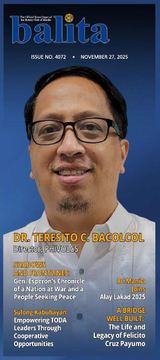
 Dr. Teresito C. Bacolcol
 President’s Message