
Editorial
The editorial reflects on the September 30, 2025 magnitude 6.9 Cebu earthquake and calls for stronger partnership between science, government and civil society.
ON the night of September 30, 2025, at precisely 21:59:43 PHT, the Visayas region absorbed the full, unforgiving force of the Earth’s shifting crust. A magnitude 6.9 earthquake — now recorded as the strongest ever to strike northern Cebu — ruptured through the newly named Bogo Bay Fault with such ferocity that it reverberated across Central Visayas and rippled outward to Western and Eastern Visayas, Southern Luzon, and even Mindanao. In its violent passage, the quake claimed seventy-nine lives, injured more than 1,271 others, and shattered the stability of communities from Bogo to Cebu City. More than 185,900 homes were damaged, nearly 10,600 structures collapsed, and infrastructure losses surged to ₱ 16.23 billion. Landslides buried roads and barrios, tsunami advisories disrupted coastal towns, and power systems failed in wide swaths of the archipelago.
In an instant, thousands were plunged into darkness — both literal and existential — as aftershocks continued to shake the region into the following days.
In moments like these, the Philippine Institute of Volcanology and Seismology (PHIVOLCS) becomes the nation’s most vital source of clarity amidst chaos. Far too often, however, the public encounters PHIVOLCS only as a voice issuing urgent warnings or confirming the grim details of catastrophe. What remains obscured beneath the urgency is the scale of scientific labor and institutional commitment that makes such warnings possible in the first place.
Under the stewardship of Director Dr. Teresito C. Bacolcol, whose academic and professional rigor spans geophysics, crustal deformation, GPS geodesy, and active fault motion — as evidenced in his extensive body of work — PHIVOLCS has strengthened our understanding of seismic threats with an expertise unmatched in the region. The identification of the Bogo Bay Fault, supported by documented surface ruptures and fault scarps, is not merely a scientific achievement; it is a lifesaving map of danger zones that, if taken seriously by local governments and planners, should guide where we build, rebuild, or retreat.
Yet the reality is stark: time and again, disasters reveal the same national fractures. Hazard maps exist, yet settlements continue to rise over active faults. Earthquake protocols are taught, but not practiced. Engineering standards are written, yet inconsistently enforced. PHIVOLCS can produce the science, but the science means little without political will, community compliance, and national discipline.
The Visayas earthquake was not simply a geological episode; it was a mirror held to our own preparedness. And in that mirror, we saw how much remains undone.
This is where civil society must step in, for resilience cannot — and must not — be the responsibility of government alone. The Rotary Club of Manila (RCM), Asia’s first and by far one of the nation’s most influential civic institutions, stands uniquely positioned to fill the widening gap between scientific warning and community action.
With over a century of service woven into its identity, RCM can mobilize relief with unparalleled speed, moving essential goods, medical supplies, clean water, and generators into the devastated northern Cebu corridor long before bureaucratic mechanisms activate fully.
Beyond the immediate, Rotary’s strength lies in reconstruction — lasting, dignified, engineered rebuilding. Schools, hospitals, and community centers destroyed by the quake can rise stronger through partnerships anchored on Rotary’s reputation for integrity, transparency, and long-term engagement. By coordinating closely with PHIVOLCS, RCM can also take on the crucial task of transforming complex scientific data into accessible, community-level education: workshops, seminars, information drives, and preparedness drills that actually reach ordinary families where they live, study, and work.
Equally important, Rotary’s voice carries influence. Its membership is filled with leaders in business, law, engineering, academia, and public service. That collective influence can champion the enforcement of building codes, the relocation of communities lying directly over active faults, the modernization of PHIVOLCS equipment, and the prioritization of disaster-resilient infrastructure across vulnerable regions. When Rotary speaks, decision-makers listen. When Rotary acts, others follow.
The lesson of September 30, 2025 is clear: earthquakes do not kill people — unsafe structures and unprepared societies do. We will never stop the ground from shaking, but we can stop it from burying our future.
PHIVOLCS must be supported, not only with words but with sustained investments, political protection, and civic partnership. Government must enforce what the science demands. And the Rotary Club of Manila must continue standing where it has always stood — at the intersection of compassion, leadership, and nation-building — helping ensure that the next time the earth heaves beneath us, fewer lives will fall with it. In a country fated to tremble, resilience must be a habit, not an aspiration. The ground may shift — but our resolve to safeguard the Filipino people must remain immovable.
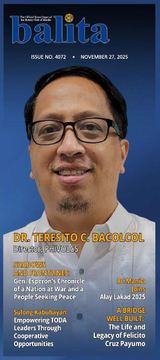
 Dr. Teresito C. Bacolcol
 President’s Message
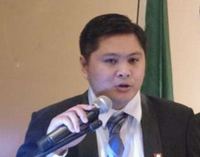 Shadows and Frontlines: Gen. Esperon’s Chronicle of a Nation at War and a People Seeking Peace