

Shadows and Frontlines: Gen. Esperon’s Chronicle of a Nation at War and a People Seeking Peace
General Esperon spoke at a joint meeting with the Rotary Club of Agham on the insurgency, failed peace talks and NTF–ELCAC.

THE 13th Weekly Membership Meeting of the Rotary Club of Manila unfolded on a calm Thursday afternoon at the Manila Polo Club, where distinguished Rotarians from Asia’s First Rotary Club gathered in a joint fellowship with the Rotary Club of Agham, Quezon City. There was a quiet hum of anticipation in the air — an atmosphere shaped by warm greetings, familiar smiles, and the promise of an intellectually stirring session under the guidance of Moderator Past Director Issam Eldebs.
PD Issam Eldebs moderated the meeting.

Part I: Rituals and Fellowship
At 12:30 PM, the gavel struck as President Raoul C. Creencia of RCM and President Lorenzo Angelo Santos of RC Agham jointly called the assembly to order. What followed was a series of dignified rituals that rooted the moment in tradition and shared purpose: an invocation by Rtn. Carlos “Caloy” Buendia, a heartfelt prayer that invited peace and wisdom; the Philippine National Anthem rendered with solemn reverence; and the hymns of both clubs, with the voices of the RCM WF Music Chorale rising to fill the room with rich harmony.

The recitation of the Four-Way Test by President Lorenzo reaffirmed Rotary’s moral compass, echoing through the hall like a quiet oath. Moderator Issam Eldebs followed with an eloquent acknowledgment of guests, his words weaving together the names and achievements of the many dignitaries, business leaders, diplomats, civic servants, and uniformed officers who had come to share in the day’s fellowship.
Laughter and warm applause broke the formality when the RCM Chorale performed the spirited Welcome Song, followed by the cheerful recognition of birthday celebrants from both clubs. The moment captured the delightful blend of fellowship and joy that marks Rotary life.
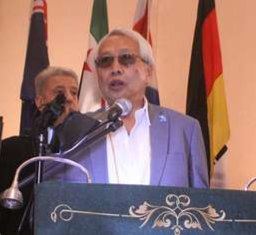
A highlight of the afternoon was the induction of two new members — Mr. Eric G. Eugenio of CE-Logic, Inc. and Atty. Oliver L. Pantaleon of ACCRALAW — whose accomplishments and character were introduced with pride by Past President Teddy Ocampo and President Raoul Creencia. The oath of membership administered by President Raoul sealed their entry into a century-old tradition of service and ethical leadership.
Part II: Presidents’ Time

The program flowed seamlessly into the portion reserved for the club presidents, where Presidents Lorenzo and Raoul spoke of ongoing initiatives, collaborative opportunities, and shared aspirations for the communities both clubs serve. Their messages underscored the growing synergy between their organizations — one rooted in science and innovation, the other in legacy and broad civic stewardship.
A Mistah’s Introduction

The stage was then given to Past President Rafael “Raffy” Alunan III, whose presence alone lends gravitas to any gathering. As he rose to introduce the Guest of Honor and Speaker, he spoke not merely as a former Cabinet Secretary but as a lifelong friend — a “Mistah” — of the man whose voice would soon command the room. His introduction was at once affectionate, insightful, and historically textured, recalling shared trials in national service and the kind of camaraderie forged only in moments of profound consequence.
Crossroads of Conflict and Peace

When General Hermogenes C. Esperon Jr. stepped forward, there was a perceptible shift in the room — a quieting, an unspoken recognition of a man who had lived the highs and costs of national security for decades. His opening words were warm and personal, rich with humor and memory. He addressed PP Raffy Alunan with brotherly fondness, recalling a vivid vignette from their past when rogue officers attempted to “withdraw support,” and how absurd it was to attempt such a move without consulting the very commanders who held the real operational strength. The anecdote, delivered with good nature and razor-sharp clarity, set the tone for a sprawling narrative that would encompass history, ideology, governance, and the very soul of insurgency in the Philippines.
Before delving into his central theme, he acknowledged an array of friends, colleagues, and fellow Rotarians — his own club president, diplomats, former classmates, Special Forces mentors, and civic leaders who had crossed paths with him throughout his long career. The acknowledgments alone might have taken the entirety of a lesser speaker’s time, but Esperon gently reined himself in, greeting birthday celebrants with sincerity and preparing the room for the weightier substance that lay ahead.

Reframing the Topic: The True National Security Threat
Esperon began by confessing that he initially believed he was invited to speak on the West Philippine Sea, a domain he knows intimately as former chairman of the National Task Force for the West Philippine Sea. But he chose instead to confront what he described as the most dangerous national security threat during his tenure: the Communist Party of the Philippines, the New People’s Army, and the National Democratic Front.

What followed was a sweeping narrative — historical, analytical, and deeply personal — on the 56-year shadow cast by the insurgency. He described the intricate structure of the CPP, from its central committee and national bureaus to the underground networks embedded in youth sectors, labor groups, and even legal organizations. His description of the NPA’s guerrilla fronts, each spanning multiple municipalities and establishing shadow governments, revealed just how systematically the rebellion embedded itself into far-flung communities.
He did not shy away from recounting the human toll: thousands of civilians — many from indigenous communities — killed in purges or caught in the crossfire; the ruthless assassinations carried out by internal cleansing squads; and the heartbreaking loss of bright young Filipinos deceived into taking up arms, including six of his own classmates from Philippine Science High School. These were stories that momentarily choked his voice, for they were clearly not statistics but memories.

Why Peace Talks Failed
Esperon revisited the long history of failed peace negotiations—from talks with various regional groups to formal encounters with the CPP-NPA leadership. Each attempt, he said, had been exploited by the insurgents to consolidate, rearm, and advance their cause. His recollection of a high-level command conference under President Rodrigo Duterte was particularly striking: the moment the President rejected any suggestion of a coalition government with the rebels, declaring with fury his refusal to allow peace talks to become a backdoor for power-sharing.

This decisive break led to a new approach: to bring the peace process to the communities instead of negotiating with the ideological elite of the Communist Party.
The Birth of NTF–ELCAC

It was here that Esperon introduced one of the most transformative policies in recent Philippine counterinsurgency history — the creation of the National Task Force to End Local Communist Armed Conflict (NTF–ELCAC).
The shift was profound. The armed forces were no longer the sole movers in a decades-long struggle. Instead, a whole-of-nation approach was institutionalized through Executive Order 70, structured from national leadership down to the barangay level.

He described the structure with the familiarity of an architect: cabinet clusters, regional task forces led by cabinet members assigned to their home regions, barangay-level coordination, and the twelve specialized clusters — including strategic communications, international engagement, law enforcement support, and local peace engagement. Civilian agencies, he emphasized, finally took the lead in resolving what was fundamentally a social and ideological conflict, not merely a military one.
The Barangay Development Program: A Turning Point

Esperon spoke with visible passion about the Barangay Development Program, which he considered the cornerstone of the campaign’s success. For decades, insurgents had captivated isolated communities with romanticized promises. But for the first time, government arrived with roads, school buildings, water systems, health centers, electrification, and livelihood projects — practical, tangible, community-identified needs answered with speed and sincerity.
Each barangay under the program received up to ₱20 million in development funds, with projects coursed through local government leaders rather than distant offices. The results were transformative, and Esperon knew it. These developments, he said, exposed the hollow promises of the insurgency and restored faith in government.

Within three years, the program helped dismantle 80 guerrilla fronts; the remaining nine were neutralized under the current administration.
What remains today are political formations without the power to wage armed rebellion — a reality Esperon recounts with a mixture of relief, pride, and caution.

A Third Rectification and A Look Back
Esperon explained that the CPP has once again embarked on a “third rectification movement,” following internal crises similar to those of 1968 and 1996. But he expressed hope that the collapse of armed fronts marked a turning point in the nation’s history.

He acknowledged that in his years as AFP chief and National Security Adviser, progress was slow — reducing enemy numbers by mere hundreds.
But with civilian government and community support, what had been unattainable for decades was finally achieved.

A Rotarian’s View of Peace
In a beautiful closing reflection, Esperon linked his national security work to his life as a Rotarian. He recalled planting trees along the Agusan River with Rotarians in Butuan, assisting displaced families in North Cotabato, and even cultivating vegetables in MNLF camps — an act that led to a humorous but meaningful consequence: the wives of former combatants refusing to let their husbands return to war lest the vegetable gardens and chicken farms suffer. The audience laughed, but the message was crystalline: peace is built not with weapons but with livelihood, dignity, trust, and service.

“If I had my way,” he said softly, “I would always choose peace. I think I’ve done my part.”
The applause that followed carried warmth, admiration, and respect — the kind that fills a room when truth is spoken by one who has lived it.

Open Forum, Appreciation, and Adjournment
The open forum that followed was lively and engaging, with Rotarians posing incisive questions that allowed Esperon to further illuminate the complexities of insurgency, national policy, and long-term peacebuilding. The exchange was thoughtful, spirited, and marked by mutual respect.

President Raoul Creencia then presented the Certificate of Appreciation, honoring the General for his decades of service and for sharing insights that resonated long after the program’s end. With closing remarks from both presidents and the final strike of the gavel, the meeting was adjourned — a fitting end to an afternoon rich in fellowship, wisdom, and hope.

 Dr. Teresito C. Bacolcol
 President’s Message