

A City in the Pines, A Vision in Motion: Rotary Club of Manila’s 18th Weekly Membership Meeting with JHMC President & CEO Manjit T. Singh Reandi
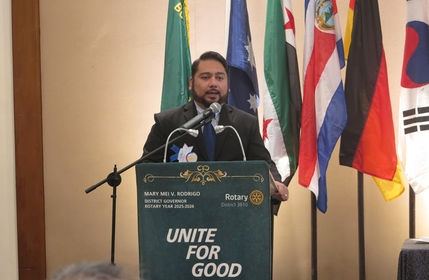
The stately halls of the Manila Polo Club once again became a meeting ground of minds and missions as the Rotary Club of Manila convened its 18th Weekly Membership Meeting for Rotary Year 2025–2026. Presided over by Vice President Ricardo S.B. “Ricky” Guevara and deftly moderated by Past District Governor Alexander P. “Alex” Cureg, the gathering unfolded not merely as a luncheon meeting, but as a journey — through history, ecology, community development, and a bold vision of inclusive, sustainable tourism — led by the day’s distinguished guest speaker, Mr. Manjit T. Singh Reandi, President and Chief Executive Officer of the John Hay Management Corporation (JHMC).
From the outset, there was a palpable sense that this would be more than a routine address. As Rotarians and guests settled in, the familiar rhythms of fellowship, song, and shared purpose set the tone, but it was the anticipation of hearing from the steward of one of the country’s most storied and environmentally significant landscapes — Camp John Hay in Baguio City — that lent the afternoon its particular gravity.

From History to Living Heritage
Mr. Reandi began by situating Camp John Hay within the long arc of Philippine and global history. Once a rest-and-recreation haven for American servicemen, the camp bears the name of John Milton Hay, U.S. Secretary of State under Presidents William McKinley and Theodore Roosevelt. It was, he noted with solemn poignancy, at the gates of Camp John Hay that the first bomb of World War II in the Philippines fell in December 1941. And within its grounds still stands the table on which General Tomoyuki Yamashita formally surrendered in 1945 — now preserved at the U.S. Ambassador’s Residence in the John Hay Reservation Area.

Yet Camp John Hay is not a relic frozen in time. Spread across 625 hectares, divided between a 30-hectare Special Economic Zone and a 325-hectare Reservation Area encompassing 14 barangays, it is today a living, breathing ecosystem and economic hub. “We are,” Mr. Reandi quipped with a smile, “the only city in the Philippines with fully air-conditioned outdoors,” referring to Baguio’s pine-cooled climate — made even cooler, by scientific measurement, within the forested core of the camp itself.
Stewardship of the Environment

Central to his message was a profound respect for nature. Camp John Hay, he shared, contains 53.6 percent of Baguio City’s remaining forest reserve and the majority of its pine trees. This is not merely scenic capital; it is ecological responsibility.
JHMC, he proudly noted, is the only government-owned and controlled corporation in the country with ISO certification in environmental management. Their initiatives range from biodiversity conservation — such as the partnership with the Department of Environment and Natural Resources’ research arm and the protection of a 30-hectare experimental forest — to the revival of an 11-hectare bambusetum, one of the largest in Northern Luzon, home to rare and even China-endemic bamboo species.

Equally innovative is their wildfire mitigation strategy: the use of agave plants, rich in water content, as natural firebreaks — an indigenous solution now validated through research partnerships with local universities.
Community at the Heart of Development

Beyond forests and facilities, Mr. Reandi emphasized that the true soul of Camp John Hay lies in its people. Eighty percent of JHMC’s workforce comes from the Cordilleras, and under his leadership, the camp’s development has taken on a distinctly inclusive, community-centered character.
From partnering with local artisans for Christmas markets and cultural bazaars, to welcoming the famed “Pony Boys” of Wright Park and Loakan into the camp as part of its tourism experience, JHMC has sought to ensure that growth is shared. Through collaborations with TESDA, DSWD, and DTI, the John Hay Training Center now offers free skills development and entrepreneurship programs to residents of the reservation barangays — equipping them not only to find employment within the zone, but to build sustainable livelihoods of their own. The Philippine Experience Program, launched with the Department of Tourism, positions Camp John Hay as the northern gateway to the country’s cultural tapestry, beginning at the historic Bell House.

Here, heritage courts, amphitheaters, secret gardens, and soon a market-place for local produce converge to create an immersive narrative of Cordilleran and Filipino identity.
A Vision of Inclusive, Future-Ready Tourism

Innovation, however, does not stop at community markets and heritage trails. Mr. Reandi outlined an ambitious roadmap: the development of golf tourism linked to international markets, explored through engagements in Japan and plans to connect Baguio seamlessly via Clark International Airport; and most strikingly, a proposed cable car system stretching from Tuba, Benguet, into Camp John Hay and looping through key points in the city — envisioning a car-free, congestion-free Baguio that marries mobility with minimal environmental impact. Complementing this are plans for a major Cordillera museum, skywalks, forest boardwalks, and expanded hospitality facilities — all designed under green architecture principles, ensuring that progress never comes at the cost of the environment.
Economically, the numbers underscore the camp’s significance: 7 to 8 million visitors annually, gross sales reaching approximately ₱1.45 billion, and more than 3,200 direct jobs, with many more indirectly supported. Tourism and hospitality remain the anchor, but a growing ecosystem of eco-friendly, innovation-driven enterprises signals a diversified and resilient future.

Rotary and the Spirit of Service
Throughout his presentation, what resonated most with the Rotarian audience was not merely the scale of projects, but the philosophy behind them: stewardship, inclusivity, transparency, and service — values that mirror Rotary’s own ideals. Mr. Reandi spoke of quarterly dialogues with locators, of governance reforms, of gender and development excellence, and of anti-red tape initiatives that have placed JHMC among the top-performing GOCCs in the country.

In him, the Club saw not only a corporate leader, but a custodian of heritage and a partner in nation-building.
As Vice President Ricky Guevara later presented the Certificate of Appreciation, the applause that filled the hall was not perfunctory. It was the collective recognition that Camp John Hay, under its present stewardship, stands as a model of how history, environment, community, and economic vitality can be woven into a single, coherent vision of sustainable progress.

The 18th Weekly Membership Meeting thus concluded not merely with the formalities of adjournment, but with a renewed sense of inspiration. In the cool pine air of Baguio evoked through words and images, Rotarians were reminded that service, when guided by foresight and compassion, can indeed transform landscapes — and lives.
Meeting Fellowship


 Dr. Andreas Michael Pfaffernoschke
 RI District 3810 Midyear Review in Vietnam
 OF LEDGERS AND LANDSCAPES | The Life, Learning, and Cultural Stewardship of Jaime del Carmen Laya