

OF LEDGERS AND LANDSCAPES | The Life, Learning, and Cultural Stewardship of Jaime del Carmen Laya

There are men who leave their mark through force of personality, and there are those whose influence is quieter, almost architectural. They do not dominate rooms. They design them. They do not seek to be remembered. They ensure that what follows them does not collapse.
Jaime “Jimmy” del Carmen Laya belongs unmistakably to the second kind.
He never believed that leadership was about being right in public. He believed it was about building systems sturdy enough to withstand error, ambition, and time.
The Day the Radio Spoke
Jimmy remembers the radio more clearly than the room.
Memory, over time, is selective. It releases faces, loosens edges, dims the color of walls and furniture. But sound — especially the sound that arrives uninvited — has a way of staying intact. Even now, what remains most vivid to Jimmy Laya is not where he was standing, nor how the light fell that morning, but the voice that came through the radio: calm, factual, almost indifferent to the weight of what it carried.
He did not learn that his time in government had ended through a sealed envelope, a discreet phone call, or the courtesy of advance notice. There was no formal goodbye, no moment staged for transition. He learned it the way nations often learn the truth about themselves — suddenly, impersonally, through broadcast.
It was February 1986.
Just moments earlier, he had come from a courtesy call on President Corazon Aquino, part of the Marcos Cabinet led by Cesar E. A. Virata — his former professor, mentor, and longtime collaborator in both academe and government. The meeting itself bore the unmistakable tone of an ending, though no one named it as such. It was polite, restrained, almost ritualistic. History, for a brief moment, observed manners.
There were no raised voices, no proclamations of rupture. Only the quiet understanding that the country was moving, that the ground beneath institutions was shifting, and that the structures of authority were being rearranged in real time.
Then the radio spoke.

The announcement was spare. The Cabinet had been replaced.
No embellishment followed. No commentary on service rendered, no enumeration of years spent, no acknowledgment of personal cost or professional sacrifice. The words were delivered plainly, as if describing a change in traffic flow or a shift in weather. And in that very plainness lay their finality.
Jimmy absorbed the news without visible reaction. What struck him was not the abruptness of the announcement, but its inevitability. Governments, he had long believed, must move forward decisively. They could not pause for sentiment, nor wait for individuals to gather their thoughts. Institutions, if they were to function at all, could not be hostage to personal closure.
Power, once withdrawn, had to be relinquished cleanly.
He would later reflect that the moment felt less like an expulsion than a conclusion — one reached not by argument or protest, but by circumstance. Public office, in his understanding, was never an extension of the self. It was not identity. It was a role — necessary for a time, demanding in its season, and finite by design.
In that sense, there was no bitterness to process, no sense of loss to mourn. What mattered was not how the departure unfolded, but whether the work done within the institution would endure after the individual had stepped away.
That distinction — between position and purpose — had guided him long before that day. It had shaped how he taught, how he governed, how he managed, and how he collected and preserved. Titles were temporary. Systems were what remained.
As he moved forward from that moment, there was no dramatic recalibration of self, no existential unraveling. The radio announcement did not unsettle his sense of direction. If anything, it clarified it. It reaffirmed a belief he had practiced quietly throughout his life: that authority must never be confused with permanence, and that influence is most meaningful when it survives one’s absence.
The day the radio spoke did not end Jimmy Laya’s public life. It simply returned him to what he had always trusted most — work that required no applause, institutions that could stand without him, and a life defined not by how loudly one exits a room, but by whether the room still holds its shape long after one has gone.
A House Built of Books
Jaime del Carmen Laya was born on January 8, 1939, into a household where learning was not celebrated as achievement, but practiced as habit.

Knowledge in that home was not ornamental. It was not something displayed, cited, or used to establish superiority. It was lived. Books were present not as trophies, but as tools — handled, returned to shelves, taken down again. Conversation did not revolve around accolades or ambition, but around ideas, stories, and the steady obligations of daily life. Learning was not framed as a path upward, but as a way of staying oriented in the world.
His father, Juan Cabreros Laya, was a novelist, playwright, and cultural worker of quiet distinction. He moved easily between literature and public engagement, between the discipline of writing and the demands of civic life. At a time when Filipino letters were still shaping a national voice, Juan Laya wrote with moral seriousness and historical consciousness. His novel Lahing Kayumanggi would later become required reading for teachers of Pilipino in the 1950s. Another work, His Native Soil, earned the Commonwealth Literary Award for the Novel in 1940 — an honor bestowed at the Metropolitan Theater by President Manuel L. Quezon. During the Japanese Occupation, he was active in Dramatic Philippines, a theater group that persisted under conditions of scarcity and risk. Art, in that sense, was not an abstraction. It was something done in real time, under pressure, with consequence.
His mother, Silvina del Carmen, was a teacher whose influence was felt less through instruction than through example. She continued in public education and would later become a superintendent in the public school system, raising her children with steadiness rather than spectacle. She demonstrated what it meant to prepare carefully, to speak plainly, to finish what one had started. From her, Jimmy absorbed the idea that authority did not require volume, and that competence, once established, did not need to be announced.
Between them, an unspoken ethic governed the household: do not take advantage of others; do your work well; let your actions speak. These were not rules recited aloud. They were expectations embedded in routine. Ethics were transmitted through repetition — through watching adults do what they said they would do, day after day.
This quiet continuity shaped him more deeply than any single admonition could have. The only boy in a household of sisters, Jimmy grew accustomed early to solitude. Left largely to his own devices, he learned to occupy himself quietly — watching plays alone, wandering through Filipiniana libraries, reading without supervision. The war intruded early into his consciousness, not as narrative, but as atmosphere.
He was still very young when Manila burned. Yet the memory stayed — not as fear, but as light. The unnatural glow in the night sky. The sense that something familiar was being undone. He remembered Japanese patrols moving through the streets, their presence both routine and menacing, and then, just as vividly, the sudden release of joy when American troops marched down Rizal Avenue in 1945, greeted by crowds that seemed to materialize out of nowhere.
For a brief time, an American soldier — a Texan named Joseph Slay — was billeted in their Sampaloc home. The detail lingered not because it was extraordinary, but because it was intimate. The soldier slept without a mosquito net after spraying the room with DDT. It was an ordinary human accommodation amid extraordinary circumstances. The war, he learned early, was not only fought in headlines and battles. It unfolded in living rooms, in borrowed beds, in gestures of temporary coexistence.
These memories endured not because they were dramatic, but because they revealed how fragile normalcy could be, and how easily it could be disrupted by forces beyond one’s control. Then came the loss that altered the architecture of his thinking. When his father died suddenly in a car accident, Jimmy was still young — barely into adolescence. The death was abrupt and irrevocable. There was no long illness to prepare for it, no gradual loosening of ties. One day his father was there; the next, he was not.
The loss left a permanent mark. It introduced him early to finitude, not as abstraction, but as lived fact. Life no longer appeared open-ended, but bounded. Time, he understood, was not guaranteed. The question that followed was not dramatic, but practical: if time were limited, what should be done with it? What obligations mattered most? What work was worth sustained effort? This awareness did not make him reckless. It made him careful.
He learned to value preparation over impulse, structure over improvisation. Even as a boy, he gravitated toward order — not rigid order, but coherence. He wanted things to make sense. He was drawn to systems that explained themselves, to arrangements where parts related logically to one another.
Books became companions in this search. Reading was not escape, but orientation. He read widely and without hierarchy — history, economics, literature, architecture, numbers, art — absorbing not only content, but form: how arguments were built, how narratives held together, how balance was achieved without excess.

Through reading, he learned to recognize proportion, clarity, and restraint — qualities that would later shape his approach to finance, education, governance, and visual culture. Long before he encountered balance sheets or museum collections, he was already training his eye to see how parts related to wholes, how excess weakened structure, and how meaning often resided not in what was added, but in what was deliberately left out.
By the time he entered adulthood, the foundations were already laid — not in ambition, but in discipline; not in spectacle, but in attention. The habits formed in that early household would follow him everywhere, quietly informing the life he would go on to build.
Formal schooling did not interrupt this domestic education; it extended it.
Jimmy’s early years in elementary school revealed nothing flamboyant. He was not remembered as a prodigy in the theatrical sense, nor as a student who sought attention. What distinguished him even then was steadiness. Teachers noted his seriousness — not severity, but attentiveness. He listened carefully, followed instructions precisely, and completed work without dramatics. Excellence, for him, was not a performance. It was a habit.
By the time he reached Arellano High School, from which he graduated in 1953, these habits had hardened into instinct. The school was demanding, and the postwar years offered little indulgence for distraction. Jimmy adapted easily to structure. Timetables appealed to him. Rules clarified expectations. Within those boundaries, he found freedom rather than constraint.
He gravitated toward subjects that required internal order — mathematics, logic, structured argument — yet he never abandoned his love for reading. Literature remained present not as escapism, but as moral calibration. Stories trained his sense of proportion: how actions led to consequences, how choices accumulated over time.
His classmates would later recall him as diligent rather than dazzling. He was not the loudest voice in the room, nor the quickest to volunteer opinion. But when he spoke, his comments were precise. There was an economy to his thinking that suggested early restraint — an instinct to say only what advanced understanding.
School, for Jimmy, was never merely preparation for a career. It was rehearsal for responsibility.
By the time he left Arellano High School, the trajectory was already visible, even if unnamed. The boy who had grown up surrounded by books had learned to move comfortably between discipline and curiosity, between rule-following and independent judgment. He carried with him not a hunger for distinction, but a respect for structure — an understanding that institutions, like people, functioned best when built deliberately and maintained carefully.
The University of the Philippines would refine these instincts. But they had been formed long before he ever set foot in Diliman.
The Discipline of Excellence At the University of the Philippines

At the University of the Philippines Diliman, Jimmy Laya’s gifts became unmistakable — not because they announced themselves loudly, but because they held under scrutiny.
At the core of this long arc stood an academic formation that never loosened its grip on his thinking. Jimmy was trained rigorously in accounting and finance. He moved through the campus with an ease that came from preparation rather than confidence. The work did not overwhelm him; it organized him. When he graduated magna cum laude in 1957 with a degree in business administration and placed eighth in the Certified Public Accountant examinations at the age of eighteen, the achievements were remarkable even by the university’s exacting standards. Yet they did not intoxicate him. If anything, they sharpened his curiosity.
He was far less interested in the applause that followed than in the mechanics beneath it.
Numbers, for Jimmy Laya, were never abstractions. They were expressions of order — ways of describing how effort translated into outcome, how resources moved, how institutions either held together or quietly failed. While others saw accounting as terminal expertise, he saw it as a language that pointed toward deeper questions. Why did certain organizations remain coherent under stress while others fragmented? What invisible assumptions held systems together? Where did discipline end and judgment begin?
These questions could not be answered locally, or quickly.
He left for the United States not in pursuit of prestige, but of perspective. At Georgia Institute of Technology, where he earned a master’s degree in industrial management in 1960, he encountered an environment that emphasized process over personality, optimization over intuition. Systems were dissected, tested, improved. Efficiency was treated not as speed, but as alignment.
From there, he went on to Stanford University, earning a doctorate in financial management in 1965. Stanford exposed him to a culture of analytical rigor that was both demanding and unsentimental. Ideas were not admired for elegance alone. They were stresstested. Models were dismantled. Assumptions were challenged not to provoke debate, but to reveal limits. His doctoral dissertation — A Cash Flow Model and the Rate of Return: The Effect of Price Level Change and Other Factors on Book-Yield — reflected an early and sustained concern with realism in measurement, with how theoretical constructs behaved when exposed to inflation, distortion, and time.
The experience resonated deeply with him. Yet he did not return home armed with ideological certainty or missionary zeal. He returned with tools — and with a sharpened skepticism toward easy answers. The more he learned, the more he understood how partial most explanations were. Complexity, he realized, was not an obstacle to be conquered, but a condition to be respected.
As a Ford Foundation grantee, he became the first Ph.D. in business produced by the U.P. College of Business Administration — an institutional milestone that symbolized his lifelong role as bridge-builder between global rigor and local responsibility. He returned to the University to join the faculty and began teaching economics, finance, and accounting. not merely credentialed, but committed, serving as faculty member from 1957 to 1978 where he would shape generations of economists, managers, and accountants who learned — often without realizing it — that discipline was a moral stance as much as a technical one.
His classrooms were marked by clarity rather than charisma. He did not seek to persuade students into agreement. He sought to train them in discernment. Arguments had to be coherent. Assumptions had to be named. Conclusions had to survive scrutiny. He believed education was not about producing consensus, but competence. Not about shaping opinion, but cultivating judgment. Ideas, he insisted, only mattered if they could function under pressure.
Students sensed this immediately. He was demanding without being theatrical, exacting without humiliation. He corrected errors not to assert authority, but to protect standards. Over time, it became clear that his seriousness was not severity. It was respect — for the discipline, for the institution, and for the students who had entrusted him with their formation.

Leadership, when it arrived, did so without declaration.
Jimmy did not seek prominence. He worked within systems, respected hierarchy, and followed institutional processes with care. Yet his reliability set him apart. He noticed structural problems others had learned to work around. He asked why inefficiencies persisted. He proposed solutions quietly, implemented them patiently, and stayed to see whether they worked.
Trust accumulated around him almost incidentally.
By the time he succeeded Cesar E. A. Virata as Dean of the College of Business Administration in 1967, the transition felt natural rather than ambitious. He was still young, but he had already demonstrated a rare capacity to hold complexity without losing coherence.
As dean, his gaze extended beyond the classroom.
He began thinking about how education itself was structured — about curricula that responded to real conditions, about graduate programs that prepared leaders rather than technicians, about research institutions that supported inquiry rather than prestige. He was no longer concerned only with producing graduates. He was thinking about building an ecosystem — one that could generate professionals who understood not just how to succeed, but how to sustain.
The work was meticulous, demanding, and unfinished.
And it was only beginning.
Rebuilding Business Education
When Jimmy Laya assumed the deanship of the University of the Philippines College of Business Administration in 1967, he did not experience the moment as a promotion. He experienced it as a problem that had been waiting to be named.
The College, as he encountered it, was competent but incomplete. It produced graduates who knew how to compute, how to analyze figures, how to perform within established frameworks. Yet too often, they struggled to see how those frameworks related to one another.

Knowledge existed in compartments. Accounting, economics, management, agriculture, policy — each was taught as if it occupied a separate universe, intersecting only by accident.
To Jimmy Laya, this fragmentation was not merely academic. It reflected an economy that no longer existed.
The Philippines he saw emerging was a system of interdependencies — agriculture feeding industry, industry shaping services, services influencing policy, policy restructuring incentives that rippled back through the entire economy. Business education that treated these domains as discrete disciplines was, in effect, training students for a world already in retreat. If education did not evolve, it would become technically proficient yet strategically blind.
He did not announce this diagnosis with fanfare.
Jimmy Laya did not begin with speeches or sweeping declarations. He began with structure. Administration, as he understood it, was not about persuasion alone. It was about alignment — of curricula with reality, of faculty expertise with institutional goals, of student formation with the responsibilities they would eventually carry.
He believed that reform should be quiet, methodical, and defensible. Each proposal had to withstand a simple but unforgiving question: What problem does this solve that the existing structure cannot? If the answer was unclear, the proposal did not proceed.
From this logic emerged the Doctoral Program in Business Administration. It was not conceived as an abstract exercise in theory, nor as a credential to be accumulated. It was designed to cultivate scholars capable of grappling seriously with Philippine conditions — men and women who could bring rigorous analytical tools to local realities rather than importing models uncritically. The aim was intellectual sovereignty, not imitation.
The Master of Agribusiness Management followed naturally. Jimmy Laya had long been troubled by the way development discourse treated agriculture as a residual category — important in rhetoric, marginal in strategy. He rejected the notion that agriculture was pre-modern or peripheral. It was central, structurally and morally, to the Philippine economy. To ignore it was not only analytically flawed, but socially irresponsible. The program sought to reconnect business education to the land, to production cycles, to the lives and labor of those who sustained the economy long before balance sheets recorded their value.
The five-year Bachelor of Science in Business Administration and Accountancy proved more controversial. Critics argued that it would delay students’ entry into the workforce, that it imposed unnecessary rigor in an economy hungry for credentialed labor. Jimmy Laya was unmoved. Time, he believed, was not wasted if it was used to integrate learning.
Accountancy, in his view, was not simply technical proficiency. It was ethical responsibility. Those entrusted with certifying truth in numbers carried a burden that could not be rushed. Students needed time — not only to master technique, but to mature into judgment. Compression, he felt, risked producing efficiency without conscience.
He also insisted on a full-time MBA program, resisting pressures to accommodate part-time formats that prioritized convenience over immersion. Serious management education, he believed, required sustained engagement — space to think, to argue, to fail safely, and to reconsider assumptions.

Then came the joint degree programs — with Agriculture, Economics, and Home Economics. These were not experiments designed to impress. They were correctives. Business students, Jimmy Laya believed, needed to understand production systems, labor realities, consumer behavior, and the economics of hospitality and service. Management divorced from context was management in name only.
Faculty reaction was mixed. Some welcomed the changes; others worried about disruption, dilution, or loss of disciplinary purity. Jimmy Laya listened carefully, but he did not govern by consensus alone. Institutions, he understood, often resist reform not because ideas are wrong, but because they unsettle routines that have grown comfortable. His responsibility was not to eliminate discomfort, but to ensure that it led somewhere constructive.
In 1971, this philosophy took institutional form with the establishment of the U.P. Business Research Foundation. The Foundation created a formal bridge between scholarship and practice. Faculty were encouraged to conduct research that mattered, to engage in consultancy without abandoning academic rigor, and to hold professorial chairs that recognized sustained contribution rather than episodic achievement.
It institutionalized something Jimmy Laya had long practiced intuitively: that theory gains strength when tested against reality, and that practice deepens when subjected to disciplined inquiry.
That same year, his attention turned to the College’s physical environment.
The existing facilities no longer matched the seriousness of its ambitions.
Classrooms were functional but inadequate. Research space was limited. Informal intellectual exchange — the kind that happens between lectures, in hallways and shared rooms — was constrained. Ideas, Jimmy Laya believed, needed space — literal space — to develop fully.
Plans were quietly drawn for a new building. Not a grand monument, but a structure that conveyed permanence rather than improvisation. One that suggested the College expected to be there for the long term, and intended to do its work with gravity. Construction would begin in 1976, after his term had ended, but the impulse was unmistakable: institutions should look as serious as they intend to be.
Recognition arrived, predictably and awkwardly.
In 1967, the same year he became dean, Jimmy Laya was named one of The Outstanding Young Men of the Philippines (T.O.Y.M.) by the Philippine Jaycees, cited for Business Education. He accepted the honor with gratitude, but without attachment. Awards, he believed, were secondary indicators at best. They mattered only insofar as they affirmed that an institution was moving in the right direction. They were never the point.
By the time he stepped down as dean in 1975, the College of Business Administration had been quietly transformed. It was no longer merely training professionals. It was shaping institutional thinkers — men and women prepared to navigate complexity without resorting to simplification.

Jimmy Laya had not imposed a personality on the College. He had given it something far more durable: a structure capable of evolving without him.
Rotary: The Weekly Rehearsal of Public Virtue
Jimmy Laya joined the Rotary Club of Manila in 1975, at a point in his life when professional responsibility had begun to accumulate and public visibility had become unavoidable. By then, he had already moved through academe into government, and his days were increasingly shaped by institutions that demanded judgment under pressure. To an outsider, Rotary might have appeared redundant — another organization competing for time, another set of meetings layered onto an already full schedule.
To Jimmy Laya, it was something else entirely.
It was practice.
He entered Rotary not seeking expansion, but consolidation. Sponsored by its Past Vice President Jose Roberto “Robbie” Delgado, co-founder, CEO, and chairman of the Transnational Diversified Group, Jimmy approached the Club without expectation of prominence or influence. What attracted him was not Rotary’s prestige, but its structure — its stubborn refusal to reinvent itself simply to remain interesting. In a professional world increasingly enamored with novelty, disruption, and rhetorical urgency, Rotary’s insistence on repetition struck him as quietly radical.
The same meetings. The same order of business. The same questions asked again and again, even when the answers appeared obvious. Especially when they appeared obvious.
His classification, Government–Education, was descriptive rather than aspirational. Rotary did not ask him to transform, to rebrand, or to perform a version of himself for approval. It required something far more demanding: presence. Attendance. Participation. Return. It insisted that one show up not when inspired, but when routine threatened to dull attention.
Jimmy Laya understood institutions as moral technologies — structures that shape behavior not through intensity, but through duration. Rotary, in this sense, functioned as an ethical gymnasium. One did not attend to be stirred emotionally. One attended to keep habits from eroding.
The Four-Way Test, recited so often that it risked becoming background noise, was a case in point. Its genius lay precisely in that risk. Truth, fairness, goodwill, mutual benefit — these were not principles meant to dazzle. They were standards meant to be rehearsed. Their power came not from eloquence, but from persistence. Recited weekly, they worked their way quietly into reflex.
Jimmy Laya understood this immediately. He had spent his life inside systems where ethical lapses rarely arrived dramatically. They crept in through exception, through haste, through the small accommodations made when no one seemed to be watching. Rotary’s discipline lay in preventing that creep.

He did not seek prominence within the Club. He served when asked, declined when necessary, and remained present without posturing. Leadership, he believed, was not about visibility. It was about reliability. His contribution was steady rather than spectacular, cumulative rather than episodic.
In 1996, he was named a Paul Harris Fellow — a recognition not of a single gesture, but of sustained commitment. The honor did not change his behavior. It merely acknowledged what had already been consistent. Later designated Senior Active, he became part of the Club’s institutional memory, even as other professional obligations intermittently drew him away.
His most revealing Rotary role came quietly, without ceremony.
In Rotary Year 2005–2006, Jimmy Laya served as Internal Auditor.
It was not a glamorous position. There were no speeches to deliver, no applause to receive. The work involved scrutiny rather than celebration — reviewing records, examining controls, asking whether procedures were followed not in spirit alone, but in fact. For many, it would have seemed a burdensome assignment.
For Jimmy Laya, it was familiar ground.
He had long believed that institutions failed not because of bad intentions, but because of neglected systems. Transparency, accountability, and internal control were not bureaucratic irritants; they were moral safeguards. When systems weakened, even the most idealistic organizations became vulnerable — to error, to complacency, to quiet drift.
As Internal Auditor, he approached Rotary the same way he approached banks, universities, and public offices — not with suspicion, but with care. The goal was not to catch wrongdoing, but to ensure that trust was deserved. Integrity, he believed, had to be verifiable.
Rotary, for Jimmy Laya, was never separate from the rest of his life. It was not an extracurricular commitment. It was rehearsal — a place where the habits required of public service could be practiced without the distortions of power or urgency. Patience. Restraint. Consistency. The willingness to submit oneself to rules even when one had outgrown the need for supervision.
In a world increasingly impatient with continuity, Rotary offered something rare: the discipline of staying the course. Of returning, week after week, to principles that did not change simply because the world around them did.
For Jimmy Laya, that discipline was not nostalgic.

It was essential.
When Theory Meets Gravity
Jimmy Laya did not enter government believing that good ideas automatically prevailed.
When Gerardo P. Sicat — his former cohort and young career co-instructors at the University of the Philippines — assumed leadership of the National Economic and Development Authority in 1974, he invited Jimmy Laya to serve as his deputy — not as an act of patronage, but of confidence.
Jimmy’s work quickly earned him respect within the technocratic core of government. So indispensable did he become that Central Bank Governor Gregorio S. Licaros requested to share his services, leading to his concurrent role as Deputy Governor.
By the time he accepted senior roles in national administration, he had spent enough years inside complex institutions to understand a hard truth: policy rarely failed because people did not know better. It failed because systems did not align. Intent drifted away from execution. Authority outpaced accountability. Political urgency collided with administrative reality. Between what was imagined and what could actually be implemented, gaps formed — and it was in those gaps that even well-meaning reforms quietly unraveled.
He arrived in government without illusions of mastery. What he brought instead was a habit of observation. He paid attention to how decisions moved — or stalled — as they passed through layers of bureaucracy. He noticed where discretion hardened into privilege, where exceptions accumulated until rules no longer held, where processes designed for clarity had become rituals of accommodation.
It was this reputation — for precision, restraint, and institutional loyalty — that led President Ferdinand E. Marcos to elevate him to Minister of the Budget, where Jimmy introduced reforms aimed not at expansion, but at restoring coherence to public expenditure. During this time, the country was already straining under the weight of its own complexity. Programs had multiplied rapidly, often in response to political imperatives rather than long-term coherence. New initiatives were layered on top of old ones, rarely retired, frequently overlapping. Budgeting, in practice, had become reactive — less a strategic instrument than an annual exercise in negotiation, bargaining, and deferral.
The budget no longer described a plan. It described a truce.
Jimmy Laya did not respond with rhetoric. He did not cast himself as a reformer battling entrenched interests. He framed his task in a quieter, more demanding way. What the system required, he believed, was not reinvention, but repair.
Repair meant restoring the relationship between planning and budgeting — ensuring that expenditures reflected articulated priorities rather than inherited entitlements. It meant clarifying lines of responsibility so that programs could be evaluated not only for intent, but for outcome. It meant insisting on procedures that could be defended not just in political forums, but within the logic of the institution itself.

He treated the budget not as a statement of desire, but as an expression of constraint. Every peso allocated carried a cost beyond its immediate use. It foreclosed alternatives. It signaled preference. To deny this was to invite imbalance. Governments, he understood, did not collapse only from corruption or crisis. They collapsed when promises outran capacity.
Under his stewardship, coherence became the objective.
Performance budgeting was strengthened not as an ideological statement, but as a means of asking whether programs did what they claimed. Multi-year perspectives were introduced to counter the short-termism that distorted annual cycles. Regional rationalization sought to align national priorities with local realities, reducing duplication and unevenness that had crept into implementation.
None of these measures were revolutionary. That was precisely their point.
They were attempts to make government legible to itself — to allow decision-makers to see, clearly and honestly, what the state was actually doing. Jimmy Laya believed that opacity bred irresponsibility, while clarity, even when uncomfortable, created the conditions for discipline.
What frustrated him most was not resistance from politicians. He understood their pressures, their constituencies, their need to respond visibly. What troubled him was the quiet erosion of rules through exception. Each exemption appeared reasonable in isolation. Taken together, they hollowed out the system. Flexibility, unbounded, became arbitrariness.
His response was not confrontation, but structure.
If discretion could not be eliminated — and he knew it could not — it had to be bounded. Choices had to be traceable. Deviations had to be justified. Systems had to be strong enough to absorb pressure without deforming beyond recognition.
The work was slow. It required patience rather than flair, persistence rather than proclamation. It did not lend itself to dramatic narratives of victory or defeat.
It also did not make headlines.
What it did was more difficult, and more enduring. It reduced the likelihood of sudden failure. It lowered the risk of collapse disguised as momentum. It strengthened the institutional fabric in ways that would only become visible when tested by strain.

For Jimmy Laya, that was the measure of success. Not applause, but endurance. Not recognition, but resilience.
Central Banking Under Constraint
In 1981, when the position became vacant, Jimmy Laya was appointed Governor of the Central Bank of the Philippines, becoming the youngest person ever to hold the post. The appointment was widely noted for its symbolism — youth elevated to one of the most consequential economic offices in the country — but symbolism was the least of his concerns.
The timing could not have been more unforgiving.
The global environment was tightening its grip. Interest rates abroad were rising sharply, driven by policy shifts far beyond Philippine control. International capital was becoming cautious, selective, impatient. At home, confidence was already brittle, sustained more by habit than conviction. Political uncertainty hovered over every major decision, shaping expectations in ways that monetary instruments alone could not correct.
Jimmy Laya entered the office with no illusion that authority equaled sovereignty. Central banks, he understood, operated within constraint. Their tools were powerful, but finite. Their decisions reverberated through markets, but they could not command trust by decree.
He rejected the romantic image of the central banker as a figure operating in a realm of technical purity, insulated from politics and human behavior. Monetary decisions, he knew, were entangled — woven through expectations, fears, international pressures, and domestic narratives. The challenge was not to pretend these forces did not exist, but to navigate them without surrendering coherence.
Then came August 1983.
The assassination of Senator Benigno Aquino Jr. ruptured what little confidence remained. The shock was not only political; it was psychological. Markets respond not just to numbers, but to meaning, and the event signaled instability that could not be priced easily. Capital flows thinned almost immediately. Investors hesitated. Credit tightened. Rumors traveled faster than data.
By 1984, the Philippines faced a full-blown financial crisis.
Foreign financing dried up. Debt obligations loomed larger than available reserves. The margin for maneuver narrowed until there was almost none left. Eventually, a debt standstill became unavoidable — a decision as sobering as it was consequential. It marked the point at which external confidence could no longer be sustained by internal assurances alone.

These were the moments when technocratic training met its limits. Models faltered under conditions they had not been designed to accommodate. Historical precedent offered guidance, but no blueprint. Every decision carried consequences that extended far beyond balance sheets — into employment, prices, livelihoods, and national credibility.
Jimmy Laya did not later describe this period with defensiveness or self-exculpation. He acknowledged missteps where they occurred. He recognized constraints where they prevailed. He accepted the reality that some outcomes were shaped by forces beyond domestic control. Powerful countries pursued their own interests. International institutions had their own thresholds of tolerance. The global financial system was not neutral terrain.
Yet even within these constraints, he insisted on discipline. Decisions, he believed, had to be reasoned, documented, and defensible. Not because they would always succeed, but because coherence itself was stabilizing. Panic was contagious. So was disorder. A central bank that appeared uncertain amplified fear. One that acted methodically — even under strain — signaled resolve. Clarity, even when painful, was preferable to reassurance built on illusion.
It was during these years — almost paradoxically — that Jimmy Laya made one of his most enduring and least expected contributions.
Amid financial crisis, when reserves were scarce and attention consumed by survival, he expanded the Central Bank’s acquisition of Philippine artworks and pre-Hispanic artifacts. To some observers, the decision appeared incongruous, even indulgent. Why invest in art when the economy was under siege?
To Jimmy Laya, the logic was precise. Institutions, he believed, derived authority not only from function, but from meaning. A central bank was not merely a vault or a regulator. It was a symbol of continuity. In moments when confidence was fragile, when faith in systems wavered, cultural memory served as reassurance that the nation was more than its crisis.
Art, in this sense, was not decoration. It was assertion. The acquisition of works by Félix Resurrección Hidalgo, Simón Flores, and others — alongside ancestral gold and pre-Hispanic artifacts — was an act of institutional self-definition. It declared that even under strain, the country would not abandon its story.
That while numbers fluctuated and capital retreated, identity endured.
These collections would later form the nucleus of what became the Museo ng Bangko Sentral ng Pilipinas, a permanent repository of cultural memory housed within a financial institution. The juxtaposition was deliberate. Finance and heritage were not opposites. They were parallel forms of stewardship — one concerned with resources, the other with meaning.
The decision reflected a belief that crises, while destabilizing, also clarified priorities. And that even in moments of contraction, a nation must remember who it is — or risk losing more than solvency.
For Jimmy Laya, central banking was never only about managing currency. It was about preserving coherence — economic, institutional, and cultural — when the forces arrayed against it were strongest. That, he believed, was the quiet responsibility of power exercised without illusion.

The Custodian of Memory
Jimmy Laya’s sensitivity to memory found earlier expression in another role — one that spoke directly to his understanding of visual culture, space, and the obligations of stewardship.
In 1979, he was appointed the first Action Officer of the Intramuros Administration, at a time when the historic walled city stood at a crossroads. Decades after the war, Intramuros remained scarred not only by physical destruction, but by uncertainty. Parts of it had been reconstructed hastily. Other sections had been left to decay. The danger was not simply neglect, but misinterpretation.
Intramuros was not merely a site. It was a palimpsest — a record of layered histories written over one another: colonial ambition etched into stone, religious devotion embedded in orientation and form, wartime destruction visible in absences as much as in ruins, and postwar neglect evident in improvisations that confused survival with restoration. To intervene without understanding these layers was to risk turning memory into caricature.
Jimmy Laya understood this immediately.
He approached the task not as a developer seeking activation, nor as a curator arranging spectacle, but as a scholar trained to read form. He believed that buildings were texts, and that restoration required literacy. Walls were not neutral surfaces. Their thickness, alignment, and articulation responded to climate, defense, and ritual. Gates were oriented deliberately — toward procession, toward surveillance, toward threshold. Ornamentation was not excess. It was language.
To erase these features in the name of modernization was not progress. It was amnesia.
Under his stewardship, attention shifted from isolated attractions to coherence. Fortifications were studied as systems rather than backdrops. Gates were treated as sequences rather than landmarks. Ecclesiastical structures were understood not simply as devotional spaces, but as spatial narratives — arrangements of light, proportion, and movement designed to shape experience over time.
Objects were collected, catalogued, and documented with care. Publications followed — not glossy promotional material, but records meant to endure. The aim was not to impress visitors, but to orient them. Intramuros, Jimmy Laya believed, should be encountered as an archive one could walk through, where understanding deepened with attention rather than speed.
He resisted the temptation to dramatize restoration. There were no grand unveilings meant to announce transformation. The work was incremental, deliberate, and often invisible to casual observers. Success was measured not by crowds, but by fidelity — to original form, to documented history, to the quiet intelligence embedded in the built environment.
Decades later, when Jimmy Laya helped spearhead the restoration of the Jesuit House in Cebu through the Escuela Taller de Filipinas Foundation, the same philosophy reasserted itself with clarity. The structure, dating back nearly three centuries, bore the marks of multiple adaptations. Some were sympathetic. Others were distortions accumulated over time.

Once again, Jimmy Laya insisted that restoration was not reinvention. It was responsibility.
The task was not to leave a personal imprint, nor to update the building to contemporary taste. It was to remove the accretions that obscured its logic and allow the original form — its proportions, materials, and intent — to speak again. Modern intervention, where necessary, had to be legible and restrained, never pretending to be what it was not.
This approach required humility. It demanded acceptance that the restorer was a temporary steward, not an author.
The same sensibility that guided his work in budgeting and central banking — respect for structure, suspicion of excess, insistence on coherence — found its natural counterpart in visual culture. In both realms, Jimmy Laya believed that systems endured not because they dazzled, but because they were intelligible. Flourish without structure collapsed under scrutiny. Restraint, properly exercised, became a form of care.
For Jimmy Laya, preservation was not nostalgia. It was continuity.
And continuity, he understood, was the quiet labor that allowed memory to survive without becoming spectacle.
Culture as National Infrastructure
When Jimmy Laya assumed the role of Minister of Education, Culture and Sports in 1984, he inherited a portfolio that many regarded as ancillary to what were then called the “serious” concerns of governance. Economic stabilization, political negotiation, and security dominated public discourse. Education and culture, by contrast, were often framed as downstream considerations — important, perhaps, but postponable.
He did not share that view.
To Jimmy, education and culture were not supplemental. They were structural. They shaped not only what a society knew, but how it behaved under strain. Economic systems could be repaired. Political arrangements could be renegotiated. But when a nation lost coherence — when it ceased to recognize shared standards of responsibility, memory, and meaning — recovery became far more elusive.
He believed that nations did not fail only through fiscal mismanagement or external shock. They failed through erosion. Education systems that trained for skill without responsibility produced competence without conscience. Cultural institutions treated as luxuries fostered a public life disconnected from memory. The result, he feared, was a society that functioned efficiently but hollowly — capable of output, but uncertain of purpose.

His tenure in the ministry was brief and politically turbulent, unfolding amid intensifying national uncertainty. Yet his approach did not waver. He resisted spectacle and avoided grand proclamations. Instead, he focused on alignment — between policy and preservation, between educational outcomes and civic responsibility, between cultural investment and long-term continuity.
Education, in his view, was not merely about throughput — how many students passed through classrooms, how quickly credentials were issued. It was about formation. What habits were being cultivated? What standards were being normalized? What responsibilities were being quietly deferred?
Culture, likewise, was not an adornment. It was infrastructure of a different kind. It shaped how societies remembered themselves, how they oriented future generations toward the past without becoming captive to it.
After 1986, released from the immediacy of formal office, Jimmy Laya returned to this work with greater clarity and patience. Freed from the constraints of ministerial timeframes, he could focus on institutional architecture rather than policy firefighting.
As Chairman of the National Commission for Culture and the Arts, beginning in 1996, he presided over a period of critical consolidation. The Philippine cultural landscape had long been fragmented — multiple agencies operating with overlapping mandates, uneven resources, and unclear lines of authority. Good intentions abounded, but coherence was lacking.
Jimmy approached the problem as he always had: not through reinvention, but through structure.
In 1998, the National Museum System was enacted, providing long-overdue clarity to the stewardship of the nation’s material heritage. Roles were defined. Responsibilities were aligned. Resources were stabilized. It was, in essence, a budgetary act applied to culture — an exercise in institutional design that treated heritage not as sentiment, but as obligation.
The effect was subtle but profound. Cultural work could now proceed with continuity rather than improvisation. Preservation ceased to depend solely on personalities or short-term advocacy. It became embedded in the system itself.
Years later, when Jimmy Laya assumed the chairmanship of the Cultural Center of the Philippines, he encountered a different but related challenge. The CCP’s iconic structure — already heavy with symbolic and architectural significance — required attention. Time had taken its toll. Systems aged. Standards evolved. The temptation, in such moments, was cosmetic transformation.
Jimmy Laya rejected that temptation outright.
He was precise in his language. This was not renovation. It was rehabilitation. The distinction mattered. Renovation implied replacement, reinvention, the imposition of contemporary taste. Rehabilitation implied care — investigation, repair, strengthening. The goal was not to modernize appearance, but to restore function.

The building, he insisted, would look the same. Its form already carried meaning. Its proportions, materials, and spatial logic were part of its identity. The task was to ensure that it could continue to serve — technically, acoustically, structurally — for generations yet to come. To intervene without erasing. To strengthen without altering character.
Once again, the pattern was unmistakable. In finance, in education, in culture, Jimmy Laya’s instinct was identical: build systems that could endure without explanation. Institutions, he believed, should not require constant justification. Their design should make their purpose evident. Their structure should quietly enforce their values.
In a public life marked by turbulence, he remained committed to continuity. And in fields too often dismissed as secondary, he demonstrated that the deepest forms of governance were those that shaped memory, responsibility, and meaning — slowly, deliberately, and with care.
The Banker Who Never Stopped Teaching
After public office, Jimmy Laya did not retreat. He recalibrated.
The radio announcement of 1986 had closed one chapter of his life with unmistakable finality, but it did not extinguish his appetite for work, nor his faith in institutions as instruments for the public good. What changed was not conviction, but proximity. The work moved away from the glare of office and toward quieter forms of influence. It became more selective, more deliberate, and in many ways more enduring.
He understood that public service did not end with formal authority. It simply changed its scale.
Returning to professional practice, Jimmy Laya brought with him the same seriousness that had marked his years in government. In 1986, he founded J.C. Laya & Co., Ltd., a firm that helped institutionalize standards of professionalism that extended far beyond client engagements. The firm’s growth was steady, cumulative, and reputation-driven — mirroring the very principles he had taught and practiced for decades.
What began as a modest accounting and management consultancy was shaped by the same principles that guided his work as dean, minister, and central banker: clarity of purpose, rigor of method, and respect for institutional continuity. The firm grew steadily — not through spectacle or aggressive expansion, but through accumulated trust.
Over time, it became Laya, Mananghaya & Co., and eventually the Philippine member firm of KPMG International, now known as R.G. Manabat & Co., expanding from a handful of professionals into one of the country’s largest accounting and consultancy firms. By the time Jimmy Laya retired from active practice as chairman in 2004, the organization employed hundreds and had helped shape not only corporate practice, but the standards of the profession itself.
Yet growth was never the point.

What mattered to Jimmy was credibility — whether the firm’s work could withstand scrutiny, whether its judgments would remain defensible long after engagements concluded. He believed that trust was the true currency of finance. Capital could be replenished. Reputation, once compromised, could not. This conviction informed his leadership in professional organizations and his insistence on ethical restraint, even when shortcuts were tempting or expedient.
Competence without conscience, he believed, was ultimately destructive.
From professional practice, banking followed naturally.
At Philtrust Bank, where he would serve as Vice Chairman and later as Chairman and President, Jimmy Laya approached governance with the sensibility of a custodian rather than a strategist. He understood cycles — how confidence accumulated slowly and evaporated quickly — and he resisted the seduction of short-term performance. To him, banking was not about avoiding risk entirely, but about understanding it. Systems had to be strong enough to absorb error without collapsing, transparent enough to reveal stress before it became crisis.
He favored prudence over bravado, coherence over momentum. Decisions were evaluated not only for profitability, but for sustainability. Banking, in his view, was a public trust as much as a private enterprise.
Beginning in 2007, he served as an independent director of GMA Network, Inc., contributing to governance in one of the country’s most influential media institutions. His presence on the boards of Ayala Land, Manila Water Company, Philippine AXA Life Insurance Company, and Charter Ping An Insurance Corporation reflected not only professional stature, but a reputation for judgment under constraint — an attribute boards value most when markets are calm, and need most when they are not.
Parallel to this corporate stewardship ran his continuing devotion to culture and education. He chaired the Don Norberto Ty Foundation and the Escuela Taller de Filipinas Foundation, institutions dedicated to preserving craft, memory, and skill across generations. He served as trustee of St. Paul University–Quezon City, the Cultural Center of the Philippines, the Metropolitan Museum of Manila, the Yuchengco Museum, Fundación Santiago, and the Ayala Foundation, among others — quietly reinforcing the infrastructure of Philippine cultural life without ever confusing patronage with spectacle.
Despite the formality of boardrooms and balance sheets, Jimmy Laya never abandoned his identity as an educator. Writing remained a constant thread. His weekly column in the Manila Bulletin — Wala Lang — continued to offer readers brief but incisive meditations on history, art, culture, and national memory. The title, deliberately modest, concealed an exacting intelligence. Each column compressed insight into economy, wit into restraint. Collected into three carefully produced volumes, the essays became objects of sharing — books given not as declarations, but as invitations to reflect.
Colleagues and younger professionals often remarked that he taught without lecturing. He listened carefully, asked precise questions, and corrected gently.
Authority, he believed, was most effective when exercised sparingly. His advice was rarely prescriptive, but it was consistent: read more, think longer, resist haste. He had little patience for intellectual shortcuts and even less for moral ones.
He continued to write — not to explain himself, but to document what might otherwise be lost. His columns and books ranged across governance, history, art, economics, and memory. They were neither memoir nor polemic. They were acts of preservation, grounded in a belief that experience left unrecorded eventually distorts itself. Writing, for him, was a form of stewardship. His home became an extension of that impulse.

Filled with books — history, economics, architecture, visual arts, opera, mystery — alongside paintings, santos, furniture, textiles, and objects that recalled earlier chapters of life, it functioned less as a residence than as a living archive. He once described himself, with amused self-awareness, as a congenital tsundoku, surrounded by stacks of unread books. The accumulation was not indulgence. It was anticipation. Each book represented a future conversation, a deferred inquiry, a curiosity not yet satisfied.
Even as age advanced, routine retained its importance.
He continued to go to the office, to attend meetings, to read until sleep overtook him mid-page. He exercised when time permitted, practiced restraint in diet, and treated health not as entitlement but as responsibility. He approached aging as he approached institutions — with realism, discipline, and acceptance of limits.
Retirement, to him, was not idleness. It was discretion.
It was the freedom to choose what still mattered, and the wisdom to recognize that meaningful work did not require constant visibility. Influence could persist without announcement. Purpose could endure without title.
In recalibrating his life after public office, Jimmy Laya did not diminish his commitments. He refined them. He shifted from positions of command to roles of stewardship, from urgency to continuity, from intervention to care.
And in doing so, he demonstrated — once again — that the most enduring forms of service are often the quietest.
What Endures
Jimmy Laya does not measure success the way many of his contemporaries did.
He does not count applause. He does not linger on titles. He measures a life by what remains standing when the moment has passed — by what continues to function without explanation, without supervision, without his presence.
The habit formed early. After his father died young, he began to think of life as finite rather than open-ended, asking what might be done if time were uncertain and limited. The exercise was not morbid. It was clarifying. It gave him urgency without haste, ambition without impatience. It taught him to value preparation over drama, endurance over display.

He has lived through war and liberation, dictatorship and transition, boom and collapse. He witnessed the Diliman Republic at close range, drove through streets littered with debris after political rallies, navigated the financial crisis of 1984, and learned of his own departure from office through a radio broadcast. He has seen institutions strain, falter, and sometimes fail — and has spent a lifetime trying to ensure that when they did, they fell less violently.
Fulfillment, to him, was never theatrical.
Doing one’s best, whether recognized or not, was sufficient.
That his children have found their paths — and have become good parents themselves — is reward enough.
Those paths stretch far beyond any single geography, yet remain quietly tethered to the same ethic. His eldest, Mianne, built her professional life in global consulting and now works with McKinsey & Company in Madrid, where she lives with her husband, Carlos Ortega. Their children, Diego and Isabel — now in college at Harvard — once spent a summer doing volunteer work in Tacloban, an unannounced gesture that carried forward the belief that privilege is best answered by service.
His only son, Juan Claudio — known in the family as Jamesy — established his career in Singapore, where he is now a partner at KPMG. He and his wife, Kate Ansbro, are raising their daughters, Sophie and Ana, at a distance that geography never fully translated into absence.
The youngest, Amelia, works in Washington with the World Bank, drawn, as her father once was, to institutions where policy meets consequence.
Only Alexandra — Sandra — remained based in the Philippines. A noted gastroenterologist, she lives with her husband, Mario Zinampan, and their daughter, Irene, a champion gymnast at the British School. To many, she is also familiar as the physician who cared for Joshua, the son of Kris Aquino — an association she neither sought nor advertises, and one that sits lightly beside the daily seriousness of her work.
What unites these lives is not prominence, nor the repetition of a name, but the persistence of habits formed early: competence without display, responsibility without announcement, and service understood not as performance but as obligation.
That the institutions he touched — academic, financial, cultural, civic — continue to function is satisfaction enough. That Rotary still meets weekly, asking the same questions it always has, comforts him more than he might readily admit.
As for dreams, they are modest and exacting: a peaceful old age, good health, and the ability to remain useful.

He still wakes each day with intention. He still reads voraciously. He still believes that culture is not a luxury, but a necessity — one of the quiet infrastructures that makes a society intelligible to itself.
His legacy, therefore, is not dramatic. It is durable.
A college curriculum that still works.
A budget process that still holds.
A museum collection that still tells a story.
A restored wall that still remembers.
A cultural center that still breathes.
A Rotary Club that still gathers.
Jimmy Laya did not seek to be unforgettable. He sought to be useful. And in choosing usefulness over spectacle, stewardship over applause, and continuity over immediacy, he became something far rarer than celebrated. He became enduring.
Epilogue: After the Rooms Are Quiet
When the rooms finally grow quiet, when the chairs are returned to their places and the lights dim without ceremony, what remains is rarely the name of the last person who spoke. What remains are the rooms themselves — how they were built, whether they feel steady underfoot, whether those who enter them later sense order or confusion, dignity or neglect.

Jimmy Laya understood this instinctively.
He lived his life with an unusual awareness that every position is temporary, every title provisional, every moment of authority borrowed. What mattered was not the duration of one’s presence, but the condition in which one left things behind. His work was shaped by that awareness, and so was his temperament. He was never hurried by applause, never unnerved by obscurity. He moved with the patience of someone who knew that the true measure of a life would be taken long after he had stepped out of the frame.
In time, history would record his roles: academic, public servant, central banker, cultural steward, professional, Rotarian. But those labels, useful as they are, miss the essential throughline. Jimmy was, above all, a custodian — of ideas, of institutions, of memory. He believed that things worth keeping required not passion alone, but discipline; not enthusiasm, but systems; not charisma, but care.
There is a particular courage in that kind of life. It asks a person to accept that the most meaningful work may never bear his name, that its success will look effortless precisely because it was done well. It asks for humility without withdrawal, conviction without exhibition. It asks one to trust that usefulness, quietly practiced, is a form of dignity.
In his later years, as the tempo of public life softened but never fully stopped, Jimmy did not retreat into nostalgia.
He continued to read voraciously, to write, to attend meetings, to walk familiar paths, to concern himself with both the health of institutions and the well-being of those who would inherit them. His curiosity did not dim. His sense of responsibility did not dissolve with age.
Time did not narrow him; it clarified him.
He took pleasure in small continuities: the rhythm of a workday, the weight of a book in hand, the quiet satisfaction of a system functioning as it should. He found reassurance in the persistence of things larger than himself — organizations that still met, buildings that still stood, programs that still shaped lives. These were not trophies. They were confirmations.
If there is a quiet sorrow in such a life, it is the knowledge that its greatest successes will not announce themselves. A student will pass through an improved curriculum without knowing who designed it. A citizen will walk through a restored historic space without knowing who insisted it be done properly. An institution will survive a transition without knowing whose foresight made that survival possible.
But Jimmy never sought to be remembered in that way. He sought something else entirely.
He sought coherence.

Coherence between values and action.
Between intellect and conscience.
Between power and restraint.
Between the present moment and the future it quietly prepares.
In a time increasingly impatient with anything that does not produce immediate spectacle, his life offers a different lesson: that endurance is not passive, that restraint is not weakness, and that the most responsible form of ambition is the kind that designs itself to be unnecessary.
When future generations encounter the institutions he touched, they may not ask who built them. They may simply assume they were always meant to be there. That assumption — mistaken, yet generous — is the highest compliment such a life can receive.
And so, when the rooms finally grow quiet, when the work passes to other hands and the day ends without fanfare, Jimmy Laya’s presence does not vanish. It lingers — in the steadiness of systems, in the preservation of memory, in the assurance that someone once cared enough to build carefully.
This is not the ending of a story, but the completion of a circle.
A life that began with books and example returns, at last, to something equally simple and enduring: the knowledge that one has done what needed to be done, as well as it could be done, and left the world knowing how to go on without you.
For some lives, that would feel like erasure.
For Jaime del Carmen Laya, it is fulfillment.

 Dr. Andreas Michael Pfaffernoschke
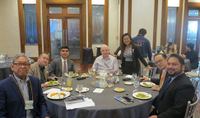 A City in the Pines, A Vision in Motion: Rotary Club of Manila’s 18th Weekly Membership Meeting with JHMC President & CEO Manjit T. Singh Reandi
 RI District 3810 Midyear Review in Vietnam