

Editorial

Reginald T. Yu
Editor-in-Chief
The forthcoming address of His Excellency Dr. Andreas Michael Pfaffernoschke, Ambassador Extraordinary and Plenipotentiary of the Federal Republic of Germany to the Philippines, comes at a moment when the value of principled diplomacy and genuine International partnership has never been more urgent.
His presence as Guest of Honor and Speaker is not merely ceremonial. It is a timely opportunity to reflect on the depth, maturity, and promise of Philippines-Germany relations — two nations separated by geography but united by a shared commitment to democratic values, multilateral cooperation, and sustainable development.
In a world increasingly shaped by geopolitical tension, economic uncertainty, climate vulnerability, and rapid technological change, Germany stands as a global leader in advocating rules-based order, innovation-driven growth, and climate responsibility. The Philippines, for its part, is an emerging regional partner - resilient, youthful, and strategically positioned in Southeast Asia, with a growing role in shaping the future of the Indo-Pacific.
Ambassador Pfaffernoschke represents a diplomatic tradition that views cooperation not as charity, but as partnership; not as short-term transaction, but as long-term investment in people,
institutions, and shared progress. Germany's engagement with the Philippines - across development cooperation, renewable energy, climate adaptation, vocational training, technology transfer, governance, and private sector collaboration - has consistently reflected this philosophy.
As we anticipate his address, we do so with the expectation of insights grounded in both global perspective and local relevance:
• How nations can work together amid shifting geopolitical alignments
• How economic cooperation can be aligned with sustainability and inclusivity
• How technological and human capital development can be leveraged for long-term resilience
• And how trust, dialogue, and shared values remain the bedrock of meaningful international relations
For the Rotary community and for readers of The Balita, this moment is especially significant. Rotary's ideals of international understanding, peace through service, and leadership beyond borders find a natural resonance in the mission of diplomacy. The work of building bridges — between cultures, institutions, and generations — is the common ground where civic leadership and statecraft meet.
The visit of Ambassador Pfaffernoschke invites us to look beyond immediate concerns and toward a broader horizon: a Philippines that is an active, confident partner in global cooperation; and a Germany that continues to engage not only with governments, but with civil society, business, and community leaders in shaping a shared future.
Before he takes the podium, we welcome him with deep respect and high expectation. His forthcoming message promises not only to illuminate the state of Philippines-Germany relations, but to challenge us to think more expansively about our role in a world where progress is no longer the task of any one nation, but the shared responsibility of all.

 Dr. Andreas Michael Pfaffernoschke
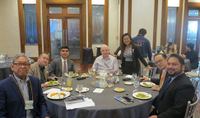 A City in the Pines, A Vision in Motion: Rotary Club of Manila’s 18th Weekly Membership Meeting with JHMC President & CEO Manjit T. Singh Reandi
 RI District 3810 Midyear Review in Vietnam