

Inside the Flood Control Scandal: Singson Speaks to Aleco

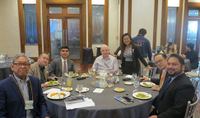
In the quiet, amber-lit setting of an intimate breakfast gathering, a small circle of members from the Rotary Club of Manila’s Aleco Group listened closely to a rare and unvarnished account from former Department of Public Works and Highways Secretary and former Independent Commission for Infrastructure Commissioner Rogelio “Babes” Singson.
It was not a ceremonial talk nor a retrospective filled with pleasantries. It was a sober, firsthand exposition by a man who once stood at the front lines of one of the country’s most corruption-prone sectors, offering a clinical and deeply unsettling dissection of what he described as the ongoing crisis in flood control governance.

Secretary Singson spoke with the precision of an engineer and the moral clarity of a reform advocate as he laid bare the anatomy of what has come to be known as the “Flood Control Corruption Exposed” scandal—a multibillion-peso web of alleged irregularities that, since 2024, has not only submerged communities but steadily eroded public trust and institutional integrity.
Peeling back the layers of the General Appropriations Act, he described a sophisticated system of budgetary manipulation carried out not with force, but with paperwork, signatures, and strategic legislative insertions. According to his analysis, an estimated ₱500 billion has flowed through more than 5,500 flood control projects, with a significant portion coursing through the ₱214-billion Unprogrammed Appropriations. This pool of funds, he warned, has become fertile ground for ghost projects, bloated costs, and the alleged concentration of contracts among a small circle of favored firms, reportedly insulated by political patrons who themselves benefit from the system.

Beyond exposing fiscal irregularities, Singson lamented the abandonment of a science-based vision he had championed during the administration of President Benigno "Noynoy" Aquino III: Integrated Water Resources Management (IWRM). This holistic framework treats rivers, watersheds, forests, agriculture, solid waste systems, drainage, and coastal zones as one interconnected ecological system. Its neglect, he explained, is now evident in denuded uplands that dump silt into rivers, plastic waste that clogs urban waterways, eroded farmlands and landfill runoff that poison estuaries, and flood control structures rendered ineffective by upstream degradation and downstream mismanagement. The nation, he said, has been addressing symptoms while ignoring the disease.
He also expressed grave concern over the distortion of the Convergence Fund, originally designed to enable DPWH to collaborate with agencies such as the Departments of Education, Tourism, and Health to produce infrastructure with multiplied social impact. In some cases, he noted, the mechanism has reportedly evolved into a channel for procedural circumvention, where success is measured less by public safety or functionality and more by the speed of fund obligation and disbursement.

Citing reports from Bulacan, he pointed to claims that as much as ₱2 billion a month had been spent through in-house construction arrangements and borrowed contractor licenses, all shielded by the presumption of regularity, even as questions lingered over quality, necessity, and genuine public value.
Yet Singson's message was not one of despair. As the discussion drew to a close, he offered a framework for reform distilled into what he called the "Five Rs of Good Governance": the Right Project, at the Right Cost, implemented by the Right People, with the Right Quality, and delivered Right on Time. Simple in formulation, the principles demand a level of discipline that would fundamentally challenge entrenched practices.

He then issued a call that resonated strongly with his Rotary audience: the creation of a Citizens’ Mandated Audit. This proposed coalition would bring together civil society organizations, professional associations, faith-based groups, and volunteer institutions to conduct independent reviews of public works—scrutinizing budgets, validating physical accomplishments, and demanding transparency and accountability. Complementing this, he advocated for an Integrity Pledge for contractors, modeled on the uncompromising standards of Hong Kong’s Independent Commission Against Corruption, binding participation in public projects not only to technical competence but to enforceable ethical commitments.
For the Rotary Club of Manila, the discussion pointed to a clear civic role. With members drawn from engineering, architecture, accounting, law, environmental science, information technology, urban planning, education, and community leadership, the organization possesses a depth of professional expertise uniquely suited to support such a citizen-led audit initiative. It can convene multi-sector coalitions, partner with universities and watchdog groups, train citizen-auditors, deploy technical review teams, and provide a trusted, non-partisan platform for the responsible and factual presentation of findings.

Beyond auditing, Rotary's service tradition also positions it to help revive the principles of Integrated Water Resources Management through watershed rehabilitation, solid-waste programs, river and estero clean-ups, coastal protection, and public education that links environmental stewardship with anti-corruption advocacy. In this way, flood control is reframed not as a cycle of concrete pouring and ribbon-cutting, but as a long-term commitment to systems thinking, sustainability, and integrity.
Secretary Singson's testimony that morning served both as a warning and a roadmap. Flooding, he underscored, is not solely an act of nature. It is, too often, the product of distorted priorities, corrupted processes, and weakened institutions. But precisely because it is man-made, it can also be undone—if informed citizens, principled professionals, and values-driven institutions choose to stand not on the sidelines of polite concern, but on the front lines of truth, accountability, and nation-building.

Recognition Corner
IAT Xavier “Xavy” Zialcita Joins Seafront Board

Seafront Resources Corp. has named Rizal Commercial Banking Corp.’s (RCBC) Xavier Y. Zialcita to its board.
IAT Xavier “Xavy” Zialcita currently serves as senior vice president for strategic initiatives at RCBC and brings more than 20 years of experience in investment banking, corporate advisory, and strategic planning.


 Dr. Andreas Michael Pfaffernoschke
 A City in the Pines, A Vision in Motion: Rotary Club of Manila’s 18th Weekly Membership Meeting with JHMC President & CEO Manjit T. Singh Reandi
 RI District 3810 Midyear Review in Vietnam