

OXYGEN AND FIRE | Joaquin Capen Rodriguez’s Life of Ambition, Integrity, and Stewardship

The first warning did not come through politics or finance. It came at dusk.
There was a time when Philippine rivers flickered at twilight — when humid air carried the faint hum of insects and small lights pulsed above the water. Children chased them. Farmers paused. Night descended not as darkness, but as glow.
Then one evening, Joaquin “Jackie” Capen Rodriguez noticed they were gone.
No announcement marked their departure. Nature does not accuse aloud. It simply withdraws.
Fireflies survive only where balance endures — where air is clean, where rivers breathe, where ecosystems hold. When they vanish, something has already shifted.
Jackie had lived through louder disruptions. He was born into war, carried as an infant into the mountains while his mother was imprisoned. He built companies, lost hundreds of millions in collapse, argued across ideological divides, presided over civic institutions, endured public opposition, buried the woman who shared sixty-three years of his life.
He had survived fire.
But the absence of fireflies unsettled him differently.
Because it was not event-driven.
It was generational.
His generation had measured forests in board feet and rivers in megawatts. Expansion had meant progress. Speed had meant success. The earth had seemed inexhaustible.
Now the air felt subtly thinner.

He began to think in terms of oxygen.
Oxygen had sustained him as a hidden infant in the Cordillera mountains. It had filled his lungs on varsity courts where he tried to prove he belonged. It steadied him after financial collapse. It animated the forests he later tried to replant. It was what cities needed more of — literally and figuratively.
Oxygen is invisible yet essential.
So are integrity, humility, and legacy.
To understand Joaquin Capen Rodriguez is to trace a life shaped by fire and oxygen — by war and ambition, loss and recalibration, enterprise and service.
He would come to measure success not by scale or title, but by atmosphere.
Not by what he accumulated, but by what remains breathable after he is gone.
His story begins in war — an infant carried into the mountains so he might live.
And it ends decades later by a river, an old man standing at dusk, searching the dark for lights that once flickered freely.
A Child of War and Mountains
Joaquin “Jackie” Capen Rodriguez was born on April 27, 1941, at 1:45 in the morning, in Ugac Norte, Tuguegarao, Cagayan — a province that, within months, would become part of the front line of a global war.
He entered the world into a family shaped by layered histories. His grandmother, Florence Noel Capen, traced her lineage to Alsace-Lorraine, a region long contested between France and Germany — itself a symbol of shifting borders and divided sovereignties. His paternal line carried Spanish roots from Galicia and Catalonia, including Jewish and Hispanic ancestry. His father bore the bearing of a frontier builder; his mother the discipline of American-influenced education.

It was a household where Europe, America, and the Philippine frontier converged.
But history was accelerating.
On December 8, 1941 — hours after the attack on Pearl Harbor — Japanese forces began bombing key installations across the Philippines. Within days, Northern Luzon was engulfed in military movement.
Tuguegarao and nearby regions became strategically exposed due to their proximity to airfields and transport routes.
Civilian life unraveled quickly.
Roads filled with evacuees. Communication lines faltered. Rumors traveled faster than verified reports. Families hid valuables, burned documents, prepared for displacement.
Jackie’s mother was arrested and later imprisoned in Camp Holmes in Baguio, a detention site that held both Filipino civilians and foreign nationals. The imprisonment was not ideological; it was part of the machinery of occupation. In wartime, vulnerability is often arbitrary.
For the infant Jackie — barely eight months old — the risk was existential.
The decision was made swiftly. He would be removed from the lowlands and taken into the Cordillera mountains, to Pasil, Kalinga. It was not a dramatic evacuation. There were no convoys or escorts. It was quiet, deliberate concealment — the kind that saves lives without fanfare.
The journey into the mountains marked his first experience of displacement.
Pasil was geographically removed from the main military routes. Japanese forces focused on cities, transport corridors, and coastal access points. The highlands offered natural insulation. The terrain itself was protection.
While urban centers experienced surveillance, shortages, and uncertainty, life in Kalinga retained its rhythm. Agriculture continued. Tribal governance functioned. Ritual and kinship maintained order.
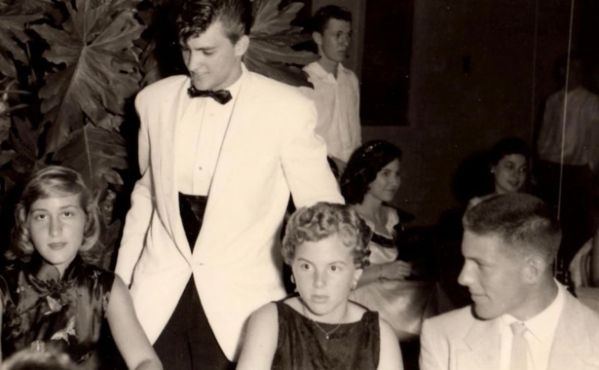
For a child whose birth year coincided with invasion, this environment became formative.
He did not grow up surrounded by constant gunfire or military patrols. Instead, his earliest memories were shaped by mountain air, river currents, and communal life. The Cordillera landscape imposed patience. Rice was cultivated by season, not by urgency. Rivers moved steadily regardless of political upheaval.
He absorbed, almost unconsciously, a different model of authority. In tribal communities, leadership was earned through respect and responsibility rather than imposed through hierarchy alone. Courage was not performative; it was demonstrated in daily conduct.
His parents, despite separation and uncertainty, maintained discipline in his upbringing. His mother, shaped by American schooling, emphasized structure and moral clarity. His father embodied resilience and adaptability. Though wartime constrained communication, the household narrative reinforced continuity — that this period of disruption would not define the family’s future.
Language became a quiet instrument of stability.
With his grandfather, he spoke Spanish — a bridge to lineage and memory.
With his mother, English — the language of education and emerging governance. With neighbors and peers, he spoke Ibanag, Itawis, Ilocano, and Kalinga. He moved between linguistic worlds with ease.
Each language carried a different cadence of thought. He learned that identity could shift without dissolving. One could inhabit multiple cultural frameworks without fragmentation.
This early cultural fluency would later prove invaluable in business negotiations, civic leadership, and diplomacy. But at the time, it was simply normal life.
War remained present but indirect. He was aware of absence — of a mother imprisoned, of conversations hushed when adults gathered. He sensed vulnerability without fully understanding its scale.
What the war taught him, even before comprehension, was fragility.
War taught him this early: order can vanish quickly, institutions can falter, and security is never guaranteed.

The mountains, however, taught him perspective.
Nature endured. Seasons returned. Life continued beyond human conflict.
This dual exposure — instability and continuity — shaped his temperament. He would later respond to financial collapse, institutional conflict, and political tension not with panic, but with recalibration.
He had already learned, as an infant, that survival sometimes requires relocation rather than resistance. That protection can be quiet. That stability must be maintained, not assumed.
When he eventually descended from the mountains into a nation rebuilding after occupation, he carried with him an internal compass formed by displacement and refuge.
War did not define him as trauma. It defined him as adaptable. Stability, he would later conclude, is never permanent.
But perspective can be.
The Grandfather and The Castle
If Kalinga gave Jackie breadth of perspective, his grandfather gave him structure.
Judge Joaquin Rodriguez Serra was born in Tarragona, Spain — a Mediterranean city shaped by Roman ruins and centuries of political transition. His father came from Galicia in northern Spain, a region known for its maritime resilience and deep Catholic tradition. His mother was Catalan, of Jewish and Hispanic descent, raised in a culture long accustomed to balancing local identity with broader national authority.
He arrived in the Philippines during a period of transition. Spanish colonial rule had ended. American administration had begun reshaping institutions — courts, schools, civil governance. The country was redefining itself in real time.
The judge would become appointed governor of Mindanao during the American era — specifically overseeing what were then referred to as the Provincias Moras, regions where Muslim communities had historically maintained autonomy and resistance to outside control.

Mindanao at that time was not yet the commercial hub it would later become. It was frontier territory — culturally diverse, politically sensitive, economically underdeveloped. Governance required more than legal authority. It required negotiation between religious communities, indigenous traditions, and colonial administrative systems.
Rodriguez Serra operated within this complexity. He was not merely an official; he was a bridge.
Davao: Building More Than Property
In Davao, he established Hacienda Carmen — not simply as agricultural enterprise, but as a long-term stake in land that was still being structured economically and socially. Ownership in frontier regions often signaled power. But what distinguished him was what followed.
He later donated land to local natives — land that still carries the name Carmen today. The gesture reflected not charity alone, but philosophy: stewardship over extraction.
He also founded Echo de Davao, the region’s first newspaper. Establishing a press in an emerging city is a declaration that public discourse matters — that information, transparency, and civic dialogue are foundations of growth.
His Bolton Street residence in Davao was more than home. It housed his office and printing operations. Decades later, that property would become the site of the University of Mindanao — a transition from private estate to educational institution.
In these decisions, a pattern emerges: what begins as personal enterprise often becomes public infrastructure. That pattern would not be lost on his grandson.
Manila and the Commonwealth Circle
In 1920, at the urging of President Manuel Quezon, Rodriguez Serra relocated to Manila. The capital during the Commonwealth period was a crucible of political thought. Independence from the United States was being negotiated. Constitutional frameworks were being refined. Intellectual leaders debated the shape of Filipino identity.
He moved within circles that included Jose Laurel, Sergio Osmeña, Claro Recto, Quentin Paredes, and other architects of early republican leadership.
Yet he did not pursue office aggressively. He practiced law. He maintained his bearing. He embodied continuity between Spanish-era jurisprudence and American-modeled legal reform.

When he died in 1956 at eighty-seven years old, three presidents and eleven senators attended his wake. It was a public affirmation of stature.
But for young Jackie, the lessons were not delivered in ceremony.
They were delivered in conversation.
The Refusal to Shift
As English steadily replaced Spanish in the courts and commercial houses of Manila, many professionals adjusted quickly. English opened doors. It meant access to American administrators, broader clientele, smoother integration into the new power structure shaping the country. The transition was practical, even inevitable.
Judge Joaquin Rodriguez Serra understood this as well as anyone.
Yet he did not fully make the shift.
He continued to practice largely in Spanish, drafting arguments and delivering reasoning in the language that had formed his legal mind. Clients diminished. Opportunities narrowed. Younger lawyers adapted faster, moved more fluidly in English proceedings, aligned themselves with the emerging order.
To outside observers, the judge’s insistence seemed impractical — perhaps even stubborn. Why cling to a fading language when adaptation promised expansion?
But to him, the matter was not about nostalgia. It was about coherence.
He did not reject modernity. He resisted erasure.
Language, for him, carried more than vocabulary; it carried memory, lineage, intellectual formation. To abandon it entirely for convenience felt like surrendering continuity. Adaptation, yes. But not self-abandonment.

His grandson watched quietly.
The lesson was not delivered as a lecture. It was absorbed through pattern. The judge did not complain about lost clients. He did not dramatize sacrifice. He simply continued.
From that quiet persistence, Jackie internalized a distinction that would guide him decades later: influence may diminish; dignity must not.
The judge often spoke of family as a castle — not a monument of stone, but a structure of reputation built generation after generation. Each decision was a block. Education added strength. Discipline reinforced walls. Generosity fortified foundations. Recklessness, dishonor, or negligence weakened them.
Wealth, he would explain, is movable. It can be gained, multiplied, lost.
Reputation is structural.
Once cracked, it requires generations to repair.
“In family,” he would say to his grandson, “the respect for one is the respect for all.”
It was not sentimental advice. It was intergenerational discipline. To carry a surname was to carry cumulative weight.
Young Jackie grew up aware that his name was not merely personal — it was inherited architecture.
He observed the judge in small details: the way he entered a room without haste, the way he held silence when others argued, the way he refused to raise his voice even when challenged. Authority did not require volume. Composure was its own form of strength.
Children absorb posture before they understand principle.

Jackie learned that steadiness outlasts spectacle.
Years later, when ₱950 million evaporated in the Oranbo collapse, the metaphor returned with force: you can lose land, but not the blocks. Integrity, discipline, and family cohesion remained.
The spine formed in childhood held.
Competition and The Education of Belonging
When Jackie returned fully to Manila for formal schooling, he entered a world very different from the Cordillera mountains of his early years.
Post-war Manila was rebuilding with energy and ambition. American influence shaped curriculum and civic life. English dominated elite education. Schools like American School and later De La Salle were incubators for the country’s future professionals — lawyers, executives, public officials.
In that environment, Jackie sensed something subtle but persistent: he stood slightly apart.
He carried Spanish lineage in a society redefining itself after colonial transition. Spanish surnames still suggested prestige in certain circles, but they also signaled a fading chapter of history. He had grown up among mountain communities speaking dialects that many Manila classmates did not know. His childhood had included tribal rhythms unfamiliar to urban elites.
He was neither fully provincial nor fully metropolitan. Neither wholly of the old order nor entirely of the new.
It was not exclusion he felt. It was difference. Difference presents a quiet fork in the road. It can produce withdrawal — a gradual retreat into caution.
Or it can produce effort.
He chose effort.
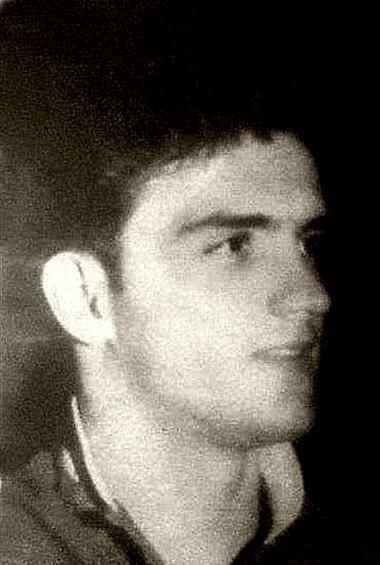
“I always tried a little harder,” he would later say. The sentence sounds modest, almost casual. In truth, it captures a defining habit.
Sports became his proving ground.
On the basketball court and tennis court, lineage dissolved. Performance was visible, immediate, undeniable. If you could run faster, defend harder, shoot accurately, endure conditioning — standing followed naturally.
The clarity appealed to him.
In social spaces, belonging could feel implicit and layered with nuance. On the court, belonging was earned through contribution.
Varsity athletics demanded discipline. Practices were repetitive. Conditioning was relentless. Coaches emphasized teamwork over ego. Preparation often determined the outcome long before the whistle blew.
He learned that defeat, while public, was instructive.
A missed shot required adjustment. A lost match required analysis. Loss did not define identity; it provided information.
Adolescence sharpened awareness of difference — accent, posture, subtle social codes. But instead of breeding resentment, it intensified drive. Insecurity, he discovered, can be converted into fuel if directed toward preparation rather than comparison.
The pattern formed almost unconsciously: Compete harder. Prepare longer. Recover faster.
He did not resent classmates who seemed naturally at ease in elite circles. He studied them. He matched them. Often, he surpassed them — not by entitlement, but by effort.
That discipline would follow him into boardrooms and negotiations. The executive who studied mining geology before assuming leadership, the investor who structured deals carefully, the Rotary officer who prepared thoroughly before proposing initiatives — each traced back to a young athlete who refused retreat.

Belonging, he learned early, is not granted.
It is built.
And once built, it steadies.
Structure and Leadership
Athletics taught him more than endurance and accuracy.
It introduced him to structure.
On a team, talent alone is insufficient. Five players move, but only if they move together does the game open. A captain is not appointed by proclamation; he is recognized by performance. Teammates follow the player who delivers when it matters, who runs drills without complaint, who absorbs pressure without collapse.
Jackie began to notice something subtle: authority on the court is fragile.
A captain who fails to perform loses influence quickly. A player who lectures but cannot defend loses credibility. Respect cannot be demanded; it must be demonstrated repeatedly.
He watched older teammates rise and fall in standing based on consistency. He saw how quickly admiration shifted when performance declined.
Leadership, he realized, was not a static title. It was a daily test.
That insight stayed with him.
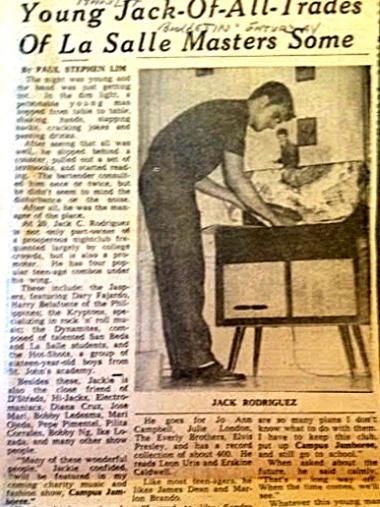
Years later, in boardrooms and civic organizations, he would instinctively distrust authority detached from competence. Titles meant little without delivery. Influence, he would come to believe, must be renewed continually through credibility.
Sports also introduced him to public vulnerability.
When a game is lost, there is no private interpretation. The scoreboard is visible. Teammates feel it. Spectators register it. There is no hiding behind explanation.
He learned to walk off the court after defeat without excuse. To shake hands. To return to practice.
Loss became part of rhythm, not rupture.
That quiet conditioning prepared him, though he did not know it then, for larger arenas where setbacks would carry heavier consequences. Financial collapse, institutional opposition, political tension — none of these would feel entirely unfamiliar.
He had already experienced the discipline of recovery under watchful eyes.
Post-War Manila and Ambition
The Manila he inhabited during his De La Salle years amplified this instinct toward striving.
Post-war optimism still animated the city. Infrastructure projects were expanding. New commercial districts were rising. Families who had rebuilt after occupation were now thinking in terms of growth. The Philippines, confident in its education system and regional position, encouraged ambition.
Young men were expected not merely to inherit, but to build.
In classrooms and corridors, conversations were rarely small. They revolved around enterprise, law, engineering, public service. The assumption was forward movement.

Jackie’s competitive instinct fit naturally into that environment. He did not need to be convinced that effort would matter; he had already tested that premise on the court.
But there was a difference in tone.
For some classmates, ambition felt like extension of entitlement. They carried inherited advantage comfortably, as if success were expected outcome.
For Jackie, ambition was not assumed.
It was pursued.
The mountain-raised boy who had grown up speaking multiple dialects did not presume he belonged automatically among Manila’s future elite.
He worked to belong. He studied harder. Trained longer. Prepared more carefully. He did not see advantage as birthright. He saw it as target.
And that difference — subtle but decisive — would define the manner in which he later built enterprises, navigated setbacks, and carried responsibility.
He did not assume scale.
He earned it.
Carrying the Habit Forward
When Jackie eventually stepped into mining and real estate, the habits he had formed in adolescence did not announce themselves dramatically. They simply reappeared.

Before entering an industry, he immersed himself in it. In mining, he did not rely on summaries from engineers; he studied geological reports. He learned how extraction sites functioned, how commodity pricing moved with global demand, how regulatory approvals could stall progress. In real estate, he walked properties personally, examined infrastructure plans, questioned projections.
Preparation had become reflex.
He did not assume competence would transfer automatically from one field to another. He treated each venture the way he once approached a new season in athletics: understand the terrain, train deliberately, earn your place.
He could have leaned more heavily on surname and association. His lineage carried history. His connections were substantial. But instinct resisted complacency. On a court, reputation does not win games. In business, it does not secure sustainable returns.
Work does.
The discipline that once governed conditioning drills now governed boardroom preparation. Meetings were not improvised; they were structured. Risks were assessed before capital was deployed. Decisions were revisited and recalibrated when necessary.
When the Asian Financial Crisis struck in 1997 and Oranbo collapsed under the weight of systemic shock, the same internal rhythm activated. He did not indulge paralysis. He reviewed exposure. He gathered family. He restructured strategy. The competitor who had once analyzed missed shots now analyzed leverage ratios.
Defeat required response.
The team instinct also surfaced. In athletics, individual brilliance means little without coordinated execution. In enterprise, success depended on sons, partners, managers, financiers. Shared objective mattered more than personal ego.
Later, in Rotary leadership, that understanding deepened. Volunteer institutions cannot be commanded; they must be aligned. He approached civic leadership not as proprietor but as teammate — listening, persuading, adjusting.
The young man who once said he “always tried a little harder” did not outgrow that impulse.
He refined it.

The effort became more strategic. The competitiveness became quieter. The drive remained constant.
Difference had never weakened him.
It had trained him.
Being slightly apart in school had sharpened discipline. Being raised in multiple cultural environments had expanded adaptability. Feeling the need to prove himself had cultivated resilience.
Over time, these traits ceased to feel compensatory.
They became structural. And that work ethic — steady, unadvertised, persistent — would become one of the most consistent threads running through his life, from mining pits to diplomatic halls to family gatherings on Sunday afternoons.
Rise and Scale
By his late thirties, Jackie had moved decisively into large-scale enterprise.
The Philippines during the 1980s and early 1990s was a country in transition. Political upheaval had reshaped leadership. Economic reforms were uneven but ambitious. Infrastructure development accelerated. Frontier industries — mining, property development, agribusiness — attracted entrepreneurs willing to operate at scale.
Jackie did not gravitate toward small ventures. He entered sectors where decisions affected terrain, capital flows, and long-term regional growth.
At thirty-nine, he became president of Benguet Exploration Mining Corporation — a position that placed him at the center of an industry both economically critical and politically sensitive. Mining in the Philippines has always been complicated. It requires regulatory negotiation, environmental compliance, community engagement, and large capital investment. Commodity prices fluctuate with global markets. Infrastructure costs are significant. Returns are rarely immediate.
Mining demands patience and risk tolerance.

It also demands conviction.
Jackie approached it methodically. He immersed himself in operational details — geology, extraction logistics, regulatory frameworks. He negotiated with engineers and financiers alike. The role required both strategic overview and granular understanding.
The scale of mining changed his perception of enterprise. Decisions were no longer about individual properties or transactions; they were about multiyear projections and international commodity cycles.
Success followed.
Early wins reinforced confidence. Strategic decisions proved effective. Leadership authority solidified. He developed a reputation for decisiveness and preparedness.
Diversification followed naturally.
Agriculture expanded. Real estate acquisitions increased. Asset management structures became more formalized. In 1990, he established Guidance Management Corporation — not simply as holding vehicle, but as mechanism to consolidate and protect family assets for future generations.
The move reflected foresight. He was thinking in decades, not quarters.
Momentum built steadily.
Confidence, however, can subtly shift into assumption. When success compounds, it creates the impression that disciplined preparation can neutralize most variables. Markets appear navigable. Risk appears manageable. Scale appears controllable.
The line between competence and overconfidence is rarely visible in real time.
The Oranbo Opportunity

Then came Oranbo.
Three and a half hectares in Pasig — strategically located at a time when Metro Manila’s urban expansion was accelerating. The site presented development potential aligned with regional growth trends. Infrastructure projects were underway. Commercial real estate demand was rising.
The purchase price was ₱950 million.
Jackie put down ₱500 million. The remaining ₱450 million was financed through bank loans. A Singapore-based development partner entered into agreement, bringing international expertise and projected capital leverage.
It was not speculative recklessness. It was structured. It was calculated.
It was consistent with prevailing optimism in Southeast Asian markets during the mid-1990s.
Across the region, growth was strong. Thailand, Malaysia, Indonesia, and the Philippines were experiencing rising investment flows. Credit was accessible. Currency values appeared stable.
Few anticipated systemic collapse.
The Shock of 1997
In July 1997, Thailand devalued the baht.
What began as localized currency adjustment spread rapidly. Investor confidence evaporated across Southeast Asia. The Philippine peso weakened sharply. Interest rates spiked. Credit tightened abruptly. Foreign capital withdrew.
The Asian Financial Crisis was not gradual.

It was sudden.
Projects dependent on leveraged financing were exposed immediately. Debt servicing costs rose. Asset values fell. Development timelines stalled.
Oranbo, built on carefully structured assumptions, became vulnerable to forces beyond managerial control.
Within months, the financial architecture underpinning the project destabilized.
The property was lost.
Nearly a billion pesos in value disappeared.
The Psychological Break
Financial loss at that scale is not merely a number on paper.
It alters internal equilibrium.
Jackie had believed in preparation, negotiation, and disciplined risk assessment. Those principles had served him well for decades. The crisis revealed limits.
Systemic collapse does not discriminate between reckless and careful operators.
The loss punctured a quiet assumption: that disciplined leadership could always outmaneuver volatility.

He has described that period not as despair, but as clarity.
Ambition had been tested.
The illusion of control had been exposed.
Regrouping
The critical response came not in panic, but in regrouping.
Family gathered. Sons were already involved in enterprise. The decision was made collectively: withdraw emotionally or rebuild strategically.
They rebuilt.
The loss did not fracture the family structure. It reinforced it.
The metaphor inherited from his grandfather resurfaced with renewed force.
The castle held — not because land was secure, but because character and cohesion remained.
What endured after Oranbo was not asset base, but cohesion. The family enterprise adjusted. Risk assessment became more conservative. Leverage was approached with greater caution. Expansion remained possible, but tempered by experience.
The collapse did not end ambition.

It refined it.
From Scale to Stewardship
The Oranbo episode marked a turning point.
Before the crisis, expansion had been central. After it, stewardship became more pronounced.
He began to think more consciously about sustainability — not only environmental sustainability, but financial and generational sustainability. Growth without structural resilience is fragile.
The experience deepened his later environmental advocacy. Mining had already exposed him to the tension between extraction and preservation. The financial crisis exposed the tension between leverage and durability.
Both taught the same lesson: Scale without balance is unstable.
The competitive athlete had matured into executive leader. The executive leader had been tested by systemic collapse.
And from that testing emerged something quieter, but stronger — perspective.
Love, Partnership, and the Architecture of Continuity
Long before Oranbo collapsed.
Long before mining presidencies and Rotary debates.

There was Sonja.
Jackie met Sonja Habana in the early 1960s, when his life was still gathering direction but not yet momentum. The Philippines was optimistic then — rebuilding from war, industrializing cautiously, believing in upward movement. Young men with ambition felt the horizon widening.
Sonja came from Davao, from a family whose own history mirrored the frontier ethic that had shaped parts of his lineage.
The Habana clan traced its roots to Iloilo but had moved south in search of opportunity, building quietly and steadily. There was nothing ostentatious about her background. It was disciplined, rooted, hardworking.
They met through shared circles — family connections, gatherings, conversations that began politely and extended longer than expected. There was no cinematic drama, no instant proclamation. What unfolded was something steadier.
What caught his attention was not glamour.
It was composure.
She carried herself with an ease that did not seek approval. She listened more than she spoke. Her faith was not performative; it was integrated into daily conduct. There was a steadiness in her — the kind that does not draw the room’s attention immediately but, once noticed, becomes quietly indispensable.
He, by contrast, was forward-moving. Competitive. Already thinking about enterprise, expansion, possibility. His mind leaned toward the next venture, the next horizon.
They were different in tempo: he accelerated; she anchored — and the difference created balance.
And that difference created balance rather than friction.
Courtship in that era was not casual. Families observed. Intentions were clarified. Conversations extended beyond affection to questions of direction. What kind of life would they build? Where would they live? What principles would guide them?

Jackie knew, even then, that his future would not be static. Mining, agriculture, real estate — these were not professions rooted in one place. They required travel, risk, relocation. Stability would not come from predictability.
Sonja understood the life he was building would never be predictable. She chose him anyway. They married in 1962.
He was young, ambitious, convinced that the future would reward effort. What he did not yet fully grasp was that expansion without anchor becomes drift.
She became that anchor.
Their marriage developed around a deliberate, almost intuitive division of strength. He managed the outer world — negotiations, acquisitions, risk exposure, capital allocation. She managed the inner world — the daily architecture of family life, the tone of discipline, the formation of character.
It was not a hierarchy.
It was complementarity.
While he traveled to Spain, Thailand, and the United States pursuing enterprise, she ensured that home remained consistent. Their four sons — Joaquin Jr. (Jack), Sean, Armando Carlos (Archie), and Antonio — were raised not with entitlement, but with expectation. Church attendance was habitual. Education was nonnegotiable. Respect was required. Conversations were direct.
Sunday lunches became ritual. Not elaborate affairs — simply consistent ones. Everyone present. Stories shared. Disagreements aired without theatrics. It was through these repeated, almost ordinary moments that cohesion formed.
Families that build multigenerational enterprises often fracture not because of financial stress, but because of relational neglect. Sonja understood this instinctively. She cultivated unity deliberately.
When Oranbo collapsed in 1997 and nearly ₱950 million evaporated, the crisis entered their home not as accusation but as recalibration. External perception shifted. Leverage tightened. Years of disciplined growth appeared suddenly vulnerable.
Moments like that test more than balance sheets.

They test marriages.
There were no dramatic confrontations. No visible recriminations. Instead, there was reassessment. Sons gathered. Strategy was reexamined. Expenses were reviewed.
Expansion paused. She reinforced calm. He absorbed the blow. The castle held.
Parenting had always been part of their long view. Their sons were not raised merely to inherit assets; they were raised to understand responsibility. They learned business mechanics, yes — but also restraint. They were taught that power, unchecked by conscience, corrodes families. They were reminded that a surname carries obligation.
Succession was gradual. Leadership was transferred deliberately. By the time Jackie began devoting more time to Rotary and civic service, the next generation was prepared to assume operational control.
This was possible because home had been structured with foresight.
Their life together unfolded across geographies — Davao, Manila, Madrid, Malaga, Bangkok, Los Angeles, Orlando. Each move required adaptation. Each adjustment required negotiation. Through it all, partnership endured.
Sixty-three years.
Longevity in marriage is rarely the product of uninterrupted harmony. It is the result of continuous adjustment. They argued. They recalibrated. They forgave. They resumed.
He built externally. She preserved internally. And in that interplay, continuity solidified.
Three months and three weeks before he would publicly reflect on his life, Sonja passed away.
Grief in later years is less explosive than in youth. It arrives as subtraction. The house feels altered. The air feels thinner. Routine becomes echo.
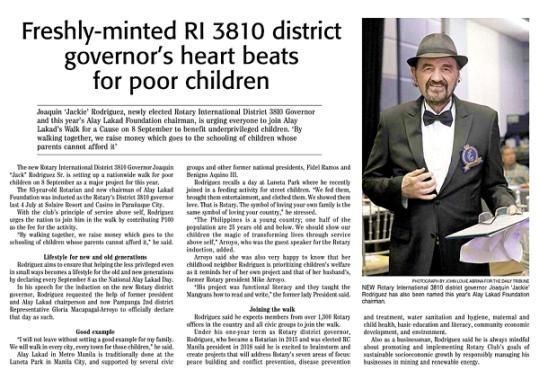
He speaks of it without dramatization. Happiness once meant full schedules and three meals a day; now it means one simple meal. Once it meant playing basketball or tennis; now it means watching a game quietly. Once it meant travel to Paris or Madrid; now it means sitting with grandchildren.
Loss recalibrates scale; ambition softens, and presence enlarges.
When asked how he wishes to be remembered, he does not cite mining leadership, diplomatic service, or Rotary initiatives. He does not mention assets or titles.
He answers simply: Ulirang Ama — Most Outstanding Father. It is not modesty; it is order.
Enterprises rise and fall. Public positions rotate. Recognition fades. But if children stand steady — if grandchildren inherit coherence — then the architecture endures.
Marriage was not a chapter in his life. It was the foundation beneath all others. He may have built companies. But together, they built continuity.
With the household steady and the next generation stepping forward, he began turning outward — to service and institution-building beyond his own enterprises.
Rotary: From Profit to Service
Jackie entered the Rotary Club of Manila in 2016.
By then, he was an established businessman. Mining had expanded his scale. Family enterprise was stable. His sons were assuming operational leadership. The urgency of daily management had begun to ease.
A different question surfaced: If enterprise builds wealth, what builds balance?
Rotary offered an answer.

In business, success had always been measurable — margins, assets, return on capital. Authority carried weight; decisions translated directly into outcome.
Rotary spoke a different language.
There were no dividends. No contracts compelling compliance. Projects advanced only through persuasion. Leadership conferred responsibility, not control.
In mining, approval meant execution. In Rotary, approval required conviction. The adjustment refined him.
When he was elected President of the Rotary Club of Manila in 2019 — with the shortest span between induction and presidency in the Club’s recent memory — he treated the office not as culmination, but as discipline. He embraced servant-leadership not as slogan, but as practice: authority without ownership, influence without compensation, responsibility without entitlement. In volunteer institutions, capital carries little weight; credibility carries everything — and must be earned repeatedly.
His presidency emphasized structure and measurable service. Environmental programs were sharpened. Educational initiatives strengthened. Governance was documented carefully. He believed Rotary’s moral authority depended on procedural clarity.
Through the TREES initiative, he pushed for sustainability over symbolism. Early reforestation efforts had prioritized visibility; survival rates lagged. He insisted on monitoring, community engagement, and higher survival rather than higher headlines. Bamboo became strategic — fastgrowing, soil-stabilizing, economically viable. Environmentalism detached from livelihood fails in developing contexts. Bamboo aligned ecology with income.
His thinking broadened: cities generate carbon; they must also generate oxygen
He began advocating for municipal ecological parks — five to ten hectares dedicated not merely to recreation but to oxygen production and environmental education. It was not anti-development; it was ecological accounting. Extraction must be balanced by restoration.
Programs like Alay Lakad reinforced another conviction: peace is built through opportunity. Inequality fuels grievance; education reduces it. Scholarships and youth development were not charity, but preventative investment.
His diplomatic experience in Serbia had shown him how disparities harden into fracture. Rotary allowed him to work upstream — strengthening cohesion before division.
After completing his club presidency, fellow Rotarians urged him to run at the district level. Leadership beyond a single club required election by weighted vote across District 3810.

He entered the race for District Governor Nominee for Rotary Year 2024–2025.
Two candidates stood: Joaquin Capen Rodriguez of the Rotary Club of Manila, and Vilma Castillo Vinluan of the Rotary Club of Sampaloc. On November 9, 2021, District Governor Robert G. Koa announced the results of the election conducted through the Rotarycontracted SimplyVoting platform.
Of 129 weighted votes cast, Jackie received 56.6 percent. His closest opponent received 43.4 percent. There were no abstentions.
The margin was clear, though not overwhelming. It signaled both confidence and the presence of differing expectations within the district.
He was declared District Governor Nominee for Rotary Year 2024–2025.
District 3810 spans Manila, Pasay, Cavite, and Occidental Mindoro — a wide geographic and socio-economic range. Governance at that scale requires diplomacy as much as direction.
Jackie approached the role with the same discipline that had defined his presidency. Documentation mattered. Compliance mattered. Integrity mattered. He believed strong institutions protect both leaders and members; structure prevents favoritism; procedure prevents arbitrariness.
But structure, when applied firmly, can unsettle those accustomed to flexibility.
The tensions that would later surface did not begin in hostility.
They began in philosophy.
For Jackie, Rotary’s values — integrity, fairness, transparency — were operational standards, not ceremonial words.
As District Governor, he acted accordingly.

And that commitment would soon test him more severely than any business setback ever had.
Ideology and Peace
Jackie’s friendship with self-exiled Communist Party of the Philippines founder and leader Jose Maria Sison endured not because they agreed, but because neither man feared disagreement.
One evening, long after insurgency had reshaped the country’s political landscape, they sat across a modest dining table. No press. No audience. Just two men aware that history had placed them on different sides of the same national wound.
“You build enterprises,” Sison said evenly. “But who owns the land beneath them?”
Jackie paused. Silence, he believed, clarifies thought.
“The question is not ownership alone,” he replied. “It is opportunity. If people participate in growth, they defend stability.”
“Stability for whom?” Sison asked.
The exchange did not escalate; it deepened.
Sison argued that the system preserved elite advantage and that reform without
rupture merely prolongs injustice. Jackie did not deny inequality. He had seen rural poverty firsthand. But he rejected the idea that destruction guarantees justice.
“If you burn institutions,” he said, “you still have to build new ones. Power does not disappear. It transfers.”

They moved between theory and lived experience — revolutionary models and economic realities. What lingered for Jackie was not the rhetoric, but the shared premise: both wanted a better Philippines. They differed on method, not on diagnosis.
At one point, the tone softened.
“If education had been equitable decades ago,” Jackie said quietly, “perhaps fewer young men would carry rifles.”
“Education within a broken system teaches obedience,” Sison replied.
The argument never resolved
It was not meant to.
Jackie never romanticized armed struggle. He knew its cost. But he also refused to reduce insurgency to criminality alone. Inequality creates
vacuum; where opportunity is absent, resentment organizes itself.
The conversation clarified his conviction: reform must be structural — but lawful. Justice must be pursued — but without violence
Later, in peace consultations, he carried that perspective with him. Ceasefires pause conflict; opportunity prevents its return. Economic inclusion, education, and institutional credibility mattered more than signatures alone.
The middle ground drew suspicion from both extremes. He accepted that.
Dialogue is slower than revolution. But it is less likely to bleed.

Years later, observing Balkan fragmentation as Consul General, he would recall those conversations. He had seen how quickly lines harden when dialogue collapses.
National cohesion requires space for disagreement without dehumanization.
The long argument with his friend never ended. Perhaps that was its value.
As long as two men can sit at a table and argue about justice without reaching for weapons, a country still has hope.
The Balkan Lens
For twenty-eight years, Jackie served as Consul General of Serbia.
The title sounded ceremonial. The vantage point was not.
Serbia was still living in the shadow of Yugoslavia’s collapse — borders redrawn, families divided, institutions strained. Jackie did not witness the height of war, but he observed its residue: guarded language in official settings, economic reports reflecting uneven development, conversations that carried memory beneath civility.
Yugoslavia had not collapsed overnight.
Malacañang Palace, 2018 — Presentation of CredIt weakened gradually — through regional disparity, ethnic nationalism, and institutions overshadowed by personality. Unity had been sustained by force and charisma more than durable structure. When that leadership disappeared, suppressed tensions resurfaced.
Jackie listened more than he spoke.
The pattern unsettled him because it felt familiar.

The Philippines, too, is regionally diverse. Development remains uneven. Insurgency lingers in parts of Mindanao. Political culture often gravitates toward personalities.
He did not believe the Philippines was destined for fragmentation.
But he understood how vulnerability forms.
Resentment accumulates when regions feel neglected. Loyalty shifts when institutions are perceived as partisan. Stability built on personality proves fragile.
A Serbian official once told him quietly, “We thought we were too civilized to fall apart.”
The remark lingered.
Civilization is not immunity.
Economic strain, polarization, and weakened institutions can destabilize any nation.
Jackie carried that awareness home. His advocacy for education, ecological sustainability, and economic inclusion
was not abstract idealism; it was structural thinking. Peace is preserved not by optimism, but by institutions that function predictably and fairly.
From Oranbo, he had learned that systemic forces can overwhelm even careful planning. From Sison, that inequality fuels unrest.
From Rotary, that institutions endure only when credibility is shared.

In Serbia, he saw what happens when cohesion fails to keep pace with fragmentation. The lesson did not produce alarmism. It produced vigilance.
Nations do not fracture suddenly. They weaken gradually. And unity, like reputation, must be built block by block.
The Rotary Crisis: Structure and the Cost of Standing Firm
Leadership in volunteer institutions tests character differently than leadership in business.
In enterprise, authority is reinforced by capital and contract. In Rotary, authority rests on trust — and trust can be contested.
The crisis that would mark the closing months of Jackie Rodriguez’s term as District Governor of Rotary International District 3810 did not arise from ideology or ambition. It arose from procedure.
During the district’s gubernatorial nomination process, serious allegations surfaced concerning one of the candidates — allegations involving more than fifty counts of financial malversation. The matter was not rumor alone; it was accompanied by documentation, including findings from an external audit that recommended possible criminal liability.
Jackie did not act impulsively.
Before taking any step, he formally sought guidance from Rotary International President Stephanie Urchick.
Her written reply, as he recounts it, was clear
“This is a local issue. I would also recommend that you create an investigation committee.”
To Jackie, those words were decisive.

By describing the matter as “local” and recommending the formation of an Investigation Committee, the responsibility, as he understood it, rested squarely with him as District Governor — the highest Rotary official within the district. He did not interpret the instruction as advisory in tone; he understood it as jurisdictional in nature.
He convened the Investigation Committee.
The committee reviewed the evidence and subsequently recommended disqualification of the candidate. The recommendation cited concerns over financial irregularities and violations inconsistent with Rotary’s core values — integrity, honesty, adherence to the Four-Way Test, and compliance with the organization’s by-laws and code of policies.
Jackie upheld the recommendation.
He has since explained that reversing course at that point would have projected inconsistency — even executive weakness. Having sought guidance, received authorization to treat the matter as local, and acted on the findings of a duly constituted committee, to disregard its recommendation without procedural basis would have signaled carelessness.
The election itself had not originated under his administration; it was a process inherited from the previous governor. Had Rotary International wished to assume direct oversight, it possessed the authority to do so. A directive centralizing the process — or appointing its own committee — would have removed the burden from the district.
No such directive came. The responsibility remained local.
Instead, on April 12, 2025, with barely two months remaining before the close of his term on June 30, Rotary International President Urchick issued notice removing him as District Governor.
Jackie appealed the decision. He has stated that he was informed the removal was not the result of a formal Board decision but of consultations at the international level. He awaited further clarification.
None came before the term neared its end.
He faced a choice. He could litigate. He could escalate the matter publicly. He could attempt to reclaim office through formal challenge. He chose restraint.
Litigation might have restored position. It would almost certainly have fractured the district further. Rotary, like all volunteer institutions, depends on cohesion more than coercion.
He returned to the metaphor his grandfather had once taught him: the castle.
Influence can be lost. Position can be removed. But the blocks — integrity, composure, continuity — must remain intact.
He wrote to fellow Rotarians without rancor. He acknowledged the disappointment but expressed no regret for having served. He reiterated that his actions had been guided by his mandate to safeguard the district’s integrity. He described himself, even in removal, as a “servant governor.”
There is a cost to dignity
It is not always paid in silence, but it is often paid without spectacle.
Jackie did not interpret the episode as betrayal alone. He saw it as a stress test of conviction. In volunteer institutions, disagreement can escalate quickly when procedure intersects with personality. Hard lines form. Interpretations diverge.
He accepted the consequence without surrendering the principle.
Service continued.
The episode clarified for him something he had already learned in business and diplomacy: institutions are fragile not because of conflict, but because of how conflict is handled.
Power, when contested, reveals posture.
He could not control the decision rendered above him. He could control only his response. And in that response — measured, restrained, unwilling to retaliate — the spine formed in childhood held.
Dignity sometimes costs influence.
He accepted the cost.
The castle stood.
Epilogue: Oxygen
In his later years, Jackie found himself returning repeatedly to a simple, elemental idea:
Oxygen.
Not as metaphor alone, but as measure.
Environmental advocacy, for him, was never ornamental. It was not about public tree-planting ceremonies or photographs taken beside newly planted saplings. It was structural. Urban expansion, he observed, steadily reduces breathable space. Concrete multiplies. Vehicles increase. Rivers narrow. Cities expand upward and outward, but rarely pause to account for what disappears.
Air does not protest loudly when it thins.
It simply changes.
His advocacy for ecological parks — five to ten hectares in every municipality dedicated not merely to recreation but to oxygen production — was practical. Bamboo initiatives were not romantic environmentalism; they were calculated balance. Bamboo grows rapidly. It stabilizes soil. It absorbs carbon. It creates livelihood. Restoration must be economically viable to endure.
Environmentalism detached from structure collapses.
But oxygen, he came to realize, was not limited to trees. Education produces oxygen. Fair opportunity produces oxygen. Predictable institutions produce oxygen.
Social inequity and environmental neglect share the same root: long-term disregard. When communities are ignored, when ecosystems are extracted without restoration, when access narrows for the many while concentrating for the few, the air grows thin — socially, economically, morally.
In earlier decades, he measured success in hectares acquired, ventures expanded, revenues stabilized. Those metrics were concrete and immediate.
Now he measures differently. Not in hectares. In atmosphere.
War threatened his first breath as an infant carried into the mountains while cities burned. The mountains preserved it.
Ambition expanded it — through enterprise, negotiation, risk.
Loss refined it — when nearly a billion pesos disappeared and pride was forced to recalibrate. Service redirected it — from accumulation toward inclusion. Integrity protected it — when standing firm cost him position but preserved coherence.
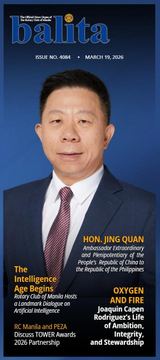
 Hon. Jing Quan
 The Intelligence Age Begins: Rotary Club of Manila Hosts a Landmark Dialogue on Artificial Intelligence
 Rotary Club of Manila and PEZA Discuss TOWER Awards 2026 Partnership