

President’s Message

The Chinese Ambassador
This week, the Rotary Club of Manila will have Chinese Ambassador Jing Quan as Guest of Honor and Speaker.
The decision to invite the Chinese Ambassador as a guest speaker, even amid strained relations between the Philippines and China over the West Philippine Sea, is best understood not as a political endorsement, but as a deliberate affirmation of Rotary’s enduring principles: dialogue, understanding, and the pursuit of peace.
Rotary has always stood as a bridge-builder. Founded on the ideals of service above self and mutual respect among peoples, Rotary creates spaces where conversations can occur even – especially -- when official channels are tense or constrained. In inviting the Chinese Ambassador, the Rotary Club of Manila is not taking sides in a geopolitical dispute; rather, it is upholding a tradition of constructive engagement. Dialogue is not a concession -- it is a necessity.
Diplomatic tensions, particularly those involving territorial and sovereign interests, are often complex and deeply rooted. The disputes in the West Philippine Sea evoke strong national sentiments, and rightly so. Yet history has shown that isolation and silence rarely lead to resolution. Engagement, on the other hand, allows for clarity, reduces misperceptions, and fosters the human dimension often lost in state-to-state exchanges. A guest speaking engagement in a civic forum like Rotary provides a unique opportunity for listening -- not necessarily agreeing, but understanding.
It is also important to recognize that the Rotary Club of Manila, as the oldest Rotary club in Asia, occupies a unique position in Philippine civil society. Its platform is not merely social; it is intellectual and diplomatic in the broader sense. By hosting no less than China’s Ambassador to our country, the Club affirms its role as a convener of ideas and perspectives. It allows its members -- leaders from business, law, media, and public service -- to engage directly with a key international actor whose policies and positions significantly impact the region.
Moreover, such an invitation reflects confidence rather than weakness. It signals that Filipino institutions and leaders are secure enough in their national position to engage openly, ask difficult questions, and articulate concerns in a respectful but candid manner. Dialogue in this context becomes an assertion of agency, not acquiescence.
There is also a practical dimension. The Philippines and China, despite their disputes, remain economically intertwined and geographically proximate. Channels of communication must remain open, not only at the level of governments but also among peoples and institutions. Rotary, with its global network and non-partisan character, is uniquely positioned to sustain these channels.
Ultimately, the invitation is consistent with Rotary’s long-standing commitment to peacebuilding. Peace is not achieved solely through treaties or legal victories; it is cultivated through understanding, patience, and sustained engagement. By hosting the Chinese Ambassador, the Rotary Club of Manila reinforces the idea that even in times of tension, there must be room for conversation.
In a world increasingly marked by polarization, such gestures matter. They remind us that diplomacy is not confined to formal halls of power. Sometimes, it begins in forums where individuals gather not as adversaries, but as members of a shared global community -- seeking, if not agreement, then at least a deeper understanding of one another.
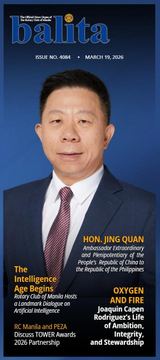
 Hon. Jing Quan
 The Intelligence Age Begins: Rotary Club of Manila Hosts a Landmark Dialogue on Artificial Intelligence
 Rotary Club of Manila and PEZA Discuss TOWER Awards 2026 Partnership