

A Convergence of Purpose: The March 24 Joint Meeting of Three Rotary Clubs

In a rare and meaningful convergence of Rotary fellowship and purpose, the Rotary Club of Manila, the Rotary Club of Makati, and the Rotary Club of Makati West gathered on March 24 for a Joint Meeting that was as much a reaffirmation of shared ideals as it was a call to collective action.
It was a gathering that transcended routine. Three of the country’s most storied Rotary institutions came together not merely to exchange courtesies, but to engage in dialogue on issues that cut across sectors, industries, and communities. The room carried a palpable sense of anticipation — one shaped by the presence of leaders who understood that service, at its highest form, demands both reflection and resolve.

Opening Ceremonies
The meeting formally commenced with the Call to Order, setting the tone for an afternoon anchored on Rotary’s enduring values — service above self, fellowship, and ethical leadership.

At the helm of the gathering were the presidents of the three clubs: Raoul Creencia of the Rotary Club of Manila, Eddie Galvez of the Rotary Club of Makati, and Gino Dumatol of the Rotary Club of Makati West. Their presence symbolized not only leadership, but unity — three institutions moving in concert toward a shared vision.
Among those recognized during the program were Jed Balayan, Treasurer of Rotary Club of Makati West; Louie Asioche, District Secretary and incoming District Governor; and Aaron Virata-Mempil of Rotary Club of Makati, who served as moderator for the afternoon’s program.
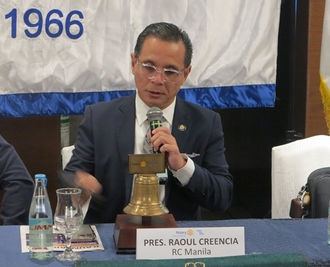
The invocation and national anthem grounded the assembly in both spiritual reflection and patriotic duty, reminding all present that Rotary’s mission is inseparable from the larger narrative of nation-building.
Fellowship and Shared Purpose

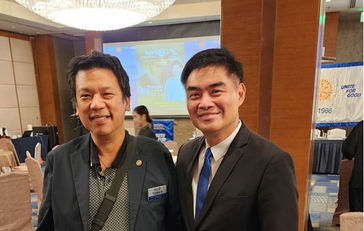
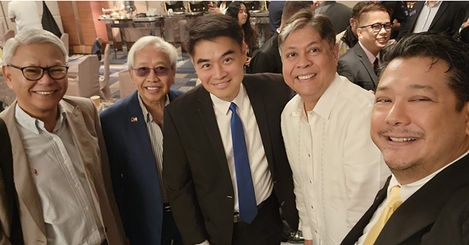
What distinguished the March 24 gathering was not merely its scale, but its spirit. Conversations unfolded naturally across tables — between seasoned Rotarians and new members, between leaders of different clubs, between individuals united by a common calling.
This was Rotary in its most authentic form — not confined within the identity of a single club, but expressed through collaboration. The joint meeting became a living testament to the power of collective action, where relationships were strengthened and new possibilities quietly began to take shape.

The Address of the Guest of Honor and Speaker
The highlight of the afternoon was the address of the Guest of Honor and Speaker, The Honorable Senator Francis Pancratius "Kiko" Pangilinan.

Speaking with candor and conviction, Senator Pangilinan opened with an apology for his delayed arrival, having come directly from a Senate hearing addressing the escalating crisis in the Middle East. Yet, rather than dwell on uncertainty, he framed the moment as an opportunity — a call to transform crisis into catalyst.
He addressed the audience not merely as Rotarians, but as leaders in the private sector, capable of shaping outcomes far beyond the confines of their respective professions.

At the heart of his speech was a powerful and deeply human narrative: the condition of the Filipino farmer. He spoke of a reality that has long persisted but remains insufficiently addressed — that those who feed the nation often cannot feed themselves.
He painted vivid portraits of elderly farmers who had spent decades tilling the land, their combined years of service reaching nearly two centuries, yet who remained trapped in cycles of poverty and indebtedness.

This, he emphasized, is not simply a matter of food supply — it is a matter of justice. Food security, in his framing, must be understood alongside food justice. A nation cannot claim stability when its primary food producers remain among its most vulnerable.
He highlighted the structural weaknesses in the agricultural sector, particularly the lack of support systems for farmers and fisherfolk. Investments in infrastructure and technology, while important, will fall short if the human foundation of agriculture remains neglected.

To address this, he outlined key reforms aimed at strengthening the sector from within. Among these were the revival of the Bureau of Agricultural Cooperatives and the renationalization of extension services — measures designed to empower farmers, improve productivity, and create sustainable support networks.
He contrasted the Philippine experience with that of more developed agricultural systems, where close coordination between extension workers and farmers ensures both efficiency and resilience. The disparity, he noted, underscores the urgency of reform.
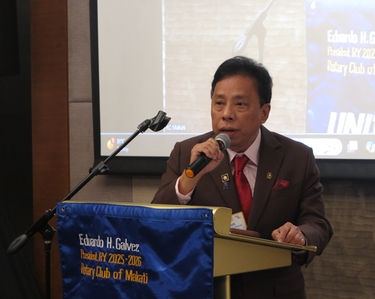
President Raoul C. Creencia, Pres. Eddie Galvez (RC Makati), and Pres. Dino Dumatol (RC Makati West) presented a Plaque of Appreciation to Senator Francis "Kiko" Pangilinan.
The discussion then widened to include energy security, particularly in light of the ongoing geopolitical tensions affecting global oil supply. The Philippines’ heavy dependence on imported oil exposes it to external shocks — an exposure that calls for a decisive shift toward renewable energy.

But beyond policy, Pangilinan’s message was fundamentally about partnership.
He underscored the indispensable role of the private sector — and organizations like Rotary — in bridging gaps that government alone cannot address. He cited initiatives that allow direct procurement from farmers, eliminating exploitative intermediaries and ensuring fairer incomes.

More importantly, he extended an invitation: for Rotarians to actively participate in nation-building by investing in agricultural systems, supporting cooperatives, and using their networks to create sustainable impact.
His speech was not merely informative — it was a challenge. A challenge to rethink priorities, to act with urgency, and to recognize that meaningful change requires collective effort.

Reflections and Closing
As the program transitioned toward its conclusion, the atmosphere shifted from attentive listening to thoughtful reflection.

The conversations that followed bore the imprint of the afternoon’s message — serious, purposeful, and forward-looking. There was a shared understanding that the issues discussed were not distant concerns, but immediate realities requiring action.
The Joint Meeting, in its entirety, became more than a scheduled gathering. It became a moment of alignment — of three Rotary clubs recognizing the strength of unity and the responsibility that comes with it.

The Adjournment marked the formal close of the program, but not the end of its impact.
Epilogue: Toward a Unified Rotary Action

If there was a single thread that ran through the March 24 Joint Meeting, it was this: the recognition that leadership, especially in times of uncertainty, demands more than position — it demands purpose.
In bringing together the Rotary Club of Manila, the Rotary Club of Makati, and the Rotary Club of Makati West, the meeting affirmed a simple but profound truth:

That the future is best shaped not in isolation, but in unity. And in that shared space — through dialogue, reflection, and a renewed commitment to service — the foundations of that unity were strengthened, one meaningful conversation at a time.
Meeting Fellowship
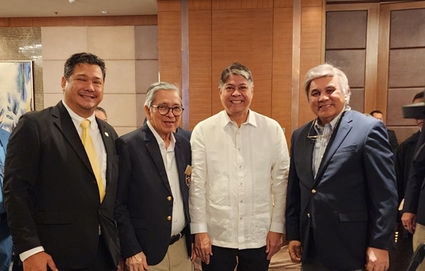
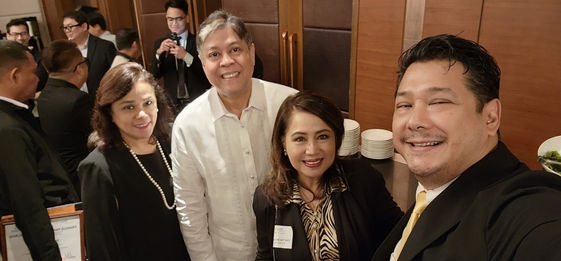

 Brandon "Gelo" Wong
 Bridging Nations, Building Understanding: The Rotary Club of Manila’s 25th Weekly Membership Meeting with H.E. Jing Quan
 Between Enterprise and Nation | The Life, Leadership, and Public Service of Abdulgani Matua Macatoman