
Editorial

Reginald T. Yu
Editor-in-Chief
In a time when nations are increasingly defined by lines — on maps, in policies, and across ideologies — it is both timely and necessary that the Rotary Club of Manila welcomes as Guest of Honor and Speaker Hon. Voltaire D. Mauricio, a man whose life’s work has been devoted to navigating precisely these lines.
A former consul general in Osaka and London, he has stood at the intersection of diplomacy, culture, and national interest. His career reminds us that the work of building bridges between nations is neither abstract nor ceremonial. It is deliberate, often difficult, and always consequential.
This week’s Weekly Membership Meeting is more than a gathering. It is an opportunity to reflect on a fundamental question: What does it mean to lead in a world that is increasingly interconnected, yet persistently divided?
Diplomacy, at its core, is not merely the art of negotiation. It is the discipline of understanding. It requires the ability to listen beyond language, to recognize interests beneath positions, and to find common ground where none appears to exist. These are not skills reserved for ambassadors alone. They are competencies that Rotary, at its best, cultivates in each of its members.
For over a century, the Rotary Club of Manila has operated not just as a civic organization, but as a quiet force of continuity. Through wars, political transitions, economic upheavals, and global crises, it has remained steadfast in its commitment to service above self. Yet today’s challenges call for something more.
They call for relevance.
In an age where influence is measured not only by authority but by credibility, Rotary must continually ask itself: Are we merely preserving tradition, or are we actively shaping the future? Are we content with being witnesses to change, or are we prepared to be agents of it?
The presence of Hon. Mauricio offers a subtle but powerful reminder. Leadership today is no longer confined to boardrooms or government offices. It is exercised in conversations, in collaborations, and in the everyday decisions that either divide or unite.
The theme “Unite for Good” is not a slogan. It is a mandate.
To unite is not to agree on everything. It is to commit to a shared purpose despite differences. It is to recognize that progress is rarely the product of uniformity, but often the result of respectful engagement among diverse perspectives.
As Rotarians, we are uniquely positioned to model this kind of leadership. Our network spans professions, sectors, and generations. Our projects touch lives in ways that statistics alone cannot capture. But the true measure of our impact lies not only in what we do, but in how we do it.
Do we listen with intent? Do we lead with integrity? Do we act with a sense of responsibility that extends beyond ourselves?
These are the quiet questions that define enduring leadership.
As we gather this Thursday at the Manila Polo Club, we do so not merely to hear a distinguished speaker, but to engage in a deeper reflection on our role in a rapidly evolving world. The flags that form the backdrop of this meeting are more than symbols of nations. They are reminders of the diversity we are called to embrace — and the unity we are challenged to build.
In the end, Rotary’s strength has never been in its history alone, but in its ability to adapt that history to the demands of the present.
And perhaps that is the enduring lesson of diplomacy, and of leadership itself:
That even in a world of many flags, there must always be a common cause.
And it is ours to carry forward.
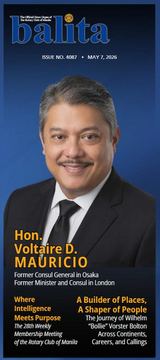
 Hon. VOLTAIRE D. MAURICIO
 A Builder of Places, A Shaper of People | The Journey of Wilhelm “Bollie” Vorster Bolton Across Continents, Careers, and Callings
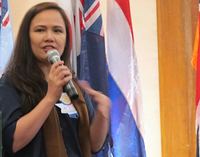 Where Intelligence Meets Purpose: The 28th Weekly Membership Meeting of the Rotary Club of Manila