

Beyond Compliance, Beyond Convenience: The Rotary Club of Manila Confronts the Climate Imperative
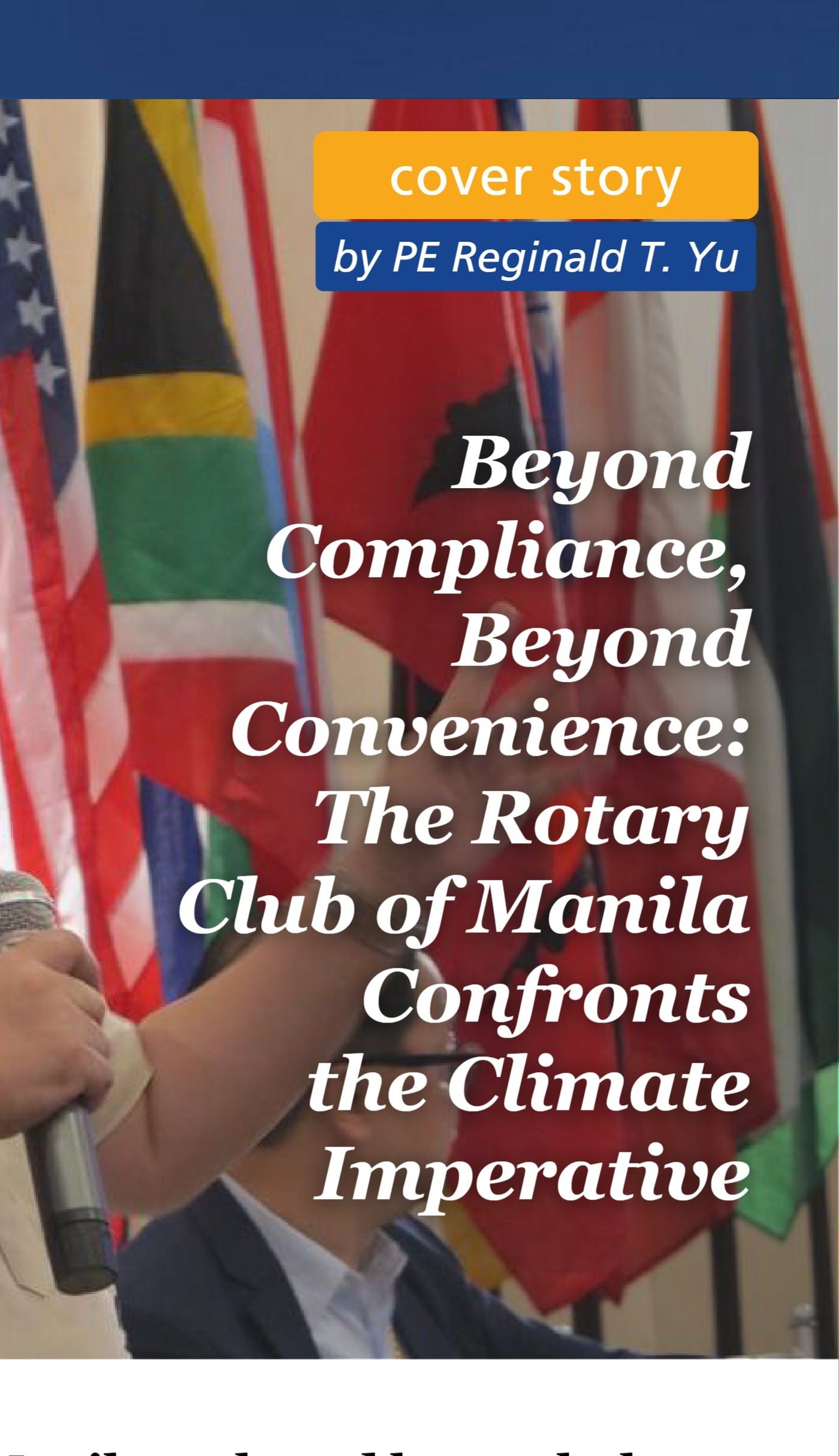
Dr. Glenn S. Banaguas spoke on private sector leadership in resiliency and sustainability at the club’s 30th Weekly Membership Meeting on May 14, 2026.

THE Rotary Club of Manila gathered beneath the familiar elegance of the Manila Polo Club for its 30th Weekly Membership Meeting of Rotary Year 2025–2026, an afternoon that began in fellowship yet gradually unfolded into a deeply meaningful discussion on leadership, sustainability, and national responsibility.
Moderated by President-Elect Reggie Yu, the meeting carried an atmosphere that was at once warm and reflective. While the traditions of Rotary remained firmly present through music, fellowship, and camaraderie, there was also a growing awareness among attendees that leadership in today’s world can no longer remain confined to ceremonial distinction or institutional prestige. Increasingly, it must confront the pressing realities of climate change, resilience, and sustainable development.
Held on Thursday, May 14, 2026, the gathering centered on the timely and intellectually compelling theme, “Beyond Compliance: Private Sector Leadership in Resiliency and Sustainability.” The very title suggested that the afternoon would move beyond environmental rhetoric and regulatory obligation toward a more transformative conversation about the role of institutions, industries, and communities in shaping the future.
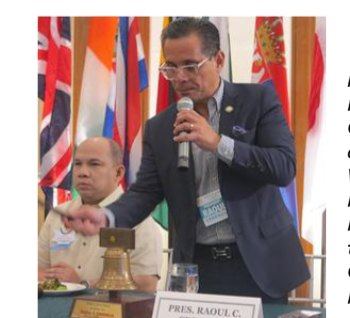
At exactly 12:30 in the afternoon, President Raoul C. Creencia formally called the meeting to order, setting into motion another chapter in the enduring tradition of fellowship and discourse that has long defined the Rotary Club of Manila.
Ceremonial Traditions and Fellowship
The solemnity of the gathering was first established through the Invocation delivered by Director-Elect John Nico P. “Nico” Valencia, followed by the Audio-Visual Presentation of the Philippine National Anthem. The Rotary Club of Manila Hymn was then rendered by the RCM World-Famous Music Chorale with the stirring familiarity that has become inseparable from the club’s institutional identity.

Rotarian Raymond N. “Ray” Davis led the recitation of The FourWay Test, whose principles of truth, fairness, goodwill, and benefit to all seemed especially relevant in a world increasingly shaped by environmental uncertainty and social vulnerability.
President-Elect Reggie Yu acknowledged the guests in attendance with warmth and familiarity, recognizing not merely their presence but their shared participation in a larger national conversation about responsible leadership.
The RCM World-Famous Music Chorale followed with a welcome song that softened the formality of the proceedings and reminded everyone present that Rotary gatherings are sustained not only by institutional continuity but by friendship, music, and fellowship.
The afternoon likewise paused to celebrate life’s joyful milestones as the club recognized its birthday celebrants. Rotarians Jun Coyuito, Mac Macapagal, Jun Bella, Jack Rodriguez, Jun Follosco, and J Alfonso L. Katigbak, together with Past Director Ner Lonzaga, were warmly greeted before the chorale rendered “Maligayang Bati” and “Happy Birthday” with cheerful enthusiasm. The moment provided a welcome reminder that even amid discussions of global challenges, Rotary remains anchored in human relationships and shared celebration.
President’s Time and Institutional Reflection
During President’s Time, President Raoul C. Creencia reflected on the importance of institutions remaining responsive to changing realities. There was a subtle but unmistakable recognition that Rotary itself — an organization founded upon service, ethical leadership, and civic engagement — must continuously redefine what meaningful service entails in an era increasingly shaped by climate volatility and socio-economic uncertainty.

The meeting’s intellectual centerpiece would soon reinforce precisely that point.
Introduction of the Guest of Honor and Speaker
Director Michael Jaey C. “Mike” Albaña introduced the Guest of Honor and Speaker with evident pride, presenting an impressive portrait of a Filipino whose work now spans the global intersection of science, diplomacy, environmental policy, and climate resilience.

The guest speaker, Dr. Glenn S. Banaguas, carried credentials reflecting not merely academic accomplishment but international relevance and influence. A UN Sasakawa Laureate, Chairman and President of ASEAN Science Diplomats, Chairman of the U.S.ASEAN Fellows for Science and Technology, Executive Fellow of the Geneva Centre for Security Policy, Distinguished Fellow of the Royal Society of Arts in the United Kingdom, and Climate Diplomat for the European Union-Asia Expert Panel for Climate Diplomacy, Dr. Banaguas represented a rare fusion of scientific rigor and policy advocacy.
From the outset, his presentation challenged the audience to reconsider climate change not as a distant environmental concern but as an immediate operational, economic, social, and moral reality.
The Climate Smart Philippines Framework

Dr. Banaguas framed his presentation around the concept of a “Climate Smart Philippines,” emphasizing that resilience and sustainability are no longer optional aspirations but strategic necessities for survival and long-term prosperity.
He described the Philippines as a geographically and administratively complex nation composed of 81 provinces, 146 cities, 1,488 municipalities, and more than 42,000 barangays — a reality that makes climate governance both extraordinarily difficult and critically important.
At the heart of his discussion was the concept of “Climate Smart” governance, built upon the dual imperatives of climate change mitigation and climate change adaptation. These, he explained, form what he called “A TRIP to Resiliency and Sustainability.”

The acronym TRIP stood for Track, Risk, Impact, and Policy, a fourdimensional framework designed to help governments, institutions, and corporations systematically understand and respond to climate realities.
Tracking Climate Realities
The “Track” component focused on analyzing human resources, demographics, historical climate data, and long-term climate projections involving rainfall and temperature changes.

What followed was among the most sobering portions of the presentation.
Using internationally recognized climate projections, Dr. Banaguas demonstrated how average temperatures in both Metro Manila and Cebu are expected to rise significantly over the coming decades. For the National Capital Region, projected average temperatures could increase by more than two degrees Celsius before the end of the century. Cebu exhibited a similarly alarming trajectory.
These were not speculative fears intended merely to provoke concern. They were evidence-based projections grounded in climate science.

Equally concerning were projections involving precipitation patterns. Metro Manila is expected to experience increasing rainfall intensity over successive decades, while Cebu similarly reflects increasingly unstable climate conditions.
The implications, he emphasized, extend far beyond weather inconvenience.
Climate change reshapes economies, labor systems, agriculture, transportation, health outcomes, infrastructure, and social stability itself.

Risk, Vulnerability, and the Geography of Disaster
The presentation then shifted toward risk analysis using the United Nations disaster risk framework, which identifies disaster risk as a function of hazard, exposure, and vulnerability.
Through a series of geographic risk maps, Dr. Banaguas illustrated the increasing vulnerability of various Philippine regions to rain-induced landslides, flooding, drought, tropical cyclones, and sea-level rise.

The visual impact of the maps transformed climate discourse from abstraction into immediacy. The Philippines was no longer merely “vulnerable” in a general sense. Entire provinces and cities could now be assessed according to their relative exposure to environmental hazards.
Particularly striking was his discussion on the changing nature of Philippine seasons. The rainy season, once relatively predictable, has now become increasingly erratic. Climate unpredictability has become so severe that defining clear seasonal boundaries has become difficult.
Likewise, droughts — once relatively infrequent — are now occurring with greater regularity, accompanied by rising heat indices and episodes of extreme heat.

Climate Change and Business Operations
For the business community present at the Manila Polo Club, the implications of the presentation became increasingly personal and operational.
Dr. Banaguas carefully connected climate science to the realities of business continuity and economic survival. Changing wind patterns, severe storms, flooding, and infrastructure vulnerability all carry direct economic consequences.

Businesses today face disruptions in logistics, communications, productivity, transportation, energy reliability, and supply chains. He emphasized that climate change can no longer be relegated to corporate social responsibility departments alone. It has become a central business risk.
Storms delay communications and operations. Flooding halts productivity. Sea-level rise threatens infrastructure. Extreme weather creates cascading economic repercussions across industries.
The message was clear: sustainability is no longer simply about compliance. It is about institutional survival.

Psychological and Human Dimensions of Climate Change
Perhaps the most unexpected and deeply human portion of the presentation involved psychological resilience.
Dr. Banaguas spoke about the emotional consequences experienced by communities repeatedly exposed to disasters — trauma, fear, anxiety, apprehension, and emotional fatigue.

Yet he also introduced a remarkable phrase: “post-traumatic growers.”
Rather than viewing vulnerable populations merely as victims, he emphasized the capacity of communities to emerge stronger, wiser, and more resilient through adversity.
In a country where faith and spirituality remain deeply woven into social life, Dr. Banaguas also explored the role of religiosity as a climatedisaster resiliency measure. Various religious traditions, he explained, often provide emotional stability, moral coherence, and collective solidarity during periods of crisis.

Faith, in many vulnerable communities, becomes not merely a spiritual refuge but a mechanism of resilience.
Policy, Governance, and Sustainability Priorities
The discussion then transitioned into policy analysis, emphasizing that resilience requires institutional integration rather than isolated initiatives.

Policies, Republic Acts, climate action plans, and local government frameworks must work cohesively if sustainability efforts are to succeed.
Dr. Banaguas outlined several priority areas essential to national climate resilience, including food security, water sufficiency, sustainable energy, human security, ecological and environmental stability, climatesmart industries and infrastructure, as well as knowledge management and capacity development.
These priorities, he argued, demand participation not only from government but from the private sector itself.

This became the philosophical core of the afternoon. The phrase “Beyond Compliance” was not rhetorical flourish. It was a challenge. Businesses must move beyond minimal regulatory obedience toward active climate leadership.
Net Zero Emissions and ESG Leadership
Dr. Banaguas discussed the growing importance of net-zero emissions strategies and decarbonization initiatives involving infrastructure, energy consumption, transportation systems, waste management, food systems, human activity, and agriculture.

He connected these efforts to the globally recognized ESG framework — Environmental, Social, and Governance — and demonstrated how the TRIP framework could serve as a practical pathway toward meaningful ESG integration.
For many in attendance, the discussion reinforced the growing realization that sustainability reporting, carbon accounting, and environmental stewardship are no longer merely public relations exercises. They are increasingly tied to investor confidence, institutional credibility, and long-term competitiveness.
Climate Smart Mindanao and Localized Action

The latter portion of the presentation highlighted actual climate-smart initiatives implemented across Mindanao through partnerships involving MINDA, DILG, CHED, NEDA, DOST, and various local stakeholders.
Dr. Banaguas showcased collaborative efforts and sustainability initiatives in Davao City, Sarangani Province, Sultan Kudarat Province, South Cotabato Province, Tacurong City, General Santos City, and Cagayan de Oro City.
These examples grounded the discussion in practical reality.

Climate resilience was no longer theoretical.
It was already being attempted, negotiated, and implemented across Philippine communities.
What emerged from these examples was a vision of sustainability not as centralized bureaucracy but as collaborative governance involving local governments, institutions, scientists, businesses, educators, and communities.

Open Forum and Institutional Reflection
By the time the open forum began, the mood inside the Manila Polo Club had noticeably shifted.
What began as a traditional weekly membership meeting had evolved into a searching conversation about leadership itself.
Questions from members reflected a growing recognition that the private sector can no longer afford passive observation. Sustainability reporting, SEC compliance, carbon management, and ESG frameworks were increasingly viewed not as burdens but as strategic necessities tied directly to institutional survival and stakeholder trust.
The Rotary Club of Manila — itself an institution more than a century old — appeared uniquely positioned to host such a conversation.
For over one hundred years, the club has witnessed wars, economic upheavals, political transitions, natural disasters, and national transformation. Yet this gathering suggested that perhaps one of the defining challenges of the present generation will not merely be governance or economics, but stewardship itself.
The stewardship of institutions. The stewardship of industries. The stewardship of future generations.
Closing Ceremonies and Final Reflections
As President Raoul C. Creencia later presented Dr. Glenn Banaguas with a Certificate of Appreciation, the gesture represented more than ceremonial gratitude. It acknowledged the importance of difficult conversations — the kind that compel institutions to think beyond convenience, beyond compliance, and beyond tradition.
At exactly 2:00 in the afternoon, President Creencia formally adjourned the meeting.
Yet long after the luncheon tables had emptied and the familiar rhythms of Manila resumed outside the Polo Club gates, the central question of the afternoon continued to linger:
In a climate-challenged century, what does responsible leadership truly demand?
For the Rotary Club of Manila, the 30th Weekly Membership Meeting may well have offered an answer. Leadership today is no longer measured solely by influence, achievement, or longevity.
Increasingly, it will be measured by whether institutions possessed the courage to act before resilience became impossible.

 31st Weekly Membership Meeting Editorial
 Outstanding Ambassador Award: RCM’s Signature Project