

Staying Awake So That Others May Sleep
The editorial traces how the duties of the Philippine Secretary of National Defense have grown from fighting wars to juggling cyber threats, disasters and great-power rivalry at once.
FEW cabinet officials hold two jobs as different as the Philippine Secretary of National Defense. The secretary oversees the Armed Forces of the Philippines. By law, the same secretary also chairs the National Disaster Risk Reduction and Management Council, with the Office of Civil Defense housed in the department.
A single morning briefing can open with a Chinese coast guard cutter blocking a resupply boat near Ayungin Shoal and close with a typhoon forming east of Samar.
Add an armed encounter with the remnants of the New People's Army and the day is full. For secretaries of earlier eras, the list was shorter, more land-bound and more legible. Today's list is faster and stranger, and it mixes the strains of a great-power contest with the hazards of living on the Pacific typhoon belt and the Ring of Fire in the era of AI.
Philippine defense planning began with a hard lesson. In 1935, President Manuel Quezon asked Douglas MacArthur to build an army for the coming Commonwealth, a force meant to protect more than 7,000 islands on a small budget. When Japan invaded in December 1941, that young army, short of training, equipment and time, was thrown into the defense of Luzon and the long ordeal of Bataan. The problem was conventional and brutal: a clearly identified enemy with fleets and divisions, and not enough of anything to stop him.
After the war, the threat turned inward. Ramon Magsaysay became Secretary of National Defense in 1950, when the Huk rebellion menaced the countryside near Manila. He reformed the army, pressed soldiers to treat villagers decently and paired force with persuasion, including the Economic Development Corps, which resettled surrendered rebels on farmland in Mindanao. His insight, that the countryside had to be won as well as fought over, made him so popular that he was elected president in 1953, a presidency that was sadly cut short on Mount Manunggal.
The Cold War and martial law added other burdens. The NPA and Moro insurgencies absorbed the military for decades, while the American bases at Clark and Subic made the country a front-line state. Juan Ponce Enrile, Ferdinand Marcos's defense minister, helped enforce martial law, then in February 1986 holed up in Camp Aguinaldo with Gen. Fidel Ramos and lit the fuse of the EDSA revolution.
Ramos later served as defense secretary under Corazon Aquino and spent much of that time protecting her government from coup attempts. For these secretaries, the gravest dangers often wore the same uniform as their own officers. Then, in June 1991, Mount Pinatubo buried Clark Air Base in ash, and that September the Senate rejected a new bases treaty. The Americans left, and the country faced its seas with a thin navy and few options.
Today's secretary must still deter a great power, but the contest is fought below the threshold of war. The West Philippine Sea is the clearest case. Since the 2016 arbitral ruling upheld Philippine rights under the UN Convention on the Law of the Sea, a ruling Beijing rejects, the confrontation has been fought with coast guard cutters, water cannon, blocking maneuvers and militia boats rather than warships and missiles. In June 2024, a resupply run to Ayungin (Second Thomas) Shoal ended with a Filipino Navy sailor losing a thumb in a collision with Chinese boats. No war was declared. Secretary Gilberto Teodoro Jr. has framed the military's task as keeping enough deterrent capability for diplomacy to work, and has said resupply missions will push through despite interference.
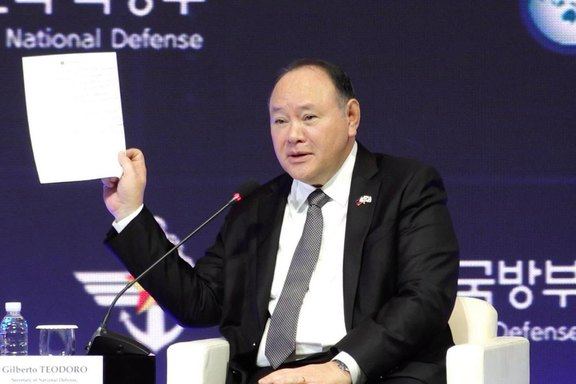
The pressure is psychological too. At a security forum in Seoul in September 2026, Teodoro was handed a note mid-speech restating Beijing's rejection of the arbitral ruling. He held it up and asked for basic decency. It was a small scene, but it captured the contest: persistent, personal and just short of the line.
Asymmetry is not new to Filipino commanders. In 2017, a few hundred fighters aligned with ISIS seized Marawi City, and five months of urban combat under Defense Secretary Delfin Lorenzana left the city in ruins and showed how a small force can tie down a larger one. Cheap technology has sharpened the lesson. Since late 2023, Houthi drones and missiles in the Red Sea have forced navies to fire interceptors costing millions at weapons costing a fraction of that. In June 2025, Ukraine smuggled drones into Russia in trucks and struck airbases far behind the front. A small Philippine fleet cannot afford to lose the economic argument, and Teodoro himself has said that defense spending, around 1.6 percent of GDP by mid-2026, needs to rise.
Beyond the sea lies a set of non-traditional threats that fit no old organizational chart. Some of these are as follows:
Cyber. In 2023, a ransomware attack on PhilHealth, the state health insurer, exposed members' records and showed that civilian systems are military targets in all but name. U.S. officials have warned of Chinese state-linked intrusions into American infrastructure, and the 2021 ransomware attack on Colonial Pipeline caused fuel shortages across the U.S. East Coast with no army involved. The military runs on power grids, ports and networks the department does not own.
Space. Satellites carry the navigation, communications and imagery that an archipelagic force needs to see its own waters. They can be jammed, hacked or attacked.
Supply chains. Teodoro has pointed out that the Philippines depends on China for basic goods and for some elements of defense supply chains, an awkward dependency for a country in a maritime dispute with its supplier.
Information and AI. Influence operations, deepfakes and algorithmic decision tools compress the time available to judge what is real. The department must adopt AI quickly while keeping humans accountable for lethal choices.
None of these fits neatly into the Army, Navy and Air Force structure, and each requires cooperation with agencies and firms the secretary does not command.
The sharpest contrast with older eras is the weight of civil defense. In many countries, the defense chief supports disaster response. In the Philippines, the defense secretary leads it, chairing the NDRRMC while the OCD serves as its secretariat. The country sits on the Pacific typhoon belt and the Ring of Fire, so the briefing rarely lacks a hazard.
Super Typhoon Haiyan (Yolanda) in November 2013 remains the hardest test. More than 6,000 people died and Tacloban was flattened. Defense Secretary Voltaire Gazmin, as NDRRMC chair, fronted a response that drew sharp criticism for slow relief even as the AFP and foreign militaries, including U.S. forces in Operation Damayan, poured in. Four years earlier, Typhoon Ondoy had flooded Metro Manila during Teodoro's first stint as secretary. He holds the post again, which means he has now seen the job from both sides of those lessons.
The doctrine has shifted from rescue to anticipation. Before Super Typhoon Uwan struck in November 2025, Teodoro urged local governments to evacuate early rather than wait to rescue people later. The OCD is mapping hazards down to the barangay level, and a Search and Rescue Strategic Plan covering 2026 to 2036 has been drawn up. Earthquakes are a growing worry: after the Cebu and Davao Oriental quakes in late 2025, Teodoro pushed for infrastructure audits. A magnitude 7.8 quake off Sarangani on June 8, 2026 killed at least 45 people, lending urgency to his call for closer public-private cooperation on earthquake readiness.
Human-made disasters add their own demands. In 2023, the tanker MT Princess Empress sank off Oriental Mindoro and spilled industrial fuel oil that fouled coastlines and fishing grounds for months, a reminder that calamity does not require a storm.
The tension is real. The Navy's ships and the Air Force's transports needed for a resupply run to Ayungin or a patrol off Palawan are the same ones needed to reach a flooded island in the Visayas. Every soldier on disaster relief duty is one fewer on training or deployment. And the line between civilian and military roles must be respected, since the Constitution makes civilian authority supreme over the armed forces, even when an emergency makes shortcuts tempting.
The Philippine defense secretary once managed a war or an insurgency. Today the secretary manages many contests at once, some fought with water cannon, others with codes and algorithms, procurement contracts and sandbags. The job rewards no single specialty and punishes narrow thinking. It requires the holder to remain awake so that the rest of the nation may soundly sleep.
Which is why the character of the person matters as much as the strategy. An effective secretary, in my humble opinion, should possess the following qualities:
Strategic judgment. The ability to separate what is urgent from what is important, and to see the next crisis while managing the current one.
Moral courage. The willingness to give unwelcome advice to presidents, Congress and generals, and to accept responsibility for the outcome.
Technological literacy. Enough understanding of the current milieu populated by drones, cyber attacks, reconnaissance satellites and AI to ask the right questions and spot a bad answer.
Managerial discipline. Honest budgeting, clean procurement and the patience to carry a modernization program through years of tight fiscal space.
Coalition skills. The diplomacy to keep allies and partners engaged, and the tact to coordinate with governors, mayors and private firms that hold part of civil defense in their hands.
Crisis composure. The calm to act in the first hours of a typhoon, a cyberattack or a confrontation at sea, when information is incomplete and delay is costly.
Fidelity to the Constitution. A firm grasp of civilian supremacy without contempt for those who serve in the military, the rules on the use of force and the limits of military roles at home.
Stamina and candor. The endurance to carry the load, and the honesty to admit mistakes early, before disasters become bigger catastrophes.
Patriotism. The understanding that the job requires a devotion to the country even if its people sometimes makes it hard to love.
No one will completely embody all nine, but the closer a secretary comes to doing so, the better the odds that the next extreme situation is met with a plan already waiting.
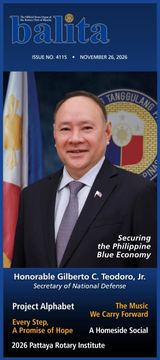
 Honorable Gilberto C. Teodoro, Jr., Secretary of National Defense
 Project Alphabet
 Every Step, A Promise of Hope
